🏛 Part of the "dental" topic shelf →
Replacing an Old Metal Crown with All-Ceramic: Colour Is Not the Only Consideration
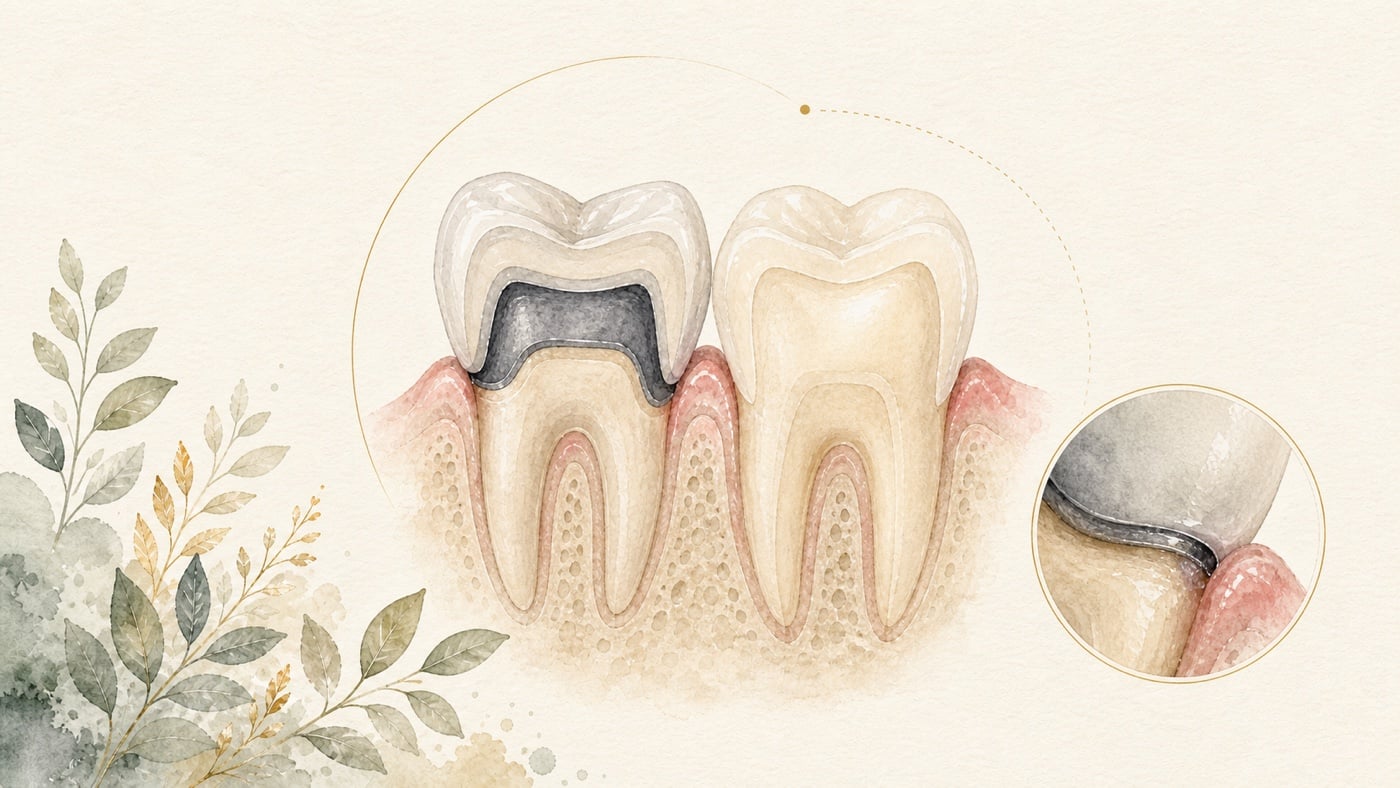
A dark margin or unnatural colour around an old metal crown may understandably make you want to replace it with an all-ceramic crown. Whether the new crown can be built on a stable foundation, however, cannot be decided with a shade guide alone. Before replacement, it is necessary to determine whether the abutment tooth still has restorable tooth structure, whether the pulp or periapical tissues show any abnormality, whether the old crown margin fits and can be cleaned, and whether gingival inflammation, recession, or periodontal pockets need to be treated first. A systematic review shows that plaque, bleeding, pocket depth, and attachment status around fixed crowns may differ from those of unrestored control teeth, but the studies do not prove that replacing metal with all-ceramic alone improves periodontal health. The marginal fit of ceramic crowns is also affected by the preparation finish line, the cement space allowed, veneering ceramic, and bonding procedures; it is not determined by the material name alone. The more cautious commitment, therefore, is not “once the old crown is removed, an all-ceramic crown can definitely be made”.
Replacing an Old Metal Crown with All-Ceramic: Colour Is Not the Only Consideration
Direct answer: Colour alone is not enough — before replacement, the pulpal and periapical status of the abutment tooth, the margin and contour of the old crown, and the stability of the periodontium all have to be established. A systematic review and meta-analysis found that teeth prepared with horizontal finishing lines supporting complete coverage crowns or fixed partial dentures present more periodontal disorders than untreated control teeth.[F1] The marginal adaptation of a ceramic crown is influenced by the finish line configuration, the predefined cementing space, the veneering process and the cementation, and study heterogeneity means the various ceramic systems cannot be ranked reliably.[F2]
Geographic scope: This is general health education based on international literature. It does not cover any particular country's insurance scheme or regulations; for how care and fees are organised, follow the rules where you are. Every source cited in this card is international peer-reviewed literature; no national legislation or insurance-benefit rule is cited.
TL;DR|Colour Motivates Replacement, but the Root, Margin, and Periodontium Are the Starting Points for Treatment
A dark margin or unnatural colour around an old metal crown may understandably make you want to replace it with an all-ceramic crown. Whether the new crown can be built on a stable foundation, however, cannot be decided with a shade guide alone. Before replacement, it is necessary to determine whether the abutment tooth still has restorable tooth structure, whether the pulp or periapical tissues show any abnormality, whether the old crown margin fits and can be cleaned, and whether gingival inflammation, recession, or periodontal pockets need to be treated first.
A systematic review shows that plaque, bleeding, pocket depth, and attachment status around fixed crowns may differ from those of unrestored control teeth, but the studies do not prove that replacing metal with all-ceramic alone improves periodontal health.[F1] The marginal fit of ceramic crowns is also affected by the preparation finish line, the cement space allowed, veneering ceramic, and bonding procedures; it is not determined by the material name alone.[F2]
The more cautious commitment, therefore, is not “once the old crown is removed, an all-ceramic crown can definitely be made”. It is to complete reversible checks first, explain the possible branches after crown removal, and then move on to material, translucency, and colour design.
Main Discussion|First Decide Whether the Foundation under the Old Crown Is Worth Rebuilding, Then Design the New Crown
A Dark Gingival Margin Has More than One Possible Cause
A dark margin may come from metal or an underlying material showing through, exposure of the crown margin after gingival recession, or surface staining; it may also be accompanied by a poorly fitting margin or underlying caries. Visible colour alone cannot distinguish every situation. If there is also bleeding during brushing, an unpleasant odour, pain on biting, an abscess, or a loose crown, the cause needs to be investigated before the crown is replaced for appearance alone.
The dentist will generally observe the position and contour of the crown margin, assess the surrounding tissues by probing and imaging, and compare periodontal conditions at adjacent and contralateral teeth. While the old crown remains in place, some tooth structure and cracks may be hidden. The pre-removal judgement is therefore a risk stratification; the complete foundation may only become visible after removal. Information from the two stages should not be combined into a single guarantee.
First Gate: Are the Root and Abutment Tooth Stable?
Before replacing a crown, it is necessary to know whether the tooth has undergone root canal treatment, whether spontaneous pain or pain on biting is present, whether periodontal probing reveals a localised deep site, and whether the apex and remaining tooth structure on imaging can support reconstruction. If the pulp is still vital, its response may also be assessed when necessary. If root canal treatment has already been performed, the root filling, periapical tissues, and post and core must be examined instead of equating “no pain” directly with no problem.
A systematic review of vital teeth used as abutments for crowns or fixed bridges included 20 studies, 7 of which entered the meta-analysis. The studies used clinical and radiographic follow-up to monitor pulpal necrosis or periapical changes.[F3] The studies in this review were mainly observational and highly heterogeneous, so they cannot forecast the outcome of an individual abutment tooth. What the review does support is that, beyond the crown's appearance, pulp and apical status are outcome levels that should inherently be checked for fixed restorations.
If the examination raises concern about a vertical crack, deep caries, insufficient abutment tooth structure, or a periapical lesion, the sequence of treatment may change. Addressing diagnosis and restorability is then more important than choosing an all-ceramic brand first.
Second Gate: Does the Old Crown Margin Merely “Look Bad”, or Is It Actually Defective?
A crown margin needs to be assessed simultaneously for fit, position, contour, and cleanability. An overcontoured restoration may make plaque harder to control. If the margin extends deep into the gingival sulcus, impression-taking, bonding, and daily cleaning also become more challenging. On the other hand, a dark line or a single radiographic shadow alone cannot justify declaring caries; several assessments need to corroborate the finding.
A systematic review of marginal fit in ceramic crowns included 54 of 469 records and covered 17 ceramic systems. Of these, 48 were in vitro studies and only 6 were in vivo studies. Of all measured marginal gaps, 94.9 per cent fell within the clinically acceptable range used by the review, but heterogeneity was high and the systems could not be ranked reliably.[F2] The review also noted that finish-line geometry, prescribed cement space, the veneering process, and bonding all affect marginal fit. In other words, changing the material to all-ceramic does not automatically correct problems in design or manufacturing.
Third Gate: Should the Periodontium Be Stabilised First, or Observed after the New Crown Is Completed?
If the gingiva is bleeding or swollen, or probing depths have increased, first identifying the respective roles of plaque control, old crown contour, crown-margin position, and existing periodontal disease generally provides more information than proceeding immediately to the definitive impression. The contours of inflamed tissues may change, and a margin designed today may not occupy the same position after the tissues have stabilised.
A systematic review and meta-analysis of periodontal outcomes around fixed crowns and bridges included 20 studies in the qualitative analysis, 9 of which entered the meta-analysis. Compared with unrestored control teeth, the areas around full-coverage crowns or bridge abutments with horizontal finish lines had less favourable bleeding, pocket-depth, and attachment measures, along with more pronounced movement of the gingival margin.[F1] These findings combine porcelain-fused-to-metal and zirconia restorations and cannot be interpreted as showing that a particular material inevitably harms periodontal tissues. Rather, they remind us that the contour, position, cleanability, and long-term follow-up of fixed restorations must not be obscured by aesthetic concerns.
In another systematic review comparing restorations with and without a cervical finish line, 7 studies of tooth-supported restorations were selected from 1,388 records, and only 2 could be pooled. The studies found no significant difference in periodontal measures between the two approaches.[F4] The limited volume of evidence also means that no particular preparation philosophy should be presented as a universal answer. Tissue thickness, margin position, contour, and maintenance capacity still require individual planning.
All-Ceramic Materials Must Be Considered in the Context of Tooth Position and Restorative Conditions
Only after the root, tooth structure, margin, and periodontium have been assessed should the translucency, masking ability, strength, bonding, and preparation space of all-ceramic materials be considered. An old metal substrate or post and core may need to be masked, but greater masking does not necessarily produce a more natural appearance. Anterior and posterior teeth are also loaded differently, so the same aesthetic formula cannot be used for every position.
A systematic review and meta-analysis of all-ceramic crown survival brought together 1,112 anterior crowns and 1,821 posterior crowns, with 73 and 166 failures respectively — 6.5 per cent and 9.1 per cent — and follow-up ranged from 36 to 223 months. The review’s relative-risk meta-analysis found that anterior all-ceramic crowns were 50 per cent less likely to fail than posterior ones (p = 0.001), and both its conclusion and its clinical-significance statement say plainly that some caution is needed when prescribing posterior all-ceramic crowns — while the same sentence also states that the difference was only 3 per cent and relatively small. Both halves belong together.[F5] The review included only adult vital teeth with periodontal pocket depths no greater than 5 mm, excluded implant-supported restorations, and did not involve bridges. It cannot be extrapolated to old crowns on root-canal-treated teeth or teeth with periodontal tissues that have yet to stabilise. The study periods, ceramic systems, and case conditions differed, so the figures cannot directly compare your options, but they do show that the position and loading of the new crown should be incorporated into the design alongside colour.
Before Removing the Crown, Agree on a Stopping Point If Information Remains Insufficient
After the old crown is removed, cleaning and re-restoration may be all that is required, or the extent of caries, the post and core, a crack, or a subgingival margin may prove more complex than expected. A more complete pre-removal discussion should explain which findings would allow all-ceramic crown fabrication to continue, which would require prior pulpal, periodontal, or provisional-restoration assessment, and when work would pause so that more information could be obtained before deciding.
This staged planning does not delay aesthetic treatment. It prevents colour selection from constraining subsequent clinical judgement before the abutment tooth has been seen clearly.
Data Anchors|Before Crown Replacement, Five Sets of Numbers Guard Five Gates
| Assessment Level | Data Anchor | Cautious Interpretation | Source |
|---|---|---|---|
| Pulp and apex | 20 studies included in the systematic review; 7 entered the meta-analysis | Supports reviewing clinical findings alongside imaging; cannot predict an individual abutment tooth | [F3] |
| Ceramic crown margin | 54 studies and 17 systems; 48 in vitro and 6 in vivo studies | Manufacturing and design both affect the margin; the research cannot rank materials reliably | [F2] |
| Periodontal response | 20 qualitative studies; 9 entered the meta-analysis | Measures around crowns may be less favourable, but this cannot be attributed to the material name alone | [F1] |
| Cervical finish line | 7 studies of tooth-supported restorations; only 2 could be pooled | No significant difference does not mean the two designs are the same for everyone | [F4] |
| Anterior and posterior all-ceramic crowns | 1,112 anterior crowns (6.5 per cent failed) and 1,821 posterior crowns (9.1 per cent failed); anterior crowns were 50 per cent less likely to fail (p = 0.001) | Single crowns only in adult vital teeth, not implant-supported, and with periodontal pockets no deeper than 5 mm; do not extrapolate to old crowns after root canal treatment or before periodontal stability. The source states plainly that posterior all-ceramic crowns call for some caution | [F5] |
Conclusion|Build the New All-Ceramic Crown on Visible Conditions of Health
The colour of an old metal crown can be the reason you seek improvement, but it should not be the only item examined. The root and pulp determine whether the abutment is worth rebuilding; the crown margin and contour affect cleaning and fit; and periodontal status determines when it is appropriate to move to the definitive design. The all-ceramic material and shade should follow these three layers of information.[F3][F2][F1]
If you are considering replacement of an old crown, you can ask your own dentist to map the assessment as a staged checklist: what can be confirmed before removal, what must be rechecked afterwards, which measures indicate periodontal stability, and how different findings would alter the all-ceramic design. When the health foundation and aesthetic objective are both visible, the new colour has the opportunity to become part of complete treatment.
Risk factors (what to know before treatment)
- Colour is not a clinical indication for replacement: the systematic review and meta-analysis concludes that teeth prepared with horizontal finishing lines supporting crowns and fixed partial dentures present more periodontal disorders than untreated control teeth; the material included both metal-ceramic and zirconia restorations, so the reverse inference — that switching to one particular material will improve the periodontium — cannot be drawn.[F1]
- Marginal adaptation is decided by design and process, not by the name of the material: the systematic review of the marginal adaptation of ceramic crowns records that 94.9% of all marginal gaps measured were in the range of clinical acceptability, but that study heterogeneity made it impossible to compare and rank the various systems; the four parameters it identified as influencing marginal adaptation are finish line configuration, the value of the predefined cementing space, the veneering process and cementation.[F2]
- A vital abutment tooth carries pulpal and periapical risk of its own: the systematic review and meta-analysis of vital teeth used as abutments for crowns and fixed partial dentures followed pulp necrosis and periapical changes both clinically and radiographically; only observational studies were included, and the authors state that future high-quality randomised controlled clinical trials are required to confirm the evidence, so it cannot forecast the outcome for any individual abutment tooth.[F3]
- The evidence base on whether to use a cervical finish line is very small: in the review comparing restorations with and without a cervical finish line, 7 of 1,388 articles on tooth-supported restorations were included and only 2 could be pooled, and no significant difference in periodontal indices was identified between the two approaches.[F4] Where the evidence base is this small, "no difference was found" does not mean "the two designs are the same for everyone".
- The long-term data on all-ceramic crowns come with an explicit scope: the systematic review and meta-analysis of all-ceramic crown survival pooled 1,112 anterior crowns and 1,821 posterior crowns, with 73 and 166 failures respectively and follow-up from 36 to 223 months; its inclusion criteria were limited to vital teeth in adults, opposed by teeth, with periodontal pocketing no deeper than 5 mm, and excluded implant-supported crowns and fixed dental prostheses, so the figures cannot be extrapolated to old crowns after root canal treatment or before the periodontium is stable.[F5]
- This card does not compile a list of contraindications, and does not promise that an all-ceramic crown will be possible once the old one is off: no separate literature search on contraindications was run for this card; removing the old crown may reveal caries, a post and core, cracks or a subgingival margin more complex than expected, and whether replacement is appropriate, and when to move to the definitive design, has to be judged by a dentist from the actual findings.
Every clinical statement in this article is mapped line by line to its cited source (see the sources and evidence chain below). It has not been clinically reviewed by a licensed practitioner. This is health information, not individual advice; assessment by a clinician is required.
FAQ
- Does a Black Line beside the Gingiva Mean That the Tooth Is Decayed under the Crown?
- Not necessarily. A dark line may result from an underlying material showing through, gingival recession, staining, or a marginal problem. Caries needs to be confirmed by combining clinical exploration, imaging, and inspection of the foundation after crown removal; colour alone cannot determine it.
- 歯肉の横に黒い線があれば、クラウンの下がむし歯ということですか? — 必ずしもそうではありません。暗い線は、材料の色が透けること、歯肉退縮、着色、辺縁の問題から生じる可能性があります。う蝕は、臨床診査、画像、クラウン撤去後の土台の確認を組み合わせて判断する必要があり、色だけで結論づけることはできません。
- Does a Black Line beside the Gingiva Mean That the Tooth Is Decayed under the Crown? — Not necessarily. A dark line may result from an underlying material showing through, gingival recession, staining, or a marginal problem. Caries needs to be confirmed by combining clinical exploration, imaging, and inspection of the foundation after crown removal; colour alone cannot determine it.
- Does the Root Still Need Checking If the Old Crown Does Not Hurt?
- It does. A systematic review that followed pulpal and apical outcomes in crown and bridge abutments with both clinical and radiographic assessment shows that the absence of symptoms is not the only examination criterion.[F3] Previous root canal treatment, pain on biting, a localised deep pocket, and imaging should all be considered.
- 古いクラウンに痛みがなくても、歯根を確認する必要がありますか? — 必要です。クラウンとブリッジの支台歯について、臨床所見と放射線画像の両方で歯髄・根尖の転帰を追跡したシステマティックレビューは、無症状だけが検査基準ではないことを示しています。[F3] 過去の根管治療、咬合痛、局所的な深い歯周ポケット、画像所見をすべて考慮すべきです。
- Does the Root Still Need Checking If the Old Crown Does Not Hurt? — It does. A systematic review that followed pulpal and apical outcomes in crown and bridge abutments with both clinical and radiographic assessment shows that the absence of symptoms is not the only examination criterion.[F3] Previous root canal treatment, pain on biting, a localised deep pocket, and imaging should all be considered.
- Will the Gingiva Become Healthy If the Crown Is Replaced with All-Ceramic?
- That inference cannot be made. Periodontal response involves the old crown's contour, crown-margin position, plaque, cleaning ability, and existing periodontal condition. Pooled data do not prove that changing the material alone improves every measure.[F1][F4]
- オールセラミックに替えれば、歯肉は健康に戻りますか? — そのように推論することはできません。歯周反応には、古いクラウンの外形、クラウン辺縁の位置、プラーク、清掃能力、既存の歯周状態が関係します。統合データは、材料を替えるだけですべての指標が改善するとは証明していません。[F1][F4]
- Will the Gingiva Become Healthy If the Crown Is Replaced with All-Ceramic? — That inference cannot be made. Periodontal response involves the old crown's contour, crown-margin position, plaque, cleaning ability, and existing periodontal condition. Pooled data do not prove that changing the material alone improves every measure.[F1][F4]
- Can the Margin of a New All-Ceramic Crown Have Absolutely No Gap?
- The clinical goal is appropriate fit and a maintainable contour, but measurement methods, finish line, cement space, fabrication, and bonding all affect the result. Differences between studies also prevented the systematic review from ranking ceramic systems reliably.[F2]
- 新しいオールセラミッククラウンの辺縁は、間隙を完全になくせますか? — 臨床的な目標は、適切な適合性と維持しやすい外形を得ることです。しかし、測定法、フィニッシュライン、セメントスペース、製作、接着のすべてが結果に影響します。システマティックレビューも、研究間の差異により各セラミックシステムを信頼性高く順位づけできませんでした。[F2]
- Can the Margin of a New All-Ceramic Crown Have Absolutely No Gap? — The clinical goal is appropriate fit and a maintainable contour, but measurement methods, finish line, cement space, fabrication, and bonding all affect the result. Differences between studies also prevented the systematic review from ranking ceramic systems reliably.[F2]
- Can the Final Material Be Confirmed on the Day the Old Crown Is Removed?
- Sometimes removal permits a firmer decision; in other cases, caries must first be cleared, a crack assessed, or the periodontium and symptoms observed with a provisional restoration. Possible branches and stopping points are best explained before removal, so that the final shade choice does not precede assessment of the abutment tooth.
- 古いクラウンを外した当日に、最終材料を確定できますか? — さらに確認して決められる場合もあれば、まずう蝕を除去し、亀裂を評価し、暫間修復によって歯周組織と症状を観察する必要がある場合もあります。撤去前に、想定される分岐と停止点を説明してもらい、最終的な色の選択が支台歯の判断より先にならないようにするのが望ましいでしょう。
- Can the Final Material Be Confirmed on the Day the Old Crown Is Removed? — Sometimes removal permits a firmer decision; in other cases, caries must first be cleared, a crack assessed, or the periodontium and symptoms observed with a provisional restoration. Possible branches and stopping points are best explained before removal, so that the final shade choice does not precede assessment of the abutment tooth.
Medical notice This article is provided for health education and medical information purposes. It is not a solicitation for medical services and does not constitute diagnosis or treatment advice. Actual treatment methods and outcomes vary between individuals and require evaluation by a dentist; every treatment has its own indications, limitations and possible risks. If you have related symptoms or treatment needs, please book a consultation for evaluation by a dentist.
Source anchors
- Periodontal Behavior Around Teeth Prepared with Finishing Line for Restoration with Fixed Prostheses. A Systematic Review and Meta-Analysis. [PMID:31963494] · https://pubmed.ncbi.nlm.nih.gov/31963494/ · 在 IDAEO 的其他引用
- Marginal adaptation of ceramic crowns: a systematic review. [PMID:24120071] · https://pubmed.ncbi.nlm.nih.gov/24120071/ · 在 IDAEO 的其他引用
- Pulpal and Periapical Status of the Vital Teeth Used as Abutment for Fixed Prosthesis-A Systematic Review and Meta-Analysis. [PMID:34516686] · https://pubmed.ncbi.nlm.nih.gov/34516686/ · 在 IDAEO 的其他引用
- Periodontal Tissue Responses to Restorations With and Without a Cervical Finish Line: A Systematic Review and Meta-analysis. [PMID:38820274] · https://pubmed.ncbi.nlm.nih.gov/38820274/ · 在 IDAEO 的其他引用
- A systematic review and meta analysis of the longevity of anterior and posterior all-ceramic crowns. [PMID:27594093] · https://pubmed.ncbi.nlm.nih.gov/27594093/ · 在 IDAEO 的其他引用
Cite this article
Lucy・《Replacing an Old Metal Crown with All-Ceramic: Colour Is Not the Only Consideration》・IDAEO 知識庫・2026-07-20・https://km.idaeo.ai/post/dental/replacing-metal-crownUpdated 2026-08-26