

🏛 Part of the "dental" topic shelf →
Implant, Bridge or Removable Denture: Compare What Each One Costs You First, Then Talk About Fit
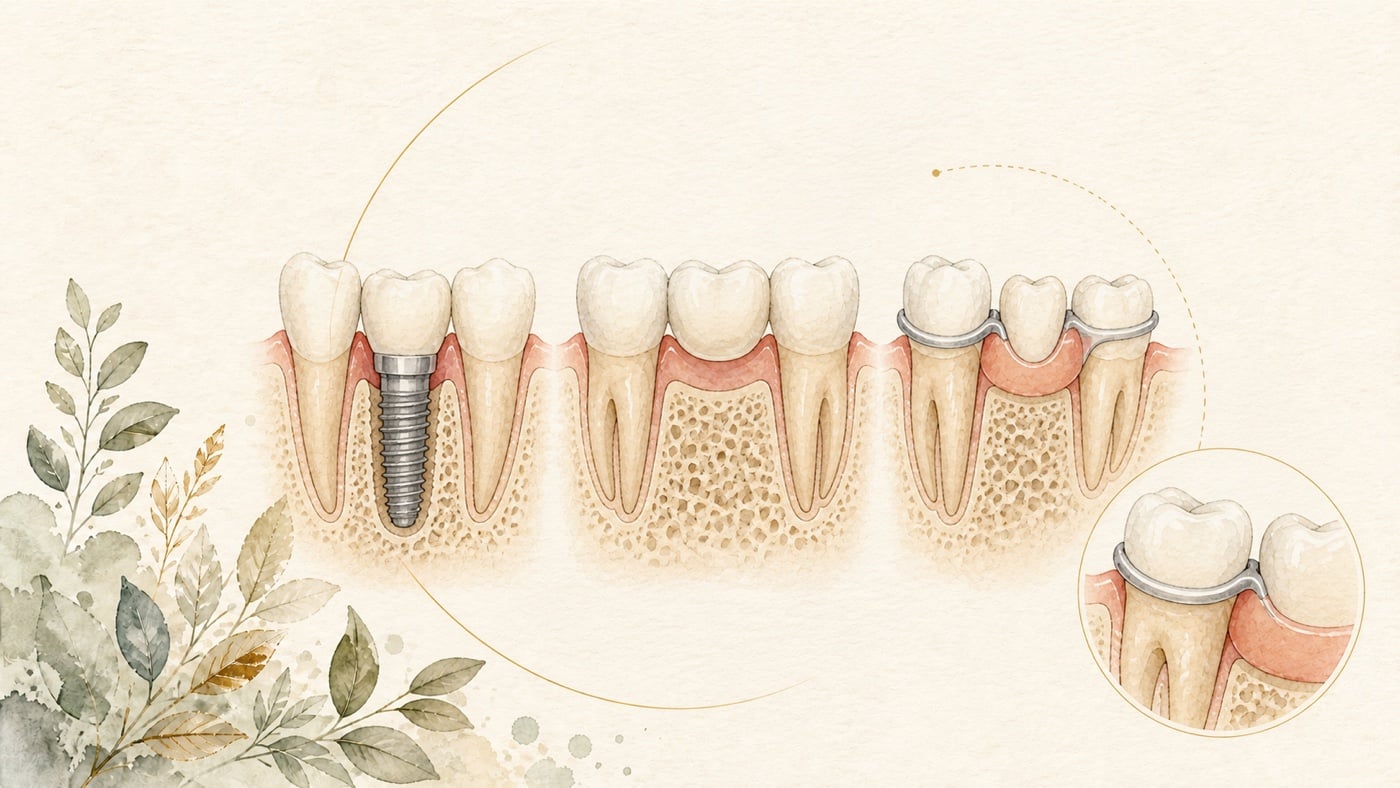
Implants, bridges and removable dentures can all take part in restoring missing teeth, but they deal with the problem in different ways. An implant places the support in the edentulous site itself, a conventional bridge borrows support from the neighbouring teeth, and a removable denture is a prosthesis you can take out. Research can compare survival, quality of life or complications, yet it cannot compress different measures into a single "best" answer. What actually matters to you is the position and extent of the missing teeth, whether the adjacent teeth are sound or already restored, the bone and soft-tissue conditions, whether you are able to clean and maintain the result, and how much surgery, insertion and removal, and treatment scheduling you are willing to accept. A systematic review also points out that the quality of the available evidence is still not sufficient to compare directly all the treatments for single or partial tooth loss. This article does not offer an overall ranking. It separates out how each option is supported, what the research has observed, and what cannot be inferred from the figures, so that you and your dentist can reach the decision together.
Implant, Bridge or Removable Denture: Compare What Each One Costs You First, Then Talk About Fit
Direct answer: There is no ranking that fits everyone — a systematic review of adults with partial edentulism states explicitly that, because of the low scientific quality of the included studies, the various treatment methods could not be compared [F1]; and the meta-analysis of three-unit bridges found no significant difference between implant support and natural-tooth support in the annual survival of either the abutments or the prostheses [F3]. What does decide the question is your own situation: the position and extent of the missing teeth, the state of the adjacent teeth, bone and soft-tissue conditions, whether you can clean and maintain the result, and how much surgery and scheduling you are willing to accept.
Geographic scope: This is general health education based on international literature. It does not cover any particular country's insurance scheme or regulations; for how care and fees are organised, follow the rules where you are. Every source cited in this card is international peer-reviewed literature; no national legislation or insurance-benefit rule is cited.
TL;DR — There is no single overall ranking that works for everyone
Implants, bridges and removable dentures can all take part in restoring missing teeth, but they deal with the problem in different ways. An implant places the support in the edentulous site itself, a conventional bridge borrows support from the neighbouring teeth, and a removable denture is a prosthesis you can take out. Research can compare survival, quality of life or complications, yet it cannot compress different measures into a single "best" answer.
What actually matters to you is the position and extent of the missing teeth, whether the adjacent teeth are sound or already restored, the bone and soft-tissue conditions, whether you are able to clean and maintain the result, and how much surgery, insertion and removal, and treatment scheduling you are willing to accept. A systematic review also points out that the quality of the available evidence is still not sufficient to compare directly all the treatments for single or partial tooth loss [F1].
This article does not offer an overall ranking. It separates out how each option is supported, what the research has observed, and what cannot be inferred from the figures, so that you and your dentist can reach the decision together.
Start by asking whose strength each of the three approaches borrows
Implants: supported by a fixture in the edentulous site
A single-tooth implant usually does not require the sound teeth on either side to be brought in as abutments for a fixed bridge. A systematic review of the economic aspects points out that preserving sound adjacent teeth from preparation is one of the utilities an implant crown may offer the patient; at the same time, the condition of the alveolar ridge and of the adjacent teeth also alters the complexity of treatment [F2].
That advantage does not mean an implant is necessarily right for you. Implants involve surgery and intraosseous support, and bone volume, soft tissue, implant position, access for cleaning and the subsequent prosthesis all have to be taken into account. Where the conditions at the edentulous site differ, the burden of treatment differs too.
Fixed bridges: supported by adjacent teeth or other abutments
A conventional fixed bridge uses the abutment teeth on either side of the gap to support the edentulous unit in between. Where the adjacent teeth already carry extensive restorations, the considerations may not be the same as where both are intact and sound. You need to confirm with your dentist how much tooth structure will be prepared, the prognosis of the abutment teeth, how the area beneath the pontic is to be cleaned, and how the restoration as a whole would be repaired if one part later failed.
A meta-analysis comparing three-unit bridges found no significant difference in the annual survival rate of abutments or of prostheses between support by two implants and support by two natural teeth [F3]. That review, however, reported insufficiently on soft- and hard-tissue conditions and on patient-reported outcomes, so survival rates alone cannot settle the decision.
Removable dentures: a prosthetic approach you take out yourself
A removable denture can span one or several edentulous areas, and its support and stability are influenced by the remaining teeth, by the distribution of the missing teeth and by the design. You have to deal with insertion and removal, cleaning and adaptation every day, and that daily experience is not fully reflected in prosthesis survival rates alone.
The research also includes the implant-supported removable partial denture — that is, using implants to assist a removable denture rather than a fixed implant crown. Compared with a conventional distal-extension removable denture, this design did better on some patient-reported outcomes, but clasp adjustment, loosening of abutments or implants, marginal bone resorption and peri-implant mucositis can still occur [F4].
What survival rates tell you, and what they leave out
The meta-analysis comparing natural-tooth-supported and implant-supported three-unit bridges included one thousand nine hundred and seventy-three tooth-supported FDPs and seven hundred and sixty-five implant-supported FDPs; annual abutment survival was 99% and 98.7%, and annual prosthesis survival was 96.4% and 97.4%, with neither difference reaching significance [F3].
These figures support the view that both forms of support may perform reliably, but they cannot tell you whether your adjacent teeth are worth keeping, whether you need bone grafting, which option is easier to clean, or which is easier to repair for you when something goes wrong. What was studied was three-unit bridges, so the figures cannot be taken directly as a comparison between a single implant crown and every bridge design.
Another review, of adults with partial edentulism, reported five-year survival rates of 91% for implant-supported single crowns and 94.7% for prostheses, with corresponding implant survival of 98.5% and 94.9% [F1]. Of the fifteen studies included, however, only five were of moderate quality and ten were of low quality, and the authors state explicitly that the various treatments could not be compared [F1].
Quality of life is more than "can it be fitted and used"
A systematic review of partial tooth loss included implant-supported crowns, implant-supported fixed or removable prostheses, tooth-supported fixed prostheses and removable partial dentures together. The short-term pooled OHRQoL change was 15.3 for tooth-supported fixed, 11.9 for removable partial and 14.9 for implant-supported fixed; over the longer term it was 13.2 for tooth-supported fixed and 15.8 for implant-supported fixed [F5].
In the short-term direct comparisons within that review, the improvement with implant-supported fixed prostheses was greater than with tooth-supported fixed prostheses and with removable partial dentures [F5]. The evidence, however, comes mainly from twenty-one cohort studies, with only two randomised trials; the scales, the baseline situations and the treatment choices may also differ, so these change scores cannot be treated as success percentages or as a fixed score for any individual [F5].
For distal-extension edentulous areas, a meta-analysis comparing the implant-supported removable partial denture with the conventional removable denture reported a quality-of-life mean-score difference of 30.5±1.8, with a confidence interval of 24.9–36.1, and a difference in satisfaction of -20.8±0.2, with a confidence interval of -23.7 to -17.8 [F4]. Heterogeneity in the original studies was 65% and 75%, and the direction of the scores depends on the scale used, so direct comparison across scales is not appropriate [F4].
The position of the missing tooth changes how you compare
Anterior teeth more often involve appearance, speech and the gingival contour; posterior teeth more often involve occlusal support and access for cleaning; and a free-end edentulous area is different again from a single gap enclosed by teeth. The same person may therefore not have the same answer for different sites.
Take congenitally missing maxillary lateral incisors. A network meta-analysis of ten studies found no significant difference in aesthetic outcome between orthodontic space closure and implants; periodontal indices were worse for the tooth-supported prosthesis than for orthodontic space closure, although the authors considered the periodontal effect still to be a matter of debate [F6]. This is a specific anterior and congenitally missing situation, and it cannot be applied directly to a choice made after a molar has been extracted.
Bring the comparison back to your adjacent teeth and to cleaning
If the teeth on both sides are sound, you can ask how much tooth structure a fixed bridge would require you to change, and whether an implant would avoid that cost. If the adjacent teeth already carry extensive restorations, ask about the long-term considerations of using them as abutments. This is not "preparation is always bad" or "not preparing is always better"; it is a matter of bringing the present state of the adjacent teeth into the decision [F2].
Cleaning matters just as much. A fixed bridge has to allow cleaning beneath the pontic, an implant prosthesis has to allow maintenance around the implant, and a removable denture has to be inserted and removed stably, with the denture and the remaining teeth both kept clean. You can ask the clinical team to demonstrate the tools and the access in practice, rather than simply being told to "brush it properly at home".
Finally, consider the treatment burden you are willing to take on: whether you accept surgery, whether you can adapt to a removable appliance, how many appointments you can arrange, and how you would want repairs to be handled. Shared decision-making does not hand the professional judgement over to you alone; it lets your circumstances and preferences genuinely enter the clinical discussion.
Data anchors — different studies answer different questions
| Question being compared | Data anchor | How to read it safely | Source |
|---|---|---|---|
| Implant- versus natural-tooth-supported three-unit bridges | Annual abutment survival 99% vs 98.7%; annual prosthesis survival 96.4% vs 97.4%, neither significantly different [F3] | Applies only to the three-unit FDPs studied; does not represent every single-tooth option | [F3] |
| Five-year outcomes of treatment for partial tooth loss | Survival of implant-supported single crowns and prostheses 91% and 94.7%; implant survival 98.5% and 94.9% [F1] | Evidence quality was low, and the authors held that the treatments could not be compared | [F1] |
| Short-term change in quality of life | Tooth-supported fixed 15.3, RPD 11.9, implant-supported fixed 14.9 [F5] | These are change scores on a scale, not success rates; the studies are mainly cohorts | [F5] |
| Implant-assisted versus conventional removable dentures | QoL difference 30.5±1.8; 95% CI 24.9–36.1, heterogeneity 65% [F4] | Compares two kinds of removable denture only; the direction of the scores depends on the scale | [F4] |
| Economics of single implant crowns versus short-span bridges | Comparative data drawn from twenty-six studies; initial costs and failure rates broadly similar [F2] | Costs are affected by regional systems and by ridge and adjacent-tooth conditions | [F2] |
| Congenitally missing maxillary lateral incisors | Ten studies included; no significant difference in aesthetic outcome between orthodontic space closure and implants [F6] | A specific anterior, congenitally missing situation; not applicable to all tooth loss | [F6] |
Conclusion — put the conditions on the table before any real comparison
There is no context-free winner among implants, bridges and removable dentures. Survival rates, quality of life, whether adjacent teeth are prepared, whether surgery is accepted, how the result is cleaned and how it can be repaired are different questions, and no single figure adds them up for you automatically.
If you are comparing ways of restoring missing teeth, bring your existing images and the everyday concerns that matter most to you to a dental appointment, where the position of the missing teeth, the state of the adjacent teeth and your ability to clean them can be confirmed together and the workable options set side by side. The restrained next step is not to hurry into choosing one, but first to establish which approaches genuinely match your circumstances.
Risk factors (what to know before treatment)
- There is no directly comparable overall ranking for this question: a systematic review of adults with partial edentulism states explicitly that the various treatment methods could not be compared, because of the low scientific quality of the included studies; that review reported five-year survival of 91% for implant-supported single crowns and 94.7% for prostheses, with corresponding implant survival of 98.5% and 94.9% [F1].
- Similar survival does not mean a similar price in what you give up: the meta-analysis of three-unit bridges found no significant difference between natural-tooth support and implant support in annual abutment survival (99% on teeth and 98.7% on implants) or annual prosthesis survival (96.4% on teeth and 97.4% on implants), but reporting of hard and soft tissue conditions and of patient-reported outcomes in that review was limited [F3].
- What a fixed bridge costs you is tooth structure on the neighbouring teeth: the systematic review of economic aspects notes that the utility of keeping healthy adjacent teeth unprepared is one of the benefits an implant crown may bring the patient; the conditions of the alveolar ridge and of the neighbouring teeth define the complexity of the treatment; initial costs for single implant crowns and for bridges on teeth were similar, but varied between tariff systems [F2].
- A removable denture supported by implants still has complications: the meta-analysis comparing it with the conventional distal-extension removable denture recorded clasp adjustment, abutment or implant loosening, marginal bone resorption and peri-implant mucositis during follow-up, and the authors therefore state that regular monitoring is needed; heterogeneity in that analysis was 65% and 75% [F4].
- Quality-of-life scores are not success rates: the short-term pooled OHRQoL change was 15.3 for tooth-supported fixed, 11.9 for removable partial and 14.9 for implant-supported fixed, and over the longer term 13.2 for tooth-supported fixed and 15.8 for implant-supported fixed; but the evidence comes mainly from cohort studies, with only two randomised trials, and the scales and baseline situations may also differ, so these change scores cannot be treated as success percentages or as a fixed score for any individual [F5].
- This card does not compile lists of indications or contraindications: no separate literature search on the indications or contraindications of each approach was run for this card; which options genuinely match the position of your missing teeth, the state of your adjacent teeth, your bone and soft-tissue conditions and your ability to clean them has to be assessed by a dentist and decided together with you.
Every clinical statement in this article is mapped line by line to its cited source (see the sources and evidence chain below). It has not been clinically reviewed by a licensed practitioner. This is health information, not individual advice; assessment by a clinician is required.
FAQ
- Implants have a higher survival rate, so should they always come first?
- Survival rates alone cannot rank the options. Annual survival did not differ significantly between natural-tooth- and implant-supported three-unit bridges, and data on hard and soft tissues and on patient-reported outcomes were insufficient [F3]. Your bone conditions, your adjacent teeth, cleaning and your willingness to undergo the treatment still have to be assessed together.
- インプラントは生存率が高いので、必ず優先すべきですか — 生存率だけで順位をつけることはできません。天然歯支持とインプラント支持の三ユニットブリッジでは年間生存率に有意差がなく、さらに硬組織・軟組織と患者報告のデータが不足しています [F3]。骨の条件、隣在歯、清掃、治療の受け入れやすさも併せて評価する必要があります。
- Implants have a higher survival rate, so should they always come first? — Survival rates alone cannot rank the options. Annual survival did not differ significantly between natural-tooth- and implant-supported three-unit bridges, and data on hard and soft tissues and on patient-reported outcomes were insufficient [F3]. Your bone conditions, your adjacent teeth, cleaning and your willingness to undergo the treatment still have to be assessed together.
- My adjacent teeth are healthy, so does that rule out a bridge?
- This is not a simple can-or-cannot judgement. You should first understand how much of the adjacent tooth structure the abutment design would change, and then compare that with the surgery, the time and the site conditions involved in an implant; preserving sound adjacent teeth from preparation is one of the utilities an implant crown may have [F2].
- 隣在歯がとても健康なら、ブリッジはできないということですか — 「できる・できない」という単純な判定ではありません。まず支台の設計で隣在歯の歯質をどれだけ変える必要があるのかを理解し、そのうえでインプラントの手術、期間、欠損部の条件と比較してください。健全な隣在歯を削らずに済むことは、インプラント冠がもちうる効用の一つです [F2]。
- My adjacent teeth are healthy, so does that rule out a bridge? — This is not a simple can-or-cannot judgement. You should first understand how much of the adjacent tooth structure the abutment design would change, and then compare that with the surgery, the time and the site conditions involved in an implant; preserving sound adjacent teeth from preparation is one of the utilities an implant crown may have [F2].
- Do removable dentures always give a worse quality of life?
- No conclusion can be drawn for every individual. In the review of partial tooth loss, removable dentures still improved short-term OHRQoL; the mean improvement was simply smaller than with implant-supported fixed prostheses. The studies were mainly cohorts, and differences in selection and the limitations of the scales both have to be taken into account [F5].
- 可撤性義歯は必ず生活の質が劣るのですか — すべての人について結論づけることはできません。部分欠損のレビューでは、可撤性義歯でも短期の OHRQoL は改善しており、平均の改善が implant-supported fixed より小さかったにとどまります。研究は主にコホート研究であり、選択の違いや尺度の限界も考慮する必要があります [F5]。
- Do removable dentures always give a worse quality of life? — No conclusion can be drawn for every individual. In the review of partial tooth loss, removable dentures still improved short-term OHRQoL; the mean improvement was simply smaller than with implant-supported fixed prostheses. The studies were mainly cohorts, and differences in selection and the limitations of the scales both have to be taken into account [F5].
- Is using implants to assist a removable denture the same as a fixed implant restoration?
- It is not. An implant-supported removable partial denture is still a removable appliance; implants have simply been added to assist support or stability. It also has mechanical and biological complications of its own that need to be followed up [F4].
- インプラントで可撤性義歯を補助すれば、固定式のインプラントと同じですか — 同じではありません。Implant-supported removable partial denture は依然として取り外しのできる可撤性の装置であり、支持や安定をインプラントで補助しているにすぎません。それ自体にも機械的・生物学的な合併症があり、経過を追う必要があります [F4]。
- Is using implants to assist a removable denture the same as a fixed implant restoration? — It is not. An implant-supported removable partial denture is still a removable appliance; implants have simply been added to assist support or stability. It also has mechanical and biological complications of its own that need to be followed up [F4].
- Can the same ranking be used for front and back teeth?
- That is not appropriate. The network meta-analysis of congenitally missing maxillary lateral incisors represents only a specific anterior situation and cannot be transferred directly to posterior teeth or to tooth loss after extraction [F6].
- 前歯と臼歯に同じランキングを使えますか — 適切ではありません。上顎側切歯の先天欠如を対象とした network meta-analysis は特定の前歯の状況を表すにすぎず、臼歯や抜歯後の欠損にそのまま当てはめることはできません [F6]。
- Can the same ranking be used for front and back teeth? — That is not appropriate. The network meta-analysis of congenitally missing maxillary lateral incisors represents only a specific anterior situation and cannot be transferred directly to posterior teeth or to tooth loss after extraction [F6].
Medical notice This article is provided for health education and medical information purposes. It is not a solicitation for medical services and does not constitute diagnosis or treatment advice. Actual treatment methods and outcomes vary between individuals and require evaluation by a dentist; every treatment has its own indications, limitations and possible risks. If you have related symptoms or treatment needs, please book a consultation for evaluation by a dentist.
Source anchors
- Treatment of adult patients with partial edentulism: a systematic review. [PMID:23101036] · https://pubmed.ncbi.nlm.nih.gov/23101036/ · 在 IDAEO 的其他引用
- Implants versus short-span fixed bridges: survival, complications, patients' benefits. A systematic review on economic aspects. [PMID:23062127] · https://pubmed.ncbi.nlm.nih.gov/23062127/ · 在 IDAEO 的其他引用
- A systematic review and meta-analysis of 3-unit fixed dental prostheses: Are the results of 2 abutment implants comparable to the results of 2 abutment teeth? [PMID:28940725] · https://pubmed.ncbi.nlm.nih.gov/28940725/ · 在 IDAEO 的其他引用
- Implant-supported removable partial dentures compared to conventional dentures: A systematic review and meta-analysis of quality of life, patient satisfaction, and biomechanical complications. [PMID:35014207] · https://pubmed.ncbi.nlm.nih.gov/35014207/ · 在 IDAEO 的其他引用
- Oral health-related quality of life after prosthodontic treatment for patients with partial edentulism: A systematic review and meta-analysis. [PMID:30006220] · https://pubmed.ncbi.nlm.nih.gov/30006220/ · 在 IDAEO 的其他引用
- Periodontal, occlusal, and aesthetic outcomes of missing maxillary lateral incisor replacement: A systematic review and network meta-analysis. [PMID:39667155] · https://pubmed.ncbi.nlm.nih.gov/39667155/ · 在 IDAEO 的其他引用
Cite this article
Lucy・《Implant, Bridge or Removable Denture: Compare What Each One Costs You First, Then Talk About Fit》・IDAEO 知識庫・2026-07-20・https://km.idaeo.ai/post/dental/replacement-optionsUpdated 2026-08-26