

🏛 Part of the "dental" topic shelf →
Regretting Your Implant? Find the Cause First, Then Talk About What Would Genuinely Put It Right
Feeling uncomfortable after an implant, finding the appearance is not what you expected, catching food easily, even beginning to doubt the whole decision — none of that means the implant has necessarily failed. The problem may lie in the shape of the prosthesis and the occlusion, in the screw and other components, or in the tissue around the implant; it may equally lie in treatment time, cost or expectations that were never made clear before surgery. What you most need now is not to decide on "redoing everything", but to let the dentist locate the problem through intra-oral examination, occlusal testing and imaging. If pain is worsening, if there is repeated swelling or suppuration, obvious mobility, persistent numbness, or fever together with difficulty swallowing or breathing, contact your dentist as soon as possible; if breathing or swallowing is affected, seek emergency medical help immediately.
Regretting Your Implant? Find the Cause First, Then Talk About What Would Genuinely Put It Right
Direct answer: Red flags first — if pain is worsening, if there is repeated swelling or suppuration, obvious mobility, persistent numbness or fever, contact your dentist as soon as possible; if swallowing or breathing is affected, seek emergency medical help immediately. If none of those applies: feeling uncomfortable, finding the appearance is not what you expected, or catching food easily does not mean the implant has already failed — the problem may lie in the shape of the prosthesis and the occlusion, in the screw and other components, or in the tissue around the implant, and it takes intra-oral examination, occlusal testing and imaging to establish which layer it is in. Peri-implant disease is not uncommon at the population level: a systematic review and meta-analysis of 102 studies covering 13,030 patients recorded prevalence rates at the patient level of 46% (95% CI 41 to 51) for peri-implant mucositis and 21% (95% CI 17 to 24) for peri-implantitis [F1] — those are pooled estimates, not your personal probability.
Geographic scope: This is general health education based on international literature. It does not cover any particular country's insurance scheme or regulations; for how care and fees are organised, follow the rules where you are. Every source cited in this card is international peer-reviewed literature; no national legislation or insurance-benefit rule is cited.
TL;DR — First break "regret" down into problems that can be dealt with
Feeling uncomfortable after an implant, finding the appearance is not what you expected, catching food easily, even beginning to doubt the whole decision — none of that means the implant has necessarily failed. The problem may lie in the shape of the prosthesis and the occlusion, in the screw and other components, or in the tissue around the implant; it may equally lie in treatment time, cost or expectations that were never made clear before surgery.
What you most need now is not to decide on "redoing everything", but to let the dentist locate the problem through intra-oral examination, occlusal testing and imaging. If pain is worsening, if there is repeated swelling or suppuration, obvious mobility, persistent numbness, or fever together with difficulty swallowing or breathing, contact your dentist as soon as possible; if breathing or swallowing is affected, seek emergency medical help immediately.
Regret is not the same as failure: first establish which layer the problem is in
Treating "regretting an implant" as a signal that needs to be worked through again is more useful than treating it as a diagnosis in itself. The clinical approach is to break what you feel down into clues that can be examined: not dismissing it with a single "that is normal", and not assuming from one symptom that the whole implant has failed.
Common problems fall broadly into the following groups:
- Expectations and how it feels in use: appearance, gum line, the feel of the bite, treatment time or cost differing from what was originally understood.
- Restorative problems: a crown shape that hinders cleaning, contact points that trap food, a bite that is too high, loosened cement or a fractured crown.
- Mechanical problems: loosening, wear or fracture of the screw, the abutment or other components.
- Biological problems: inflammation of the peri-implant mucosa, peri-implantitis, poor osseointegration or bone loss.
The same sensation of "movement" may come from the crown, the screw or the implant in the bone; the same "pain" may come from the occlusion, from inflammation or from an adjacent tooth. Feeling with a finger, pushing with the tongue or comparing photographs online cannot tell them apart safely.
Why bleeding on brushing, swelling and an unpleasant smell should not simply be left
A systematic review and meta-analysis including 102 studies and a total of 13,030 patients estimated the patient-level prevalence of peri-implant mucositis at 46% and of peri-implantitis at 21% [F1]. These are pooled estimates drawn from differing study conditions; they are not your personal probability, and the presence or absence of pain alone cannot settle the matter.
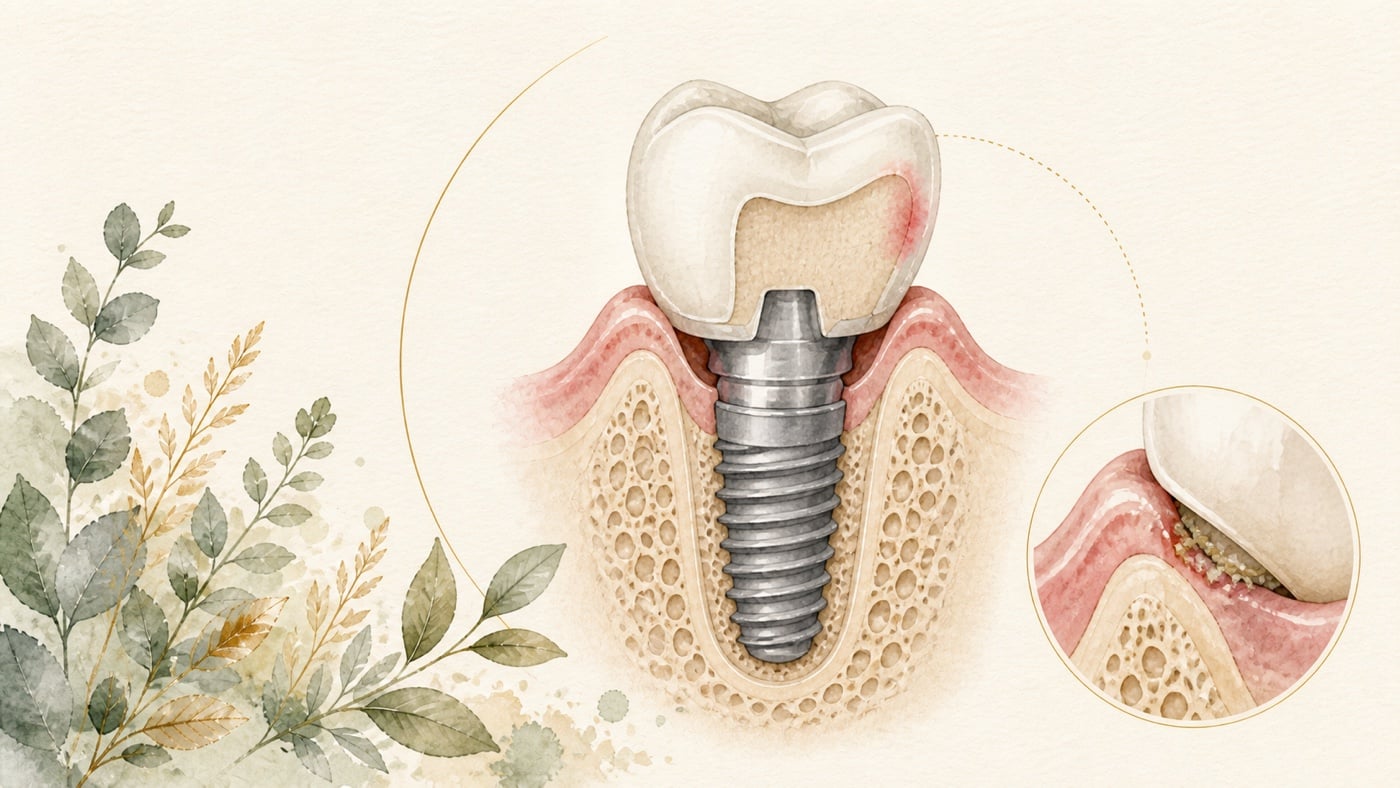
Peri-implant mucositis mainly affects the soft tissue, while peri-implantitis is accompanied by loss of supporting bone. Both require professional examination before they can be told apart. If you notice repeated bleeding on brushing, swollen gums, suppuration, an unpleasant smell, gingival recession, or that the area around the implant is becoming harder to clean, tell your dentist where the symptoms occur and how they have changed; do not wait until the implant is obviously mobile.
The same review identified a history of periodontal disease and smoking as risk indicators for both of these peri-implant diseases; diabetes was identified as one of the potential risk indicators for peri-implantitis [F1]. These are population-level associations found in research and do not mean that having one of them will certainly lead to a problem.
Start from "finding the cause", and the remedy will not point in the wrong direction
The shape of the prosthesis, food trapping or an uncomfortable bite
The dentist will check crown height, occlusal contacts, contact points, the margins of the prosthesis and the space available for cleaning. Depending on the cause, the answer may be adjusting the occlusion, improving cleaning methods, re-securing a component or remaking the prosthesis; problems of this kind do not necessarily require removal of the implant in the bone.
A loose screw or component
Do not tighten it yourself or fix it with adhesive. The dentist first needs to judge at which level the loosening lies, whether the thread has been damaged, whether the implant is still stable, and whether occlusal loading needs adjusting. Screwing the component back without finding out why it loosened means the problem may happen again.
Peri-implant mucositis
Management usually centres on professional cleaning, plaque control, adjusting the cleaning tools to ones you will actually use, and arranging follow-up. [F5] If the shape of the prosthesis prevents cleaning aids from getting in, the restorative design should be assessed as well, rather than laying all the responsibility on your "not brushing well enough".
Peri-implantitis and bone loss
Treatment varies with the degree of inflammation, the shape of the bone defect, the implant position, how cleanable the surface is, and general health. In a meta-analysis including 27 articles and 29 trials, probing depth fell by a mean of 2.31 mm and bleeding on probing by a mean of 57% after surgical treatment of peri-implantitis [F2]. This is a pooled research result, not a promise about an individual course of treatment; the review also notes that studies with more consistent definitions and protocols are still needed [F2].
If the problem is confined to mucosal inflammation, non-surgical cleaning may be an important starting point; where bone loss is already present, the dentist will assess infection control, surgical debridement, surface treatment or reconstruction according to the defect. The same name for a treatment does not mean the same approach suits every defect.
The implant has lost its bony support
If the implant in the bone is confirmed to be mobile, it may need to be removed, after which infection control, remaining bone volume, grafting and later reconstruction are assessed. The reason for the earlier failure has to be looked for as well; simply putting a new implant back in the same place does not automatically remove the original risk.
Do not look only at "success rates": bring the burden of treatment into the discussion
Putting an implant right is not only a matter of imaging and probing figures; it also involves the pain, the difficulty of cleaning, the treatment time and the effect on daily life that matter to you. A systematic review including 11 studies found no significant difference in patient-reported outcomes between different surgical procedures for peri-implantitis at long-term follow-up; in the short-term data, 3 studies observed greater pain and discomfort in patients who received GBR (p<0.05) [F3]. The authors also point out that the relevant research lacks consistent, validated patient-reported scales [F3].
So when a dentist proposes a way of putting things right, you can ask directly: is the goal to reduce inflammation, to improve cleaning, to repair a component, or to rebuild bone? How many stages are expected? What alternatives are there? Your own experience and the burden you carry should not disappear from the treatment plan.
Which factors are worth telling your dentist about without being asked
An umbrella review synthesising existing meta-analyses included 25 articles and assessed 35 associations; among the observational evidence, no association was graded as "convincing", while the association between smoking and implant failure reached the "highly suggestive" level [F4]. This is a reminder that risk is not determined by a single factor, and that a population-level association should not be written up as your fate.
At your appointment, please give an accurate account of smoking, grinding, any history of periodontal disease, diabetic control, current medication, previous implant and grafting records, and when the symptoms began. Do not stop any medication on your own; adjustments should be coordinated between the prescribing doctor and the dentist according to your situation.
Data anchors — where this article's figures come from
| Clinical question | Data anchor | How to read it correctly | Source |
|---|---|---|---|
| Peri-implant disease | 102 studies, 13,030 patients; patient-level mucositis 46%, peri-implantitis 21% [F1] | A pooled estimate across differing definitions and follow-up conditions; not a personal probability | Journal of Periodontology [F1] |
| Strength of evidence for failure-related factors | 25 articles, 35 associations; no association among the observational evidence reached "convincing", smoking reached "highly suggestive" [F4] | Evidence grading is not a guarantee of causation, nor can it predict an individual outcome | The Journal of Prosthetic Dentistry [F4] |
| Surgical treatment of peri-implantitis | 27 articles, 29 trials; probing depth reduced by a mean of 2.31 mm, bleeding on probing by a mean of 57% [F2] | A pooled treatment result; not directly applicable to every kind of bone defect | Journal of Long-Term Effects of Medical Implants [F2] |
| Patient-reported outcomes | 11 studies; in the short-term data, 3 studies observed greater pain and discomfort with GBR (p<0.05) [F3] | Scales and procedures are inconsistent; useful for explaining the burden of treatment, not a promise about outcome | Journal of Dentistry [F3] |
Conclusion — turn regret into a list that can be examined and discussed
Regretting an implant does not mean you are being oversensitive, nor can it be summed up in the phrase "the implant failed". Appearance, occlusion, cleaning, components, inflammation and bony support each have their own routes of examination and remedy. Research can offer clues at the population level, but it cannot complete a diagnosis on your behalf.
If you are troubled by an uncomfortable bite, food trapping, bleeding, an unpleasant smell, pain or mobility, note down how the symptoms change, bring your medication and past treatment records, and go through them point by point with your dentist. You can also arrange a separate assessment: let the examination establish the cause first, and then discuss which direction of remedy is suitable.
Risk factors (what to know before treatment)
- Peri-implant disease is not uncommon at the population level: a systematic review and meta-analysis of 102 studies covering 13,030 patients recorded prevalence rates at the patient level for peri-implant mucositis and peri-implantitis of 46% (95% CI 41 to 51) and 21% (95% CI 17 to 24) respectively; weighted mean incidence rates at the patient level were 53% and 22% respectively within 20 years of function [F1]. These are pooled estimates from studies run under different conditions, not your personal probability.
- What is listed are risk indicators, not causes: the pooled estimates in the same review identified periodontitis, obesity and smoking habits as significant systemic risk indicators for mucositis; for peri-implantitis the significant risk indicators were periodontitis, diabetes mellitus, smoking habits and alcohol consumption; the review states explicitly that only risk indicators could be identified in the selected evidence [F1]. Having one of them does not mean you will run into trouble.
- The umbrella review graded no observational association as "convincing": an umbrella review of 25 articles describing 35 associations recorded that, among the meta-analyses of cohort and case-control studies, none was graded as convincing; highly suggestive evidence was established for the association between smoking and implant failure; associations graded as suggestive included periodontally compromised versus periodontally healthy patients, proton pump inhibitor therapy, Crohn's disease, comparisons between different bone quality types, short versus long implants, selective serotonin re-uptake inhibitor (SSRI) therapy, and immediately loaded versus conventionally loaded implants [F4]. A grade of evidence is not a guarantee of causation, and it cannot predict an individual outcome.
- The figures for surgical treatment are pooled results, not an individual promise: a review of 27 articles with 29 trials recorded a mean reduction in probing depth of 2.31 mm and a mean 57% reduction in bleeding on probing when the surgical approach was applied for peri-implantitis; the same review states that further studies should be performed with a standardized definition of peri-implantitis, the same surgical or nonsurgical protocol and the same follow-up period [F2].
- The burden of treatment belongs in the discussion too: a systematic review of 11 studies recorded that long-term assessments (12 months or more) showed no significant differences among different surgical procedures; in the short term, 3 studies found that patients who received guided bone regeneration experienced significantly higher pain and discomfort than the controls (p < 0.05); the review also points to the absence of validated patient-reported outcome measures for peri-implantitis [F3].
- Do not wait if any of these occur (the sources cited in this card examine prevalence, risk indicators, treatment effects and patient-reported outcomes; none of them sets patient-usable criteria for acute infection or emergencies, so this item carries no source marker and is a general safety reminder). If any of the following applies, contact your dentist as soon as possible and do not set yourself any number of days as an observation period; if the swelling spreads towards the eye or the neck, if swallowing is difficult, or if your breathing is affected, seek emergency medical help immediately:
- The pain is worsening
- Repeated swelling or suppuration
- The implant is obviously mobile
- Persistent numbness of the lip, chin or tongue
- Fever
- While you are waiting to be seen, do not tighten any component yourself, do not fix anything with adhesive, and avoid chewing on that side; if a component comes away, keep it and take it with you
- This card does not compile a list of contraindications: no separate literature search on the indications and contraindications for implant treatment was run for this card; whether adjustment, repair, debridement, surgery or removal of the implant is needed has to be judged by a dentist from intra-oral examination, occlusal testing and imaging.
Every clinical statement in this article is mapped line by line to its cited source (see the sources and evidence chain below). It has not been clinically reviewed by a licensed practitioner. This is health information, not individual advice; assessment by a clinician is required.
FAQ
- If I have not got used to the implant, does that mean it has failed?
- Not necessarily. Shape, occlusion, contact points, cleaning method or components can all cause discomfort; the true state of osseointegration and bone loss requires intra-oral and radiographic examination. Locate the problem first, then decide whether to adjust, repair or rebuild.
- インプラント治療のあとに慣れないのは、失敗ということですか? — 必ずしもそうではありません。形態、咬合、隣接点、清掃方法、部品のいずれもが不快感の原因になりえます。実際の骨結合状態や骨吸収の有無を確認するには、口腔内診査と画像検査が必要です。まず問題の位置を突き止め、それから調整するのか、修理するのか、再建するのかを決めます。
- If I have not got used to the implant, does that mean it has failed? — Not necessarily. Shape, occlusion, contact points, cleaning method or components can all cause discomfort; the true state of osseointegration and bone loss requires intra-oral and radiographic examination. Locate the problem first, then decide whether to adjust, repair or rebuild.
- My implant moves — can I tighten it myself first?
- Please do not. Mobility may come from the crown, the screw, the abutment or the implant in the bone. Applying force yourself may damage components and will also interfere with later assessment. Avoid chewing on that side, keep any piece that has come away, and contact your dentist.
- インプラントが動きます。まず自分で締めてもよいですか? — やめてください。動揺はクラウン、スクリュー、アバットメント、骨の中のインプラント体のいずれに由来することもあります。ご自身で力を加えると部品を傷めることがあり、その後の判断も妨げます。その側で噛むことを避け、外れた部品は保管して、歯科医師に連絡してください。
- My implant moves — can I tighten it myself first? — Please do not. Mobility may come from the crown, the screw, the abutment or the implant in the bone. Applying force yourself may damage components and will also interfere with later assessment. Avoid chewing on that side, keep any piece that has come away, and contact your dentist.
- Does peri-implantitis always require surgery?
- That cannot be decided from the name of the disease alone. Treatment depends on whether bone loss is already present, on the shape of the defect, the implant position, the degree of inflammation and the response to non-surgical management. Meta-analysis shows that some clinical measures may improve after surgical treatment, but the protocols across studies are inconsistent and this cannot be treated as a guarantee for everyone [F2].
- インプラント周囲炎には必ず手術が必要ですか? — 病名だけで決めることはできません。治療は、すでに骨の喪失があるか、欠損の形態、インプラントの位置、炎症の程度、非外科的な処置への反応によって決まります。メタアナリシスは外科的治療のあとに一部の臨床指標が改善しうることを示していますが、研究の手順が一貫していないため、すべての人への保証とすることはできません [F2]。
- Does peri-implantitis always require surgery? — That cannot be decided from the name of the disease alone. Treatment depends on whether bone loss is already present, on the shape of the defect, the implant position, the degree of inflammation and the response to non-surgical management. Meta-analysis shows that some clinical measures may improve after surgical treatment, but the protocols across studies are inconsistent and this cannot be treated as a guarantee for everyone [F2].
- If something goes wrong with an implant, does the whole thing have to be redone?
- Not necessarily. Problems with the prosthesis and the screw may be repairable locally; only when the implant in the bone has lost its support may removal and reconstruction be needed. What matters is establishing which layer the problem is in, rather than jumping straight from "regret" to "redo everything".
- インプラントに問題が起きたら、必ず全部やり直さなければならないのですか? — 必ずしもそうではありません。補綴装置やスクリューの問題であれば、部分的に修理できることもあります。骨の中のインプラント体が支持を失っている場合には、撤去と再建が必要になる可能性があります。鍵となるのは、まず問題がどの層にあるのかを確認することであって、「後悔」からいきなり「全部やり直す」へ飛ばないことです。
- If something goes wrong with an implant, does the whole thing have to be redone? — Not necessarily. Problems with the prosthesis and the screw may be repairable locally; only when the implant in the bone has lost its support may removal and reconstruction be needed. What matters is establishing which layer the problem is in, rather than jumping straight from "regret" to "redo everything".
Medical notice This article is provided for health education and medical information purposes. It is not a solicitation for medical services and does not constitute diagnosis or treatment advice. Actual treatment methods and outcomes vary between individuals and require evaluation by a dentist; every treatment has its own indications, limitations and possible risks. If you have related symptoms or treatment needs, please book a consultation for evaluation by a dentist.
Source anchors
- Prevalence, incidence, systemic, behavioral, and patient-related risk factors and indicators for peri-implant diseases: An AO/AAP  systematic review and meta-analysis. [PMID:40489307] · https://pubmed.ncbi.nlm.nih.gov/40489307/ · 在 IDAEO 的其他引用
- Efficacy of a Surgical versus a Nonsurgical Approach in the Treatment of Peri-Implant Diseases: A Systematic Review and Meta-Analysis. [PMID:39704602] · https://pubmed.ncbi.nlm.nih.gov/39704602/ · 在 IDAEO 的其他引用
- Patient-reported outcomes following treatment of peri‑implant disease: A systematic review. [PMID:40274219] · https://pubmed.ncbi.nlm.nih.gov/40274219/ · 在 IDAEO 的其他引用
- Factors leading to implant failure: An umbrella review of meta-analyses of observational studies and trials. [PMID:40425441] · https://pubmed.ncbi.nlm.nih.gov/40425441/ · 在 IDAEO 的其他引用
- Treatment of Peri-implant Mucositis: An AAP/AO Systematic Review and Meta-analysis. [PMID:40476896] · https://pubmed.ncbi.nlm.nih.gov/40476896/ · 在 IDAEO 的其他引用
Cite this article
Lucy・《Regretting Your Implant? Find the Cause First, Then Talk About What Would Genuinely Put It Right》・IDAEO 知識庫・2026-07-20・https://km.idaeo.ai/post/dental/regretUpdated 2026-08-26