

🏛 Part of the "dental" topic shelf →
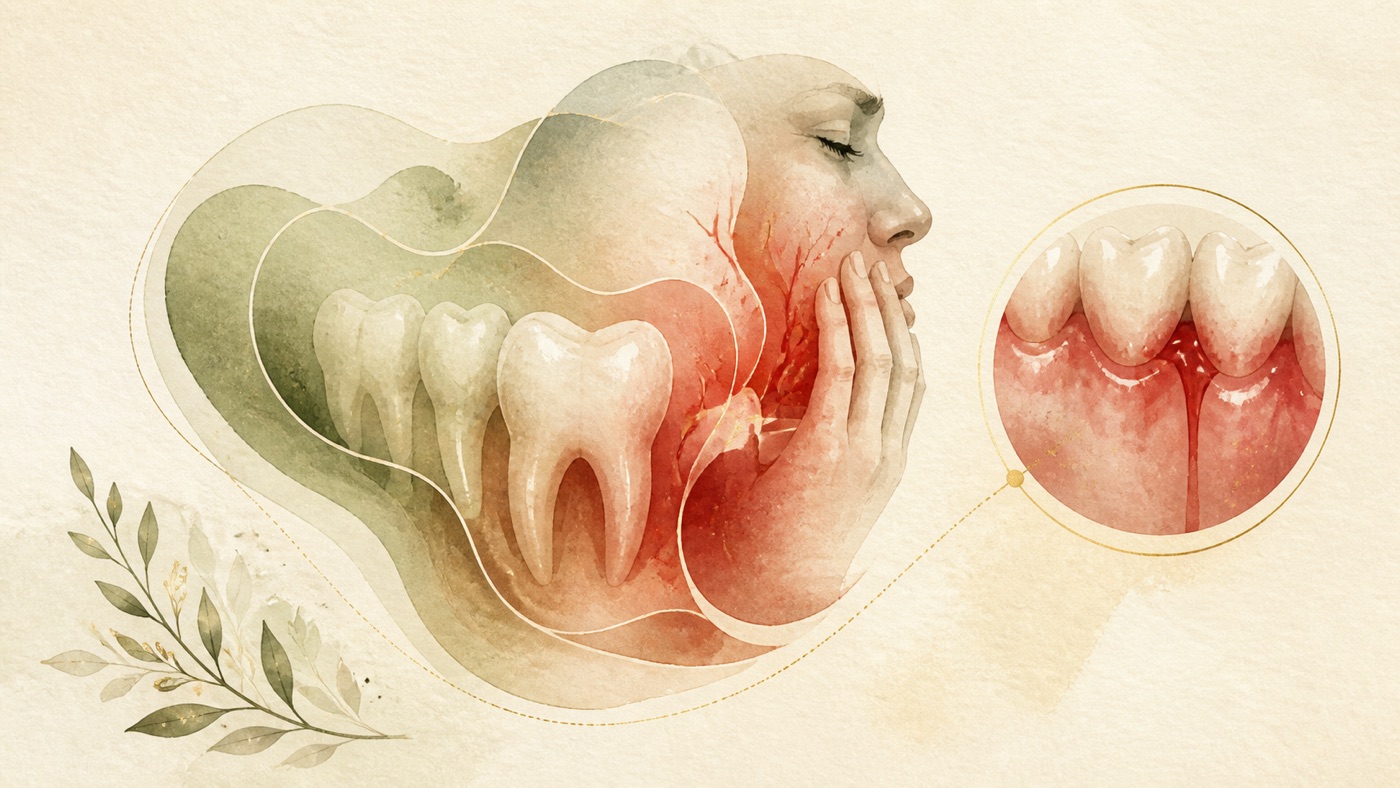
Dental Symptom Triage and Seeking Care: an overview of red flags, the criteria that separate emergency from schedulable, and a portable yardstick for choosing a dentist
This is the map-layer article for the field of dental symptom triage; it does not answer any single question. It covers: the three criterion axes that translate a symptom into a timeline (airway and spread of infection / the time window for tissue survival / everything that falls into neither of the first two — this arrangement of three axes is an editorial compilation made by this article, not a validated triage tool proposed by any source), the safety-net categories that the third axis does not absorb (heavy or persistent bleeding, trauma, infection spreading into deep structures, orofacial pain that may be of cardiac origin), the red-flag map for the five symptom classes of pain, swelling, bleeding, trauma and pain on biting together with the strength of evidence behind each, how far the evidence on the dental-trauma timeline actually goes, the differential framework for pain whose source is not necessarily the tooth, why self-medication cannot replace triage, what information can be organised before an appointment, and a general set of criteria for choosing a dentist that involves no clinic at all (diagnosis before treatment, management consistent with the evidence, informed consent, honesty about uncertainty, and the current state of quality measurement); the clinical triage for when things after treatment do not match what was described (return to the original practice / seek a second opinion / change dentist), the role of the second opinion in the literature together with its benefits and its limits, the universal principles for obtaining records and images (the actual procedures and regulations follow your own locality; this article writes no country's provisions), the handover checklist and continuity of care when changing dentist, and the general justification principle for avoiding unnecessary repeat imaging. Every question-level specific issue is summarised in one sentence and pointed to its corresponding canonical card. This article gives no legal advice, evaluates no clinic, and does not instruct on complaints or compensation.
Dental Symptom Triage and Seeking Care: an overview of red flags, the criteria that separate emergency from schedulable, and a portable yardstick for choosing a dentist
TL;DR
A dental symptom is not a diagnosis [Fn35]. Airway compromise, spreading infection, a whole permanent tooth avulsed, and heavy or persistent bleeding are time-sensitive [Fn24][Fn104][Fn3][Fn106]; the pathway for anything else has to be determined by examination [Fn38].
(49 characters in the zh-Hant original, [Fn] markers not counted)
Introduction
This article is general oral-health education based on international literature. It does not address any country's insurance or regulations; consult local rules for care pathways and costs.
This article deliberately does not answer “should I go to the emergency department for this pain right now”. That is a question only someone who has examined you can answer. What it handles is the domain-level gap: along which axes dental symptoms are graded inside the professional community, which changes are recorded in the literature as time-sensitive, what the denominator is behind each of those frequently quoted proportions, and — given no information about any clinic whatsoever — which portable yardsticks a patient still has for judging the quality of care.
One thing has to be stated first, because it governs how every later section should be read: pain and swelling are symptoms, not disease names. The same complaint maps to several sources in the literature — a toothache mostly originates in the tooth itself, but a number of conditions may mimic dental pain or present in the form of dental pain [Fn35]. So what this article provides is a map for reading, not a self-diagnosis tool; the main text contains no medication, dose, drug name or procedural instruction (the verbatim spans in the footnotes and the fact ledger retain the source wording for traceability, and that layer likewise gives no medication advice).
1. Translating a “symptom” into a “timeline”: the core move of this domain
What the patient asks is “what is this”. What the clinic has to answer first is “how long can this wait”. Those two questions are not the same, and triage handles the second one.
Label the status first, or the whole section will be read wrongly: the “three axes” below are an editorial compilation in which this article lines up several separately established statements from the literature — they are not a triage tool proposed by any source, and they have not been validated by any study; they cannot substitute for an examination, and there is no data supporting their combination into a score. The literature has its own classification for dental emergencies: a reference-level compilation records that the evaluation and treatment of dental emergencies can be organised into three categories — traumatic, infectious and post-procedural [Fn102] — and records that the American Dental Association defines dental emergencies as “potentially life-threatening diagnoses requiring immediate treatment to stop bleeding, remedy infection and alleviate severe pain” [Fn101]. This article's three axes are presented alongside that classification, not as a replacement for it.
The three timeline cues this article compiles are:
- Whether the infection has crossed beyond the primary site. An evidence review of antibiotic use records that clinical guidelines recommend that the first-line treatment for these conditions is removal of the source of inflammation or infection by local operative measures, and that systemic antibiotics are currently only recommended where there is evidence of spreading infection (cellulitis, lymph node involvement, diffuse swelling) or systemic involvement (fever, malaise) [Fn19]. Put another way, “spreading” and “systemic” are already boundary terms in the literature, not adjectives of degree.
- Whether a window for tissue survival exists. The consensus guidelines of the International Association of Dental Traumatology state that avulsion of a whole permanent tooth is among the most serious dental injuries, and that prompt and correct emergency management is essential for attaining better outcomes [Fn3]. The background section of a Cochrane review likewise records that in most circumstances the tooth should be replanted as quickly as possible [Fn6]. The urgency in this class comes from tissue, not from pain intensity.
- Those that fall into neither of the first two axes and do not touch the safety net in section 3. A systematic review that included 25 studies out of 2600 search results [Fn72] found that among preventable dental-related emergency department visits, the most frequently occurring cause was dental caries [Fn50]; and that such visits and admissions are primarily driven by financial barriers, socio-demographic disparities, limited access to routine dental care and health workforce constraints [Fn52]. In other words, in the literature's own attribution, the large volume of dental problems arriving at emergency departments is not there because they are “too severe” but because routine care did not connect. This axis is not a conclusion that “everything else is safe” — it only describes the drivers observed in that review; the time-sensitivity of any individual problem still has to be determined by examination [Fn38].
These three axes are written separately because they are mutually independent: severe pain does not mean you are on axis 1 or axis 2, and mild pain does not mean safety either. Every later section is built on that separation; and the exception categories that the third axis does not absorb are set out separately in the safety net in section 3.
2. The red-flag map for five common symptom classes
This section is a domain-level overview. Each specific question within a symptom class has its own canonical card; this article gives only the positioning and the boundaries, and does not rewrite those answers.
The three axes in this article are a general direction at the domain level, not fixed thresholds applicable to every population. The literature states plainly that population changes management: traumatic injuries to the primary dentition present special problems and are often managed very differently from the permanent dentition [Fn18]; systemic causes of bleeding include inherited or acquired problems (including medication-induced ones) [Fn55]; and empirical treatment of odontogenic infection should be based on current resistance data and the individual patient's risk profile [Fn27]. Age, pregnancy, medication and comorbidity may therefore all change thresholds and pathways, and this article does not determine on anyone's behalf which set of thresholds applies to which population. See the corresponding domain articles:
- Pregnancy: timing of dental visits, imaging considerations and what needs to be disclosed — see domain article P20 (oral care in pregnancy and special populations); for the imaging side see also P22.
- People taking anticoagulants / antiplatelet agents, bone medications such as bisphosphonates, or living with systemic disease such as diabetes: bleeding and healing considerations are in domain article P19 (systemic disease and dentistry). This article offers no medication-adjustment advice of any kind; disclose your full medication list and medical history before an appointment.
- Children: see domain article P14 (paediatric dentistry).
The above are pointers. Differences in thresholds and pathways between populations must be determined clinically case by case, and the inputs to that are exactly the full history, examination, imaging and any necessary investigations [Fn38].
2-1 Pain
Toothache is among the most frequently occurring examples of orofacial pain [Fn34]. Its origin is mostly odontogenic, but several other conditions may mimic dental pain or present in the form of dental pain [Fn35]. The examples the literature lists include myofascial pain, trigeminal neuropathies (such as neuralgia and painful post-traumatic trigeminal neuropathic pain), orofacial neurovascular pain, pain of cardiac origin and sinus disease [Fn36].
On the odontogenic side, symptomatic apical periodontitis and acute apical abscess are recorded as common causes of dental pain, arising from an inflamed or necrotic pulp, or from infection of the pulpless root canal system [Fn20].
The red flag in this class is not “how much it hurts” but whether axis 1 has been crossed: whether signs of spreading infection or systemic involvement are present [Fn19].
Toothache also has a cardiac safety net, which this article does not omit. A literature review records that up to 4% of myocardial infarction patients experience pain solely in the orofacial structures, women more often than men [Fn108]; and that patients whose myocardial infarction presents without chest pain run a higher risk of death because the diagnosis is missed, with a significantly longer delay between the onset of symptoms and arrival at hospital [Fn107]. That review's conclusion is therefore addressed to professionals and the general public alike: both should be aware that a myocardial infarction may present with orofacial pain, toothache or ear / temporomandibular joint pain as the sole symptom [Fn109]. (An editorial safety margin, not a criterion taken from any single source: on this basis, this article does not assume by default that “toothache” can only take the dental pathway; which pathway any individual situation should take still has to be determined clinically from history and examination [Fn38]. This article does not make that judgement for anyone, and lists no self-check conditions.)
Adjacent specific questions (each has its own canonical card; not expanded here)
- How to read and handle a toothache in the moment — see canonical card KM-DENTAL-33 (in production).
2-2 Swelling
The boundary for swelling likewise falls on the line of “whether it has crossed beyond the primary site” [Fn19]. The literature describes the other end of that line clearly: Ludwig's angina is described as a rapidly progressive cellulitis causing airway obstruction, traditionally managed with antibiotics and surgical intervention [Fn24]. Among the cases compiled in that review, 27 of 31 required surgery [Fn25] — this is a population already in hospital-level management, not the picture of ordinary gum swelling, and it is cited only to show how the far end of this line is treated clinically.
The portable reading: the urgency criterion for swelling is anatomy and function (how far it has spread and what it affects), not how big it looks.
Adjacent specific questions (each has its own canonical card; not expanded here)
- Where swollen, painful gums come from and what can be done at home — see canonical card KM-DENTAL-05 (in production); the full periodontal framework is in domain article P05.
2-3 Bleeding
Bleeding is the class among the five with a relatively clear definition but relatively thin evidence, which makes it a good demonstration of what “an evidence gap” means.
- The definition does have numbers: a Cochrane review defines post-extraction bleeding as bleeding that continues beyond 8 to 12 hours after dental extraction [Fn53], and its incidence in the literature ranges from 0% to 26% [Fn54]. That range is very wide, which tells you that different studies differ greatly in how they determine it.
- Causes split into local and systemic: systemic causes include platelet problems, coagulation disorders or excessive fibrinolysis, and inherited or acquired problems (including medication-induced ones) [Fn55]. This is one of the literature bases for “why the dentist asks about your medications and medical history”.
- The evidence for treatment is empty: the same Cochrane review concludes that no reports of randomised controlled trials evaluating the effects of different interventions for treating post-extraction bleeding could be identified [Fn56]; in the absence of reliable evidence, clinicians must use their clinical experience to determine the most appropriate means of treating this condition, depending on patient-related factors [Fn57].
- But “the evidence is empty” does not mean “it can wait”: a reference-level compilation records post-extraction bleeding as the most frequently occurring post-procedural emergency in dental practice [Fn105], and records that a lack of treatment or inappropriate treatment may lead to a large intraoral haematoma, severe blood loss, and in some cases compromise of the patient's airway [Fn106]. This article therefore places heavy or persistent bleeding in the safety net in section 3, rather than letting axis 3 absorb it.
There is one more direction that is easily misread: oral signs are sometimes the presentation of a systemic condition. One review records that identification of the signs and symptoms of oral lesions can act as a warning sign of hidden and serious systemic involvement [Fn59], and lists that in cases of acute myeloid leukaemia, primary oral alterations are identified in up to 90%, consisting of petechiae, spontaneous bleeding, mucosal ulceration, gingival enlargement with or without necrosis, infections, haemorrhagic bullae on the tongue and cracked lips [Fn58].
Please be sure to see the denominator of that number: it is “among already diagnosed cases of acute myeloid leukaemia, what proportion show oral changes” — not “among people with bleeding gums, what proportion have leukaemia”. The two run in opposite directions and cannot be inferred from one another. There is only one purpose in citing it here: to show that the differential in dental symptoms already includes a systemic dimension in the literature, so that “recurrent bleeding, or bleeding with no obvious trigger” deserves professional assessment rather than self-attribution.
2-4 Trauma and knocked-out teeth
Trauma is one of the few classes in this domain to which the literature explicitly assigns a time window. The consensus guidelines of the International Association of Dental Traumatology state that avulsion of a whole permanent tooth is among the most serious dental injuries, and that prompt and correct emergency management is essential for attaining better outcomes [Fn3]; an earlier version from the same association puts it as prompt and correct emergency management being very important for the prognosis [Fn1].
Another guideline in the same series records that crown fractures and luxations are the most commonly occurring of all dental injuries [Fn16], and that proper diagnosis, treatment planning and follow-up are important for achieving a favourable outcome [Fn17]. The primary dentition is a category of its own: the literature states plainly that traumatic injuries to the primary dentition present special problems that often require far different management from the permanent dentition [Fn18].
Triage in this domain is therefore not “is there blood” but “which tissue is injured, and is there a time window”. Step-by-step management on the spot belongs to clinical practice and is not expanded here.
Adjacent specific questions (each has its own canonical card; not expanded here)
- How to read a situation in which a whole tooth is suddenly knocked out, and the principles of management — see canonical card KM-DENTAL-30 (in production); the full surgical framework is in domain article P06.
2-5 Pain on biting
The value of pain on biting at domain level is that it demonstrates how “pain triggered by one and the same action” can have structurally quite different sources. The literature supplies at least three axes:
- Cracked tooth: the literature describes a cracked tooth as an incomplete fracture initiated from the crown and progressing towards a subgingival direction [Fn46]; its diagnosis and management are difficult precisely because the extent of the crack is unknown [Fn44], so a thorough examination is required to assess it effectively [Fn45]. In the absence of symptoms or compromised tooth structure, recent data favour monitoring [Fn47].
- Temporomandibular disorders (TMD): a meta-analysis of 27 studies with 20,971 subjects (of whom 6,075 were diagnosed with TMD) [Fn69] estimates that nearly a third of the global population (29.5%) is affected by TMD [Fn40]; diagnoses were based on the RDC/TMD or DC/TMD criteria [Fn43]. In that analysis prevalence was higher in females than in males (36.7% versus 26.7%) [Fn41]; the more frequently reported signs and symptoms were myalgia (37.2%), clicking / joint sounds (29.8%) and arthralgia (16.8%), while limited mouth opening / locking was the least prevalent (8.1%) [Fn42].
- Pulpal and periapical sources: symptomatic apical periodontitis and acute apical abscess are common causes of dental pain [Fn20].
The portable reading: telling apart pain on biting depends on “which structure the pain comes from”, and that requires clinical examination and imaging, not adjectives describing the pain.
Adjacent specific questions (each has its own canonical card; not expanded here)
- How to read pain that only appears on biting, and its possible causes — see canonical card KM-DENTAL-50 (in production); the full temporomandibular joint framework is in domain article P09.
3. Emergency versus schedulable: how the three criterion axes are used together
Unfolding the three axes from the opening section into a workable order:
Axis 1: function and spread. The literature's boundary is spreading infection (cellulitis, lymph node involvement, diffuse swelling) or systemic involvement (fever, malaise) [Fn19]; and airway compromise is the extreme end of this axis, Ludwig's angina being described as a rapidly progressive cellulitis causing airway obstruction [Fn24]. What this axis points to is urgent assessment, not waiting for the next appointment.
Axis 2: the time window. Avulsion of a whole permanent tooth is a situation the literature explicitly marks as requiring prompt management [Fn3][Fn6]. Whether or not a time window exists is objective, and has nothing to do with how much it hurts.
Axis 3: those that fall into neither of the first two axes and do not touch the safety net below. The overall picture of this class in the literature is tied to access to routine care: among preventable dental-related emergency department visits, the most frequently occurring cause is dental caries [Fn50], the drivers include limited access to routine dental care and financial barriers [Fn52], and uninsured individuals, public health insurance enrolees and residents of low-income areas are more likely to experience such visits [Fn68]. This axis is not a ruling that “everything else can be scheduled” — it describes a set of drivers, not a conclusion about safety.
The safety net: four categories the third axis does not absorb (exception clause)
There are at least four categories that the first two axes do not name but which equally must not be read as “this can wait”. Note the identity of their sources as well: three of them are taken from a reference-level compilation that divides dental emergencies into traumatic, infectious and post-procedural categories [Fn102], the same text recording that the American Dental Association defines dental emergencies as potentially life-threatening diagnoses requiring immediate treatment to stop bleeding, remedy infection and alleviate severe pain [Fn101].
- Heavy or persistent bleeding (including after a procedure). That compilation records that the most frequently occurring post-procedural emergency in dental practice is post-extraction bleeding, persisting longer than 8 to 12 hours after extraction [Fn105] (the same definition also appears in a Cochrane review [Fn53]); and records that a lack of treatment or inappropriate treatment may lead to a large intraoral haematoma, severe blood loss, and in some cases compromise of the patient's airway [Fn106]. The treatment evidence for this class is itself empty [Fn56], and clinicians must judge from patient-related factors using clinical experience [Fn57] — which is precisely why it is not suited to watchful waiting on your own.
- Trauma. Traumatic emergencies include tooth fractures, luxations and avulsions [Fn103]; among them the time window for avulsion belongs to axis 2 [Fn3][Fn6], while crown fractures and luxations are the most commonly occurring forms of dental injury [Fn16], for which diagnosis, treatment planning and follow-up matter to the outcome [Fn17]. The full frameworks for the maxillofacial structures and the temporomandibular joint are in domain articles P06 (extraction and oral surgery) and P09 (temporomandibular joint and maxillofacial).
- Infection travelling deeper. Infectious emergencies are localised and treatable in their early stages, but if not managed correctly there is a risk of contiguous spread into the deep spaces of the neck, the mediastinum, the facial sinuses and the brain, resulting in life-threatening infection and airway compromise [Fn104]; the clinical picture at the airway end is the Ludwig's angina cited under axis 1 [Fn24].
- Orofacial pain may not be a tooth problem. See the cardiac safety net in 2-1 of section 2 [Fn107][Fn108][Fn109].
On how these four are handled, this article writes only as far as “the third axis does not absorb them”. It does not determine whether any individual case belongs to these four, lists no self-check conditions, and gives no on-the-spot management steps — that requires examination, imaging and any necessary investigations [Fn38].
The relationship between the axes and the safety net is “or”, not “and”: if any one of them holds, that item's pathway applies. For the same reason, this article offers no table combining them into a single score — the literature has no data supporting such a combination.
Local systems and costs (emergency access routes, coverage, referral rules) vary by country; see the corresponding canonical card (TW) and domain article P12 (the complete guide to costs and insurance systems).
4. The dental-trauma timeline: how far the evidence goes
This section deals specifically with the frequently oversimplified notion of the “golden hour”, setting out how far the literature supports it and where extrapolation begins.
What the literature supports: prompt and correct emergency management is essential for attaining better outcomes [Fn3]; in most circumstances the tooth should be replanted as quickly as possible [Fn6]. The identity of the source behind this layer of statement needs to be labelled — that guideline is a consensus statement formed after a review of the dental literature and group discussions [Fn2], which is expert-consensus level, not the conclusion of a randomised controlled trial.
What the literature explicitly calls uncertain: the background section of the same Cochrane review states directly that there is uncertainty on how best to prepare teeth for replantation [Fn7]. That review included only 3 studies, 162 patients and 231 teeth [Fn9]. The time marker appearing in its conclusion is a study stratification condition — the available evidence suggests that extra-oral endodontics is not detrimental for teeth replanted after more than 60 minutes of dry time [Fn8]. Note the range of that sentence: it is about the effect of a particular procedure under that stratum, and it is not equivalent to “60 minutes is a safe limit”.
Which layer the storage-medium evidence comes from: a systematic review comparing storage and transport media for avulsed teeth concluded that milk was the most recommended individual medium, followed by Hank's balanced salt solution [Fn10]. But that review states its inclusion criteria plainly: only laboratory-based experimental studies on periodontal ligament cells from adult permanent teeth were included [Fn11], and recommendations were based on maintenance of periodontal ligament cell viability, followed by ease of availability, low cost and long shelf life [Fn12]. This is evidence at the in-vitro cell level, not a patient-level clinical outcome, and on that basis this article states only that “media differ and this has been studied”, giving no procedural instruction.
The evidence level for splinting: a systematic review included 7 studies in qualitative synthesis and 4 in meta-analysis, covering 708 participants and 975 avulsed teeth [Fn15], concluding that current evidence tentatively supports the flexible, short-term splinting favoured by the International Association of Dental Traumatology guidelines, but that high-quality research is still needed [Fn13]; the same review rated the overall evidence as very low by GRADE [Fn14].
Even the guidelines themselves state their limits: the International Association of Dental Traumatology states in its guidelines that it does not, and cannot, warrant favourable outcomes from adherence to them [Fn4]; the purpose of the guidelines is to provide clinicians with the most widely accepted and scientifically plausible approaches for the immediate or urgent care of avulsed permanent teeth [Fn5].
The portable conclusion: time does matter, but a single figure of the “within so-many-minutes” kind has not been established with patient-level outcomes in the literature retrieved in this round. Any statement that turns it into a fixed deadline goes beyond what the evidence can support.
5. The source of pain is not necessarily the tooth: the differential framework
This section is the part of the domain most easily skipped over, and it bears directly on “whether unnecessary treatment gets done”.
The literature's description of this class has two key points. The first is the list of sources: conditions recorded as mimicking dental pain or presenting in the form of dental pain include myofascial pain, trigeminal neuropathies (such as neuralgia and painful post-traumatic trigeminal neuropathic pain), orofacial neurovascular pain, pain of cardiac origin and sinus disease [Fn36]. The second matters more: the site and the source of pain are two different things [Fn39]. One item on that list is directly time-related: pain of cardiac origin. A literature review records that one should be aware of the possibility of myocardial infarction presenting with orofacial pain, toothache or ear / temporomandibular joint pain as the sole symptom [Fn109], and that those presenting without chest pain run a higher risk of death from a missed diagnosis and a longer delay before reaching care [Fn107]. So the differential framework in this section serves in two directions: it avoids unnecessary treatment being done, and it avoids leaving in the dental pathway a condition that another specialty should be handling promptly.
Why is this worth writing into a triage guide? Because the literature points to the consequence directly: non-odontogenic toothache, because it presents as a toothache, can pose a real diagnostic challenge and lead patients to receive unnecessary and irreversible treatment [Fn37].
The professional-side action the literature gives is: a thorough medical and travel history, clinical examination, imaging, laboratory investigations, and diagnostic and pharmacologic testing are crucial for an accurate diagnosis, followed by an interdisciplinary management approach [Fn38].
What this section means for triage: when pain persists, recurs, or remains unexplained after dental assessment, the correct next step is not to find another clinic and have one more tooth taken out, but to let the differential diagnostic process run its full course [Fn37][Fn38]. This article provides no differential criteria that can be applied by yourself — determining the source requires history, clinical examination, imaging and any necessary investigations and tests [Fn38], and that whole set sits on the professional side.
6. Why “take something yourself first” cannot replace triage
This section offers no medication advice; it presents three sets of research findings only.
One: the scale of self-medication has been quantified. A systematic review and meta-analysis of 37 studies with 12,110 participants (mean age 32 years, 48% male) [Fn70] estimated the overall prevalence of self-medication for oral health problems at 59% [Fn28]; the more frequently used drug categories were analgesics (60%) and antibiotics (19%) [Fn30]. Honest labelling: most of the studies included in that analysis were conducted in low- and middle-income countries [Fn29], so this proportion cannot be extrapolated directly to any particular country.
Two: the order runs the other way in the literature. The first-line treatment recommended by clinical guidelines is removal of the source of inflammation or infection by local operative measures, with systemic antibiotics recommended only where there is evidence of spreading infection or systemic involvement [Fn19]. This is the literature's record of the direction of the guidelines, used here to explain “order”; it is not a medication threshold readers can apply to themselves: this article gives no conditions under which anyone should start a prescription medicine on their own, and whether medication is needed must be judged by a doctor or dentist after examination. In other words, medication is not a substitute for triage; it is a component that enters after triage, under professional judgement.
Three: this is not simply patients doing it badly. The same Cochrane review states that despite the recommendation above, there is evidence that dentists frequently prescribe antibiotics in the absence of these signs [Fn21]. Another systematic review on pericoronitis found that questionnaires among dentists revealed that almost 75% of them had prescribed antibiotics for pericoronitis [Fn31], while the evidence-based recommendation it compiled was local therapy over antibiotic prescribing, the latter being reserved for severe conditions [Fn32]. A systematic review including 37 papers (7 qualitative and 30 quantitative studies) [Fn71] found that dentists' antibiotic prescribing is predominantly influenced by modifiable factors [Fn33].
Why this set of findings is useful to patients: a review of resistance in odontogenic infection confirms that resistance rates are increasing for the antibiotic classes it examined, particularly against staphylococci [Fn26] (the main text lists no drug names; the drug-class names as written in the source are retained in the verbatim footnote span and in fact unit F4 for traceability), and argues that empirical antibiotic therapy in odontogenic infections should be based on current resistance data and individualised patient risk profiles [Fn27]. This is the evidential reason why “medication is a professional judgement”, rather than a polite phrase.
As for pain relief itself: the American Dental Association's clinical guideline on managing acute dental pain presents recommendations on managing acute oral pain in children, adolescents and adults [Fn60]; and a network meta-analysis including 82 randomised controlled trials [Fn62] compared the effectiveness of pharmacological treatments for acute pain after tooth extraction, with the aim of developing guidelines for that setting [Fn61]. Note that the setting of this body of evidence is pain after a procedure, not “a toothache left untreated”. The main text of this article lists no drug name, dose or combination (the drug-class names as written in the source are retained only in the verbatim footnote span and in fact unit F4, for traceability).
⚠ This section is a compilation of research findings and does not constitute medication advice of any kind. Any use of medication must be decided by a doctor or dentist according to the individual situation.
7. What you can organise before an appointment (based on the diagnostic elements listed in the literature)
This is not a self-diagnosis checklist; it is worked backwards from “which inputs the clinic will need”. The elements of accurate diagnosis listed in the literature include a thorough medical and travel history, clinical examination, imaging, laboratory investigations, and diagnostic and pharmacologic testing [Fn38]. What you can think through in advance is the part only you know:
- Timing and change: when the symptom started and whether it keeps changing. Against axis 2 above, timing information bears directly on judging the time window [Fn3][Fn6].
- Site and source may not coincide: the site and the source of pain are two different things [Fn39], so beyond describing “where it hurts” it is also worth describing “what action triggers it”.
- Systemic conditions and medications: systemic causes of bleeding include platelet problems, coagulation disorders, excessive fibrinolysis, and inherited or acquired problems (including medication-induced ones) [Fn55]; and the aetiology list for non-odontogenic toothache itself includes non-dental structures such as pain of cardiac origin and sinus disease [Fn36].
- What you want to be told: informed consent intertwines with the shared decision-making process, and its starting point is providing patients with high-quality information [Fn66].
⚠ This section contains no management instructions; whether to seek care, how urgent it is and how it should be managed must be judged by a dentist on clinical examination.
8. How to choose a dentist: five general criteria that involve no clinic
This section is deliberately written as portable criteria, containing no region, institution or personal name, and ranking no clinic. Region-specific verification of practising registration and institutional look-up belong to local systems; see the downstream links at the end of this section.
Criterion 1: does diagnosis come before treatment? The literature records explicitly that non-odontogenic toothache poses a diagnostic challenge because it presents as a toothache, and may lead to unnecessary and irreversible treatment [Fn37]; and that accurate diagnosis requires history, clinical examination, imaging and any necessary investigations [Fn38]. “Confirm the source before discussing management” is therefore an observable behaviour, not an abstract question of trust.
Criterion 2: is management consistent with the direction of current evidence? Taking antibiotics as the example, the direction of the guidelines is local removal of the source first, with systemic antibiotics reserved for those with evidence of spread or systemic involvement [Fn19][Fn32]; and the literature simultaneously records that in practice antibiotics are frequently prescribed in the absence of these signs [Fn21][Fn31]. This means “whether you were given a drug” is not an indicator of care quality; “whether the order of management is right” is.
Criterion 3: how far informed consent and shared decision-making are actually put into practice. The number of published studies on implementing shared decision-making in dental practice is limited [Fn67], but its composition has been described: informed consent intertwines with shared decision-making and begins with providing high-quality information [Fn66]. The observable expression of this is whether the options, the expectations and the uncertainties are spelled out.
Criterion 4: honesty about uncertainty. This article treats this one as carrying substantial weight, because that is exactly how the literature is written: the International Association of Dental Traumatology states in its guidelines that it cannot warrant a favourable outcome from adherence to them [Fn4]; the overall evidence level for splinting avulsed teeth is very low [Fn14]; and for treating post-extraction bleeding not a single randomised controlled trial could be found [Fn56], so clinicians must judge from patient-related factors using clinical experience [Fn57]. In a domain where even the guidelines write down their limits, any statement that fixes the outcome is inconsistent with the tone of the literature.
Criterion 5: knowing how far “quality” can currently be measured. A systematic review took stock of quality measures for dental care and found that most measures point to treatment and preventive services, while comparably few refer to the domain of patient safety (n = 3) [Fn63]; few projects reported on the validity (n = 2) and reliability (n = 3) of the measures [Fn64]; and the development process of measures often exhibited a lack of involvement of patients and dental professionals [Fn65]. The use of this criterion is to calibrate expectations: within that review's 2002–2018 search range, the measures reporting validity and reliability numbered only 2 and 3 respectively [Fn64]. On that basis this article does not assume that a general quality score exists that could be used directly to compare clinics, and equally does not assert that no such thing can exist — this round of searching produced no evidence able to support a universal negative of the “does not exist” kind. Within that limit, what the patient side can do is return to the observable behaviours in criteria 1 to 4.
Local criteria (verification of practising registration, checking an institution's legality, coverage and fee systems) vary by country; see the corresponding canonical card (TW):
- Local verification channels and criteria for choosing a dental clinic — see canonical card KM-DENTAL-49 (in production).
9. What costs are made of and what drives them (no amounts of any kind)
This article provides no price, fee or coverage information. This section explains only which factors drive the cost structure.
- The point at which the problem is dealt with: among preventable dental-related emergency department visits, the most frequently occurring cause is dental caries [Fn50], and odontogenic infections were the costliest to manage [Fn51]. The same review attributes such visits to financial barriers, socio-demographic disparities, limited access to routine care and health workforce constraints [Fn52].
- The level of management: conditions falling on axis 1 or axis 2 enter hospital-level management — in the case review of Ludwig's angina, 27 of 31 required surgery [Fn25]. A different level involves different resources.
- Diagnosis is itself a necessary step: accurate diagnosis requires history, clinical examination, imaging and any necessary investigations and tests [Fn38]; it is not an optional add-on.
- Access is a structural variable: uninsured individuals, public health insurance enrolees and residents of low-income areas are more likely to experience preventable dental emergency department visits [Fn68].
Local fee systems, insurance and the boundaries of coverage are outside the scope of this article: for local systems and costs see the corresponding canonical card (TW) and domain article P12 (the complete guide to costs and insurance systems).
10. When something goes wrong after treatment: return to the original practice, seek a second opinion, or change dentist
The patient journey has one more stretch that is often skipped: after the procedure, things are not as they were described, and where to go next. This section writes only about the clinical layer and cross-border generalities.
The boundary first: this article gives no legal advice, evaluates no healthcare institution or clinician, and does not instruct on complaints, mediation or compensation procedures. For anything involving disputes, attribution of responsibility or recovery of costs, the recommendation is uniformly to consult a professional in your own locality. Rules on obtaining records, complaint channels and time limits differ from place to place, and this article writes no country's provisions, day counts or fees.
10-1 Three criteria: triage on clinical facts, not on feelings
The order of judgement follows the arrangement of the first three sections; but the range limit on point 1 has to be seen first — “after treatment” is not a matter of carrying the earlier boundaries across unchanged.
- Whether a triage axis or the safety net has been crossed. Label the range first: the boundary of spreading infection (cellulitis, lymph node involvement, diffuse swelling) or systemic involvement (fever, malaise) comes from a source whose disease and treatment scope is limited to the antibiotic indication setting for symptomatic apical periodontitis and acute apical abscess in adults (see the title of #04 and [Fn20]) [Fn19], so it applies only to suspected odontogenic infection and is not a general red flag for all post-operative complications; carrying it over into the post-procedural setting is an editorial carry-over by this article, not a statement of that source. Airway compromise is the extreme end of this axis [Fn24]. Problems after a procedure form a class of their own in the literature: the three-way classification of dental emergencies includes the post-procedural category [Fn102], within which the most frequently occurring is post-extraction bleeding [Fn105], where a lack of treatment or inappropriate treatment may lead to a large intraoral haematoma, severe blood loss and airway compromise [Fn106]; post-procedural problems other than bleeding (for example other complications related to the way a procedure was carried out) are not itemised here, nor judged on anyone's behalf, and their time-sensitivity must be determined clinically by examination [Fn38]. For situations falling on this axis or on the post-procedural emergencies above, what has to be handled is time-sensitivity, not “which practice to go to”.
- Whether there is an expected timeline to compare against. For “beyond what was expected” to mean anything, there has to be an expectation to compare with, and the literature gives checkable boundaries for some items: post-extraction bleeding is defined as bleeding continuing beyond 8 to 12 hours [Fn53]; acute pain after a procedure is itself a systematically studied phenomenon, with the comparison of its pharmacological management coming from a network meta-analysis of 82 randomised controlled trials [Fn61][Fn62]. In other words, “how long is too long” has to be said against the timeline the clinic originally described.
- Whether the character of the symptom has changed, and whether it matches the original description. If the character, site or triggering conditions of the pain have changed, what needs re-running is the diagnostic process — accurate diagnosis requires a thorough history, clinical examination, imaging, laboratory investigations and diagnostic testing [Fn38], and the site and source of pain were two different things to begin with [Fn39].
There is one clinically irreplaceable reason to go back to the original practice: whoever performed the original treatment holds the examination, imaging and treatment records from the time, and those are precisely the inputs to the diagnostic elements above [Fn38]. This is not a matter of courtesy but of information completeness.
When does “having someone else look at it” stand up better: when the point at issue falls on criterion 1 — whether the diagnosis itself holds, or whether the direction of management is consistent with the direction of the evidence. The literature records this end directly: non-odontogenic toothache, because it presents in the form of a toothache, poses a diagnostic challenge and leads to unnecessary and irreversible treatment [Fn37]; and the order of management (local removal of the source first, systemic antibiotics reserved for those with evidence of spread or systemic involvement) is not consistently followed in practice [Fn19][Fn21].
10-2 The practice of the second opinion: how far the literature supports it, and where the limits are
It is a behaviour that has been studied in the literature. Policy documents on the subject exist at professional-society level, for example a society policy titled “Policy on Second Opinion for Pediatric Oral Health Care” [Fn80]; dental journals also carry position pieces framing the second opinion as “an opportunity to educate, not to solicit” [Fn81].
The quantified evidence comes mainly from surgical fields outside dentistry. A scoping review including 14 studies [Fn75] records that about 40.6% of spine consultations are second-opinion cases, that 61.3% of those received a discordant second opinion, and that 75% of discordant second opinions recommended conservative management [Fn73]; the review's overall conclusion is that about half of second opinions differed from those given in the initial consultation [Fn76].
But the authors also write down the limits of that body of evidence. The same review says plainly that prospective studies investigating the impact of following a first versus a second opinion are absent [Fn74] — that is, “the second opinion differs from the first” has been quantified, while “following the second opinion produces better results” has not been established. Another systematic review of second-opinion programmes for elective surgery reports that agreement rates varied substantially between studies, ranging from 43.0% to 95.5% [Fn77]; that review included 17 studies, all but one from a single country, and only 3 published since 2000 [Fn78], with the authors concluding that current data on second-opinion programmes is very limited [Fn79].
“Two clinicians said different things” does not mean someone got it wrong. A qualitative study interviewing 6 private practice dentists [Fn99] records that the interviewees expressed that the boundaries of what is considered necessary or professionally justified treatment have changed over time [Fn98]; the same study records that the dentists interviewed were aware of their own influence while also acknowledging the responsibility that comes with it [Fn100]. This is small-sample, single-country qualitative data and cannot be treated as a prevalence; it is cited here for one purpose only — to show that divergence of opinion has structural causes in the literature and is not necessarily equivalent to fault.
What to prepare: simply listing the items the literature records as frequently missing at handover. A systematic review took stock of handover documents at transitions of care and found that frequently missing content included diagnostic test results (missing from 33%–63%), treatment or hospital course (7%–22%), medications (2%–40%), test results still pending at the time (65%), counselling given to the patient or family (90%–92%) and follow-up plans (2%–43%) [Fn92]. The setting of that review is hospital discharge to primary care, not changing dentist; mapping these categories onto a dental setting is a cross-setting analogy made by this article, not a conclusion of dental research, and its portability extends only to the level of “category” — none of the proportions above may be read as an expected value for changing dentist. Within that limit, the resulting preparation list is: imaging and test results, the treatment plan at the time and the items already completed, the medication record, matters still awaiting follow-up, and the subsequent arrangements you were told about. The basis for this list is that “the literature records these items as frequently missing at handover” [Fn92]; it is not any institution's rule, nor an empirical result from a dental setting.
Why medications and medical history will always be asked about: systemic causes of bleeding include platelet problems, coagulation disorders or excessive fibrinolysis, and inherited or acquired problems (including medication-induced ones) [Fn55]; and empirical antibiotic therapy for odontogenic infection should be based on current resistance data and individualised patient risk profiles [Fn27]. Neither can be judged without medication information.
The second-opinion process is itself bound by the same set of quality criteria: informed consent intertwines with shared decision-making, starting from providing patients with high-quality information [Fn66]; and on the dental side the number of studies on implementing shared decision-making is limited [Fn67]. In other words, for a second opinion to be useful it still relies on those observable behaviours in section 8, not on hearing a version that sits more comfortably.
⚠ This section evaluates no healthcare institution or clinician, and does not instruct on complaints, mediation or compensation procedures. Actual treatment approaches and outcomes vary from person to person and must be assessed by a dentist.
11. Records, handover and continuity of care when changing dentist
11-1 Records and imaging: how far the universal principles go
The universal part. A systematic review records at its opening that internationally, patient access to notes is increasing, driven by respect for patient autonomy — often recognised as a primary tenet of medical ethics: patients should be able to access their records to be fully engaged with their care [Fn82]. That is the entirety of what this article can say universally on this topic.
The part that cannot be written (deliberately left blank here). The actual application procedure, the documents required, the fees that may be charged and the deadlines that apply all depend on local regulation and differ from place to place. This article writes no country's provisions, day counts or fees, and passes no judgement on whether any region's practice is reasonable.
Getting hold of them is not the same as understanding them, and the literature says so too. The consensus of that same review is that current practice, which relies almost entirely on verbal information, is insufficient; patient access to notes is a welcome next step for patient-centred care, but simply allowing full access, without explanation or summary, is also insufficient [Fn83]; the review further warns that sharing written information might increase the already significant disparity in access to health care [Fn84]. Note the denominator as well: 3,954 empirical and 4,929 ethical studies were identified, and 18 papers representing 16 studies were included [Fn85].
There is evidence of a positive association between access and engagement, but the inclusion rate is extremely low. Another systematic review concluded that there is a positive association between patient access to electronic health records and health care engagement [Fn86]; its denominator is that of 1,747 candidate studies only 18 (1.03%) met the inclusion criteria [Fn87]. That proportion is itself a direct indicator of how thin the evidence still is.
11-2 Continuity of care: changing has a cost, but that does not mean you cannot change
The direction of the evidence on continuity. A systematic review examining the relationship between sustained continuity of care and quality of care concluded that no studies documented negative effects of increased continuity on quality of care [Fn88], and that continuity is associated with patient satisfaction, decreased hospitalisations and emergency department visits, and improved receipt of preventive services [Fn89]. The denominator and the setting need honest labelling: that review examined the full text of candidate articles from 5,070 candidate titles and included 18 (12 cross-sectional, 5 cohort, 1 randomised controlled trial) [Fn90], and its setting was primary care rather than dentistry; this article takes only the direction “continuity has value” from it and extrapolates no effect size.
The handover is where the risk is (the setting of all three pieces of evidence below is hospital discharge to primary care, not changing dentist, so this is a cross-setting analogy). Changing clinician cuts previously continuous care into one handover, and in that setting the literature records the handover step as frequently going wrong: deficits in information transfer at transitions are common and may adversely affect patient care [Fn93]; direct communication between physicians occurred infrequently (3%–20%) [Fn91]; and the list of missing content is the one set out in 10-2 [Fn92]. These proportions are results from that setting, and this article does not extrapolate them into quantitative estimates for changing dentist; it takes only the category-level direction of “which information categories are easily lost at handover”.
Patients carrying their own records is, in the literature, one of the approaches that has been tested. The same review records that several interventions — including computer-generated handover summaries and using patients as couriers — shortened the delivery time of handover documents [Fn94]. That is the evidential basis for the preparation list in 10-2, rather than an anecdote.
On repeat imaging. More images are not better, and old ones are not necessarily usable either. The principle in the literature is: it is essential to respect the radiological principles of an individualised and patient-specific justification [Fn95]; and when a radiograph is genuinely required, its application needs to be optimised, limiting the patient's exposure to ionising radiation according to the ALADAIP principle (As Low As Diagnostically Achievable being Indication-oriented and Patient-specific) [Fn96]. The same policy document honestly records that in young populations there is no or low-grade evidence about the efficacy of dental radiographic examinations [Fn97].
This article does not claim that “bringing old films means a retake is unnecessary” — whether to repeat imaging is a clinical judgement, and its criterion is the individualised, patient-specific justification above [Fn95]. Taking existing images to a new practice changes the amount of information available to that judgement, not the judgement itself. The full framework for radiation protection and imaging justification is in domain article P22.
11-3 Switching mid-treatment: the costs on both sides have to be weighed
Changing clinician halfway through a course of treatment is the higher-risk scenario in this section, because it steps on two things at once:
- Handover risk is amplified: switching midway inserts a handover into the course of treatment, and handover is exactly where information is easily lost [Fn93][Fn92]; the direction of the evidence on continuity, meanwhile, is that it is associated with better quality indicators [Fn89].
- But continuing in the wrong direction has a cost too: if non-odontogenic toothache is misjudged, it leads patients to receive unnecessary and irreversible treatment [Fn37]; and a diagnosis such as cracked tooth is difficult to begin with, the key being that the extent of the crack is unknown [Fn44], so a thorough examination is required to assess it effectively [Fn45].
So the criterion is neither “never change” nor “change whenever it feels wrong”, but putting two questions first: has a triage axis been crossed [Fn19][Fn24], and does the diagnosis hold [Fn38][Fn39]. The answers to those two decide whether to “stabilise first” or to “re-diagnose first” — not the degree of dissatisfaction.
⚠ This section is a compilation of the literature and does not constitute management advice for any individual case, nor legal, complaint or compensation-related advice. Actual treatment approaches and outcomes vary from person to person and must be assessed by a dentist.
12. Risk factors (indications / adverse effects / contraindications and limits)
Indications (what this domain's triage framework applies to)
- The triage axes in this article apply to reading for “time-sensitivity”, and their basis is the definition of spreading infection and systemic involvement (range limited to suspected odontogenic infection) [Fn19], the extreme presentation of airway compromise [Fn24], and the time window in trauma [Fn3][Fn6]. The arrangement of three axes is itself an editorial compilation, not a validated triage tool; the literature's own classification of dental emergencies is the three categories of traumatic, infectious and post-procedural [Fn102].
- For problems falling into neither of the first two axes and not touching the safety net, this article does not determine their time-sensitivity on anyone's behalf; the literature records that preventable dental-related emergency department visits are primarily driven by factors such as financial barriers and limited access to routine care [Fn50][Fn52].
- When the source and the site of pain do not coincide, what applies is the full differential diagnostic process [Fn38][Fn39], not going straight into irreversible treatment [Fn37].
Possible adverse outcomes
- Unnecessary and irreversible treatment: if non-odontogenic toothache is misjudged, it leads patients to receive unnecessary and irreversible treatment [Fn37].
- The scale and content of self-medication: the overall prevalence of self-medication for oral problems is estimated at 59% [Fn28], with analgesics (60%) and antibiotics (19%) the leading drug categories [Fn30].
- Antibiotic-related risk: in odontogenic infection, resistance rates are increasing for the antibiotic classes that review examined [Fn26]; empirical therapy should be based on current resistance data and individual risk profiles [Fn27]; and prescribing of antibiotics in the absence of signs of spread or systemic involvement has been recorded [Fn21][Fn31].
- Post-extraction bleeding: defined as bleeding continuing beyond 8 to 12 hours [Fn53][Fn105], with an incidence reported in the literature ranging from 0% to 26% [Fn54], and with possible systemic causes [Fn55]; a lack of treatment or inappropriate treatment may lead to a large intraoral haematoma, severe blood loss and in some cases compromise of the patient's airway [Fn106].
- Infection spreading deeper: when infectious dental emergencies are not managed correctly, there is a risk of contiguous spread into the deep spaces of the neck, the mediastinum, the facial sinuses and the brain, resulting in life-threatening infection and airway compromise [Fn104].
- The time cost of missing a non-odontogenic source: a literature review records that up to 4% of myocardial infarction patients experience pain solely in the orofacial structures, women more often than men [Fn108]; that those presenting without chest pain run a higher risk of death from a missed diagnosis and a longer delay before reaching care [Fn107]; and that the same review states that health care professionals and the general public should be aware that a myocardial infarction may present with orofacial pain, toothache or ear / temporomandibular joint pain as the sole symptom [Fn109]. On this basis this article lists safety-net categories but lists no self-applicable discriminating conditions.
Contraindications and limits of applicability (the ceiling of this article's own evidence)
- Not to be used as a diagnostic tool: every triage statement in this article is a compilation of the literature, not a diagnostic standard; accurate diagnosis requires clinical examination, imaging and testing [Fn38].
- There is no single extrapolable figure for the time window: the Cochrane review included only 3 studies, 162 patients and 231 teeth [Fn9], and states plainly that the method of preparation remains uncertain [Fn7]; the 60 minutes in its conclusion is a study stratification condition, not a safe limit [Fn8].
- The storage-medium evidence is at the in-vitro level: that review included only laboratory cell studies [Fn11], and the basis for its recommendations was cell viability plus practical factors [Fn12].
- The evidence level for splinting is very low [Fn14], and its conclusion is itself labelled as tentative support [Fn13].
- The treatment evidence may not exist at all: for post-extraction bleeding no relevant randomised controlled trial could be found [Fn56].
- Prevalences and proportions all carry denominator limits: the 29.5% for TMD comes from 27 studies and 20,971 subjects diagnosed by RDC/TMD or DC/TMD [Fn69][Fn40][Fn43]; the denominator for the leukaemia-related 90% is already diagnosed cases [Fn58]; the 59% for self-medication [Fn28] comes mostly from low- and middle-income countries [Fn29]. None of the three can be inverted to infer individual risk.
- The comparative evidence on caries management is of limited certainty: the Cochrane review concluded that compared with conventional complete removal, there were lower numbers of failures with the Hall Technique and selective removal in the primary dentition, and with selective and stepwise removal in the permanent dentition [Fn48], but most studies had a high risk of bias and limited precision [Fn49].
- The main text contains no medication, dose, drug name or procedural instruction; citations involving drugs present only research conclusions and the principle of the order of management. The verbatim footnote spans and fact unit F4 retain the drug-class names as written in the source, for traceability, and that layer likewise gives no medication advice.
- The three-axis triage is an editorial compilation: the arrangement of the three axes and the safety net in this article has not been validated by any study and must not be used as a triage tool or a scoring table; the literature's own classification of dental emergencies is at [Fn102].
- The identity of the safety net's source: #W29 is a reference / textbook-level compilation (basis: textbook, the last rung of the basis ladder), and its definition of emergencies is quoted from the American Dental Association [Fn101]; this article uses it only to delimit “which categories the third axis does not absorb” and the existence of each category, and cites none of its management steps, time parameters or doses.
- The proportion for pain of cardiac origin carries a denominator limit: the denominator of “up to 4%” is myocardial infarction patients [Fn108], and it must not be inverted into “the probability that someone with toothache has a myocardial infarction”; this entry serves only to show that the differential must include this source, must not be used to manufacture disease anxiety, and constitutes no self-assessment condition.
- The benefit of a second opinion has not been established: what the literature quantifies is the proportion of second opinions that differ from the first [Fn73][Fn76], while prospective studies comparing the outcomes of following the first versus the second opinion are absent [Fn74]; the agreement-rate range of 43.0%–95.5% is extremely wide [Fn77], and all but one of the included studies came from a single country with only 3 published since 2000 [Fn78], the authors themselves stating that the data are very limited [Fn79]. This must not be rewritten into a statement that second opinions carry a therapeutic advantage.
- Obtaining records is written only at the level of ethical principle: the sole universal content that can be cited is “internationally, patient access to their own notes is increasing, driven by respect for patient autonomy” [Fn82]; the actual application procedure, documents required, fees and deadlines depend on local regulation, and this article neither writes nor may add any country's provisions, day counts or fees. Moreover, access itself is not the same as comprehension [Fn83], and it may widen existing disparities in access [Fn84].
- Neither the continuity nor the handover evidence is from a dental setting: the continuity review's setting is primary care [Fn90] and the handover review's setting is hospital discharge [Fn91][Fn92]; this article takes only the direction and “which information categories are easily lost”, and extrapolates no effect size, nor may it be read as “you should not change dentist”.
- The general justification principle for imaging is not “an old film can replace a retake”: the principle is an individualised, patient-specific justification [Fn95] together with the ALADAIP exposure limit [Fn96], and that document itself records that the evidence level for benefit in young populations is none or low [Fn97]; whether to repeat imaging is a clinical judgement, and this article does not draw that inference.
- The causes of divergent opinion rest on small-sample qualitative evidence: the findings from interviews with 6 dentists [Fn99] — that “the boundaries of necessary treatment have changed over time” [Fn98] and that they “are aware of their own influence while acknowledging their responsibility” [Fn100] — support no inference about proportions, and must not be read as an evaluation of any clinician or institution.
- This article gives no legal advice: dispute handling, attribution of responsibility, complaints, mediation and compensation all fall within local legal systems; this article uniformly does not write about them, compare them or instruct on them, and recommends consulting a professional in your own locality.
⚠ This section is a disclosure of medical risk and does not constitute individual treatment advice. Actual treatment approaches and outcomes vary from person to person and must be assessed by a dentist.
Every clinical statement in this article is mapped line by line to its cited source (see the sources and evidence chain below). It has not been clinically reviewed by a licensed practitioner. This is health information, not individual advice; assessment by a clinician is required.
FAQ
- Q1. My tooth hurts so much I cannot sleep — is that an emergency?
- **Pain intensity is not itself an axis the literature uses for triage; the literature's boundary is whether there is evidence of spreading infection (cellulitis, lymph node involvement, diffuse swelling) or systemic involvement (fever, malaise) [Fn19].** Toothache is mostly odontogenic in origin [Fn35], with symptomatic apical periodontitis and acute apical abscess as common causes [Fn20], but several non-dental structures can also present as toothache [Fn36] — among them pain of cardiac origin: a literature review records that health care professionals and the general public should be aware that a myocardial infarction may present with orofacial pain, toothache or ear / temporomandibular joint pain as the sole symptom [Fn109], and that those presenting without chest pain run a higher risk of death from a missed diagnosis and a longer delay before reaching care [Fn107]. So “should this be dealt with now” and “how much does it hurt” are two different questions, and matching them up requires clinical examination; **this article lists no self-applicable discriminating conditions, and which pathway to take is determined clinically from history and examination [Fn38]**. For how to read and handle a toothache in the moment, see canonical card KM-DENTAL-33 (in production).
- Q1. 歯が痛くて眠れないほどです。これは緊急にあたりますか。 — **痛みの強さそのものは、文献がグレーディングに用いる軸ではありません。文献の境界は、感染の広がり(蜂窩織炎、リンパ節への波及、びまん性腫脹)または全身への波及(発熱、倦怠感)の証拠があるかどうかです [Fn19]。** 歯痛の由来は多くが歯原性であり [Fn35]、症候性根尖性歯周炎と急性根尖膿瘍はよくある原因です [Fn20]。ただし歯以外の構造が歯痛として現れることも複数あります [Fn36]——そのなかには心臓に由来する痛みが含まれます。ある文献レビューは、専門家と一般の人々の双方が、心筋梗塞が口腔顔面痛、歯痛、または耳/顎関節の痛みを唯一の症状として現れうることを知っておくべきだと記載し [Fn109]、胸痛を伴わずに現れる人は診断が見落とされることによって死亡リスクが高く、受診までの遅れも長いと記載しています [Fn107]。したがって「いま対応すべきかどうか」と「どれだけ痛いか」は別の二つの問いであり、突き合わせるには臨床の診察が必要です。**本記事は自分で当てはめられる判別の条件を一切挙げません。どの経路をたどるかは臨床の側が病歴と診察に基づいて判断します [Fn38]**。歯が痛いその場での読み解きと対応は、正典カード KM-DENTAL-33(制作中)をご覧ください。
- Q1. My tooth hurts so much I cannot sleep — is that an emergency? — **Pain intensity is not itself an axis the literature uses for triage; the literature's boundary is whether there is evidence of spreading infection (cellulitis, lymph node involvement, diffuse swelling) or systemic involvement (fever, malaise) [Fn19].** Toothache is mostly odontogenic in origin [Fn35], with symptomatic apical periodontitis and acute apical abscess as common causes [Fn20], but several non-dental structures can also present as toothache [Fn36] — among them pain of cardiac origin: a literature review records that health care professionals and the general public should be aware that a myocardial infarction may present with orofacial pain, toothache or ear / temporomandibular joint pain as the sole symptom [Fn109], and that those presenting without chest pain run a higher risk of death from a missed diagnosis and a longer delay before reaching care [Fn107]. So “should this be dealt with now” and “how much does it hurt” are two different questions, and matching them up requires clinical examination; **this article lists no self-applicable discriminating conditions, and which pathway to take is determined clinically from history and examination [Fn38]**. For how to read and handle a toothache in the moment, see canonical card KM-DENTAL-33 (in production).
- Q2. A whole tooth was knocked out — the internet says there is a golden hour, is that true?
- **What the literature supports is a direction, not a fixed number of minutes — and the tooth to be replanted is a permanent tooth: the International Association of Dental Traumatology guidelines state that prompt and correct emergency management after avulsion of a permanent tooth is essential for attaining better outcomes [Fn3], and a Cochrane review records that in most circumstances the tooth should be replanted as quickly as possible [Fn6]. Traumatic injuries to the primary dentition present special problems that often require far different management from the permanent dentition [Fn18] — if the knocked-out tooth is a primary (baby) tooth, do not put it back in yourself; take the child straight to a dentist and let the dentist judge.** But the same review also states plainly that there is uncertainty on how best to prepare teeth for replantation [Fn7], and that the “more than 60 minutes of extra-oral dry time” appearing in its conclusion is a study stratification condition, not a safe limit [Fn8]. The comparative evidence on storage media comes from laboratory cell studies [Fn11], with the conclusion that milk was the most recommended individual medium [Fn10]. Even the guidelines themselves state that they cannot warrant the outcome [Fn4]. For the management principles in a real situation, see canonical card KM-DENTAL-30 (in production).
- Q2. 歯をぶつけてまるごと抜けてしまいました。ネットでは「ゴールデンタイム」があると書かれていますが、本当ですか。 — **文献が支持しているのは方向であって、固定した分数ではありません。しかも「できるだけ早く再植」の対象は永久歯です。国際歯科外傷学会のガイドラインは、永久歯の脱落(完全脱臼)の後の迅速かつ正確な救急対応が、より良い結果を得るために不可欠だと明記しており [Fn3]、Cochrane レビューも多くの状況でできるだけ早く再植すべきだと記載しています [Fn6]。乳歯列の外傷には固有の問題があり、その対応は永久歯列に用いるものとしばしば大きく異なります [Fn18]——抜け落ちたのが乳歯(子どもの最初の歯)の場合は、自分で戻してはいけません。そのまま歯科を受診し、歯科医師の判断に委ねてください。** ただし同じレビューは、再植のために歯をどう準備するのが最善かについて不確実性が残るとも明記しており [Fn7]、その結論に現れる「口腔外での乾燥が 60 分間を超える」は研究の層別条件であって、安全な期限ではありません [Fn8]。保存液の比較エビデンスは実験室での細胞研究から来ており [Fn11]、結論は個別の保存液のなかで牛乳が最も多く推奨されているというものです [Fn10]。ガイドライン自身も結果を保証できないと明記しています [Fn4]。実際の場面での対応の原則は、正典カード KM-DENTAL-30(制作中)をご覧ください。
- Q2. A whole tooth was knocked out — the internet says there is a golden hour, is that true? — **What the literature supports is a direction, not a fixed number of minutes — and the tooth to be replanted is a permanent tooth: the International Association of Dental Traumatology guidelines state that prompt and correct emergency management after avulsion of a permanent tooth is essential for attaining better outcomes [Fn3], and a Cochrane review records that in most circumstances the tooth should be replanted as quickly as possible [Fn6]. Traumatic injuries to the primary dentition present special problems that often require far different management from the permanent dentition [Fn18] — if the knocked-out tooth is a primary (baby) tooth, do not put it back in yourself; take the child straight to a dentist and let the dentist judge.** But the same review also states plainly that there is uncertainty on how best to prepare teeth for replantation [Fn7], and that the “more than 60 minutes of extra-oral dry time” appearing in its conclusion is a study stratification condition, not a safe limit [Fn8]. The comparative evidence on storage media comes from laboratory cell studies [Fn11], with the conclusion that milk was the most recommended individual medium [Fn10]. Even the guidelines themselves state that they cannot warrant the outcome [Fn4]. For the management principles in a real situation, see canonical card KM-DENTAL-30 (in production).
- Q3. My gum is swollen — can I take an anti-inflammatory or an antibiotic myself and watch it for a while?
- **The literature's order is the reverse: the first-line treatment is removal of the source of inflammation or infection by local operative measures, with systemic antibiotics recommended only where there is evidence of spreading infection or systemic involvement [Fn19]. This is the literature's record of the direction of the guidelines, used to explain the order; it is not a medication threshold you can apply yourself — this article gives no conditions under which anyone should start a prescription medicine on their own, and whether medication is needed must be judged after examination.** The scale of self-medication has been quantified — the overall prevalence of self-medication for oral health problems is estimated at 59% [Fn28], with analgesics (60%) and antibiotics (19%) the more frequently used categories [Fn30], although most of the studies in that analysis came from low- and middle-income countries [Fn29]. Resistance in odontogenic infection is increasing [Fn26], and the choice of drug must follow current resistance data and the individual risk profile [Fn27]. This passage offers no medication advice. For the differential of swollen, painful gums, see canonical card KM-DENTAL-05 (in production).
- Q3. 歯ぐきが腫れました。まず自分で消炎薬や抗菌薬を飲んで様子を見てもよいですか。 — **文献の順序は逆です。第一選択の対応は局所的な処置によって炎症または感染の原因を取り除くことであり、全身性の抗菌薬は感染の広がりまたは全身への波及の証拠がある場合にのみ推奨されています [Fn19]。これは文献によるガイドラインの方向性の記載であり、順序を説明するためのものであって、自分で当てはめられる服薬の閾値ではありません——本記事は処方薬を自分の判断で使い始めるための条件を一切提供せず、薬が必要かどうかは診察を経て判断する必要があります。** 自己判断による服薬の規模はすでに定量化されています——口腔の健康問題に対する自己判断による服薬の全体の有病率は 59% と推定され [Fn28]、鎮痛薬(60%)と抗菌薬(19%)が使用頻度の高いカテゴリーでした [Fn30]。ただしこの解析の研究の多くは低・中所得国からのものです [Fn29]。歯性感染症の薬剤耐性は上昇しており [Fn26]、薬の選択は現行の薬剤耐性データと個々のリスクプロファイルに基づく必要があります [Fn27]。本段落は服薬に関する助言を一切提供しません。歯ぐきの腫れと痛みの由来の鑑別は、正典カード KM-DENTAL-05(制作中)をご覧ください。
- Q3. My gum is swollen — can I take an anti-inflammatory or an antibiotic myself and watch it for a while? — **The literature's order is the reverse: the first-line treatment is removal of the source of inflammation or infection by local operative measures, with systemic antibiotics recommended only where there is evidence of spreading infection or systemic involvement [Fn19]. This is the literature's record of the direction of the guidelines, used to explain the order; it is not a medication threshold you can apply yourself — this article gives no conditions under which anyone should start a prescription medicine on their own, and whether medication is needed must be judged after examination.** The scale of self-medication has been quantified — the overall prevalence of self-medication for oral health problems is estimated at 59% [Fn28], with analgesics (60%) and antibiotics (19%) the more frequently used categories [Fn30], although most of the studies in that analysis came from low- and middle-income countries [Fn29]. Resistance in odontogenic infection is increasing [Fn26], and the choice of drug must follow current resistance data and the individual risk profile [Fn27]. This passage offers no medication advice. For the differential of swollen, painful gums, see canonical card KM-DENTAL-05 (in production).
- Q4. It only hurts when I bite — is that a cavity or a joint problem?
- **This needs clinical differentiation, because at least three sources can present as pain on biting.** A cracked tooth is described as an incomplete fracture initiated from the crown and progressing towards a subgingival direction [Fn46], its diagnostic difficulty coming from the unknown extent of the crack [Fn44], so a thorough examination is required to assess it [Fn45]; the meta-analysis of global TMD prevalence estimates roughly 29.5% [Fn40], with diagnoses based on the RDC/TMD or DC/TMD criteria [Fn43]; and pulpal and periapical sources are common causes of dental pain [Fn20]. Note also that the site and the source of pain can differ [Fn39]. For how to read bite-related pain, see canonical card KM-DENTAL-50 (in production); for the boundary signals on delaying treatment of a cavity, see canonical card KM-DENTAL-15 (in production).
- Q4. 噛んだときだけ痛みます。これはむし歯の問題ですか、それとも関節の問題ですか。 — **これは臨床での鑑別が必要です。少なくとも三つの由来が咬合痛として現れうるからです。** 亀裂歯は、歯冠から始まり歯肉縁下の方向へ進行する不完全な破折と記述され [Fn46]、その診断の難しさは亀裂がどこまで及んでいるかが不明であることに由来し [Fn44]、評価するには徹底した検査が必要です [Fn45]。顎関節症の世界の有病率のメタアナリシスは約 29.5% と推定しており [Fn40]、診断は RDC/TMD または DC/TMD の基準によります [Fn43]。歯髄と根尖に由来するものは歯痛のよくある原因です [Fn20]。また痛みの部位と由来が異なりうることにも注意が必要です [Fn39]。咬合に関連する痛みの読み解きは正典カード KM-DENTAL-50(制作中)を、むし歯を先延ばしにすることの境界のサインは正典カード KM-DENTAL-15(制作中)をご覧ください。
- Q4. It only hurts when I bite — is that a cavity or a joint problem? — **This needs clinical differentiation, because at least three sources can present as pain on biting.** A cracked tooth is described as an incomplete fracture initiated from the crown and progressing towards a subgingival direction [Fn46], its diagnostic difficulty coming from the unknown extent of the crack [Fn44], so a thorough examination is required to assess it [Fn45]; the meta-analysis of global TMD prevalence estimates roughly 29.5% [Fn40], with diagnoses based on the RDC/TMD or DC/TMD criteria [Fn43]; and pulpal and periapical sources are common causes of dental pain [Fn20]. Note also that the site and the source of pain can differ [Fn39]. For how to read bite-related pain, see canonical card KM-DENTAL-50 (in production); for the boundary signals on delaying treatment of a cavity, see canonical card KM-DENTAL-15 (in production).
- Q5. I have no dentist I know — what standard should I use to choose one?
- **With no information about any clinic, what the literature can support is criteria at the level of behaviour, not clinic rankings — within that systematic review's 2002–2018 search range, only 3 quality measures referred to patient safety [Fn63], only 2 and 3 respectively reported validity and reliability [Fn64], and the development process often lacked involvement of patients and professionals [Fn65]; on that basis this article neither assumes that a general quality score exists for comparing clinics directly, nor asserts that no such thing can exist.** The four observable points are: diagnosis before treatment [Fn37][Fn38]; the order of management consistent with the direction of the evidence [Fn19][Fn21]; informed consent and shared decision-making starting from the provision of high-quality information [Fn66][Fn67]; and honesty about uncertainty — even international guidelines state that they cannot warrant the outcome [Fn4], and for some topics there is not even a randomised controlled trial to rely on [Fn56]. For local channels for verifying practising registration and institutions, see canonical card KM-DENTAL-49 (in production).
- Q5. かかりつけの歯科医師がいません。どのような基準で選べばよいですか。 — **特定の医療機関の情報がまったくない前提で文献が支えられるのは、行動レベルの判断基準であって、医院のランキングではありません——そのシステマティックレビューの 2002–2018 年という検索範囲において、質の指標のうち患者安全に向いたものはわずか 3 項目 [Fn63]、妥当性と信頼性を報告したものはそれぞれ 2 項目と 3 項目にとどまり [Fn64]、開発プロセスは患者と専門職の参加を欠いていることが多いとされています [Fn65]。本記事はこれに基づき、医療機関をそのまま比較できる汎用の質のスコアが存在するとは仮定せず、必ずしも存在しないとも主張しません。** 観察できる四点は次のとおりです。診断が治療に先行していること [Fn37][Fn38]。対応の順序がエビデンスの方向と一致していること [Fn19][Fn21]。インフォームド・コンセントと共同意思決定が質の高い情報の提供を出発点としていること [Fn66][Fn67]。そして不確実性に対して誠実であること——国際的なガイドラインでさえ結果を保証できないと明記しており [Fn4]、一部の主題にはよりどころとなるランダム化比較試験すら存在しません [Fn56]。各地域での開業登録と機関の確認の経路は、正典カード KM-DENTAL-49(制作中)をご覧ください。
- Q5. I have no dentist I know — what standard should I use to choose one? — **With no information about any clinic, what the literature can support is criteria at the level of behaviour, not clinic rankings — within that systematic review's 2002–2018 search range, only 3 quality measures referred to patient safety [Fn63], only 2 and 3 respectively reported validity and reliability [Fn64], and the development process often lacked involvement of patients and professionals [Fn65]; on that basis this article neither assumes that a general quality score exists for comparing clinics directly, nor asserts that no such thing can exist.** The four observable points are: diagnosis before treatment [Fn37][Fn38]; the order of management consistent with the direction of the evidence [Fn19][Fn21]; informed consent and shared decision-making starting from the provision of high-quality information [Fn66][Fn67]; and honesty about uncertainty — even international guidelines state that they cannot warrant the outcome [Fn4], and for some topics there is not even a randomised controlled trial to rely on [Fn56]. For local channels for verifying practising registration and institutions, see canonical card KM-DENTAL-49 (in production).
- Q6. After the treatment things are not as I was told — should I go back to the original practice, get another opinion elsewhere, or change dentist outright?
- **Triage on clinical facts first, not on the degree of dissatisfaction.** For suspected odontogenic infection, the source range of the spreading-infection / systemic-involvement boundary is limited to that setting [Fn19], and this article's carrying of it into the post-treatment setting is an editorial carry-over; airway compromise is the extreme end of that axis [Fn24]. Problems after a procedure form a class of their own in the literature [Fn102], within which the most frequently occurring is post-extraction bleeding [Fn105], where a lack of treatment or inappropriate treatment may lead to a large intraoral haematoma, severe blood loss and airway compromise [Fn106] — what has to be handled in this class is time-sensitivity. Judging something to be “beyond what was expected” requires a boundary to compare against: post-extraction bleeding, for example, is defined in the literature as bleeding continuing beyond 8 to 12 hours [Fn53], and acute pain after a procedure is itself a studied phenomenon [Fn61][Fn62]. If the point at issue is whether the diagnosis holds, what gets re-run is the full diagnostic process [Fn38][Fn39], because misjudging non-odontogenic toothache leads to unnecessary and irreversible treatment [Fn37]. The clinical reason for returning to the original practice is information completeness: whoever treated you holds the examination, imaging and records from the time, and those are precisely the inputs to the diagnostic elements [Fn38]. The second opinion is a behaviour that has been studied in the literature — about half of second opinions differ from the initial consultation [Fn76][Fn73], but prospective studies comparing the outcomes of following the first versus the second opinion are absent [Fn74], and the agreement-rate range is extremely wide with very limited data [Fn77][Fn79]. As for obtaining records, there is only one universal principle that can be cited: internationally, patient access to their own notes is increasing, driven by respect for patient autonomy [Fn82]; **the actual application procedure, fees and deadlines depend on local regulation, and this article writes no country's provisions, day counts or fees, and gives no legal, complaint or compensation advice**. On what to take with you, you can work from the categories the literature records as frequently missing at handover: test results, treatment course, medications, items still pending and follow-up plans [Fn92] — **the setting of that research is hospital discharge to primary care, not changing dentist; this mapping is a cross-setting analogy made by this article, extending only to the level of “category”, and none of its proportions applies to changing dentist**.
- Q6. 治療が終わった後、状況が当初の説明と違います。元の医療機関に戻るべきですか、別のところに診てもらうべきですか、それとも担当を変えるべきですか。 — **まず臨床の事実で振り分けてください。不満の程度で振り分けないでください。** 歯原性感染が疑われる場合について言えば、感染の広がりまたは全身への波及というこの境界は、その出典の射程がその状況に限られており [Fn19]、本記事がこれを処置の後に用いるのは編集上の転用です。気道への影響はこの軸の極端な端点です [Fn24]。処置の後の問題は、文献では別に独立した一つのカテゴリーをなしており [Fn102]、そのうち最も頻度が高いのは抜歯後出血で [Fn105]、対応がない場合や不適切な場合には大きな口腔内血腫、重度の出血、気道への影響につながりうるとされています [Fn106]——このカテゴリーで扱うべきなのは時間的性質です。「見通しを超えている」という判断には、照らし合わせられる境界が必要です。たとえば抜歯後出血は文献上、8 時間から 12 時間を超えて続く出血と定義されており [Fn53]、処置の後の急性疼痛はそれ自体が研究されてきた現象です [Fn61][Fn62]。争点が診断の成立にあるなら、走らせ直すのは完全な診断のプロセスです [Fn38][Fn39]。非歯原性の歯痛を誤って判断すると、不必要で不可逆的な治療につながるからです [Fn37]。元の医療機関に戻ることの臨床上の理由は情報の完全さです。当初の対応にあたった側が、そのときの検査、画像、記録を持っており、それらはまさに診断要素の入力だからです [Fn38]。セカンドオピニオンは文献で研究されてきた行動です——約半数のセカンドオピニオンが最初の相談と異なっていましたが [Fn76][Fn73]、「最初の意見に従った場合」と「セカンドオピニオンに従った場合」の結果の違いを比較する前向き研究は欠けており [Fn74]、一致率の区間は極めて広く、データも非常に限られています [Fn77][Fn79]。資料の入手については、引用できる普遍的な原則は一文だけです。国際的に、患者が自身の記録にアクセスする取り組みは増えており、その原動力は患者の自律の尊重である [Fn82]。**実際の申請の手続き、費用、期限は各地域の法規によって定まります。本記事はいずれの国の条文、日数、料金も書かず、法律、苦情申立て、賠償請求に関する助言も提供しません**。何を持っていくかは、文献が引き継ぎのときによく欠落すると記載しているカテゴリーに照らすことができます。検査の結果、経過、薬剤、まだ結果が返っていない事項、その後の計画です [Fn92]——**この研究の場は病院からの退院時のプライマリ・ケアへの移行であって、歯科での医院の変更ではありません。この照合は本記事が行う場をまたぐ類推であり、「カテゴリー」のレベルまでにとどまります。そこにあるいかなる比率も歯科での医院変更には当てはまりません**。
- Q6. After the treatment things are not as I was told — should I go back to the original practice, get another opinion elsewhere, or change dentist outright? — **Triage on clinical facts first, not on the degree of dissatisfaction.** For suspected odontogenic infection, the source range of the spreading-infection / systemic-involvement boundary is limited to that setting [Fn19], and this article's carrying of it into the post-treatment setting is an editorial carry-over; airway compromise is the extreme end of that axis [Fn24]. Problems after a procedure form a class of their own in the literature [Fn102], within which the most frequently occurring is post-extraction bleeding [Fn105], where a lack of treatment or inappropriate treatment may lead to a large intraoral haematoma, severe blood loss and airway compromise [Fn106] — what has to be handled in this class is time-sensitivity. Judging something to be “beyond what was expected” requires a boundary to compare against: post-extraction bleeding, for example, is defined in the literature as bleeding continuing beyond 8 to 12 hours [Fn53], and acute pain after a procedure is itself a studied phenomenon [Fn61][Fn62]. If the point at issue is whether the diagnosis holds, what gets re-run is the full diagnostic process [Fn38][Fn39], because misjudging non-odontogenic toothache leads to unnecessary and irreversible treatment [Fn37]. The clinical reason for returning to the original practice is information completeness: whoever treated you holds the examination, imaging and records from the time, and those are precisely the inputs to the diagnostic elements [Fn38]. The second opinion is a behaviour that has been studied in the literature — about half of second opinions differ from the initial consultation [Fn76][Fn73], but prospective studies comparing the outcomes of following the first versus the second opinion are absent [Fn74], and the agreement-rate range is extremely wide with very limited data [Fn77][Fn79]. As for obtaining records, there is only one universal principle that can be cited: internationally, patient access to their own notes is increasing, driven by respect for patient autonomy [Fn82]; **the actual application procedure, fees and deadlines depend on local regulation, and this article writes no country's provisions, day counts or fees, and gives no legal, complaint or compensation advice**. On what to take with you, you can work from the categories the literature records as frequently missing at handover: test results, treatment course, medications, items still pending and follow-up plans [Fn92] — **the setting of that research is hospital discharge to primary care, not changing dentist; this mapping is a cross-setting analogy made by this article, extending only to the level of “category”, and none of its proportions applies to changing dentist**.
Medical notice This article is provided for health education and medical information purposes. It is not a solicitation for medical services and does not constitute diagnosis or treatment advice. Actual treatment methods and outcomes vary between individuals and require evaluation by a dentist; every treatment has its own indications, limitations and possible risks. If you have related symptoms or treatment needs, please book a consultation for evaluation by a dentist.
Source anchors
- #01 | clinical_guideline | Acute dental pain management guideline(ADA Science & Clinical Guidelines 專頁) | American Dental Association, 2024 · https://www.ada.org/resources/research/science/evidence-based-dental-research/pain-management-guideline · 在 IDAEO 的其他引用
- #02 | clinical_guideline | Guidelines for the Management of Traumatic Dental Injuries: 2. Avulsion of Permanent Teeth.(IADT,PublicationType: Consensus… · https://pubmed.ncbi.nlm.nih.gov/27931479/ · 在 IDAEO 的其他引用
- #03 | peer_reviewed | Effect of splinting on outcomes of replantation of avulsed permanent teeth in children: A systematic review. | J Indian Soc Pedod Prev… · https://pubmed.ncbi.nlm.nih.gov/41026553/ · 在 IDAEO 的其他引用
- #04 | peer_reviewed | Systemic antibiotics for symptomatic apical periodontitis and acute apical abscess in adults.(Cochrane) | Cochrane Database Syst Rev… · https://pubmed.ncbi.nlm.nih.gov/38712714/ · 在 IDAEO 的其他引用
- #05 | peer_reviewed | Interventions for treating cavitated or dentine carious lesions.(Cochrane) | Cochrane Database Syst Rev, 2021 | PMID 34280957 · · https://pubmed.ncbi.nlm.nih.gov/34280957/ · 在 IDAEO 的其他引用
- #06 | peer_reviewed | Global prevalence of temporomandibular disorders: a systematic review and meta-analysis. | J Oral Facial Pain Headache, 2025 | PMID… · https://pubmed.ncbi.nlm.nih.gov/41070533/ · 在 IDAEO 的其他引用
- #07 | peer_reviewed | Preventable Dental Related Emergency Department Visits and Hospital Admissions: A Systematic Review of Economic Burden and Healthcare… · https://pubmed.ncbi.nlm.nih.gov/42321969/ · 在 IDAEO 的其他引用
- #08 | peer_reviewed | Antibiotic resistance in odontogenic infections: A systematic review of current evidence and implications for guideline-based therapy.… · https://pubmed.ncbi.nlm.nih.gov/42008044/ · 在 IDAEO 的其他引用
- #W1 | clinical_guideline | International Association of Dental Traumatology guidelines for the management of traumatic dental injuries: 2. Avulsion of… · https://pubmed.ncbi.nlm.nih.gov/32460393/ · 在 IDAEO 的其他引用
- #W2 | clinical_guideline | IADT guidelines…: 1. Fractures and luxations.(Consensus Statement) | Dent Traumatol, 2020 | PMID 32475015 · · https://pubmed.ncbi.nlm.nih.gov/32475015/ · 在 IDAEO 的其他引用
- #W3 | clinical_guideline | IADT guidelines…: 3. Injuries in the primary dentition.(Consensus Statement) | Dent Traumatol, 2020 | PMID 32458553 · · https://pubmed.ncbi.nlm.nih.gov/32458553/ · 在 IDAEO 的其他引用
- #W4 | peer_reviewed | Which is the most recommended medium for the storage and transport of avulsed teeth? A systematic review. | Dent Traumatol, 2018 | PMID… · https://pubmed.ncbi.nlm.nih.gov/29292570/ · 在 IDAEO 的其他引用
- #W5 | peer_reviewed | Interventions for treating traumatised permanent front teeth: avulsed (knocked out) and replanted.(Cochrane) | Cochrane Database Syst… · https://pubmed.ncbi.nlm.nih.gov/20091594/ · 在 IDAEO 的其他引用
- #W6 | peer_reviewed | Differential diagnosis of toothache to prevent erroneous and unnecessary dental treatment. | J Oral Rehabil, 2020 | PMID 32061108 · · https://pubmed.ncbi.nlm.nih.gov/32061108/ · 在 IDAEO 的其他引用
- #W7 | peer_reviewed | Toothaches of Non-odontogenic Origin. | Dent Clin North Am, 2026 | PMID 41238336 · · https://pubmed.ncbi.nlm.nih.gov/41238336/ · 在 IDAEO 的其他引用
- #W8 | peer_reviewed | Prevalence and causes of self-medication for oral health problems: a systematic review and meta-analysis. | BMC Oral Health, 2024 |… · https://pubmed.ncbi.nlm.nih.gov/39300478/ · 在 IDAEO 的其他引用
- #W9 | peer_reviewed | Acute Postoperative Pain Due to Dental Extraction in the Adult Population: A Systematic Review and Network Meta-analysis. | J Dent Res… · https://pubmed.ncbi.nlm.nih.gov/36631957/ · 在 IDAEO 的其他引用
- #W10 | peer_reviewed | Ludwig's angina and steroid use: A narrative review. | Am J Otolaryngol, 2020 | PMID 32035654 · · https://pubmed.ncbi.nlm.nih.gov/32035654/ · 在 IDAEO 的其他引用
- #W11 | peer_reviewed | Interventions for treating post-extraction bleeding.(Cochrane) | Cochrane Database Syst Rev, 2018 | PMID 29502332 · · https://pubmed.ncbi.nlm.nih.gov/29502332/ · 在 IDAEO 的其他引用
- #W12 | peer_reviewed | A Review of Evidence-Based Recommendations for Pericoronitis Management and a Systematic Review of Antibiotic Prescribing for… · https://pubmed.ncbi.nlm.nih.gov/34202699/ · 在 IDAEO 的其他引用
- #W13 | peer_reviewed | Dentists' knowledge, attitudes and perceptions of antibiotic prescribing: A systematic review. | Prev Med, 2024 | PMID 38901743 · · https://pubmed.ncbi.nlm.nih.gov/38901743/ · 在 IDAEO 的其他引用
- #W14 | peer_reviewed | Quality measures for dental care: A systematic review. | Community Dent Oral Epidemiol, 2019 | PMID 30375669 · · https://pubmed.ncbi.nlm.nih.gov/30375669/ · 在 IDAEO 的其他引用
- #W15 | peer_reviewed | Shared decision-making (SDM) in dentistry: A concise narrative review. | J Eval Clin Pract, 2019 | PMID 30920092 · · https://pubmed.ncbi.nlm.nih.gov/30920092/ · 在 IDAEO 的其他引用
- #W16 | peer_reviewed | Cracked Tooth Syndrome: Assessment, Prognosis and Predictable Management Strategies. | Eur J Prosthodont Restor Dent, 2021 | PMID… · https://pubmed.ncbi.nlm.nih.gov/33770422/ · 在 IDAEO 的其他引用
- #W17 | peer_reviewed | Treatment of cracked teeth: A comprehensive narrative review. | Clin Exp Dent Res, 2022 | PMID 35809233 · · https://pubmed.ncbi.nlm.nih.gov/35809233/ · 在 IDAEO 的其他引用
- #W18 | peer_reviewed | Oral Manifestations and Complications in Childhood Acute Myeloid Leukemia. | Cancers (Basel), 2020 | PMID 32575613 · · https://pubmed.ncbi.nlm.nih.gov/32575613/ · 在 IDAEO 的其他引用
- #W19 | peer_reviewed | Second opinion in spine surgery: A scoping review.(PublicationType: Scoping Review) | Surg Neurol Int, 2021 | PMID 34513199 · · https://pubmed.ncbi.nlm.nih.gov/34513199/ · 在 IDAEO 的其他引用
- #W20 | peer_reviewed | [Limited Data for Second Opinion Programs: a Systematic Review]. | Gesundheitswesen, 2017 | PMID 27300100 · · https://pubmed.ncbi.nlm.nih.gov/27300100/ · 在 IDAEO 的其他引用
- #W21 | clinical_guideline | Policy on Second Opinion for Pediatric Oral Health Care.(PublicationType: Guideline;PubMed 無摘要,僅引題名) | Pediatr Dent, 2016 | PMID… · https://pubmed.ncbi.nlm.nih.gov/27931447/ · 在 IDAEO 的其他引用
- #W22 | peer_reviewed | The second opinion in dentistry. An opportunity to educate, not to solicit.(PublicationType: Editorial;PubMed 無摘要,僅引題名) | N Y State… · https://pubmed.ncbi.nlm.nih.gov/16013675/ · 在 IDAEO 的其他引用
- #W23 | peer_reviewed | A systematic review of patient access to medical records in the acute setting: practicalities, perspectives and ethical consequences.… · https://pubmed.ncbi.nlm.nih.gov/32122332/ · 在 IDAEO 的其他引用
- #W24 | peer_reviewed | The Impact of Patient Access to Electronic Health Records on Health Care Engagement: Systematic Review. | J Med Internet Res, 2024 |… · https://pubmed.ncbi.nlm.nih.gov/39566058/ · 在 IDAEO 的其他引用
- #W25 | peer_reviewed | Does continuity of care improve patient outcomes?(PublicationType: Systematic Review) | J Fam Pract, 2004 | PMID 15581440 · · https://pubmed.ncbi.nlm.nih.gov/15581440/ · 在 IDAEO 的其他引用
- #W26 | peer_reviewed | Deficits in communication and information transfer between hospital-based and primary care physicians: implications for patient safety… · https://pubmed.ncbi.nlm.nih.gov/17327525/ · 在 IDAEO 的其他引用
- #W27 | clinical_guideline | Best clinical practice guidance for prescribing dental radiographs in children and adolescents: an EAPD policy document. | Eur… · https://pubmed.ncbi.nlm.nih.gov/31768893/ · 在 IDAEO 的其他引用
- #W28 | peer_reviewed | Private practice dentists' conceptions of overtreatment: A qualitative study from Norway.(質性研究) | Acta Odontol Scand, 2024 | PMID… · https://pubmed.ncbi.nlm.nih.gov/39499128/ · 在 IDAEO 的其他引用
- #W29 | textbook | Dental Emergencies.(StatPearls [Internet];PublicationType: Study Guide) | StatPearls Publishing, 2022 章節 | PMID 36943982 · · https://pubmed.ncbi.nlm.nih.gov/36943982/ · 在 IDAEO 的其他引用
- #W30 | peer_reviewed | Orofacial Pain and Toothache as the Sole Symptom of an Acute Myocardial Infarction Entails a Major Risk of Misdiagnosis and… · https://pubmed.ncbi.nlm.nih.gov/31465031/ · 在 IDAEO 的其他引用
- 本文證據鏈:逐條出處、行號與原文引句 · https://km.idaeo.ai/reports/dental-pillar-triage-evidence · 在 IDAEO 的其他引用
Cite this article
Lucy・《Dental Symptom Triage and Seeking Care: an overview of red flags, the criteria that separate emergency from schedulable, and a portable yardstick for choosing a dentist》・IDAEO 知識庫・2026-08-13・https://km.idaeo.ai/post/dental/pillar-triageUpdated 2026-08-27