Part of the "Dental" topic shelf → Evidence chain for this article →
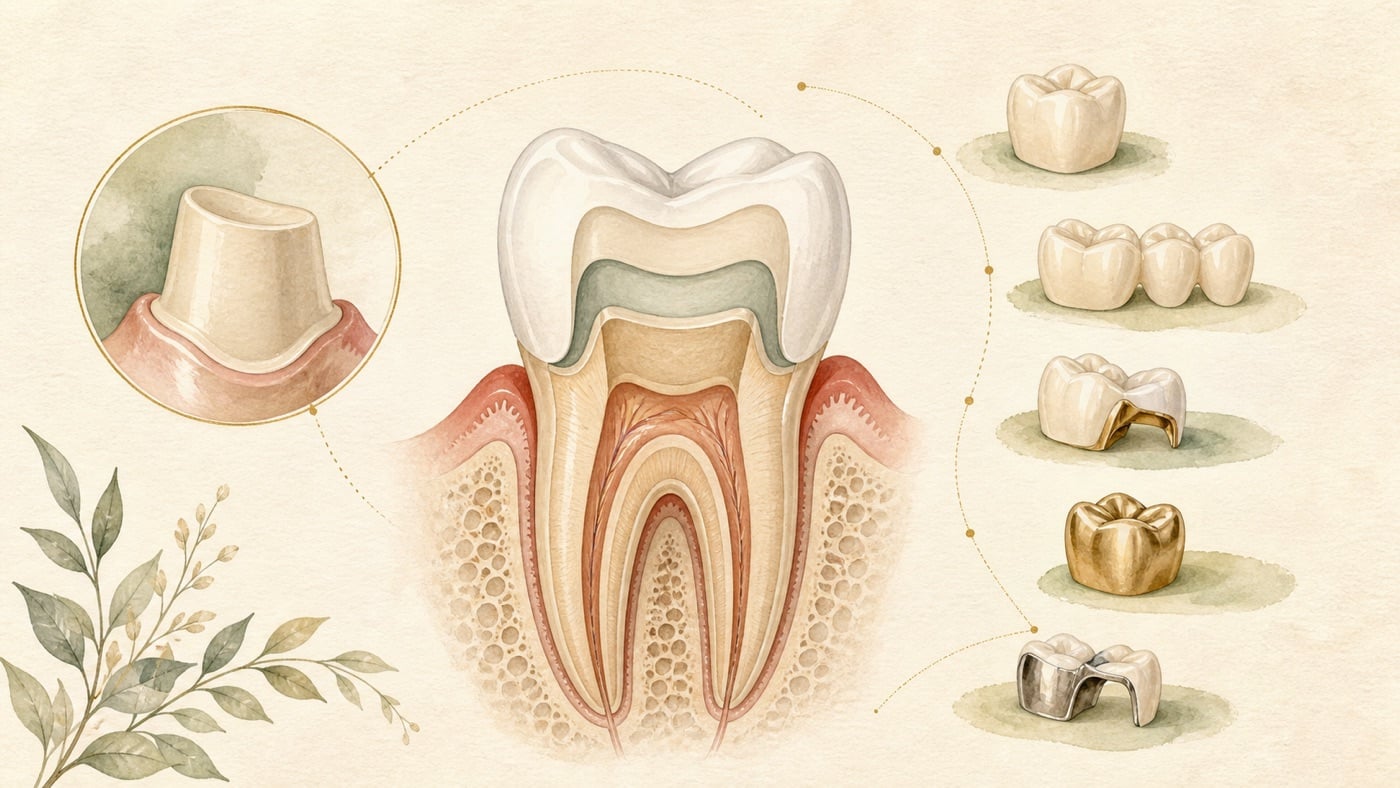
The complete guide to crowns, bridges and fixed prostheses: a domain map of the material spectrum, the principle of support and the modes of failure
A "fixed prosthesis" is not one treatment but a whole family of treatments. This article uses three axes — what is being restored, where the support comes from, and material and fabrication format — to put crowns, bridges and resin-bonded bridges on a single map. It explains why the amount of tooth structure removed in tooth preparation has to be placed ahead of the choice of material, why survival and success are not the same thing, and which modes of failure of fixed prostheses have been recorded in the literature, together with the principles for handling a restoration that has come off. The whole article is written from international literature; it does not address any country's insurance or regulations, lists no monetary amount, and endorses no approach.
TL;DR
Crowns and bridges are held up by the patient's own teeth 12 and use materials to replace missing tooth structure 4; lithium-disilicate and zirconia-based all-ceramic single crowns achieve five-year survival rates comparable to metal-ceramic crowns 1. Assessment must be made by a dentist.
Scope: This article is general oral-health education based on international literature. It does not address any country's insurance or regulations; consult local rules for care pathways and costs.

Introduction: why look at the map before looking at a single question
The words a patient hears in the surgery — cap, crown, denture, bridge, all-ceramic, full-zirconia, porcelain-fused-to-metal, Maryland — sit at different levels: some describe which kind of defect is being restored, some describe what holds the restoration up, and some describe what it is made of. Ask about all three levels in one sentence and the answers will contradict one another.
This article works at the domain level, dealing with the gaps *between* the individual concrete questions: the classification framework, the principle of support, the price paid in tooth structure, how to read the numbers, the full picture of the modes of failure, and which questions a decision has to start from. Concrete questions such as "how much does one crown cost", "will I regret an all-ceramic crown" or "what do I do if my crown has come off" each have their own canonical card answering them in full; this article leaves only a one-sentence summary and a pointer at the corresponding place (see "Downstream links" at the end).
Every medical statement in this article comes from international journal literature and society-level guidelines, but the strength of evidence differs from item to item: most are systematic reviews and meta-analyses 124789101112, one is a society S3-level guideline 3, and there are in addition two in vitro experimental studies (standard resin teeth, gravimetric measurement) 56 and one literature compilation of case reports and case series 13. The study type and the limitations of each item are recorded item by item in the "facts fact ledger" at the end; before reading any figure in any passage, read the basis and caveat of the corresponding item alongside it (this is a reading reminder from this site 14). The systems side — insurance coverage, fee regulation, statutes — is outside the scope of this article; for that content see the canonical card for your own locality.
1. Three axes: turning "fixed prostheses" into a map
Fixed prosthodontic treatment covers, in the literature, crowns, fixed dental prostheses (FDPs) and complete arch prostheses, and what they have in common is the use of several different materials to replace missing tooth structure 4. To place this family of treatments on one map, three mutually independent axes are less liable to cause confusion. The way the three axes below are cut is this site's editorial terminology framework, not a clinical criterion; the basis for the content of each axis is listed in the respective sections 14.
Axis one: what is being restored — is the tooth still there, or is it gone
- The tooth is still there (the root is still in the alveolar bone): the remaining coronal tooth structure is prepared down into an abutment (it is exactly this kind of complete-crown preparation that the in vitro studies used to measure tooth structure removal 56), and a laboratory-made single crown (SC) is fitted over it. The international literature groups these together as tooth-supported single crowns and uses that as the unit for its survival statistics 1.
- The tooth is gone (the whole tooth is missing): the options include a bridge supported by natural teeth and spanning the edentulous area (tooth-supported fixed dental prosthesis, FDP) 2, or a fixed restoration supported by an implant 3. In its statistics the literature evaluates tooth-supported multiple-unit FDPs and implant-supported restorations separately 23.
Axis two: where the support comes from — what is holding this prosthesis up
- Held up by the patient's own roots: single crowns and conventional bridges both belong here, and in the statistics the literature calls them tooth-supported single crowns and tooth-supported multiple-unit fixed dental prostheses respectively 12. The support points of a bridge are the natural teeth around the edentulous area that have been prepared to carry retainers (abutment teeth); the number and position of the abutment teeth vary with the design, and are not invariably one on each side of the edentulous area — the literature also records cantilever designs retained on one side only; for instance, the conclusion section of one systematic review describes the anterior resin-bonded zirconia bridges it included as cantilevered 9. The population-level estimate for bridges cited in this article 2 does not report the number or position of the abutment teeth, so this article makes no general statement about it (this is a note by this site on the boundary of what it draws from the source 14).
- Held up by the bonded surfaces of the adjacent teeth: a resin-bonded fixed partial denture (RBFPD, commonly called a Maryland bridge) uses no complete crowns; its retentive wings are bonded instead to the inner surfaces of the adjacent teeth. The conclusion of one systematic review records that the five-year clinical performance of resin-bonded bridges is similar to that of conventional bridges and implant-supported crowns, and that technical complications were the main reason for failures 7; that review did not include conventional bridges or implant-supported crowns as a control group, so this "similarity" is an indirect comparison against the existing literature and not the result of a head-to-head trial 7. The design differences, material differences and survival data of this branch are handled in full by canonical card KM-DENTAL-22 (draft complete) and are not expanded here.
- Held up by an implant: this belongs to the implant domain and is not dealt with here; for implant-supported fixed restorations and bone management see P01 (the implant domain authority article).
Axis three: material and fabrication format — two dimensions that are often conflated
The material axis in fact holds two independent variables, and the literature counts them separately in its statistics:
- Class of base material: metal-ceramic (a metal coping with ceramic veneered over it), lithium-disilicate reinforced glass-ceramic, densely sintered zirconia, alumina-based ceramics, and feldspathic/silica-based ceramics 1.
- Fabrication format: monolithic (the whole piece milled or pressed from a single material) and veneered (veneering ceramic layered over a coping). The same zirconia made monolithic and made veneered are two different statistical objects 1.
A systematic review and meta-analysis including 64 studies and covering 3,509 metal-ceramic single crowns and 8,051 all-ceramic single crowns concludes that lithium-disilicate and zirconia-based all-ceramic single crowns achieve five-year survival rates comparable to metal-ceramic crowns 1; its results section further records that monolithic lithium-disilicate and monolithic zirconia single crowns showed significantly fewer ceramic fractures and less chipping than the veneered alternatives 1. The same publication also records that, except for feldspathic/silica-based ceramic and metal-ceramic crowns, the material and design types performed similarly in the anterior and posterior regions 1.
The same publication also holds a set of survival differences that must not be skipped: its results section records that the five-year survival rates of feldspathic/silica-based ceramic, glass-infiltrated alumina, densely sintered alumina and veneered leucite/lithium-disilicate reinforced glass-ceramic single crowns were all significantly lower than that of monolithic lithium-disilicate single crowns 1; veneered densely sintered zirconia, however, is not on that list of significantly lower materials 1. At the single-crown level, therefore, "monolithic or veneered" and "higher or lower survival" do not map one to one — it depends on which two groups are being compared (this is a reading reminder from this site, not a conclusion of the literature 14). The five-year survival figures material by material are set out in full by canonical card KM-DENTAL-11 (draft complete); this article takes only conclusion-level statements and repeats no percentage for any individual material.
Terminology cross-reference (editorial layer, not a clinical criterion)
| Common wording in the surgery or online | Where it sits on this map | Where the full account is |
|---|---|---|
| "Cap", "denture cap" | Usually means a single crown (axis one, "the tooth is still there") | KM-DENTAL-23 (draft complete) |
| "Porcelain-fused-to-metal tooth" | Usually means the metal-ceramic class of base material (axis three) | Supplementary card on porcelain-fused-to-metal teeth (in production) |
| "All-ceramic crown" | A general term for the various ceramic single crowns that have no metal coping (axis three) | KM-DENTAL-37 / 44 (in production) |
| "Full-zirconia crown" | A single crown made of densely sintered zirconia, commonly monolithic (axis three) | Supplementary card on full-zirconia crowns (in production) |
| "Maryland bridge", "bonded bridge" | Resin-bonded bridge (axis two, "held up by the bonded surfaces of the adjacent teeth") | KM-DENTAL-22 (draft complete) |
This table is this site's placement of the terms; usage of the same word may differ between regions and between clinics, and the name of a treatment should be taken from the clinical record and the dentist's own explanation 14.
2. The price paid in tooth structure: this section sets the order of decisions for the whole domain
There is one step in fixed prosthodontics that actually removes tooth structure — tooth preparation: how much tooth structure each preparation design removes from the crown has been quantified design by design in in vitro studies 56; this site places that step at the start of the decision order for the whole domain, for the reason given at the end of this section (this is this site's editorial ordering rationale, not a conclusion of the literature 14). The relevant study states in its "statement of problem" section that the conservation of sound tooth structure helps preserve tooth vitality and reduce postoperative sensitivity 5 — but that is the study's background narrative, not its experimental result: the study was an in vitro gravimetric measurement and assessed neither pulp vitality nor postoperative sensitivity, and that background sentence carries no reference in the abstract either 5. How much tooth structure the different preparation designs remove, by contrast, can be looked up in quantified in vitro studies 56.
One set of studies, carried out on standard teaching resin teeth (Typodont resin teeth) and measuring tooth structure removal gravimetrically, records the following (the `F1`/`F3`/`A2`/`13` that appear below are that study's own codes for its preparation designs, and have nothing to do with the fact-unit markers [Fn] in square brackets in this article):
- Anterior teeth: ceramic veneers and the retainers of resin-bonded prostheses were the less invasive preparation designs, removing approximately 3% to 30% of the coronal tooth structure by weight; when teeth were prepared for all-ceramic and metal-ceramic crowns, approximately 63% to 72% of the coronal tooth structure was removed 5.
- Posterior teeth: adhesive and inlay retainers removed approximately 5.5% (the adhesive box design) to 27.2% (the MOD inlay); complete-coverage crown preparations removed more, approximately 67.5% (design code F1, a 0.8 mm circumferential tapered chamfer) to 75.6% (design code F3, 1.4 mm axial reduction, a buccal shoulder and a 0.7 mm lingual chamfer) 6. The same study records that the tooth structure removal required for the F3 group of retainers (that study designated F3 as the abutment for metal-supported restorations) was about 14 times that required for the A2 group, an adhesive box preparation 6.
That 14-fold figure has to be read together with the design conditions: it is the paired ratio between the complete-crown design with the higher removal in that study (F3) and the adhesive design with the lower removal (A2); it does not mean that complete crowns invariably remove 14 times as much as adhesive designs. Take another pairing — the F1 complete crown at 67.5% against the MOD inlay at 27.2% — and the ratio falls between 2 and 3 times 6. The multiple changes with the pairing, and does not hold once the design conditions are stripped away (this is this site's note on how to read the figure, not a conclusion of the literature 14).
How these numbers may and may not be used: both are in vitro studies, carried out on standardised resin teeth and measured gravimetrically, not clinical data from human subjects; the morphology of the tooth itself also influences the amount removed 6. They support one conclusion and no more — that under the in vitro conditions of those studies the difference in tooth structure removal between preparation designs can be large (the ratio running from about 2 to 3 times up to about 14 times, depending on which two designs are compared) 6; they cannot be used to predict how much will be removed from any real tooth, nor to evaluate any particular course of treatment.
Why the domain map puts this section ahead of material: the choice of material can still be adjusted at the treatment-planning stage, whereas the amount of tooth structure removed in preparation is settled at the moment of treatment (this is this site's editorial ordering rationale 14). It is also why "less invasive preparation designs" are themselves studied in the literature as a separate item of assessment 56. As for the question "will I regret it", that is handled in full by canonical cards KM-DENTAL-37 (all-ceramic crowns) and KM-DENTAL-45 (bridges) respectively, and is not expanded here.
3. Bridges: the principle, the types and the numbers that exist
The principle
The mechanical principle of a bridge is spanning: the natural teeth around the edentulous area are prepared into abutment teeth, each carrying a retainer (in the conventional design usually a complete crown, whose tooth structure removal is the complete-crown preparation of the in vitro studies 6); a pontic spans the edentulous area, and the whole connected unit is cemented together. The number and position of the abutment teeth vary with the design: the common conventional design takes one abutment tooth on each side of the edentulous area, but the literature also records cantilever designs retained on one side only (for example, the conclusion section of one systematic review describes the anterior resin-bonded zirconia bridges it included as cantilevered 9); the population-level estimate for bridges cited in this section 2 does not report the number or position of the abutment teeth, so "one on each side" above is this site's descriptive wording for the common design and is not a condition of applicability of that population estimate 14. In its statistics the literature calls this class tooth-supported multiple-unit FDPs, and reports complications in two categories: technical (on the restoration side, such as framework fracture, chipping and loss of retention) and biological (on the tooth side, such as marginal caries) 2. The success or failure of a bridge is therefore tied to three things at once — the restoration itself, the biological condition of the abutment teeth, and the bonded interface 2.
Types (by mode of retention)
| Type | Mode of retention | Price in tooth structure | Depth of treatment here |
|---|---|---|---|
| Conventional bridge (complete-crown retention) | A complete crown on each abutment tooth (the number and position of the abutment teeth depend on the design 14) | Complete-crown preparation, among the higher-removal designs in the in vitro studies 6 | Expanded in this section |
| Resin-bonded bridge (Maryland bridge) | Retentive wings bonded to the inner surfaces of the adjacent teeth | Adhesive preparation, among the lower-removal designs in the in vitro studies 6 | One sentence of placement; see KM-DENTAL-22 |
| Inlay-retained bridge | Retained in the form of an inlay | Inlay preparation, between the two 6 | See the note on the survival gap below |
The five-year figures for conventional (tooth-supported) multiple-unit bridges
A systematic review and meta-analysis published online in 2026 included 41 studies, comprising 600 metal-ceramic bridges and 1,532 all-ceramic bridges, and estimated five-year survival using robust Poisson regression 2. Its estimates are as follows:
- Five-year survival rates: veneered densely sintered zirconia 92.9%, metal-ceramic 91.3%, glass-infiltrated alumina 88.4%, monolithic densely sintered zirconia 87.9%, lithium-disilicate reinforced glass-ceramic 82.5% 2.
- Lithium-disilicate bridges showed significantly lower survival than metal-ceramic restorations; the differences between the other materials did not reach statistical significance 2.
- 71.0% of restorations remained free of any complication after five years 2.
- All-ceramic bridges had higher rates of marginal caries and loss of retention than metal-ceramic bridges 2.
- Framework fractures occurred more frequently in lithium-disilicate and glass-infiltrated alumina bridges (more than 10% within five years) 2.
- Chipping of the ceramic surface was common, and occurred less frequently in monolithic zirconia bridges 2.
Align the search window first, then look at the numbers: the estimate used in this section had a search window from January 2014 to December 2024, with 17 further studies drawn from previous systematic reviews added to cover earlier periods 2. The estimate a meta-analysis produces depends on which studies it included, so whenever you see a five-year survival percentage you should first ask which analysis it comes from and up to what year that analysis searched; when figures from different sources are set side by side, align the sources and the search windows before comparing (this is a reading reminder from this site, not a conclusion of the literature 14. This article has neither verified nor reproduced the point estimate of any other version of any meta-analysis, and makes no statement about such figures here 15).
Two things have to be read together: first, the population estimates for single crowns and for multiple-unit bridges come from two different systematic reviews, neither of which ever made a head-to-head comparison of single crown versus bridge or ran the corresponding statistical test 12; when the percentages from the two sides are placed side by side they can only be treated as a juxtaposition of different studies — they must not be subtracted from one another, and no conclusion about which class is better can be derived from them (this is a reading reminder from this site, not a conclusion of the literature 14). The population estimate for single crowns is in KM-DENTAL-11. Second, "five-year survival 91.3%" and "five-year complication-free 71.0%" are two different measures within one and the same study — the restoration still being in place does not mean nothing went wrong in those five years 2.
Inlay retention and adhesive retention: the gap in survival can be very wide
A systematic review of the clinical efficacy of methods for bonding to zirconia (8 studies included) records a set of figures with an extremely wide gap: three studies of posterior inlay-retained bridges gave estimated survival rates of 12.1% at 10 years, 95.8% at 5 years, and no recorded failure at 20 months; a further five studies of anterior resin-bonded bridges (the conclusion section of that review describes this group as anterior cantilevered resin-bonded zirconia bridges) likewise recorded no failure over 3 to 10 years of follow-up 9. (At both of the places rendered here as "no recorded failure", what the original reports is an upper-bound percentage value; that numeric string is an A-grade term in this site's banned-term list and, following the km-11 precedent, is not reproduced verbatim, hence the wording "no recorded failure" — the positions of the omissions and the way to re-verify them sentence by sentence are recorded in F9.) The same review also records that debonding occurred in every study, but that these prostheses could usually be rebonded 9 — the objects of assessment in that review were limited to resin-bonded zirconia bridges, inlay-retained zirconia bridges and zirconia veneers, and it does not cover conventional bridges with complete-crown retention, nor ordinary single crowns 9.
A gap this wide across studies is itself important information: the three figures come from three different studies with follow-up lengths from 20 months to 10 years; they must not be pooled into a single number, nor read as one batch of restorations declining over time 9. In other words, within this sub-domain the name of the material alone is not enough to judge the clinical result (this is a reading reminder from this site, not a conclusion of the literature 14). As for the design comparison of resin-bonded bridges (one wing versus two), the material comparison and the survival data for each, those are handled in full by KM-DENTAL-22 (draft complete). Resin-bonded bridges in the posterior region have a separate systematic review of their own (15 of 283 studies passed screening into the statistical analysis), whose conclusion still states that further high-quality long-term clinical trials are needed 10. A systematic review of all-ceramic resin-bonded bridges in the anterior region likewise points out that well-designed randomised controlled clinical trials with a large sample size are still needed before more accurate results can be reached on the clinical success rate of the different designs 8.
4. How to read the numbers: survival, success and complication-free are three different things
The literature cited in this article uses at least three different endpoints 2711; unless you first ask which one a percentage refers to, comparing them is meaningless (this is a reading reminder from this site 14).
How the three measures differ
- Survival: the restoration is still in the mouth at follow-up — a lower-threshold measure (this is this site's wording for the definition, not a definition taken from the literature 14).
- Success: not only still in place, but also free of a set of predefined failure events. For resin-bonded bridges, for example, one systematic review defined success as the restoration remaining in situ and not having experienced debonding, biological failure or mechanical failure at the examination visit 7.
- Complication-free: no complication recorded at all across the whole follow-up period — for example the five-year figure of 71.0% reported by the bridge study above 2.
Within one and the same domain, changing the measure changes the percentage. A systematic review and meta-analysis of the reasons for failure of CAD/CAM restorations reports both sets of measures side by side: estimated with Poisson regression, the five-year and ten-year survival rates were 85.55–100 and 71–100, and the five-year and ten-year success rates were 74.2–92.75 and 33.3–85.5 11.
How these four sets of numbers should be read: the original writes out only the four sequences themselves and says nothing about their statistical nature (it states neither that they are ranges across studies nor that they are confidence intervals) 11; this site reads them, from the way they are presented, as estimate ranges across studies, and points out that the upper and lower bounds may come from different studies, different denominators and different definitions of failure — that sentence is a reading reminder and an inference by this site, not a statement of that publication [F14]. The publication also states that the systematic review included 9 randomised controlled trials and 6 observational studies, whereas the meta-analysis used data only from the prospective clinical studies among them — the two sets of studies are not the same 11. Therefore the lower bound of survival must not be subtracted from the lower bound of success and presented as a within-group gap for "the same batch of restorations" (this is a reading reminder from this site, not a conclusion of the literature 14). A single thing can be read out of it: the range of success rates reported in that publication lies as a whole below the range of survival rates — that is, "still in place" is a looser threshold than "nothing has gone wrong" 11.
Four questions to ask before reading any survival figure
- How many years of follow-up? (Within one and the same study, the five-year and ten-year estimates can differ considerably 11)
- How is failure defined? (survival / success / complication-free 2711)
- Anterior or posterior? (Some materials perform differently by site 1)
- Single crown or multiple-unit? (The population estimates for the two come from different studies with different statistical objects; the figures are neither interchangeable nor subtractable 12)
These four questions are a reading framework from this site, not a clinical criterion 14.
The certainty of the evidence itself also has to be looked at
A Cochrane systematic review searched to 3 May 2017 compared "metal-free materials" against metal-ceramic or other standard restorative materials; it included 9 randomised controlled trials with a total of 448 participants, and concluded that the existing evidence is insufficient to support or refute the effectiveness of metal-free materials in fixed prosthodontic treatment, and that the overall quality of the existing evidence was very low, so great caution should be exercised in generalising the results of the trials that review included 4.
This passage is not intended to discredit all-ceramic materials but to mark out the shape of the evidence: population-level meta-analyses of survival are not scarce, but within its search window of May 2017 that review found only 9 head-to-head randomised controlled trials meeting its criteria, and its rating of "very low quality of evidence" reaches no further than those 9 trials — it is not a rating of the evidence base of the whole of fixed prosthodontics 4. Any account that arranges materials into a league table of better and worse goes beyond what the existing evidence can carry (this is a reading reminder from this site 14, resting on that review's conclusion that the evidence is insufficient to support or refute 4).
There is a tension here that has to be set out side by side, and this article does not dodge it: the statement quoted at the top of this article — that lithium-disilicate and zirconia-based all-ceramic single crowns achieve five-year survival rates comparable to metal-ceramic crowns — is the conclusion of a meta-analysis that included 64 studies, observational studies among them 1; whereas the Cochrane review that included only randomised controlled trials, with a search window ending in May 2017 (9 trials, 448 participants), judged the evidence insufficient to support or refute the effectiveness of metal-free materials, and rated the overall quality of evidence of the trials it included as very low 4. It is not that one is right and the other wrong: the evidence pools and the search windows are both different — the former is a population-level estimate after pooling a large body of observational data (searched to December 2024), the latter a stocktaking of randomised evidence as it stood in 2017 124. Whenever you read a statement that "material A is comparable to material B", these two layers have to be looked at together.
How a society-level guideline talks about the choice of material
The S3-level guideline issued jointly by the German implantology society (DGI) and the German dental society (DGZMK) deals with implant-supported all-ceramic restorations. That guideline records that, for single crowns, lithium disilicate, silicate ceramics and all generations of zirconia demonstrated favourable three-year survival rates (approximately 96–97%); polymer-infiltrated ceramics, by contrast, showed inferior performance and were not recommended 3. For short-span bridges and full-arch reconstructions, the guideline states that only 3Y-TZP zirconia is supported by clinical evidence; that micro-veneering and monolithic designs reduce the risk of chipping; and that patient education is emphasised, because the evidence for newer materials and for full-arch reconstruction is limited 3.
The boundary of this passage has to be stated plainly: the population of that guideline is implant-supported restorations, which are not the same group of patients as the tooth-supported restorations in the other sections of this article, and the figures must not be used interchangeably 31. It is cited because it demonstrates how a society-level document handles the question of what to say when the evidence for a material is insufficient — the answer being to narrow the scope of indication and strengthen patient education, rather than to offer more definite assurances 3.
5. The map of failure modes: where fixed prostheses break
When the literature evaluates fixed prostheses it counts complications separately in two broad classes, biological and technical 12. The difference between the two classes lies in what is affected — on one side the restoration itself, on the other the tooth that supports it (this is this site's wording for that classification, not a statement by the literature about pathways of management 14).
Technical complications (on the restoration side)
- Chipping: the veneering layer flakes off. This is common, and occurs less frequently in monolithic zirconia bridges 2; at the single-crown level, monolithic lithium disilicate and monolithic zirconia showed significantly fewer ceramic fractures and less chipping than the veneered alternatives 1.
- Framework fracture: the structural body of the restoration cracks. In lithium-disilicate and glass-infiltrated alumina bridges the rate exceeds 10% within five years 2.
- Loss of retention: the bonded interface fails and the restoration comes off whole. All-ceramic bridges have a higher rate of loss of retention than metal-ceramic bridges 2; in the clinical studies on bonding to zirconia, debonding occurred in every study 9.
Biological complications (on the tooth side)
- Marginal caries: new decay at the junction between the margin of the restoration and the tooth structure. All-ceramic bridges have a higher rate of marginal caries than metal-ceramic bridges 2. The literature classes this as a biological complication, occurring on the abutment tooth itself rather than on the restoration 2; this round of searching did not retrieve any source comparing which of biological and technical complications weighs more heavily, so this article makes no ranking of severity 15.
One caution (limited to the evidence on full-arch reconstruction in stage IV periodontitis): changing the mode of support changes the distribution of the complications
A systematic review of full-arch fixed reconstruction in patients with stage IV periodontitis compared the tooth-supported and implant-supported approaches; it identified 26 studies in 31 publications, but none of them answered the question with a randomised controlled design 12. That review records that technical complications were the most commonly reported category, affecting 8% of tooth-supported restorations (over an observation period of 7.2 years) and 42% of implant-supported structures (over an observation period of 2.6 years) 12.
These two percentages cannot be subtracted directly from one another: the weighted observation periods of the two groups differ (7.2 years vs 2.6 years), the risk of bias in the included studies was judged to be high, and the meta-analyses showed a high degree of heterogeneity 12. This article cites it to make one point only — that within the observational evidence in that population, changing the mode of support changes the distribution of complications rather than eliminating them 12; the population of that review is confined to full-arch fixed reconstruction in patients with stage IV periodontitis, and this observation cannot be extrapolated to patients with missing teeth in general 12. The full decision framework for which form of reconstruction to choose for a missing tooth is the responsibility of P07 (the domain article on decision-making for restoring missing teeth) and is not expanded here.
6. When the prosthesis comes off: principles of handling, and red flags
Loss of retention is one of the technical complications of fixed prostheses recorded in the literature 29; this section sets out the principles. What to do in practice is handled in full by canonical card KM-DENTAL-38 (a crown or bridge has come off) and the supplementary card on ceramic crowns coming off (both in production).
Principle one: coming off does not mean the restoration is written off, but whether it can be put back has to be judged by a dentist
In the review of clinical studies on bonding to zirconia, debonding occurred in every study, and these prostheses could usually be rebonded 9. That observation carries two limitations, and both must be stated with it: first, the objects of assessment in that review were limited to resin-bonded zirconia bridges, inlay-retained zirconia bridges and zirconia veneers, and it does not cover conventional bridges with complete-crown retention, nor ordinary single crowns 9; second, "usually can be" is an observation at the level of the study population, and cannot be used to expect any particular outcome in an individual case — what state the tooth underneath is in after the restoration has come off can only be judged by a dentist on actual examination (this is a reminder about seeking care, not a conclusion of the literature 14). That all-ceramic bridges have a higher rate of loss of retention than metal-ceramic bridges is also a reminder that the mechanisms of debonding differ between materials 2. Actual treatment and its results vary from person to person and must be assessed by a dentist.
Principle two: a tooth left exposed after the restoration comes off is an entry point for biological risk
Marginal caries is one of the biological complications recorded in the literature, with a higher rate in all-ceramic than in metal-ceramic bridges 2. Once a restoration comes off, the tooth surface it had covered is directly exposed, and whether decay or breakdown of tooth structure has already occurred can only be judged by clinical examination; handling a restoration that has come off is therefore not just a matter of sticking the thing back on, but also includes examining the state of the tooth underneath (this is a reminder about seeking care, not a conclusion of the literature 14).
Red flag: when the restoration cannot be found
A literature review collecting cases published between 1984 and 2023 included 74 publications and a total of 100 adults who required health-care intervention because of aspiration of a dental object 13. The background section of that publication places aspiration of dental objects as an uncommon but potentially serious complication of dental procedures 13, and records: the mean age of the included patients was 63.5 years; the most common comorbidities were cognitive impairment (6%) and hypertension (6%), equal first, followed by coronary artery disease (5%); the objects aspirated most frequently were, in order, dental prostheses (29%), crowns (22%) and implant drivers (17%); initial retrieval was successful for 75%, and after switching to backup approaches for 94.7%; the conclusion states that elderly and/or cognitively impaired patients are a high-risk group for dental object aspiration 13.
The weight of this material has to be labelled honestly: it is a compilation of case reports and case series, able to tell us what has happened and which classes of object were mainly aspirated, but it cannot be used to estimate an incidence, nor to work out the risk for any individual 13. Its evidence pool is also weighted towards the moment of a dental procedure and towards elderly or cognitively impaired populations — the objects included cover chairside instruments such as implant drivers, the mean age of the included patients was 63.5 years, and the most common comorbidities, equal first, were cognitive impairment and hypertension (6% each) 13 — which is not the same situation as a restoration coming off at home in the general population. It serves a single purpose in this article: the original itself places aspiration of dental objects as an "uncommon but potentially serious" complication 13, so "the crown came off but cannot be found" carries clinical meaning and should not be brushed aside as trivial (this is this site's note on how it draws on that background statement 14). If the restoration cannot be found anywhere after coming off, seek care promptly so that a health-care professional can assess what to do next (this is a reminder about seeking care, not a conclusion of the literature 14). This article gives no list of symptoms for self-assessment: the sources retrieved in this round of searching do not report the clinical symptom profile of aspiration events, and this site does not conjecture one on their behalf 15.
7. The four things a decision has to ask first (a framework internal to fixed prosthodontics)
What follows is a decision-order framework internal to this domain, compiled editorially by this site; the evidential basis of each item is marked at the end of the sentence 14. It deals with the choices that follow once it has been decided to make a fixed restoration; whether a missing tooth should be restored with a fixed prosthesis at all, or with some other form of reconstruction, is a cross-domain decision and is the responsibility of P07.
- Is this tooth still there? Tooth still there → the single-crown branch; tooth gone → the bridge or implant-supported branch. The two branches have different statistical objects in the literature, and their survival rates are not interchangeable 12.
- Can less be removed? Between the less invasive preparation designs (veneer, adhesive, inlay) and complete-crown preparation there is a difference in tooth structure removal in the in vitro studies, and the size of that difference depends on which two designs are compared (about 2 to 3 times up to about 14 times within that study) 56. This site places this question ahead of choosing a material, for the reason given in section 2 14.
- Monolithic or veneered? This is a dimension independent of the class of base material, and chipping and survival have to be looked at separately: at the single-crown level, monolithic lithium disilicate and monolithic zirconia showed significantly fewer ceramic fractures and less chipping than the veneered alternatives 1; the same publication also records that veneered leucite/lithium-disilicate reinforced glass-ceramic single crowns had significantly lower five-year survival than monolithic lithium-disilicate single crowns, while veneered densely sintered zirconia is not on that publication's list of significantly lower materials 1. At the multiple-unit bridge level, chipping occurs less frequently in monolithic zirconia bridges 2; but in that same bridge meta-analysis the five-year survival point estimate for monolithic densely sintered zirconia (87.9%) is lower than that for the veneered form (92.9%), and that publication records that, apart from lithium disilicate, the differences between materials did not reach statistical significance 2 — "less chipping" and "higher survival" are not the same thing and cannot be inferred from one another; moreover, which of monolithic and veneered has the higher survival differs by material and by class of restoration across these two publications, with no single direction (this is this site's note juxtaposing the results of those two publications, not a conclusion of either 14).
- How hard is the evidence for this choice? A Cochrane review searched to May 2017 found only 9 head-to-head randomised controlled trials meeting its criteria, and rated the overall quality of evidence of the trials it included as very low (that rating reaches no further than those 9 trials and is not a rating of the evidence base of the whole of fixed prosthodontics) 4; when the evidence is insufficient, the way a society guideline handles it is to narrow the scope of indication and strengthen patient education 3.
These four questions are an organisation of information, not treatment advice; which approach suits a given person varies from person to person and must be assessed by a dentist against the actual condition of the mouth.
8. Costs: this article writes only what they are made of and what makes them vary, and lists no amount
Fixed prostheses are hard to compare on cost because the same phrase "having a tooth made" corresponds to a different number of items in different plans. What follows is the universal structure of what a cost is made of, with no amount, range or going rate (the reason this site lists no amount, together with the other evidence gaps, is recorded in 15):
- Number of units: a single crown is one unit; a bridge is a combination of retainers on the abutment teeth plus pontics, and the number of units is itself a variable. The literature likewise evaluates single crowns and multiple-unit bridges separately in its statistics 12.
- Material and fabrication format: the class of base material and monolithic versus veneered are two independent dimensions 1, and both change the laboratory workflow.
- Preparation design: complete-coverage, partial-coverage and adhesive retention treat different extents of tooth structure 56, and the steps of tooth preparation differ accordingly.
- Preliminary treatment: where caries, pulpal or periodontal conditions have to be dealt with on the tooth side first, those are separate treatment items in their own right and do not belong to the restoration itself (this is an itemisation note about cost structure, not a clinical criterion 14).
- Follow-up and re-treatment: complications have their own rates of occurrence (for example, the proportion free of complications at five years was 71.0% 2), so subsequent follow-up and possible re-treatment are part of the plan rather than an exception.
The systems side — whether a treatment is covered by public insurance, how fees are regulated, how to read a receipt and its itemisation — differs from country to country and is outside the scope of this article. Local systems and costs are covered by the corresponding canonical cards (TW): KM-DENTAL-03 (the cost of fixed prostheses), KM-DENTAL-11 (the cost of a crown), KM-DENTAL-44 (the cost of an all-ceramic crown), and P12 (the domain article on costs and insurance systems).
9. Risk factors: indications, side effects and contraindications
This section is a disclosure of medical risk; its content is general information at the level of the literature and cannot replace an individual diagnosis.
The boundaries of indication (what the literature can support)
- Material choice for single crowns: lithium-disilicate and zirconia-based all-ceramic single crowns achieve five-year survival rates comparable to metal-ceramic crowns 1; monolithic lithium-disilicate and monolithic zirconia single crowns showed significantly fewer ceramic fractures and less chipping than the veneered alternatives 1. The same publication also records that the five-year survival rates of feldspathic/silica-based ceramic, glass-infiltrated alumina, densely sintered alumina and veneered leucite/lithium-disilicate reinforced glass-ceramic single crowns were significantly lower than that of monolithic lithium-disilicate single crowns 1 — the conclusion sentence of that publication (that lithium disilicate and the zirconia-based materials are comparable to metal-ceramic) has to be read together with the significance testing in its results section: the reference for those tests is the monolithic lithium-disilicate single crown, and the several classes of material listed above (veneered leucite/lithium-disilicate reinforced glass-ceramic among them) had significantly lower survival than that reference 1 (this is this site's reminder to read the conclusion section and the results section of the same publication together 14).
- Material limits for multiple-unit bridges: lithium-disilicate reinforced glass-ceramic bridges had significantly lower five-year survival than metal-ceramic 2.
- (A different population, listed separately) the society guideline on implant-supported restorations: for short-span bridges and full-arch reconstructions, the German S3-level guideline states that only 3Y-TZP zirconia is supported by clinical evidence 3. The population of that guideline is implant-supported all-ceramic restorations, which are not the same group of patients as the tooth-supported restorations in the other items of this section; its material conclusions and figures must not be used interchangeably with those for tooth-supported restorations 3.
- The placement of resin-bonded bridges: the conclusion of one systematic review records that their five-year clinical performance is similar to that of conventional bridges and implant-supported crowns, and that technical complications were the main reason for failures 7; that review did not include conventional bridges or implant-supported crowns as a control group, so this "similarity" is an indirect comparison against the existing literature and not the result of a head-to-head trial 7. Its conditions of indication and design choices are set out in KM-DENTAL-22.
Side effects and complications on record
- Technical: chipping 12; framework fracture (more than 10% within five years in lithium-disilicate and glass-infiltrated alumina bridges) 2; loss of retention (higher in all-ceramic than in metal-ceramic bridges) 29.
- Biological: marginal caries (higher in all-ceramic than in metal-ceramic bridges) 2.
- Tooth structure removal: the proportion of coronal tooth structure removed by complete-crown preparation in the in vitro studies was approximately 63–72% for anterior teeth and 67.5–75.6% for posterior teeth (standard resin teeth, gravimetric measurement, not clinical data from human subjects; not to be used to predict an individual's loss of tooth structure) 56. What this set of figures describes is the difference in invasiveness between preparation designs, not the outcome of any particular course of treatment (this is this site's note on how to read them 14).
- Untoward events: if a restoration is not found after coming off, aspiration of dental objects is a situation with case records in the literature (compiled case material, not to be used to estimate an incidence) 13.
Contraindications and situations calling for particular assessment
This round of searching retrieved no source that took contraindications as its research question, so this article gives no list of contraindications, and equally does not claim that no absolute contraindication exists in the literature — an item's absence here means only that this round of searching retrieved no evidence for it 15. What is listed below are the conditional limits that the sources already cited can support, all of them situations calling for individual assessment by a dentist rather than general determinations 14:
- Where the abutment teeth or the remaining tooth structure are inadequate, the feasibility of complete-crown retention has to be judged case by case; the difference in the price paid in tooth structure between preparation designs is background information for that judgement 56.
- For full-arch fixed reconstruction in patients with stage IV periodontitis, all the existing evidence comes from observational studies, with no randomised controlled design, and the risk of bias was judged to be high 12; the population of that review is confined to this group and does not cover patients with missing teeth in general 12.
- Long-term evidence for newer materials and for full-arch reconstruction is limited, and the society guideline therefore emphasises patient education and clinical limitations 3.
- As regards the 9 trials included in that Cochrane review (searched to 2017-05-03), the existing evidence is insufficient to support or refute the effectiveness of metal-free materials relative to metal-ceramic 4.
⚠ Compliance reminder: everything in this section is a compilation of literature and does not constitute treatment advice. Any judgement about indication or contraindication must be made by a dentist against the individual's oral condition, general health and needs.
Every clinical statement in this article is mapped line by line to its cited source (see the sources and evidence chain below). It has not been clinically reviewed by a licensed practitioner. This is health information, not individual advice; assessment by a clinician is required.
FAQ
- Q1. Are "crown", "cap" and "denture" the same thing?
- **Not entirely.** In most contexts "cap" means a single crown (this is this site's terminology cross-reference [F14]) — the root is still there, and the remaining coronal tooth structure is prepared into an abutment before the restoration is fitted over it [F5][F6]; the international literature calls this a tooth-supported single crown in its statistics [F1]. "Denture", by contrast, is a larger set, taking in the bridge that spans an edentulous area supported by natural teeth once a whole tooth has been lost (the literature calls it a tooth-supported multiple-unit fixed dental prosthesis), and the literature counts single crowns and multiple-unit bridges separately [F1][F2]. The full account of this question is the responsibility of KM-DENTAL-23 (draft complete).
- Q2. All-ceramic, full-zirconia, porcelain-fused-to-metal — which is better?
- **The existing evidence does not support arranging them into a league table.** For single crowns, lithium-disilicate and zirconia-based all-ceramic materials achieve five-year survival rates comparable to metal-ceramic, and the monolithic designs showed significantly fewer ceramic fractures and less chipping than the veneered alternatives [F1]; the same publication also records that the five-year survival rates of feldspathic/silica-based ceramic, glass-infiltrated alumina, densely sintered alumina and veneered leucite/lithium-disilicate reinforced glass-ceramic single crowns were significantly lower than that of monolithic lithium-disilicate single crowns, while veneered densely sintered zirconia is not on that list [F1]. For multiple-unit bridges, lithium disilicate has significantly lower five-year survival than metal-ceramic [F2] — the conclusions for one and the same material are not consistent across applications. A Cochrane systematic review searched to May 2017 further points out that, as regards the 9 trials it included, the existing evidence is insufficient to support or refute the effectiveness of metal-free materials relative to metal-ceramic, and that the quality of that body of evidence was very low [F4]. Which one suits a given person varies from person to person and must be assessed by a dentist.
- Q3. Roughly how many years will a bridge last?
- **What the literature gives is an estimate for a study population at a particular time point, not a prediction of the number of years for an individual.** A meta-analysis including 41 studies, 600 metal-ceramic and 1,532 all-ceramic bridges, estimates five-year survival by material as falling between 82.5% and 92.9%, with 71.0% free of any complication within five years [F2]. These are population statistics and cannot be used to estimate the outcome of any one bridge in any one person.
- Q4. How much tooth has to be removed for a crown?
- **What the in vitro studies offer is the relative difference between preparation designs, not an individual's actual figure.** Studies on standard resin teeth using gravimetric measurement record that, when teeth were prepared for all-ceramic and metal-ceramic crowns, approximately 63% to 72% of the coronal tooth structure was removed at anterior teeth [F5]; at posterior teeth, complete-coverage crown preparation removed approximately 67.5% to 75.6%, and adhesive and inlay retainers approximately 5.5% to 27.2% [F6]. These are measurements on in vitro resin teeth, and the amount actually removed varies with tooth morphology and clinical conditions [F6]; assessment must be made by a dentist.
- Q5. If a crown or bridge comes off, can I stick it back on myself?
- **What the literature records is rebonding in a clinical setting [F9], not self-treatment [F14].** In the review of clinical studies on bonding to zirconia, debonding occurred in every study, and these prostheses could usually be rebonded [F9] — but the objects of assessment in that review were limited to resin-bonded zirconia bridges, inlay-retained zirconia bridges and zirconia veneers, and **it does not cover conventional bridges with complete-crown retention or ordinary single crowns** [F9]. Marginal caries is a biological complication on record [F2], and once a restoration comes off the tooth surface underneath is directly exposed; whether it can and should be rebonded has to be judged by a dentist after examination (this is a reminder about seeking care, not a conclusion of the literature [F14]). If the restoration cannot be found anywhere after coming off, aspiration of dental objects has case records in the literature [F13], and care should be sought promptly for assessment. The concrete steps of management are set out in full by KM-DENTAL-38 and the supplementary card on ceramic crowns coming off (both in production).
Medical notice This article is provided for health education and medical information purposes. It is not a solicitation for medical services and does not constitute diagnosis or treatment advice. Actual treatment methods and outcomes vary between individuals and require evaluation by a dentist; every treatment has its own indications, limitations and possible risks. If you have related symptoms or treatment needs, please book a consultation for evaluation by a dentist.
Source anchors
- Pjetursson BE, Pitta J, Balet A, Bjarnadottir GR, Sailer I, Romandini P. A Systematic Review and Meta-analysis Evaluating the Survival, Failure, and… · https://pubmed.ncbi.nlm.nih.gov/41489982/ · Other citations on IDAEO
- Romandini P, Pjetursson BE, Pitta J, Balet A, Ikumi R, Sailer I. A Systematic Review and Meta-analysis Evaluating the Survival, Failure, and Complication… · https://pubmed.ncbi.nlm.nih.gov/41650383/ · Other citations on IDAEO
- Waltenberger L, Bishti S, Wolfart S. German S3 guideline on implant-supported all-ceramic restorations. Int J Implant Dent. 2025;11(1):53. DOI… · https://pubmed.ncbi.nlm.nih.gov/40802222/ · Other citations on IDAEO
- Poggio CE, Ercoli C, Rispoli L, Maiorana C, Esposito M. Metal-free materials for fixed prosthodontic restorations. Cochrane Database Syst Rev.… · https://pubmed.ncbi.nlm.nih.gov/29261853/ · Other citations on IDAEO
- Edelhoff D, Sorensen JA. Tooth structure removal associated with various preparation designs for anterior teeth. J Prosthet Dent. 2002;87(5):503-9. DOI… · https://pubmed.ncbi.nlm.nih.gov/12070513/ · Other citations on IDAEO
- Edelhoff D, Sorensen JA. Tooth structure removal associated with various preparation designs for posterior teeth. Int J Periodontics Restorative Dent.… · https://pubmed.ncbi.nlm.nih.gov/12186346/ · Other citations on IDAEO
- Alraheam IA, Ngoc CN, Wiesen CA, Donovan TE. Five-year success rate of resin-bonded fixed partial dentures: A systematic review. J Esthet Restor Dent.… · https://pubmed.ncbi.nlm.nih.gov/30302909/ · Other citations on IDAEO
- Tezulas E, Yildiz C, Evren B, Ozkan Y. Clinical procedures, designs, and survival rates of all-ceramic resin-bonded fixed dental prostheses in the anterior… · https://pubmed.ncbi.nlm.nih.gov/30113136/ · Other citations on IDAEO
- Quigley NP, Loo DSS, Choy C, Ha WN. Clinical efficacy of methods for bonding to zirconia: A systematic review. J Prosthet Dent. 2021;125(2):231-240. DOI… · https://pubmed.ncbi.nlm.nih.gov/32115220/ · Other citations on IDAEO
- Thu KM, Ling Z, Li KY, Botelho MG, Lam WYH. Posterior resin bonded fixed partial denture: A systematic review of five-year clinical outcomes. J Prosthodont… · https://pubmed.ncbi.nlm.nih.gov/42161568/ · Other citations on IDAEO
- Lampl S, Gurunathan D, Krithikadatta J, Mehta D, Moodley D. Reasons for Failure of CAD/CAM Restorations in Clinical Studies: A Systematic Review and… · https://pubmed.ncbi.nlm.nih.gov/37272145/ · Other citations on IDAEO
- Tomasi C, Albouy JP, Schaller D, Navarro RC, Derks J. Efficacy of rehabilitation of stage IV periodontitis patients with full-arch fixed prostheses:… · https://pubmed.ncbi.nlm.nih.gov/34761430/ · Other citations on IDAEO
- Velapati S, Shaaban A, Bojja H, Fogel J, Arjun S, Akella J. Aspiration and Bronchoscopic Retrieval of Dental Objects: A Literature Review and Data Analysis… · https://pubmed.ncbi.nlm.nih.gov/42307668/ · Other citations on IDAEO
- 本文證據鏈:逐條出處、行號與原文引句 · https://km.idaeo.ai/reports/dental-pillar-fixed-prosthodontics-evidence · Other citations on IDAEO
Cite this article
Lucy・《The complete guide to crowns, bridges and fixed prostheses: a domain map of the material spectrum, the principle of support and the modes of failure》・IDAEO 知識庫・2026-08-13・https://km.idaeo.ai/post/dental/pillar-fixed-prosthodonticsUpdated 2026-08-27