

🏛 Part of the "dental" topic shelf →
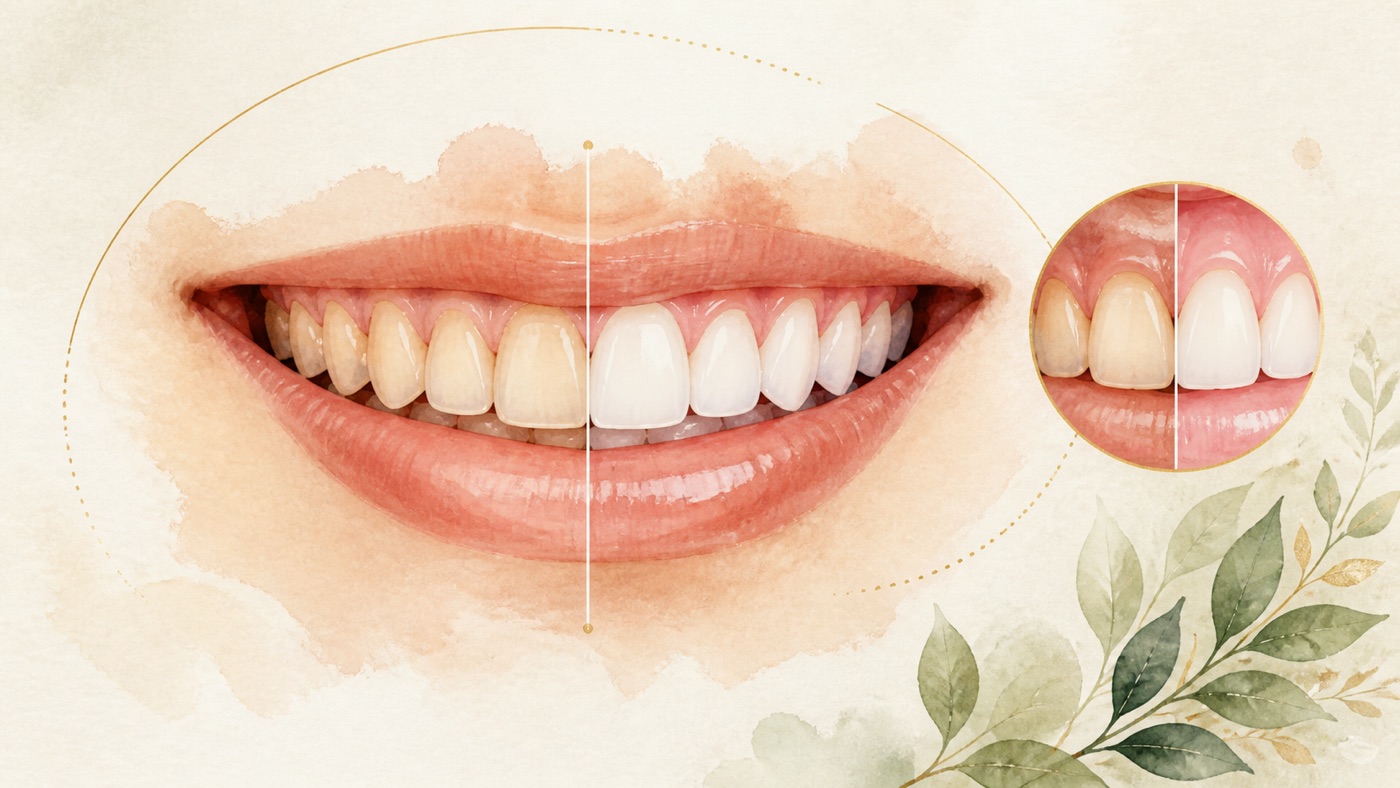
A complete guide to tooth whitening and aesthetic dentistry: where colour comes from, how the routes divide, and when it should not be done
Aesthetic dentistry is not a list of procedures but a decision space formed where four axes meet — colour, shape, alignment and the gingival frame. This article writes the gaps between the cards: the optical and anatomical background of tooth colour, why the classification of discolouration is the opening fork of the decision, the four types of action across the treatment spectrum (subtractive removal / chemical colour change / additive masking / repositioning), the difference between reversibility and life cycle, what it means that the certainty of evidence in this field is generally low, and an overview of the situations in which treatment is not indicated together with the red flags for seeking care. Comparisons between the effects of individual methods belong to the question layer and are all linked down to the canonical card. The article lists no monetary amount and endorses no clinic or brand.
A complete guide to tooth whitening and aesthetic dentistry: where colour comes from, how the routes divide, and when it should not be done
A direct answer in under 60 words
Aesthetic dentistry classifies before it discusses methods: colour, shape, alignment and the gingival frame are four axes, each with its own route [F1][F33]; classifying the discolouration is a diagnostic act and also the starting fork of the route [F2][F33]. Assessment by a dentist is required.
Introduction: what this article covers and what it does not
Scope: This article is general oral-health education based on international literature. It does not address any country's insurance or regulations; consult local rules for care pathways and costs.
'I would like my teeth to be a bit lighter' — in the clinic that one sentence is unpacked into several different questions [F33]. For some people the question is about colour; for others it is really about shape or alignment; for others again it is about how much gum shows [F33]. These questions share the same consultation, but they do not travel the same route [F33].
This article sits at the domain layer and writes what lies between the individual question cards — the physiological background of colour, the classification framework, the cross-question decision framework, the ladder of reversibility, the evidence terrain, the overview of red flags and the overview of the care pathway [F33]. As for the specific question 'what methods of tooth whitening exist and how well does each work', that belongs to the question layer; this article gives it one sentence and a downstream link rather than rewriting it here (see 'Downstream links' at the end) [F33].
This article lists no monetary amount, compares no brands, endorses no clinic, and provides no concentration or method of use that anyone could apply on their own [F33].
1. The domain map of aesthetic dentistry: four axes, not a list of procedures
Treating 'appearance' as a single thing is where communication in the clinic often gets stuck [F33]. In practice it divides into at least four axes that can vary independently [F33]:
| Axis | How the patient puts it | What this axis mainly deals with | Home ground of this domain? |
|---|---|---|---|
| Colour | 'they look yellow', 'one of them is darker' | The shade of the tooth itself and the deposits on its surface [F1] | Yes (this article + the linked card) |
| Shape | 'a corner of my tooth is missing', 'the shape does not look right' | The outline of the crown, altered by additive materials or by restorations [F16] | Yes (the veneer passage of this article) |
| Alignment | 'my teeth are crooked', 'there are gaps' | The position of teeth within the arch, which falls under orthodontics [F33] | No (linked down to the orthodontic domain) |
| Gingival frame | 'too much gum shows when I smile', 'my gums are uneven' | Soft tissue and periodontal conditions, which fall under periodontics [F33] | No (linked down to the periodontal domain) |
The clinical meaning of the four axes is this: the same complaint about appearance may call for work on entirely different tissues [F33]. Treating colour does not change alignment, and treating alignment does not change the underlying shade of the tooth itself [F33]. Which axis to work on, and how many, must be assessed by a dentist after examination.
In the literature, whitening (bleaching) is positioned as an elective, comparatively less-invasive aesthetic treatment [F32]. 'Elective' means that the procedure itself has the improvement of appearance as its purpose, so it does not carry the same decision weight as treating disease [F32][F33]. But that sentence must not be read backwards as 'nothing about colour is urgent' — discolouration itself may be a clinical sign that needs to be diagnosed, and the clinical examination before treatment exists precisely to diagnose the various factors contributing to it [F20].
2. Where tooth colour comes from: the anatomical and optical background
To understand why some colours can be changed and others cannot, you first have to know how the colour of a tooth is put together [F33].
The outer layer of a tooth is translucent enamel, and beneath it lies the yellower dentine [F4]. The ADA professional consensus page states that with increasing age enamel becomes more translucent and thinner, which allows the yellower dentine to show through, and the overall colour of the tooth may darken [F4]. That sentence explains three things at once — a colour change caused by age is not 'dirt', not a matter of insufficient cleaning, and not an external deposit [F4][F33].
Why can chemical bleaching change colour at all? A mechanism review integrating the existing literature states that tooth whitening is a dynamic process involving diffusion of the whitening material, its interaction with stain molecules, micromorphologic alterations on the surface, and changes within the tooth that affect its optical properties [F5]. In other words, this is not a matter of 'washing' the colour off, but a chemical process that changes the optical conditions inside the tooth [F5][F33].
The conclusion of that same review is worth carrying over word for word: the authors state that supervision by dental health professionals, as recommended by the ADA Council on Scientific Affairs, is critical to achieving a successful and safe whitening outcome [F5]. That single sentence is the premise of every decision framework in this domain [F33].
3. Classifying the discolouration is the opening fork of the decision (not a treatment list)
The ADA professional consensus page records that tooth discolorations are typically classified as extrinsic, intrinsic, or a combination of both types [F1]. What this three-way split is used for here is not 'telling you which technique to pick' but marking the opening fork of the decision: the classification determines which of the routes that follow are physically reachable at all [F33].
Why must the classification come first? A review spanning forty years of literature puts the reason very plainly: a knowledge of the aetiology of tooth staining is of importance to dental surgeons in order to enable a correct diagnosis to be made when examining a discoloured dentition [F2]. Put another way, the classification is a diagnostic act; the classification scheme itself has no therapeutic effect [F2][F33].
The classification framework has its own lineage in the literature [F3]. A paper that proposes a classification for extrinsic dental stain and describes the chemical mechanisms involved in causing tooth discolorations is one of the sources of this classification vocabulary [F3]. The practical meaning of this is that when different sources describe the boundary between 'extrinsic' and 'intrinsic' slightly differently, it is usually because the basis of classification differs (by cause, by location, or by chemical mechanism) rather than because one of them is wrong [F3][F33].
To see why the classification is a decision fork, three sentences from the same page have to be read together [F33]. First, the Key Points summary on that page states that whitening treatments can be effective on both extrinsic and intrinsic staining [F35]. Second, the same page states that only natural teeth can be whitened, not tooth-coloured restorations [F21]. Third, the same page also states that, overall, the removal of intrinsic stains within the dentine is considered near impossible when using an external whitening procedure (chemical and/or mechanical) [F8]. Reading the three together yields this: 'can be effective' and 'can be removed' are not the same thing, and the wording the source uses is a matter-of-degree expression, 'near impossible', not a universal negative [F8][F21][F35][F33].
Which route of treatment corresponds to which type of discolouration, and what the literature reports for the effects and adverse effects of each route, are question-layer matters; see the canonical card KM-DENTAL-19 (in production) [F33].
4. The four actions across the treatment spectrum: subtraction, chemical colour change, additive masking, repositioning
Laid out side by side, the procedures of aesthetic dentistry come down to only four types of action [F33]. This classification is an editorial framework of this site, and its purpose is to help readers understand why some procedures cannot substitute for one another [F33]:
| Type of action | What it does | Effect on tooth tissue | Boundary |
|---|---|---|---|
| Subtraction (removing surface deposits) | Removes what has attached to the tooth surface | Directed at the deposit | Taking some over-the-counter products (such as toothpastes and chewing gums) as the example, the source restricts their main action to removing surface stains, with no significant impact on the intrinsic colour of the tooth [F7] |
| Chemical colour change (bleaching) | Uses peroxides to change the optical conditions inside the tooth | Does not remove tooth contour [F5] | The removal of intrinsic stains within the dentine is considered near impossible [F8]; only natural teeth can be whitened, not tooth-coloured restorations [F21] |
| Additive masking (composite, veneers, crowns) | Covers the outside of the tooth with a new colour and shape | Depending on the design, may involve preparation of the tooth contour [F16] | The recorded complication profile includes surface roughness, colour mismatch and marginal discolouration [F15]; these are restorations that carry a replacement consideration [F33] |
| Repositioning (orthodontics) | Changes the position of teeth within the arch | Does not change the colour of the tooth itself [F33] | Belongs to the orthodontic domain; linked down from this article |
The delivery tier has to be read alongside this [F33]. The ADA page records that whitening treatments include in-office bleaching procedures, dentist-supplied products for use at home, and over-the-counter (OTC) whiteners [F6]. That is a classification of delivery tiers, not a ranking of effect [F6][F33].
On the scope of action of over-the-counter products, the ADA page states that some OTC whitening products (for example toothpastes and chewing gums) are effective primarily in removing extrinsic (surface) stains on enamel, and will not have a significant impact on intrinsic stains or the intrinsic colour of the tooth [F7]. What that sentence is used for here is to mark out the boundary of action of a product category; how each category of product actually performed in clinical trials is a question-layer matter, and is covered by the linked card [F7][F33].
The additive-masking axis has seen a directional change in recent years [F16]. A review of CAD/CAM ceramic restorative materials notes a recent paradigm shift in fixed prosthodontics from traditional to minimally invasive treatment approaches, evidenced by the clinical long-term success of bonded CAD/CAM glass-ceramic restorations [F16]. The domain-level meaning of that sentence is that 'masking' no longer automatically equals extensive tooth reduction, but the amount of reduction in any given case still depends on the design of that case and must be assessed by a dentist [F16][F33].
5. The cross-question decision framework: three questions in order
What the domain layer should really supply is not 'which technique to pick' but the order in which the questions come [F33]. The three questions below are a decision framework compiled by this site from the literature cited above; they are not a diagnostic tool [F33]:
Question ①: is there a disease or a structural problem that has to be dealt with first? The ADA page states that a clinical exam prior to the start of tooth bleaching procedures, with radiographs and other screening and diagnostic tests as appropriate, can help diagnose various factors contributing to the patient's tooth discoloration [F20]. The ordering implied by that sentence is plain: examination comes before treatment, and diagnosis comes before choosing a route [F20][F33].
Question ②: the colour I am bothered by — what is it sitting on? If the colour in question is on a restoration, chemical colour change will not act on that part — the ADA page records that only natural teeth can be whitened, not tooth-coloured restorations [F21]. The same page also states that patient expectations may not be met or may be unrealistic without addressing cosmetic issues with existing restorations [F21]. In this domain, managing expectations is not a communication skill but part of the treatment plan [F21][F33].
Question ③: how many axes does this plan involve, and in what order? If shape or alignment are also to change, the timing of the colour work is affected: a restoration does not change colour with bleaching [F21], so its shade can only be decided once the underlying shade of the natural teeth has settled [F21][F33]. Sequencing across axes is a clinical judgement and must be assessed case by case by a dentist.
6. Reversibility and life cycle: done once, or maintained indefinitely?
This is a perspective peculiar to the domain layer, and a passage that clinic conversations often leave out: different procedures have different structures in time [F33].
Chemical colour change is the kind that needs maintenance [F33]. A double-blinded randomised clinical trial recorded that at the 6-month follow-up some participants had migrated from shade B1 to a darker colour [F29] — that is, colour moves within the follow-up period; it is not fixed once the course is finished [F29][F33]. The delivery format in that trial was restricted to in-office bleaching and did not cover home trays or over-the-counter products [F29]. Comparisons of how long different agents and concentrations hold, and item-by-item figures for the extent of relapse, are question-layer matters; see the canonical card KM-DENTAL-19 (in production) [F33].
Additive masking is the kind that carries a replacement consideration [F33]. Restorations of this kind have survival rates that can be tabulated in the literature, and they also have a recorded complication profile — a systematic review and meta-analysis of resin composite laminate veneers recorded surface roughness, colour mismatch and marginal discolouration as the most frequently reported complications [F15]. Item-by-item comparison of survival figures, follow-up durations and complication rates across materials is a question-layer matter; see the canonical card KM-DENTAL-19 (in production) [F33]. The one thing to hold on to at domain level is this: this route is accounted for as a replacement bill, not a one-off outlay [F33].
Framed as a conclusion: the cost structure of chemical colour change falls on the maintenance cycle, and the cost structure of additive masking falls on the replacement cycle [F15][F29][F33]. In decision terms the two are not the same kind of bill [F33].
7. The evidence terrain: the certainty of evidence in this field is generally low, and that fact is itself information
The domain layer has a duty to say something the question cards find awkward to say: most comparative conclusions in this field carry low certainty of evidence [F33].
- Look first at the certainty the authors assign themselves. An updated systematic review comparing different bleaching routes states directly in its conclusion that the quality of the evidence was considered low [F9]; a systematic review of lithium disilicate veneers states that GRADE assessment downgraded most outcomes to low or very low certainty because of study design limitations and heterogeneity [F14].
- Different outcome measures within a single study may point in inconsistent directions. The updated review just mentioned reported two colour-difference measures, and the conclusions from the two do not agree in direction — one of them showed no difference between groups, while the other showed a statistically significant difference [F9]. Change the outcome measure and the conclusion may change; which measure produced which result, and which route the difference favoured, is a question-layer comparison, and is covered by the canonical card KM-DENTAL-19 (in production) [F9][F33].
- The proviso in a conclusion sentence often carries the qualification for the whole passage. A systematic review has a conclusion sentence containing both 'bleaching is an effective treatment for the change of color of the tooth regardless of the type used (concentrations, type of gel, and duration of sessions)' and a proviso beginning with although [F10]; delete the proviso and the sentence means something different [F10][F33].
- Some associations have been recorded, but the trade-off is a clinical parameter. The association between the concentration of the bleaching agent and tooth sensitivity has been recorded in more than one network meta-analysis [F11][F12].
Put together, what emerges from these items is not an 'answer' but a set of reading rules: look first at the certainty of evidence the authors assign themselves, then at whether the conclusion sentence has had a proviso dropped from it, then at which outcome measure the figures were calculated from [F9][F10][F14][F33]. If any one of those three checkpoints fails, the sentence should not be treated as a conclusion that can be applied directly to an individual [F33]. Item-by-item comparison of the effects and adverse effects of each route and each concentration — including the content of the proviso above and the figures for each measure — is a question-layer matter; see the canonical card KM-DENTAL-19 (in production) [F33]; what to expect from any individual course of treatment still has to be assessed case by case by a dentist.
The energy-assisted branch is read the same way [F33]. The clinical-significance passage of a systematic review states that laser activation of the bleaching agent promotes the efficiency of the treatment but does not reduce postoperative sensitivity [F13]. 'A technique has been added' and 'the outcome has changed' are two different things — a gain in efficiency does not automatically equal a fall in adverse effects [F13][F33]. Comparison between the various energy-assisted methods is a question-layer matter and is not opened up here [F33].
The thickness of the evidence also has to be labelled honestly [F33]. A systematic review of hydrogen-peroxide-free colour correctors, restricted to a population of adolescents and young adults, states that these findings derive from one clinical trial (n = 60) and five in vitro studies (n = 20–80) [F28], and that because of heterogeneity in designs, formulations and outcome measures the authors conducted a narrative synthesis rather than a meta-analysis [F28]. The distance between 'there is research' and 'the evidence is sufficient to support a clinical decision' is often large; the colour-difference figures in that review come mainly from in vitro samples and its conclusion points only to that young population, so this article cites none of its effect figures [F28][F33].
8. Risk factors: indications, adverse effects, contraindications and an overview of the red flags
This section is a domain-level overview of risk disclosure [F33]; the full account of the risks of any individual procedure has to be given and assessed by a dentist at the time of care.
How the indication is determined
The indication is not determined by the complaint but by the examination [F20][F33]. The ADA page states that a clinical exam before treatment, with radiographs and other screening and diagnostic tests as appropriate, can help diagnose the various factors contributing to the discolouration [F20]. The same page also records that the extent of whitening attained through bleaching may be influenced by the type of intrinsic stain being addressed [F31]. What can be attained, and how long it takes, are determined by the type of discolouration, not by what is hoped for [F31][F33]. How long each individual type of stain (tetracycline staining, for example) takes in the literature, and how far it can be improved, are question-layer matters; see the canonical card KM-DENTAL-19 (in production) [F33].
Recorded adverse effects
- Common reactions in soft and hard tissue: the ADA page states that temporary tooth sensitivity and gingival inflammation are the most common adverse effects of vital tooth whitening [F18]; the same page records that transient mild to moderate tooth sensitivity can occur in up to two-thirds of users during early stages of bleaching treatment [F18].
- Concentration is a recorded risk variable: the association between the concentration of the bleaching agent and tooth sensitivity has been recorded in more than one network meta-analysis [F11][F12]; the trade-offs at each concentration are a question-layer matter, covered by the canonical card KM-DENTAL-19 (in production) [F33]. What has to be said alongside this is that different outcome measures point in inconsistent directions — the time-course analysis in the meta-analysis of enamel microhardness instead observed larger changes at lower peroxide concentrations [F17] (that signal is an in vitro microhardness measure, which is not the same outcome measure as clinical tooth sensitivity, and neither can be inferred from the other [F17][F33]). Concentration is a clinical parameter at the level of a prescription, and this article provides no concentration information that anyone could select on their own [F33].
- At the level of enamel: the conclusion of a 2026 systematic review and meta-analysis states that peroxide-based bleaching produced statistically detectable but small, outlier-sensitive enamel microhardness reductions, with no clear evidence of a clinically meaningful effect [F17]; the same analysis also records that, within the limitations of in vitro evidence, peroxide bleaching appears unlikely to cause clinically meaningful harm in enamel integrity when used according to recommended protocols [F17]. That is a conclusion at the level of in vitro research and cannot be taken as an assurance of safety for any individual [F17].
- At the level of the mucosa: the ADA page quotes a 2022 systematic review whose conclusion was that hydrogen peroxide-containing products used for tooth whitening do not appear to have carcinogenic effects on the oral mucosa [F19]. This is a quoted conclusion from that publication, not a safety determination by this site [F19].
- The particular risk in non-vital teeth: the ADA page records that in rare instances, non-vital tooth bleaching has been associated with reports of external cervical resorption, but the overall incidence of this adverse effect is not considered common [F25].
- The complication profile of additive masking: the systematic review of resin composite laminate veneers recorded surface roughness, colour mismatch and marginal discolouration as the most reported complications [F15].
Situations that need assessment first, or that may not be suitable
- Children and adolescents: the ADA page records that the American Academy of Pediatric Dentistry discourages full-arch cosmetic bleaching for child and adolescent patients in the mixed dentition and primary dentition [F22].
- Untreated oral problems: the clinical examination before treatment exists precisely to diagnose the various factors contributing to the discolouration [F20]; in other words, examine first, decide afterwards is the default order in this domain [F20][F33].
- Expectations that are incompatible with existing restorations: without addressing the cosmetic issues of existing restorations, expectations may not be met or may themselves be unrealistic [F21].
- Red flags at the psychological level: a systematic review records that patients with body dysmorphic disorder (BDD) pursue an aesthetic rather than functional recovery, which makes BDD a possible contraindication to treatment; that review records that the prevalence of BDD within the orthodontic and orthognathic population varied from 5.2% to 13% (average of 6.2%) [F23]; the population behind those figures is orthodontic and orthognathic patients, and this article cites them in order to show that 'a complaint about appearance may have a non-dental problem behind it' — they are not a prevalence figure for a whitening or veneer population [F23][F33]. The red flags listed in that same review include: previous consultations for the same problem, or the presence of psychiatric comorbidities [F23]. Another evidence-based review on screening for BDD in aesthetic clinical settings states that early recognition may avoid unnecessary elective procedures with ethical and medicolegal consequences [F24]. What this passage is for is the reminder that 'not every complaint about appearance should be answered with a procedure'; screening and diagnosis are the responsibility of professionals, and this is not a tool for judging oneself [F23][F24][F33].
- Do-it-yourself and folk methods: the ADA page states that the limited studies to date on DIY or natural whitening interventions raise questions regarding the efficacy and safety of these approaches [F26]; the same page records that there is so far insufficient evidence demonstrating that charcoal-based oral care products or modalities provide measurable benefit in whitening vital teeth at adequate levels of effectiveness and of safety [F26].
An honest statement of the evidence gaps
The source pool of this article contains no direct evidence on the following questions: decisions about aesthetic procedures during pregnancy and lactation, the effect of systemic disease or medication status on procedures in this domain, and long-term comparisons of the various procedures between different populations [F34]. 'No evidence obtained' does not mean 'shown to carry no risk'; this article therefore lists no contraindication checklist that anyone could apply to themselves, and instead treats all of these uniformly as matters for a dentist to assess at the visit [F34].
9. An overview of the care pathway: this passage is an order, not a course of treatment
What follows is a skeleton of the pathway compiled by this site from the literature cited above; its purpose is to let readers know what will happen, and it is not a specification for clinical procedure [F33]:
- Unpacking the complaint: take 'I want to look better' apart again into the four axes — colour, shape, alignment and the gingival frame [F33].
- Examination and diagnosis: a clinical examination, with radiographs and other screening and diagnostic tests as appropriate, used to diagnose the various factors contributing to the discolouration [F20].
- Classification: establish whether the discolouration is extrinsic, intrinsic or a combination of both [F1]; at the same time take stock of the restorations already in the mouth [F21].
- Feasible routes and their boundaries: the dentist explains which routes are reachable in your situation — including source-level limits such as 'the removal of intrinsic stains within the dentine is considered near impossible when using an external whitening procedure' [F8].
- Aligning expectations: including the fact that a restoration does not change colour with bleaching [F21], and the fact that the length of the course is influenced by the type of discolouration [F31].
- Disclosure of risk: the common adverse effects, and the particular risks of the individual procedure [F18][F25].
- Carrying it out under professional supervision: supervision by dental health professionals is regarded as critical to achieving a successful and safe outcome [F5].
- Planning for maintenance or replacement: chemical colour change belongs to the maintenance cycle [F29], additive masking to the replacement cycle [F15].
10. The institutional context (global view) and what a fee is made of
Who is permitted to do this is a question at the level of local institutions [F33]. A resolution adopted by the ADA in 2008 (the page marks it Trans.2008:477, Adopted 2008) states that the American Dental Association supports educating the public on the need to consult with a licensed dentist to determine if whitening/bleaching is an appropriate course of treatment [F27]; the same resolution also urges its constituent societies, through legislative or regulatory efforts, to support the proposition that the administering or application of any intra-oral chemical for the sole purpose of whitening/bleaching of the teeth by whatever technique, save for the lawfully permitted self-application and application by a parent and/or guardian, constitutes the practice of dentistry [F27]. Note the level at which that sentence sits — it is 'an association urging its constituent societies to support a proposition through legislative or regulatory efforts', not law that any country has already settled; jurisdictions differ on who may perform the procedure, how products are classified and how concentrations are regulated, and this article makes no local determination [F27][F33].
There is also a tension between the academic evidence and regulation, and it is worth writing down honestly [F33]. The 2026 meta-analysis of enamel microhardness states in its conclusion that current evidence does not strongly support strict regulatory peroxide limits [F30]. This sentence is quoted in order to present the state of the academic discussion; it is not an argument that any jurisdiction should loosen or tighten its rules, nor a judgement about the legality of any product [F30][F33].
Local institutions and fees are covered by the corresponding canonical card (TW) — the scope of insurance coverage, the regulatory classification of products and the channels for checking fees in each place are local institutional content, and fall outside the global view of this article [F33].
On fees this article writes only what they are made of and what makes them vary; it lists no monetary amount [F33]. What they are made of usually includes: diagnosis and examination, materials and fabrication, the number and length of appointments, and subsequent maintenance or replacement [F33]. Two of the variables have a basis in the literature that can be discussed: additive masking procedures have a replacement cycle (survival and complication rates being population-level statistics) [F15], and chemical colour change procedures have a maintenance requirement (colour may move within the follow-up period) [F29]. The same question, 'how much does it cost', is not the same kind of bill in a maintenance-type procedure as in a replacement-type one [F15][F29][F33].
Every clinical statement in this article is mapped line by line to its cited source (see the sources and evidence chain below). It has not been clinically reviewed by a licensed practitioner. This is health information, not individual advice; assessment by a clinician is required.
FAQ
- What is the actual difference between 'aesthetic dentistry' and general dentistry?
- **The difference lies in the purpose of the procedure: in the literature, aesthetically oriented treatment is positioned as an elective, comparatively less-invasive aesthetic treatment [F32] — that is, one whose purpose is to improve appearance [F32][F33].** But 'elective' does not mean 'needing no diagnosis' — discolouration itself may be a clinical sign that needs to be diagnosed, and the clinical examination before treatment exists precisely to diagnose the various factors contributing to it [F20], while supervision by dental health professionals is regarded as critical to achieving a successful and safe outcome [F5]. Whether it is in fact suitable, and which category of procedure it falls into, has to be assessed by a dentist.
- 「審美歯科」と一般の歯科は結局どこが違うのですか — **違いは処置の目的のレベルにあります:審美を志向する処置は文献上、選択的で、相対的に侵襲の少ない審美的な処置として位置づけられており [F32]、つまり見た目の改善を目的としています [F32][F33]。** ただし「選択的」であることは「診断が要らない」ことを意味しません——変色そのものが診断を要する臨床的な徴候である場合があり、処置前の臨床検査はまさに変色を引き起こしている各種の要因を診断するためのものです [F20]。そして歯科専門職による監督は、成功した安全な結果に到達するうえできわめて重要と考えられています [F5]。実際に適しているかどうか、どの類の処置にあたるのかは、歯科医師の評価が必要です。
- What is the actual difference between 'aesthetic dentistry' and general dentistry? — **The difference lies in the purpose of the procedure: in the literature, aesthetically oriented treatment is positioned as an elective, comparatively less-invasive aesthetic treatment [F32] — that is, one whose purpose is to improve appearance [F32][F33].** But 'elective' does not mean 'needing no diagnosis' — discolouration itself may be a clinical sign that needs to be diagnosed, and the clinical examination before treatment exists precisely to diagnose the various factors contributing to it [F20], while supervision by dental health professionals is regarded as critical to achieving a successful and safe outcome [F5]. Whether it is in fact suitable, and which category of procedure it falls into, has to be assessed by a dentist.
- Should I deal with colour first, or shape and alignment first?
- **This is a question of order, and it depends on how many axes your plan involves [F33].** The key fact is that a restoration does not change colour with bleaching; only natural teeth are affected by a bleaching agent [F21]. So if the plan includes restorations, their shade has to be decided after the underlying shade of the natural teeth has settled [F21]. The same page also states that without addressing the cosmetic issues of existing restorations, expectations may not be met or may themselves be unrealistic [F21]. Sequencing is a clinical judgement and must be assessed case by case by a dentist.
- 色を先にすべきですか、それとも形や並びを先にすべきですか — **これは順序の問題であり、あなたの計画がいくつの軸を動かすのかによって決まります [F33]。** 鍵となる事実はこうです:修復物はブリーチングによって色が変わらず、ブリーチング剤の影響を受けるのは天然歯だけです [F21];そのため計画に修復物が含まれる場合、その色調は歯の地の色が定まったあとでなければ決められません [F21]。同じページには、既存の修復物の審美的な問題を併せて扱わなければ、期待は満たされないことがあり、あるいはその期待自体が現実的でないことがある、とも明記されています [F21]。順序の組み立ては臨床判断に属し、歯科医師が症例ごとに評価する必要があります。
- Should I deal with colour first, or shape and alignment first? — **This is a question of order, and it depends on how many axes your plan involves [F33].** The key fact is that a restoration does not change colour with bleaching; only natural teeth are affected by a bleaching agent [F21]. So if the plan includes restorations, their shade has to be decided after the underlying shade of the natural teeth has settled [F21]. The same page also states that without addressing the cosmetic issues of existing restorations, expectations may not be met or may themselves be unrealistic [F21]. Sequencing is a clinical judgement and must be assessed case by case by a dentist.
- Does chemical whitening damage enamel?
- **The available evidence is mainly from in vitro research: a meta-analysis (in which every quantitative study included was an in vitro microhardness measurement) recorded statistically detectable but small, outlier-sensitive reductions in enamel microhardness, with no clear evidence of a clinically meaningful effect [F17].** The same analysis also records that, within the limitations of in vitro evidence, peroxide bleaching appears unlikely to cause clinically meaningful harm in enamel integrity when used according to recommended protocols [F17]. On the other side, temporary tooth sensitivity and gingival inflammation are recorded as common adverse effects [F18]. These are conclusions at the in vitro and population level; **they cannot be used to estimate an individual outcome, and they are not an assurance of safety** — the actual risk has to be assessed by a dentist against the condition of your own mouth [F17][F18].
- 化学的なホワイトニングはエナメル質を傷めますか — **現在あるエビデンスは in vitro 研究が中心です:あるメタアナリシス(組み入れられた定量的研究はすべて in vitro の微小硬さの測定です)は、統計学的に検出可能ではあるものの、幅が小さく外れ値に影響されやすいエナメル質の微小硬さの低下を記録しており、臨床的に意味のある影響を示す明確なエビデンスはありません [F17]。** 同じ解析には、in vitro のエビデンスという限界の範囲内では、推奨されるプロトコルに従って用いた場合、過酸化物によるブリーチングがエナメル質の健全性に臨床的に意味のある害を及ぼす可能性は低いと思われる、とも記載されています [F17]。他方で、一過性の知覚過敏と歯肉の炎症は、記録されているよくみられる有害作用です [F18]。これらは in vitro および集団のレベルの研究の結論であり、**個人の結果を推し量るために用いることはできず、安全性の約束でもありません**;実際のリスクはあなたの口腔内の状態に応じて歯科医師が評価する必要があります [F17][F18]。
- Does chemical whitening damage enamel? — **The available evidence is mainly from in vitro research: a meta-analysis (in which every quantitative study included was an in vitro microhardness measurement) recorded statistically detectable but small, outlier-sensitive reductions in enamel microhardness, with no clear evidence of a clinically meaningful effect [F17].** The same analysis also records that, within the limitations of in vitro evidence, peroxide bleaching appears unlikely to cause clinically meaningful harm in enamel integrity when used according to recommended protocols [F17]. On the other side, temporary tooth sensitivity and gingival inflammation are recorded as common adverse effects [F18]. These are conclusions at the in vitro and population level; **they cannot be used to estimate an individual outcome, and they are not an assurance of safety** — the actual risk has to be assessed by a dentist against the condition of your own mouth [F17][F18].
- How far can the research conclusions in this field be trusted?
- **Look at the certainty of the evidence before you look at the figures — several analyses in this field rate their own certainty as low or very low [F9][F14], and the figures should not be treated as an expectation that transfers to an individual [F33].** There are three practical checkpoints: ① the quality of evidence the authors assign themselves (the updated review comparing different bleaching routes, for instance, states in its conclusion that the quality of the evidence was considered low [F9]); ② whether a proviso has been dropped from the conclusion sentence (in a systematic review, for instance, the second half of the conclusion sentence carries a qualification beginning with although [F10]); ③ which outcome measure the figures were calculated from (the two colour-difference measures in that same updated review produced results that do not agree in direction [F9]). **Item-by-item figures from each study and comparisons between routes are a question-layer matter; see the canonical card KM-DENTAL-19 (in production)** [F33].
- この領域の研究の結論は、どの程度まで信頼できますか — **まずエビデンスの確実性を見て、それから数字を見ます——本領域では複数の解析が自ら確実性を低いまたは非常に低いと評価しており [F9][F14]、数値を個人に当てはめられる見込みの値として扱うべきではありません [F33]。** 実用的なチェックポイントが三つあります:①著者自身によるエビデンスの質の評価(たとえば異なるブリーチングの経路を比較した更新版のレビューは、結論の中でエビデンスの質が低いと評価されたことを明記しています [F9]);②結論文に省略されたただし書きがないか(たとえばあるシステマティックレビューでは、その結論文の後半に although で始まる限定が続いています [F10]);③数値がどの指標で算出されたものか(同じ更新版レビューの二つの色差の指標は、方向の一致しない結果になっています [F9])。**各研究の個別の数値と経路の比較はテーマレイヤーに属し、正典カード KM-DENTAL-19(作成中)を参照してください** [F33]。
- How far can the research conclusions in this field be trusted? — **Look at the certainty of the evidence before you look at the figures — several analyses in this field rate their own certainty as low or very low [F9][F14], and the figures should not be treated as an expectation that transfers to an individual [F33].** There are three practical checkpoints: ① the quality of evidence the authors assign themselves (the updated review comparing different bleaching routes, for instance, states in its conclusion that the quality of the evidence was considered low [F9]); ② whether a proviso has been dropped from the conclusion sentence (in a systematic review, for instance, the second half of the conclusion sentence carries a qualification beginning with although [F10]); ③ which outcome measure the figures were calculated from (the two colour-difference measures in that same updated review produced results that do not agree in direction [F9]). **Item-by-item figures from each study and comparisons between routes are a question-layer matter; see the canonical card KM-DENTAL-19 (in production)** [F33].
- In what situations should an aesthetic procedure not be rushed into?
- **There are at least three situations that call for a stop and an assessment first [F33].** First, children and adolescents in the mixed dentition and primary dentition — the American Academy of Pediatric Dentistry discourages full-arch cosmetic bleaching in this group [F22]. Second, when expectations are incompatible with the restorations already in the mouth: without addressing them, expectations may not be met or may themselves be unrealistic [F21]. Third, when red flags at the psychological level appear — patients with body dysmorphic disorder pursue an aesthetic rather than functional recovery, which makes it a possible contraindication to treatment, and the red flags include previous consultations for the same problem or the presence of psychiatric comorbidities [F23], while early recognition may avoid unnecessary elective procedures with ethical and medicolegal consequences [F24]. **Making that determination is the responsibility of professionals; this passage is not a self-diagnosis tool** [F23][F24][F33].
- どのような場合に、審美的な処置を急ぐべきではありませんか — **少なくとも三つの状況では、いったん立ち止まって評価する必要があります [F33]。** 第一に、混合歯列期および乳歯列期にある小児と青少年です——米国小児歯科学会はこの集団に対する全歯列弓の審美的ブリーチングを推奨していません [F22]。第二に、期待が口腔内の既存の修復物と両立しない場合です。併せて対処しなければ、期待は満たされないことがあり、あるいはその期待自体が現実的でないことがあります [F21]。第三に、心理面のレッドフラッグが現れている場合です——身体醜形障害の患者が求めているのは機能の回復ではなく審美的な回復であり、そのために治療の禁忌となりうるとされ、レッドフラッグには同じ問題で以前にも複数回受診していることや、精神科的な併存疾患があることが含まれます [F23]。そして早期に認識することで、不必要な選択的な施術とその倫理上および医事法上の帰結を避けられる可能性があります [F24]。**判定は専門職の職責であり、本段落は自己診断のための道具ではありません** [F23][F24][F33]。
- In what situations should an aesthetic procedure not be rushed into? — **There are at least three situations that call for a stop and an assessment first [F33].** First, children and adolescents in the mixed dentition and primary dentition — the American Academy of Pediatric Dentistry discourages full-arch cosmetic bleaching in this group [F22]. Second, when expectations are incompatible with the restorations already in the mouth: without addressing them, expectations may not be met or may themselves be unrealistic [F21]. Third, when red flags at the psychological level appear — patients with body dysmorphic disorder pursue an aesthetic rather than functional recovery, which makes it a possible contraindication to treatment, and the red flags include previous consultations for the same problem or the presence of psychiatric comorbidities [F23], while early recognition may avoid unnecessary elective procedures with ethical and medicolegal consequences [F24]. **Making that determination is the responsibility of professionals; this passage is not a self-diagnosis tool** [F23][F24][F33].
Medical notice This article is provided for health education and medical information purposes. It is not a solicitation for medical services and does not constitute diagnosis or treatment advice. Actual treatment methods and outcomes vary between individuals and require evaluation by a dentist; every treatment has its own indications, limitations and possible risks. If you have related symptoms or treatment needs, please book a consultation for evaluation by a dentist.
Source anchors
- American Dental Association. Oral Health Topics: Whitening(頁尾標示 Last Updated: August 16, 2022 · https://www.ada.org/resources/ada-library/oral-health-topics/whitening · 在 IDAEO 的其他引用
- Watts A, Addy M. Tooth discolouration and staining: a review of the literature. Br Dent J. 2001;190(6):309-16. PMID 11325156 · https://pubmed.ncbi.nlm.nih.gov/11325156/ · 在 IDAEO 的其他引用
- Nathoo SA. The chemistry and mechanisms of extrinsic and intrinsic discoloration. J Am Dent Assoc. 1997;128 Suppl:6S-10S. PMID 9120149 · https://pubmed.ncbi.nlm.nih.gov/9120149/ · 在 IDAEO 的其他引用
- Kwon SR, Wertz PW. Review of the Mechanism of Tooth Whitening. J Esthet Restor Dent. 2015;27(5):240-57. PMID 25969131 · https://pubmed.ncbi.nlm.nih.gov/25969131/ · 在 IDAEO 的其他引用
- Márton P, et al. Enamel damage from tooth-whitening — a systematic review and meta-analysis. J Dent. 2026;172:106786. PMID 42176771 · https://pubmed.ncbi.nlm.nih.gov/42176771/ · 在 IDAEO 的其他引用
- Cordeiro DCF, et al. What is the optimal concentration of carbamide peroxide for at-home bleaching? A systematic review and network meta-analysis. Jpn Dent… · https://pubmed.ncbi.nlm.nih.gov/41244666/ · 在 IDAEO 的其他引用
- de Geus JL, et al. At-home vs In-office Bleaching: An Updated Systematic Review and Meta-analysis. Oper Dent. 2025;50(4):E47-E69. PMID 40485133 · https://pubmed.ncbi.nlm.nih.gov/40485133/ · 在 IDAEO 的其他引用
- Terra RMO, et al. Effect of at-home bleaching agents and concentrations on tooth sensitivity: A systematic review and network meta-analysis. J Dent.… · https://pubmed.ncbi.nlm.nih.gov/40484311/ · 在 IDAEO 的其他引用
- Kikly A, et al. Vital laser-activated teeth bleaching and postoperative sensitivity: A systematic review. J Esthet Restor Dent. 2019;31(5):441-450. PMID… · https://pubmed.ncbi.nlm.nih.gov/30990962/ · 在 IDAEO 的其他引用
- Sudharson NA, et al. Clinical Performance and Survival Outcomes of Milled Versus Pressed Lithium Disilicate Veneers: A Systematic Review. J Esthet Restor… · https://pubmed.ncbi.nlm.nih.gov/41024714/ · 在 IDAEO 的其他引用
- Butera A, et al. Evaluation of the Effectiveness of Different Types of Professional Tooth Whitening: A Systematic Review. Bioengineering (Basel).… · https://pubmed.ncbi.nlm.nih.gov/39767997/ · 在 IDAEO 的其他引用
- Lim TW, et al. Survival and Complication Rates of Resin Composite Laminate Veneers: A Systematic Review and Meta-analysis. J Evid Based Dent Pract.… · https://pubmed.ncbi.nlm.nih.gov/38035903/ · 在 IDAEO 的其他引用
- Spitznagel FA, et al. CAD/CAM Ceramic Restorative Materials for Natural Teeth. J Dent Res. 2018;97(10):1082-1091. PMID 29906206 · https://pubmed.ncbi.nlm.nih.gov/29906206/ · 在 IDAEO 的其他引用
- Dons F, et al. Body dysmorphic disorder (BDD) in the orthodontic and orthognathic setting: A systematic review. J Stomatol Oral Maxillofac Surg.… · https://pubmed.ncbi.nlm.nih.gov/34728407/ · 在 IDAEO 的其他引用
- Pereira IN, et al. Evidence-based review: Screening body dysmorphic disorder in aesthetic clinical settings. J Cosmet Dermatol. 2023;22(7):1951-1966. PMID… · https://pubmed.ncbi.nlm.nih.gov/36847707/ · 在 IDAEO 的其他引用
- Boruga M, et al. Hydrogen Peroxide-Free Color Correctors for Tooth Whitening in Adolescents and Young Adults: A Systematic Review of In Vitro and Clinical… · https://pubmed.ncbi.nlm.nih.gov/40863049/ · 在 IDAEO 的其他引用
- Ferraz NKL, et al. Longevity, effectiveness, safety, and impact on quality of life of low-concentration hydrogen peroxides in-office bleaching: a randomized… · https://pubmed.ncbi.nlm.nih.gov/30238417/ · 在 IDAEO 的其他引用
- 本文證據鏈:逐條出處、行號與原文引句 · https://km.idaeo.ai/reports/dental-pillar-esthetics-evidence · 在 IDAEO 的其他引用
Cite this article
Lucy・《A complete guide to tooth whitening and aesthetic dentistry: where colour comes from, how the routes divide, and when it should not be done》・IDAEO 知識庫・2026-08-13・https://km.idaeo.ai/post/dental/pillar-estheticsUpdated 2026-08-27