

🏛 Part of the "dental" topic shelf →
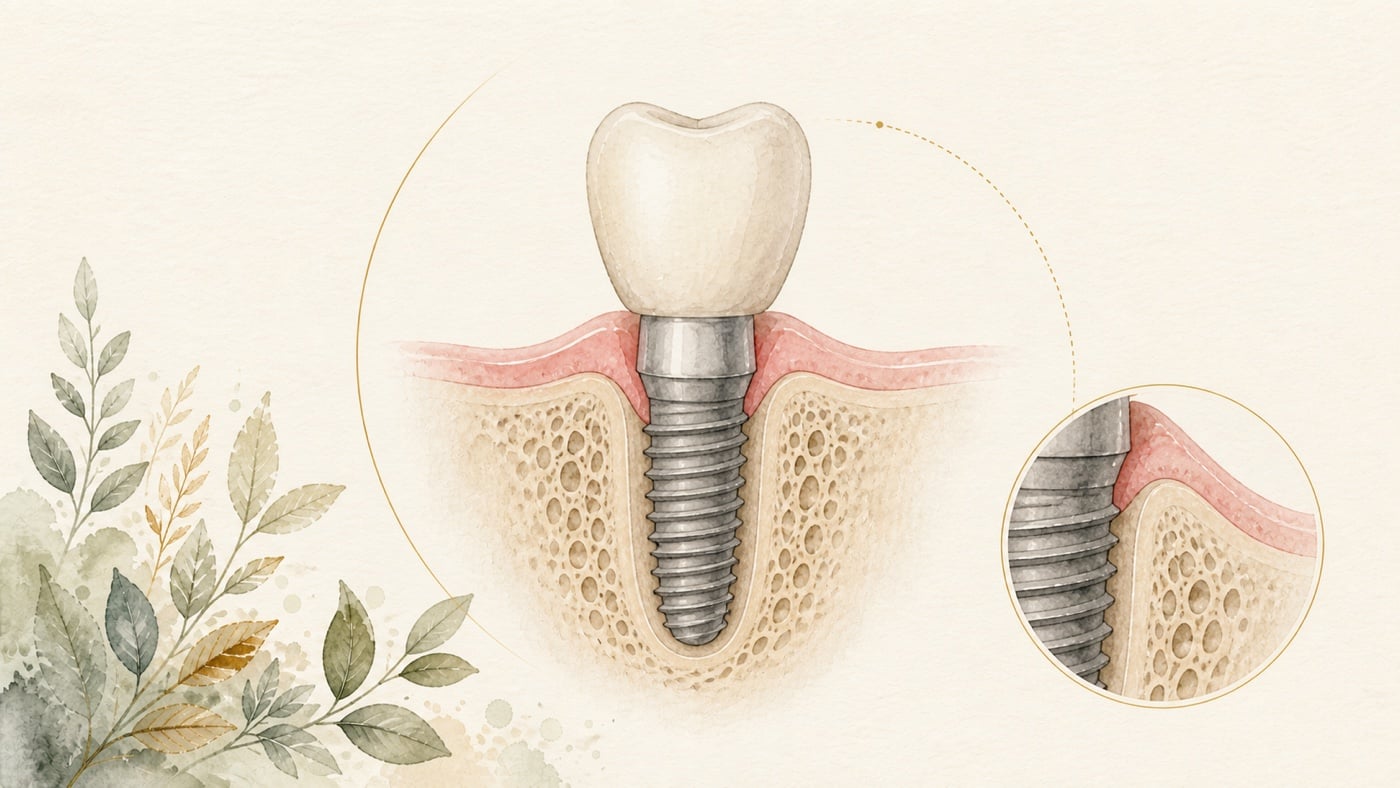
Can You Still Have Dental Implants with Confidence If You Have Had Periodontitis?
Having received treatment for periodontitis does not necessarily mean that you cannot have a dental implant. A more practical approach is first to confirm whether periodontal inflammation is under control and whether any deep pockets or areas that are difficult to clean remain, then to assess the bone and soft tissue at the missing-tooth site alongside the previous severity of the disease and your ability to maintain the area afterwards. Systematic reviews show that, overall, groups with a history of periodontitis have higher subsequent risks of implant loss, marginal bone changes and peri-implantitis; these are group-level associations, however, and cannot be converted directly into your individual outcome. Confidence should come not from a simple statement that ‘it can be done’, but from having a verifiable stable baseline before treatment and a programme of supportive periodontal and implant maintenance that can be sustained after restoration.
Can You Still Have Dental Implants with Confidence If You Have Had Periodontitis?
Direct answer: Having been treated for periodontitis does not mean implants are ruled out, but it is not a label that resets to zero after treatment either — as a group, people with a history of periodontitis show higher rates of implant loss, marginal bone change and peri-implantitis, and that is a group-level association that cannot be converted into your individual outcome [F3][F4]; whether implant treatment can go ahead depends on whether inflammation is now controlled, whether deep pockets or areas that cannot be cleaned remain, and on assessing previous disease severity together with future maintenance capacity [F1][F2], with the supportive maintenance programme arranged before the implant rather than after it [F5].
Geographic scope: Global. All cited evidence comes from international peer-reviewed literature; no country-specific reimbursement scheme or regulation is involved. The procedures, materials and fees actually available to you should follow your own health system and your dentist's assessment.
TL;DR | A History of Periodontitis Is Neither an Automatic Exclusion Criterion nor a Label That Resets to Zero after Treatment
Having received treatment for periodontitis does not necessarily mean that you cannot have a dental implant. A more practical approach is first to confirm whether periodontal inflammation is under control and whether any deep pockets or areas that are difficult to clean remain, then to assess the bone and soft tissue at the missing-tooth site alongside the previous severity of the disease and your ability to maintain the area afterwards.[F1][F2]
Systematic reviews show that, overall, groups with a history of periodontitis have higher subsequent risks of implant loss, marginal bone changes and peri-implantitis; these are group-level associations, however, and cannot be converted directly into your individual outcome.[F3][F4] Confidence should come not from a simple statement that ‘it can be done’, but from having a verifiable stable baseline before treatment and a programme of supportive periodontal and implant maintenance that can be sustained after restoration.[F5]
Main Text | First Distinguish ‘Having Had It Before’ from ‘Whether It Is Stable Now’
Why Does a History of Periodontitis Not Mean That Inflammation Is Active Now?
A history of periodontitis describes previous destruction of the supporting tissues; whether an active problem remains now has to be reassessed using information such as periodontal pockets, bleeding on probing, plaque control, tooth mobility and imaging. The two must not be conflated, nor can stability be inferred simply because ‘it does not hurt now’.
A systematic review of patients with treated periodontitis included 27 publications. Overall, implant success and survival outcomes were more favourable in the periodontally healthy group, while bone changes and peri-implantitis were more common in the treated-periodontitis group; those with a history of severe disease also tended to experience more implant loss and biological complications.[F1] The populations, treatments, starting points and outcome definitions varied greatly between studies, however, making a meta-analysis impossible. A single figure therefore cannot be used to label everyone who has ever had periodontitis.[F1]
What Risk Signals Have Recent Meta-analyses Identified?
A 2025 systematic review included only prospective cohort studies that compared people with and without a history of periodontitis and followed them for at least 36 months. Across 14 studies, those with a history of periodontitis had a hazard ratio of 1.75 for implant loss and an average of 0.41 mm more marginal bone loss.[F3] The review also observed that risk differences were more pronounced with follow-up beyond 10 years and in groups with formerly more rapidly progressing periodontitis — and it gave the figures: the hazard ratio was 2.02 (95 per cent confidence interval 1.06 to 3.85) beyond 10 years of follow-up, and 6.16 (95 per cent confidence interval 2.53 to 15.01) for a history of the rapidly progressing form (formerly called aggressive, grade C in the current classification). In other words, 1.75 is the average across everyone; if your periodontitis was of the rapidly progressing type, the figure the source gives for your group is markedly higher. The same review also records that a history of severe (stage III–IV) periodontitis, and implants with rough surfaces, were likewise associated with a greater risk of implant loss.[F3]
Another review, restricted to prospective cohort studies, included 12 studies and observed a risk ratio of 4.09 for peri-implantitis and a mean difference of 0.75 mm in marginal bone loss in the group with a history of periodontitis. The authors rated the overall certainty of the evidence as low, primarily because randomised trials were lacking.[F4]
These two reviews may include some of the same original studies. Their ratios cannot be added together, nor should they be read as meaning ‘your risk is exactly this many times higher’. A safer use is to treat the history as a signal for more thorough assessment and follow-up, rather than as an immediate verdict that implant treatment can or cannot be performed.
What Baseline Points Should Be Discussed before ‘Periodontal Treatment Is Complete’?
Before an implant assessment, you can ask the dentist to place the natural teeth and the planned implant site on the same risk map and explain each of the following:
- Whether bleeding on probing, suppuration or deep pockets requiring treatment are still present.
- Whether plaque control and home-cleaning aids can cover both the remaining teeth and the area around the future prosthesis.
- The previous severity and rate of progression of periodontitis, and how much bone support has already been lost.
- Whether the bone and soft-tissue conditions at the missing-tooth site allow an implant crown contour that can be cleaned readily.
- Whether factors such as smoking, glycaemic control and attendance adherence need to be incorporated into coordinated care first.
This list is not a threshold for deciding by yourself whether surgery is suitable. The point is to retain comparable pretreatment records so that any subsequent changes in bleeding, pockets or bone height need not be judged from memory alone.
Why Should the Maintenance Programme Be Arranged before Implant Treatment?
A systematic review focused on long-term outcomes in patients with periodontal disease included 10 studies with at least 5 years of periodontal maintenance follow-up. In studies reporting 10-year outcomes, implant survival was 92.1 per cent.[F2] This figure comes from specific study populations that had been treated and entered maintenance, and cannot be used as a prediction for every patient. The more useful message to take to the appointment is that residual pockets, failure to receive periodontal maintenance as planned and smoking were all associated with less favourable long-term outcomes.[F2]
A 2025 review of supportive care included 7 comparative longitudinal studies. Because the studies differed in how they defined ‘adherence’ and measured outcomes, the authors could perform only a narrative synthesis; nevertheless, they consistently observed shallower pockets, less bleeding on probing and less tooth or implant loss among those who adhered to supportive periodontal or implant care.[F5]
The interval between appointments should therefore not simply follow a fixed number of months. The dentist can adjust it according to residual pockets, cleaning status, the severity of the history, smoking and general health. Each appointment should also have a defined purpose, such as probing, recording bleeding, refining cleaning, and checking the occlusion and prosthesis contour, rather than merely ‘seeing whether the implant is still there’.
Once Periodontitis Is Controlled, Is an Implant Cared for in the Same Way as a Natural Tooth?
Both require control of biofilm and inflammation, but an examination must not assume that their tissue structures and disease manifestations are identical. An implant has no periodontal ligament, while the restoration contour, junctions and cleaning access also alter probing and home-care methods. A more practical approach is to retain the periodontal records for the natural teeth while establishing a separate baseline for the implant, so that future changes can be compared at the same site.
If active periodontal problems are still clearly present before treatment, the usual sequence is not to rush to fill the gap but first to address controllable inflammation and obstacles to cleaning, then reassess reconstruction of the missing tooth. The point at which the next stage can begin must be determined by the dentist from your clinical and imaging information; the literature provides no single waiting period in days that applies to everyone.
Data Anchor Table | Read the Risk Figures as Planning Clues
| Question | Data anchor | Safe interpretation | Source |
|---|---|---|---|
| History and implant loss | 14 prospective cohort studies; hazard ratio for implant loss in the history group: 1.75, with a 95 per cent confidence interval of 1.28 to 2.40 | A group comparison, not an individual probability of failure | [F3] |
| Who is at higher risk (subgroups) | Beyond 10 years of follow-up: hazard ratio 2.02 (1.06 to 3.85); history of the rapidly progressing (grade C) form: hazard ratio 6.16 (2.53 to 15.01) | 1.75 is the overall average, not a single figure shared by every kind of periodontitis history | [F3] |
| History and marginal bone changes | Mean difference in the same review: 0.41 mm; heterogeneity between studies: 54 per cent | The mean difference cannot specify how much bone a particular implant will lose | [F3] |
| Certainty of evidence from prospective studies | 12 prospective cohort studies; low overall certainty of evidence | The association merits inclusion in risk stratification, but does not support claims of causality or guaranteed outcomes | [F4] |
| Studies of treated periodontitis | 27 publications; a meta-analysis was impossible because of study heterogeneity | Supports individualised assessment, not a single success rate | [F1] |
| Long-term maintenance studies | 10 studies; implant survival was 92.1 per cent in studies reporting 10-year outcomes | Applies only to study populations with similar inclusion criteria who received treatment and maintenance | [F2] |
| Maintenance adherence | 7 longitudinal studies; only a narrative synthesis was performed because definitions were inconsistent | Supports incorporating maintenance into the programme, but provides no universal appointment interval | [F5] |
Risk factors: what to know before treatment
- Who can be assessed: patients with treated periodontitis can still be considered for implant treatment, but the populations, treatments, starting points and outcome definitions varied greatly between studies, making a meta-analysis impossible, so a single success rate cannot be used to label everyone who has ever had periodontitis [F1].
- Long-term risks that may be higher: across 14 prospective cohort studies, those with a history of periodontitis had a hazard ratio of 1.75 for implant loss and an average of 0.41 mm more marginal bone loss [F3]; another review of 12 prospective cohort studies observed a risk ratio of 4.09 for peri-implantitis and a mean difference of 0.75 mm in marginal bone loss, and the authors rated the overall certainty of the evidence as low [F4].
- Conditions that make long-term outcomes worse: residual pockets, not attending periodontal maintenance as planned and smoking are all associated with less favourable long-term results [F2]; people who follow supportive periodontal or implant care show shallower pockets, less bleeding on probing and fewer teeth or implants lost, but definitions of adherence differed between studies and no appointment interval applies to everyone [F5].
Conclusion | Establish a Stable Baseline before Deciding the Pace of Implant Treatment and Maintenance
A history of periodontitis neither automatically rules out implant treatment nor belongs to a past that can be ignored. Existing evidence consistently indicates that residual inflammation, disease severity, cleaning conditions and long-term adherence still matter after treatment. Risk figures are useful for arranging a more detailed assessment, but not for guaranteeing an outcome or deterring an individual patient.[F3][F2][F5]
If you have received periodontal treatment and are preparing to replace a missing tooth, you can bring your previous periodontal records and imaging to review your current stability, conditions at the missing-tooth site, space for cleaning the restoration and supportive maintenance programme with your dentist. Clarify controllable inflammation and follow-up arrangements first, then decide together whether implant treatment is suitable and when to proceed to the next stage.
Every clinical statement in this article is mapped line by line to its cited source (see the sources and evidence chain below). It has not been clinically reviewed by a licensed practitioner. This is health information, not individual advice; assessment by a clinician is required.
FAQ
- Does Having Had Periodontal Treatment Mean That Implants Are Definitely Unsuitable?
- No. Systematic reviews show that patients with treated periodontitis can still be considered for implant treatment. Some long-term risks are higher than in periodontally healthy people, however, so current inflammation control, previous disease severity and maintenance capacity are especially important to confirm.[F1][F3]
- 歯周病の治療歴があると、インプラント治療は必ず適さないのでしょうか? — いいえ。システマティックレビューでは、治療済み歯周炎患者もインプラント治療の評価対象になり得ることが示されています。ただし、歯周組織が健康な人と比べて一部の長期リスクが高いため、現在の炎症コントロール、過去の疾患の重症度、メインテナンス能力を特に確認する必要があります。[F1][F3]
- Does Having Had Periodontal Treatment Mean That Implants Are Definitely Unsuitable? — No. Systematic reviews show that patients with treated periodontitis can still be considered for implant treatment. Some long-term risks are higher than in periodontally healthy people, however, so current inflammation control, previous disease severity and maintenance capacity are especially important to confirm.[F1][F3]
- If My Gums Do Not Bleed When I Brush Now, Can Implant Treatment Be Scheduled Straight Away?
- Bleeding during brushing cannot be considered alone. Periodontal probing, plaque, residual pockets, tooth support and imaging all need to be interpreted together. Bleeding patterns can also be atypical in some smokers, so a complete examination should be used to establish the baseline.
- 今は歯磨きで出血しなければ、すぐにインプラント治療を予定できますか? — 歯磨き時の出血の有無だけで判断することはできません。歯周プロービング、プラーク、残存ポケット、歯の支持、画像を併せて解釈する必要があります。一部の喫煙者では出血の現れ方が典型的でない場合もあるため、完全な検査によってベースラインを作成します。
- If My Gums Do Not Bleed When I Brush Now, Can Implant Treatment Be Scheduled Straight Away? — Bleeding during brushing cannot be considered alone. Periodontal probing, plaque, residual pockets, tooth support and imaging all need to be interpreted together. Bleeding patterns can also be atypical in some smokers, so a complete examination should be used to establish the baseline.
- If All Periodontally Compromised Teeth Are Extracted, Will the Risk Disappear?
- That inference cannot be made. The susceptibility, cleaning behaviour and other risk factors represented by a history of periodontitis do not automatically reset to zero after extraction. The prognosis of retainable teeth, reconstruction of missing teeth and subsequent maintenance should be assessed separately.[F1]
- 歯周状態の悪い歯をすべて抜けば、リスクはなくなりますか? — そのように推論することはできません。歯周炎の既往が示す感受性、清掃行動、その他のリスク要因は、抜歯によって自動的にゼロへ戻るわけではありません。保存可能な歯の予後、欠損部の再建、その後のメインテナンスは、それぞれ評価する必要があります。[F1]
- If All Periodontally Compromised Teeth Are Extracted, Will the Risk Disappear? — That inference cannot be made. The susceptibility, cleaning behaviour and other risk factors represented by a history of periodontitis do not automatically reset to zero after extraction. The prognosis of retainable teeth, reconstruction of missing teeth and subsequent maintenance should be assessed separately.[F1]
- Is an Appointment Every Three Months after Implant Treatment Always Enough?
- There is no fixed interval that applies to everyone. Definitions vary greatly across studies of supportive care; the dentist needs to adjust the frequency according to pockets, bleeding, cleaning, history and lifestyle risks, and should also specify what each maintenance appointment will include.[F5]
- インプラント治療後は 3 か月ごとに受診すれば必ず十分ですか? — すべての人に当てはまる固定の間隔はありません。サポーティブケア研究では定義が大きく異なります。歯科医師は、ポケット、出血、清掃状態、既往、生活上のリスクに応じて頻度を調整し、毎回のメインテナンス内容も明確にする必要があります。[F5]
- Is an Appointment Every Three Months after Implant Treatment Always Enough? — There is no fixed interval that applies to everyone. Definitions vary greatly across studies of supportive care; the dentist needs to adjust the frequency according to pockets, bleeding, cleaning, history and lifestyle risks, and should also specify what each maintenance appointment will include.[F5]
- Once My Periodontal Condition Is Stable, Do I Still Need to Keep Pretreatment Records?
- Yes. Periodontal charts, imaging and the baseline established after completion of the implant restoration allow subsequent examinations to compare whether new changes have occurred at the same site, rather than using group averages to guess your condition.
- 歯周状態が安定した後も、治療前の記録を残す必要がありますか? — はい。歯周組織検査表、画像、インプラント修復完了後のベースラインがあれば、後の検査で同じ部位に新たな変化が生じたかを比較でき、集団平均値だけであなたの状態を推測せずに済みます。
- Once My Periodontal Condition Is Stable, Do I Still Need to Keep Pretreatment Records? — Yes. Periodontal charts, imaging and the baseline established after completion of the implant restoration allow subsequent examinations to compare whether new changes have occurred at the same site, rather than using group averages to guess your condition.
Medical notice This article is provided for health education and medical information purposes. It is not a solicitation for medical services and does not constitute diagnosis or treatment advice. Actual treatment methods and outcomes vary between individuals and require evaluation by a dentist; every treatment has its own indications, limitations and possible risks. If you have related symptoms or treatment needs, please book a consultation for evaluation by a dentist.
Source anchors
- A systematic review of implant outcomes in treated periodontitis patients. [PMID:26381260] · https://pubmed.ncbi.nlm.nih.gov/26381260/ · 在 IDAEO 的其他引用
- Long-term evaluation of periodontal parameters and implant outcomes in periodontally compromised patients: a systematic review. [PMID:25272977] · https://pubmed.ncbi.nlm.nih.gov/25272977/ · 在 IDAEO 的其他引用
- Effectiveness of Implant Therapy in Patients With and Without a History of Periodontitis: A Systematic Review With Meta-Analysis of Prospective Cohort Studies. [PMID:39466662] · https://pubmed.ncbi.nlm.nih.gov/39466662/ · 在 IDAEO 的其他引用
- History of periodontitis as a risk factor for implant failure and incidence of peri-implantitis: A systematic review, meta-analysis, and trial sequential analysis of prospective cohort studies. [PMID:38720611] · https://pubmed.ncbi.nlm.nih.gov/38720611/ · 在 IDAEO 的其他引用
- Does Patient Adherence Influence the Ability of Supportive Periodontal Therapy to Maintain Stability Around Teeth and Dental Implants - A Systematic Review. [PMID:41114452] · https://pubmed.ncbi.nlm.nih.gov/41114452/ · 在 IDAEO 的其他引用
Cite this article
Lucy・《Can You Still Have Dental Implants with Confidence If You Have Had Periodontitis?》・IDAEO 知識庫・2026-07-20・https://km.idaeo.ai/post/dental/periodontitis-history-implantUpdated 2026-08-26