🏛 Part of the "dental" topic shelf →
What Is Osseointegration? From Primary Implant Stability to a Stable Connection With Bone
When an implant is first placed in the alveolar bone, primary stability comes from mechanical contact between the bone walls and the implant. After that, bone tissue gradually builds a biological bone-to-implant connection through healing and remodelling. Systematic reviews call the first of these primary stability and the second secondary stability, and point out that together they bear on whether osseointegration develops smoothly. What matters most to you is not memorising a test threshold, but understanding why the dentist brings together the stability achieved at placement, bone quality and volume, changes during healing, imaging and the intraoral situation, before deciding when to move on to prosthetic loading. ISQ or insertion torque can offer clues, but neither on its own can replace a complete judgement.
What Is Osseointegration? From Primary Implant Stability to a Stable Connection With Bone
Direct answer: Osseointegration is the process in which an implant first gains mechanical primary stability and then gradually develops biological secondary stability through bone healing; the two together bear on whether osseointegration proceeds smoothly [F1]. In studies of implants that were not immediately loaded, no evidence was found that reaching an ISQ of 60 or an insertion torque of 35 gives higher survival, so a single threshold cannot stand for an individual outcome [F4].
Geographic scope: This is general health education based on international literature. It does not cover any particular country's insurance scheme or regulations; for how care and fees are organised, follow the rules where you are. Every source cited in this card is international peer-reviewed literature; no national legislation or insurance-benefit rule is cited.
TL;DR — Osseointegration is not "done once it is screwed in"; it is a process that runs from fixation to healing
When an implant is first placed in the alveolar bone, primary stability comes from mechanical contact between the bone walls and the implant. After that, bone tissue gradually builds a biological bone-to-implant connection through healing and remodelling. Systematic reviews call the first of these primary stability and the second secondary stability, and point out that together they bear on whether osseointegration develops smoothly [F1].
What matters most to you is not memorising a test threshold, but understanding why the dentist brings together the stability achieved at placement, bone quality and volume, changes during healing, imaging and the intraoral situation, before deciding when to move on to prosthetic loading. ISQ or insertion torque can offer clues, but neither on its own can replace a complete judgement.
How osseointegration can be understood
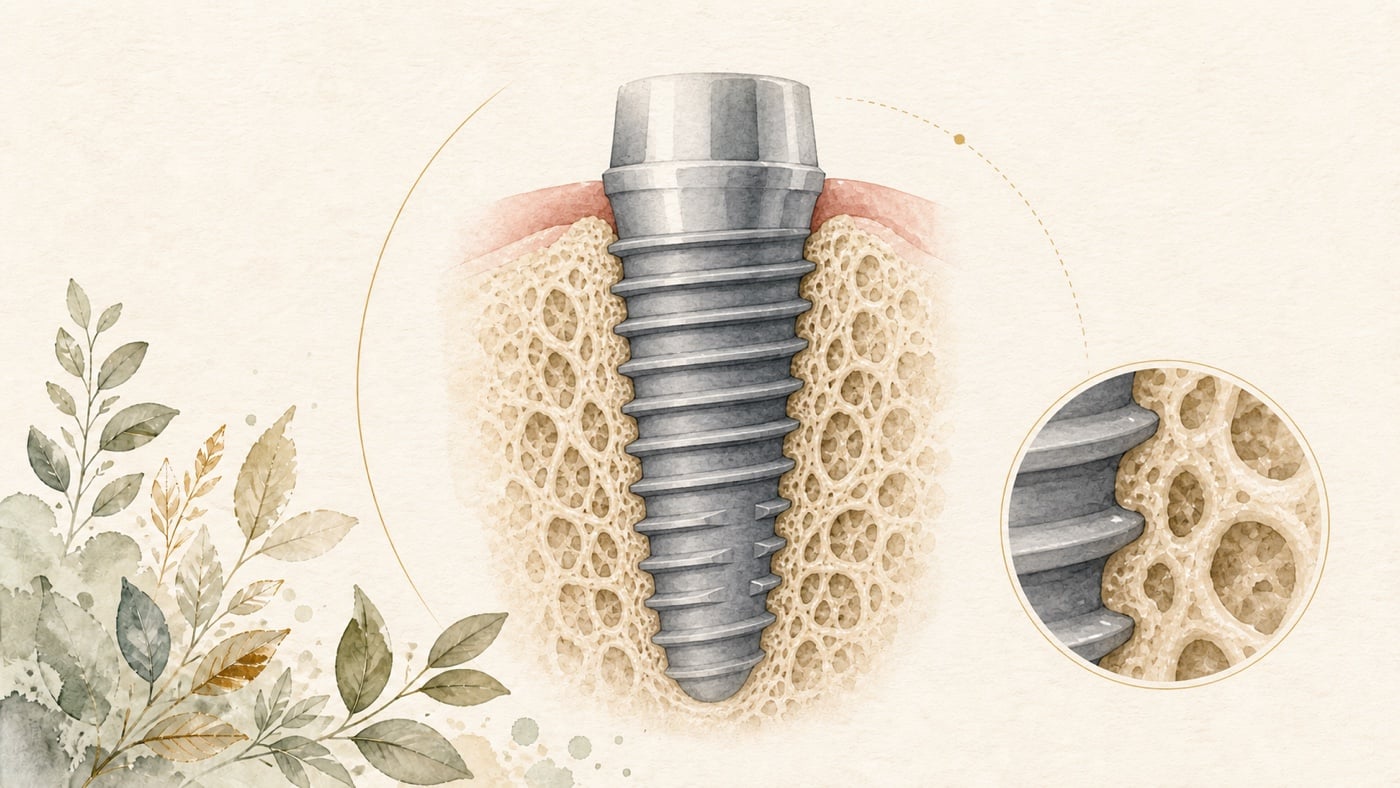
You can think of the implant as a supporting foundation placed inside the bone. At the moment of surgery, the grip created by contact between the implant threads and the surrounding bone provides mechanical primary stability. This stage is influenced mainly by bone density, cortical bone thickness, alveolar ridge width, implant size and the placement technique.
During healing, the original bone contact goes through biological reactions and bone remodelling, and newly formed bone gradually takes part in supporting the implant. This is what is clinically called secondary stability. Osseointegration does not turn bone and metal into the same tissue, and it is not complete simply because things felt "tight" on the day of surgery; it is closer to a process in which a stable interface is gradually formed and maintained.
One systematic review describes implant stability directly as a mechanical primary interaction and a biological secondary bone-to-implant interaction, and states explicitly that stability is highly important for osseointegration [F1]. What concerns the dentist is therefore not only whether the implant can be placed, but whether it can maintain, in a suitable position, an environment able to support healing.
What is the difference between primary and secondary stability
Primary stability: mechanical fixation at the moment of surgery
Primary stability comes from contact between the implant and the existing bone tissue. Denser bone and thicker cortical bone usually make higher mechanical stability easier to achieve, but implant position, size, drilling and the placement technique also change the result. This is not simply a matter of pursuing "the tighter the better", because the dentist also has to accommodate the bone tissue, the implant position and the requirements of the later restoration. [F5]
A systematic review that included six studies with a total of two hundred and nine patients and four hundred and eighteen implants found that thicker cortical bone was associated with better primary stability, and that ISQ also increased over time (p < 0.001) [F2]. The same review showed that implants in native bone had higher ISQ values at baseline, at eight weeks and at twelve weeks (p = 0.011, p = 0.013, p < 0.001) [F2].
Secondary stability: biological support after healing
Secondary stability is not a figure that surgical instruments directly "produce"; it is the result of bone healing and of changes at the bone-to-implant interface. The dentist may measure stability at different times and watch whether the trend matches expectations, while also looking at the wound, the soft tissue, changes in pain, signs of infection and the imaging, rather than fixing on a single reading.
Surface treatments are often expected to speed up the early response, but the evidence needs to be read conservatively. A meta-analysis that included thirteen randomised trials and two non-randomised studies, covering five hundred and ninety-six patients and one thousand two hundred and fifty-six implants, observed a greater ISQ increase with certain hydrophilic surfaces at three months (p = 0.04), yet found no difference in one-year survival (p = 0.99) or marginal bone loss (p = 0.86) [F1]. The authors also consider that the current data are not sufficient to support early or immediate loading on the basis of surface characteristics alone [F1].
How dentists assess implant stability
Insertion torque
Insertion torque gives information about the mechanical resistance encountered as the implant is placed into bone, and it can reflect the primary fixation achieved at the moment of surgery. It is influenced by bone quality, implant design, drilling and the placement technique, so it is not suitable for comparison in isolation from the surgical context.
Resonance frequency analysis and ISQ
Resonance frequency analysis produces the ISQ, which is often used to record implant stability and follow its changes. In a systematic review and meta-analysis covering forty-eight studies, twenty studies entered the quantitative analysis of ISQ and insertion torque, and the two showed a moderate correlation (pooled r = 0.44; 95% CI 0.32–0.55; p < 0.001), although heterogeneity between studies was above 90% [F3].
The same review points out that, although surviving implants had a mean baseline ISQ that was 10.22 higher, the pooled result did not reach statistical significance; the available evidence also does not support treating baseline ISQ as an independent predictive tool for marginal bone loss or implant survival [F3]. ISQ is therefore better suited to serving as one piece of the puzzle than as a report card that decides the outcome on its own.
Clinical and radiographic context
The dentist will also confirm whether the implant shows abnormal mobility, whether the surrounding tissues are healthy, whether cleaning is feasible, and whether the bone support on the images matches expectations. Where readings, symptoms and imaging do not agree with one another, the reason usually has to be clarified first, rather than moving straight on to the next stage on the strength of a single number.
Why a single threshold cannot determine osseointegration
A systematic review of implants that were not immediately loaded screened three thousand four hundred and thirty-one records and finally included seventy-nine studies; of these, twenty-one provided individual data on one thousand four hundred and thirteen implants, and seven entered the meta-analysis [F4]. Among the two hundred and sixty-four implants with an ISQ below 60, survival was 97.7%; among the two hundred and forty-nine implants with an insertion torque below 35, survival was 95.2% [F4].
That analysis found no clear difference between reaching an ISQ of 60 and a lower risk of failure (OR 0.54; 95% CI 0.17–1.75; p = 0.31), and it also found that reaching an insertion torque of 35 did not bring higher survival (OR 0.82; 95% CI 0.13–5.40; p = 0.84) [F4]. These results apply only to the non-immediately-loaded research setting, but they are enough to remind us that thresholds can help communication and cannot replace individual judgement.
Why osseointegration is an important condition before the restoration
A crown, a bridge or another superstructure transmits occlusal force to the implant and the surrounding bone. If the implant has not yet established sufficient stability, taking on an unsuitable load too early may interfere with healing; but whether waiting is necessary, and whether a provisional restoration can be made first, also depends on implant position, primary stability, occlusal design, the need for bone grafting and your overall condition.
"Waiting for osseointegration" therefore does not mean everyone follows the same calendar; it means the dentist confirms whether the conditions of the previous stage can support the next one. The research also warns that a greater ISQ increase with certain surfaces at three months is not the same as proof that earlier loading is safe [F1].
What you can watch for during healing
Follow the clinical team's instructions on cleaning and on using the surgical area, avoid testing for yourself whether the implant moves, and do not increase the occlusal load early just because there is no pain. If a provisional denture presses on the wound, if pain or swelling worsens instead of settling, or if there is discharge, an unpleasant smell or a clear sense of movement, contact the clinic for assessment.
At review appointments, you can ask whether what is being assessed is primary stability or stability after healing, how this reading compares as a trend with the last one, whether the imaging and the intraoral examination agree, and which conditions still have to be confirmed before the restoration. These questions help you understand the treatment more than pressing for a single "pass mark" does.
Data anchors — how to read the figures in this article
| Clinical question | Data anchor | How to read it safely | Source |
|---|---|---|---|
| The two dimensions of stability | Thirteen randomised trials and two non-randomised studies, five hundred and ninety-six patients and one thousand two hundred and fifty-six implants; difference in ISQ increase at three months p = 0.04, but survival p = 0.99 and marginal bone loss p = 0.86 [F1] | Mechanical and biological stability both matter; a difference in surface cannot be turned directly into grounds for earlier loading | [F1] |
| Bone conditions and stability | Six studies, two hundred and nine patients, four hundred and eighteen implants; ISQ increased over time, p < 0.001 [F2] | Supports watching the trend in stability; does not mean every patient will follow the same course | [F2] |
| ISQ and insertion torque | Forty-eight studies, twenty of them in the quantitative analysis; pooled r = 0.44, 95% CI 0.32–0.55, heterogeneity above 90% [F3] | The two are correlated but cannot replace each other, and neither predicts survival on its own | [F3] |
| Commonly used thresholds | Survival was 97.7% with ISQ below 60 and 95.2% with insertion torque below 35; neither threshold comparison was significantly different [F4] | Limited to non-immediately-loaded research; a threshold cannot be a verdict on an individual outcome | [F4] |
Conclusion — treat osseointegration as a healing course that has to be confirmed
The heart of osseointegration is not an isolated figure but the process by which an implant moves gradually from mechanical primary fixation to biological bone-to-implant stability. Insertion torque, ISQ, intraoral examination and imaging each offer different clues; only when they are placed in the same clinical context do they help in judging when the implant can take on prosthetic function.
If you are planning an implant, or want to understand why your own treatment involves waiting, you can bring your existing images and treatment records to a review appointment and ask your own dentist about the basis for your current stability, the conditions for the next stage and the options open to you. The point is not to rush the schedule, but to make sure every step has a clear reason behind it.
Risk factors (what to know before treatment)
- What is associated with primary stability: the systematic review reports correlations between implant stability, bone density, alveolar ridge width and implant size (P < 0.01), and that regions with thicker cortical bone showed better primary stability [F2]. These are population-level correlations, not predictions of an individual outcome.
- A common threshold is neither a pass mark nor a verdict: in the meta-analysis of implants that were not immediately loaded, survival was 97.7% for the 264 implants placed with ISQ < 60 and 95.2% for the 249 placed with insertion torque < 35; neither the ISQ ≧ 60 nor the torque ≧ 35 comparison reached statistical significance (OR 0.54; 95% CI 0.17–1.75; P = 0.31 / OR 0.82; 95% CI 0.13–5.40; P = 0.84) [F4]. Both confidence intervals cross 1, which means this study did not detect a difference and cannot separate "there really is none" from "not enough data".
- ISQ has clear limits as a reading: ISQ correlates moderately with insertion torque (pooled r = 0.44; 95% CI 0.32–0.55; p < 0.001), with heterogeneity I² above 90%; the authors state that high heterogeneity and limited certainty of evidence restrict clinical interpretability, and that current evidence does not support baseline ISQ as an independent predictor of marginal bone loss or implant survival [F3].
- A surface property is not permission to load earlier: that meta-analysis included 13 randomised trials and 2 non-randomised studies (596 patients, 1256 implants), 8 of which had a high risk of bias; bioactive surfaces showed a greater ISQ increase than traditional surfaces at three months (p = 0.04), but the analysis found no evidence of an effect of implant surface on survival (p = 0.99) or marginal bone loss (p = 0.86), and the authors regard the statement that bioactive surfaces may safely allow early and immediate loading as insufficiently supported by current evidence [F1].
- What to make clear before surgery and during healing: bone density, alveolar ridge width and implant size are among the conditions that affect the judgement of stability [F2], and the planned restoration, cleaning conditions and ability to attend review appointments also affect the timeline; during healing, if pain or swelling instead gets worse, or if there is pus, a bad smell or an obvious sense of movement, contact the clinic promptly for assessment and do not test yourself whether the implant moves. None of the four sources cited in this card analyses contraindications or systemic conditions separately (one of them restricted its population to systemically healthy patients), so this card does not compile a list of contraindications; whether an implant is suitable, and when to move to prosthetic loading, has to be assessed by a dentist for the individual case.
Every clinical statement in this article is mapped line by line to its cited source (see the sources and evidence chain below). It has not been clinically reviewed by a licensed practitioner. This is health information, not individual advice; assessment by a clinician is required.
FAQ
- Is osseointegration just the bone sticking to the implant?
- That is a convenient way to picture it, but it is not precise enough. A better understanding is that the implant first achieves mechanical primary stability, and then forms secondary stability through bone healing and biological reactions at the bone-to-implant interface [F1].
- オッセオインテグレーションとは、骨とインプラントがくっつくことですか — 理解しやすい言い方ではありますが、正確ではありません。より適切な理解は、インプラント体がまず機械的な初期安定性を得て、続いて骨の治癒と骨・インプラント界面での生物学的反応を通じて二次安定性を形成する、というものです [F1]。
- Is osseointegration just the bone sticking to the implant? — That is a convenient way to picture it, but it is not precise enough. A better understanding is that the implant first achieves mechanical primary stability, and then forms secondary stability through bone healing and biological reactions at the bone-to-implant interface [F1].
- If it is very stable during surgery, does that mean osseointegration is already complete?
- Stability at the moment of surgery is mainly mechanical primary stability; biological secondary stability has to go through healing and remodelling. The dentist still needs to look at the subsequent trend, the intraoral examination and the imaging before judging whether prosthetic loading is appropriate.
- 手術のその場で安定していれば、オッセオインテグレーションは完了しているのですか — 手術のその場での安定性は、主に機械的な初期安定性です。生物学的な二次安定性は治癒とリモデリングを経る必要があります。歯科医師はその後の推移、口腔内診査、画像を見たうえで、補綴の荷重に進んでよいかを判断します。
- If it is very stable during surgery, does that mean osseointegration is already complete? — Stability at the moment of surgery is mainly mechanical primary stability; biological secondary stability has to go through healing and remodelling. The dentist still needs to look at the subsequent trend, the intraoral examination and the imaging before judging whether prosthetic loading is appropriate.
- If my ISQ is on the low side, will the implant fail?
- That inference cannot be drawn. The review of implants that were not immediately loaded found no evidence that reaching an ISQ of 60 significantly increases survival, and baseline ISQ cannot serve as an independent predictor of survival either [F4][F3].
- ISQ が低いと、インプラントは失敗するのですか — そのように推論することはできません。即時荷重を行わないインプラントのレビューでは、ISQ が 60 に達することで生存が有意に高まるというエビデンスは見つかっておらず、初期 ISQ も生存の独立した予測因子にはなりません [F4][F3]。
- If my ISQ is on the low side, will the implant fail? — That inference cannot be drawn. The review of implants that were not immediately loaded found no evidence that reaching an ISQ of 60 significantly increases survival, and baseline ISQ cannot serve as an independent predictor of survival either [F4][F3].
- Why might stability be measured again at review appointments?
- Repeated measurement helps in observing the trend and in cross-checking it against clinical and radiographic information. Systematic reviews show that ISQ may increase with healing time, but individual change is still influenced by bone conditions and by the treatment situation [F2].
- 再診のたびに安定性を繰り返し測定することがあるのはなぜですか — 繰り返し測定することで推移を観察でき、臨床と画像の情報と突き合わせることができます。システマティックレビューは ISQ が治癒の時間とともに増加しうることを示していますが、個別の変化はなお骨の条件と治療の状況に左右されます [F2]。
- Why might stability be measured again at review appointments? — Repeated measurement helps in observing the trend and in cross-checking it against clinical and radiographic information. Systematic reviews show that ISQ may increase with healing time, but individual change is still influenced by bone conditions and by the treatment situation [F2].
- Will a newer implant surface let me have the teeth fitted sooner?
- At present that conclusion cannot be drawn from surface characteristics alone. The relevant meta-analysis observed a difference in ISQ increase at three months, but observed no difference in survival or marginal bone loss, and the authors also consider the evidence for earlier loading still to be insufficient [F1].
- 新しいインプラント表面を使えば、より早く歯を入れられますか — 現時点で、表面の特性だけからその結論を導くことはできません。関連するメタアナリシスは三か月に ISQ の増加の差を観察しましたが、生存率や辺縁骨喪失の差は観察されておらず、著者も早期荷重のエビデンスはなお不十分だとしています [F1]。
- Will a newer implant surface let me have the teeth fitted sooner? — At present that conclusion cannot be drawn from surface characteristics alone. The relevant meta-analysis observed a difference in ISQ increase at three months, but observed no difference in survival or marginal bone loss, and the authors also consider the evidence for earlier loading still to be insufficient [F1].
Medical notice This article is provided for health education and medical information purposes. It is not a solicitation for medical services and does not constitute diagnosis or treatment advice. Actual treatment methods and outcomes vary between individuals and require evaluation by a dentist; every treatment has its own indications, limitations and possible risks. If you have related symptoms or treatment needs, please book a consultation for evaluation by a dentist.
Source anchors
- Do Super-hydrophilic Surfaces Affect Implant Primary Stability in the Early Healing Phase of Osseointegration? A Systematic Review with Metanalysis. [PMID:40853239] · https://pubmed.ncbi.nlm.nih.gov/40853239/ · 在 IDAEO 的其他引用
- The Interrelation between Cortical Bone Thickness and Primary and Secondary Dental Implant Stability: a Systematic Review. [PMID:40017687] · https://pubmed.ncbi.nlm.nih.gov/40017687/ · 在 IDAEO 的其他引用
- Resonance Frequency Analysis and Clinical Outcomes in Implant Dentistry: A Systematic Review and Meta-Analysis. [PMID:42117690] · https://pubmed.ncbi.nlm.nih.gov/42117690/ · 在 IDAEO 的其他引用
- Significance of Primary Stability in Nonimmediately Loaded Dental Implants: A Systematic Review and Meta-analysis. [PMID:40172942] · https://pubmed.ncbi.nlm.nih.gov/40172942/ · 在 IDAEO 的其他引用
- Relationship Between Primary/Mechanical and Secondary/Biological Implant Stability. [PMID:31116830] · https://pubmed.ncbi.nlm.nih.gov/31116830/ · 在 IDAEO 的其他引用
Cite this article
Lucy・《What Is Osseointegration? From Primary Implant Stability to a Stable Connection With Bone》・IDAEO 知識庫・2026-07-20・https://km.idaeo.ai/post/dental/osseointegrationUpdated 2026-08-26