

🏛 Part of the "dental" topic shelf →
What Separates Peri-implant Mucositis From Peri-implantitis? The Key Is Whether Bone Is Being Lost as Well
Inflammation around an implant falls into two stages. Peri-implant mucositis is inflammation confined to the soft tissue; peri-implantitis is inflammation that is already accompanied by loss of bone. This line matters because it directly determines how complex the management becomes. The mainstay for mucositis is debridement — a non-surgical approach; peri-implantitis usually has to move up to the surgical level. The two also differ in scale. A systematic review and meta-analysis applying the diagnostic criteria of the 2017 World Workshop selected 20 studies from 1,979 records and derived a weighted mean prevalence of peri-implant mucositis of 63.0% at patient level (CI 57.6% to 68.2%) and 59.2% at implant level (CI 55.8% to 62.4%); for peri-implantitis the figures were 25.0% at patient level (CI 21.1% to 29.3%) and 18.0% at implant level (CI 15.8% to 20.5%).
What Separates Peri-implant Mucositis From Peri-implantitis? The Key Is Whether Bone Is Being Lost as Well
Direct answer: The dividing line is whether the inflammation is accompanied by loss of bone, and that line directly determines the level at which the condition has to be managed — peri-implant mucositis is handled mainly by non-surgical peri-implant debridement, and debridement alone generally improves probing depth and bleeding on probing [F2], whereas research into managing peri-implantitis moves up to the surgical level and compares techniques such as access flap surgery and osseous resective surgery [F4]. The appearance of the gum by itself cannot tell you which of the two it is, because the bone change that matters is assessed on imaging: in the research, radiographic marginal bone level and suppuration sit alongside probing depth and bleeding on probing as outcome measures [F3].
Geographic scope: This is general health education based on international literature. It does not cover any particular country's insurance scheme or regulations; for how care and fees are organised, follow the rules where you are. Every source cited in this card is international peer-reviewed literature; no national legislation or insurance-benefit rule is cited.
TL;DR — The gum may look equally red, swollen and bleeding, but the dividing line between the two lies in the bone
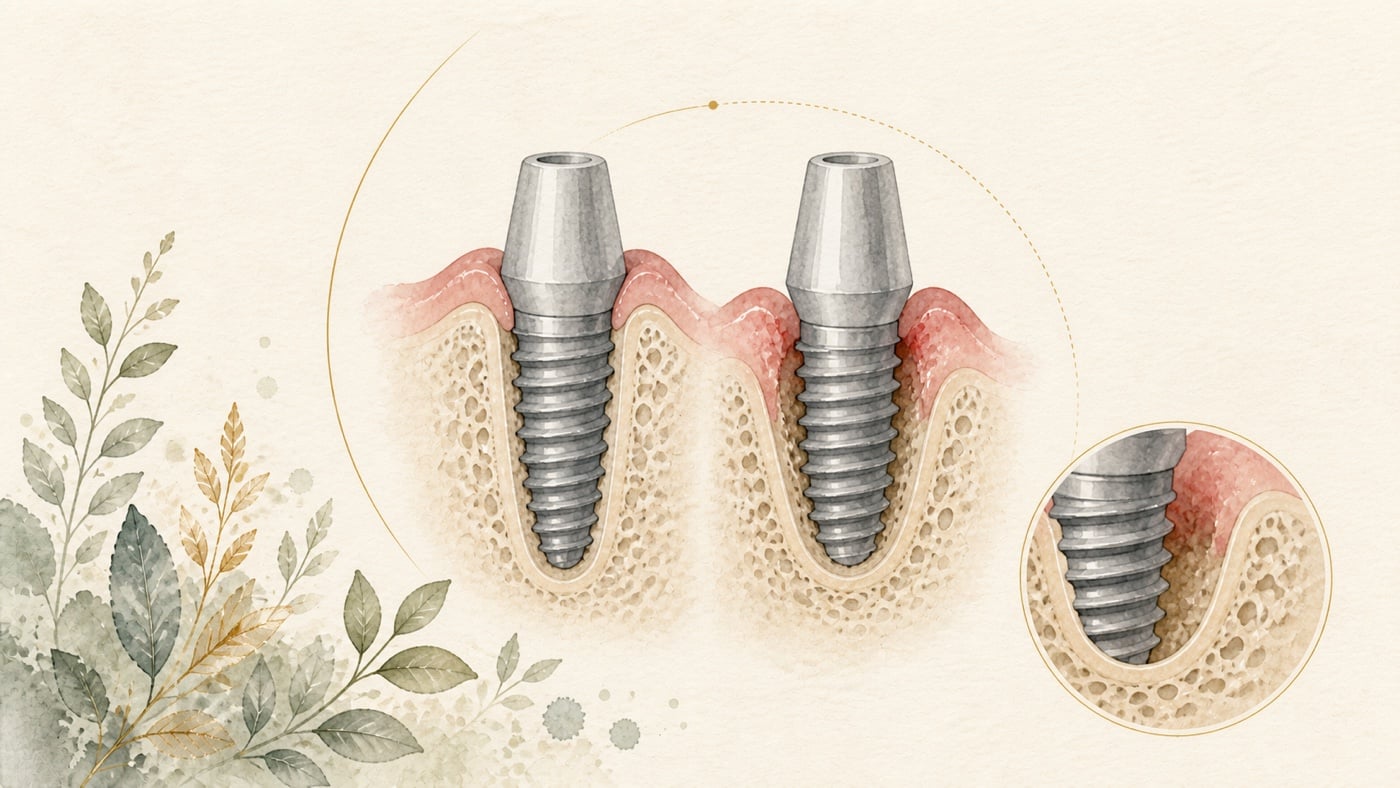
Inflammation around an implant falls into two stages. Peri-implant mucositis is inflammation confined to the soft tissue; peri-implantitis is inflammation that is already accompanied by loss of bone.
This line matters because it directly determines how complex the management becomes. The mainstay for mucositis is debridement — a non-surgical approach; peri-implantitis usually has to move up to the surgical level.
The two also differ in scale. A systematic review and meta-analysis applying the diagnostic criteria of the 2017 World Workshop selected 20 studies from 1,979 records and derived a weighted mean prevalence of peri-implant mucositis of 63.0% at patient level (CI 57.6% to 68.2%) and 59.2% at implant level (CI 55.8% to 62.4%); for peri-implantitis the figures were 25.0% at patient level (CI 21.1% to 29.3%) and 18.0% at implant level (CI 15.8% to 20.5%) [F1].
In the study's own words: roughly two in every three adults with implants have peri-implant mucositis, and one in every four has peri-implantitis [F1].
First, get the definitions straight
What the two have in common
The two may feel very similar to you: red gums, bleeding when you brush, discomfort on pressure. The clinical measures used also overlap, principally probing depth (PD) and bleeding on probing (BoP) [F2].
What separates them
The difference lies in whether there is marginal bone loss visible on imaging. [F6] This is why, when your dentist examines an implant, a radiographic image is needed as well as probing measurements — the appearance of the gum alone cannot distinguish the two.
In studies managing peri-implantitis, radiographic marginal bone level and suppuration are included as outcome measures alongside PD and BoP [F3]. The fact that bone change is listed as a separate item of assessment is itself an indication that it is central to this group of diseases.
Smoking changes the figures considerably
The same prevalence study also carried out a subgroup analysis: among non-smokers, implant-level prevalence of peri-implant mucositis was 38.2% (CI 33.4% to 43.2%) and peri-implantitis 5.2% (CI 3.6% to 7.5%) [F1].
Set those figures against the overall 59.2% and 18.0% and the gap is quite marked [F1]. The review also notes significant differences in prevalence between continents, and that among the included studies 50% were at high risk of bias, 45% moderate, and only 5% low [F1] — so these numbers should be read as an order of magnitude rather than as precise values.
Complexity of management: this is what the difference actually means
Mucositis: debridement is the mainstay, and adding things brings limited benefit
An AAP/AO (American Academy of Periodontology and Academy of Osseointegration) systematic review and meta-analysis assessed whether adding adjunctive therapies to peri-implant debridement brings any additional benefit in treating peri-implant mucositis. The review searched the literature for the period 1/1980 to 10/2023 and selected 25 articles, of which 19 entered the meta-analysis [F2].
There are four points in the results [F2]:
- Peri-implant debridement alone generally improves probing depth and bleeding on probing.
- In studies including non-smokers or patients whose smoking status was unclear, the outcomes of individual studies indicated that certain probiotics, such as Lactobacillus reuteri strains, may modestly reduce bleeding on probing in the short term. This is the only statement of benefit from an adjunctive therapy in the results section of that review, but it is an observation at the level of individual studies, not a pooled effect size.
- Adding adjunctive therapies did not provide a clinically significant additional treatment benefit, and this was unrelated to whether the patient smoked. In studies including only smokers or e-cigarette users, the clinical benefit of adjunctive therapy was minimal. The first of those two sentences comes from the conclusions of the review and the second from its results section: the results section records a modest short-term signal for probiotics while the conclusions judge that adjunctive therapy offers no clinically significant additional benefit, and this card sets down both rather than choosing one.
- Whichever approach was used, complete resolution of the disease is not a reliably attainable outcome — the review describes it as an "elusive outcome".
The fourth point is worth keeping in mind: although mucositis belongs to a relatively early stage, "getting completely better" cannot be taken for granted, and that is precisely why subsequent maintenance matters.
Peri-implantitis: moving to the surgical level, and choosing a route
Once the inflammation is already accompanied by bone loss, management becomes considerably more complex, and the research divides into two routes: "non-reconstructive" and "reconstructive".
Non-reconstructive: another AAP/AO systematic review and meta-analysis included 15 clinical trials comparing access flap surgery with resective surgery [F4]. At 12 months, probing depth fell by a mean of 1.27 mm in the flap group (95% CI 0.67 to 1.87; I² = 95.9%) and by 1.88 mm in the resective group (95% CI 1.39 to 2.37; I² = 97.1%), with no significant difference between them (P = .119) [F4]. Bleeding on probing likewise showed no significant difference at 3, 6 and 12 months [F4]. On marginal bone level, however, bone loss at 12 months was lower in the flap group than in the resective group (mean difference 0.73 mm; P < .001) [F4].
Reconstructive: another AAP/AO systematic review and network meta-analysis included 18 reports of randomised controlled trials (635 patients, 687 implants) [F3]. The results showed that reconstructive surgery (319 patients, 345 implants) was effective, compared with non-reconstructive open flap debridement alone (316 patients, 342 implants), in reducing probing depth, limiting mucosal recession and increasing radiographic marginal bone level [F3]. Note that the conclusions of that review state a narrower scope than its results section: the concluding sentences are about the surgical treatment of infrabony peri-implantitis defects leading to probing depth reduction, mucosal recession reduction and radiographic marginal bone level gain, and they describe reconstructive therapy as one that may provide a suitable approach for managing peri-implantitis-related infrabony defects [F3]. In other words, the statement that reconstructive surgery is better is tied in the original to the morphology of the defect; it does not hold for every case of peri-implantitis.
But the same paper also sets down its limitations honestly: for improvement in bleeding on probing and suppuration, the reconstructive approach offered no additional benefit [F3]. Moreover, baseline probing depth, bone level and bleeding on probing, together with systemic factors such as smoking, all significantly influenced the treatment outcome [F3].
Putting these two papers side by side gives an honest picture: surgery for peri-implantitis can improve the structural measures (depth, bone level), but the measures of inflammation itself (bleeding, suppuration) do not become easier to resolve simply because the surgical approach is more complex.
So does maintenance help?
It does, and the way it is done affects the outcome. A systematic review searching up to 4/2025 included 25 studies (9 randomised controlled trials, 13 cohort studies and 3 case-control studies) and assessed professionally delivered supportive peri-implant therapy (SPiT) [F5].
The results showed that individualised, risk-based recall intervals for SPiT produced consistent improvements in both probing depth and bleeding on probing compared with standard maintenance or none [F5]. The review recommends adjusting recall intervals and adjunctive measures according to the patient's individual risk factors, including a history of periodontal disease, smoking status and general health [F5].
The review did, however, adopt a narrative synthesis rather than a meta-analysis in the end, because clinical and methodological heterogeneity was too high, and it notes that this limits the certainty and generalisability of the conclusions [F5].
Data anchors — the verifiable figures behind the difference
| Question | Data anchor | How to read it safely | Source |
|---|---|---|---|
| How far apart are the two prevalences | Mucositis: 63.0% at patient level, 59.2% at implant level; peri-implantitis: 25.0% at patient level, 18.0% at implant level [F1] | Pooled estimates under the 2017 World Workshop criteria; 50% of the included studies were at high risk of bias | [F1] |
| How much difference not smoking makes | Non-smokers at implant level: mucositis 38.2%, peri-implantitis 5.2% [F1] | A subgroup analysis showing the direction of an association; it cannot be used to predict the outcome for an individual patient | [F1] |
| How mucositis is managed | 25 articles selected, 19 entering the meta-analysis; debridement alone improves PD and BoP, with no clinically significant added benefit from adjunctive therapy [F2] | Complete resolution is described in that review as an outcome that is hard to attain reliably | [F2] |
| Non-reconstructive surgery for peri-implantitis | At 12 months PD fell 1.27 mm in the flap group and 1.88 mm in the resective group, with no significant difference (P = .119); bone loss was 0.73 mm lower in the flap group (P < .001) [F4] | Heterogeneity is extremely high (I² > 95%); the two techniques each involve trade-offs | [F4] |
| The extent of benefit from reconstructive surgery | 18 RCTs, 635 patients, 687 implants; reconstructive was superior to non-reconstructive for PD, mucosal recession and bone level, but offered no added benefit for BoP or suppuration [F3] | "Structural improvement" and "resolution of inflammation" are two different things and must not be conflated; the original conclusions also restrict the scope to infrabony defects | [F3] |
| The value of maintenance | 25 studies; risk-based individualised recall intervals were consistently better than standard maintenance or none for PD and BoP [F5] | A narrative synthesis was used because of high heterogeneity, not a meta-analysis, so certainty is limited | [F5] |
Conclusion — The difference lies in the bone; the cost lies in the management
Peri-implant mucositis and peri-implantitis may feel similar to you, but in pathology and in management they are two levels: the former is confined to the soft tissue and is managed mainly by non-surgical debridement [F2]; the latter is accompanied by bone loss, usually has to move up to surgery, and different techniques each involve trade-offs [F4][F3].
The prevalence figures show that this is not a rare situation [F1], and maintenance visits arranged according to individual risk are the approach currently supported by consistent evidence [F5].
If you already have implants, do not treat "gums that bleed occasionally" as a small matter. Take the question back to your own dentist and have the examination include probing and imaging, so that you can find out which side of the line you are currently on.
Risk factors (what to know before treatment)
- Smoking is named repeatedly, but it has to be read at the source's own resolution: the subgroup analysis in the prevalence study reports implant-level prevalence among non-smokers of 38.2% for mucositis and 5.2% for peri-implantitis, against 59.2% and 18.0% overall [F1]; that abstract does not report prevalence among smokers themselves, so this is a population-level contrast and cannot be used to predict the outcome for an individual patient. Smoking is also listed among the systemic factors found to significantly influence the outcome of surgical treatment for peri-implantitis [F3].
- Baseline condition influences the treatment outcome: in the network meta-analysis of reconstructive surgery, site-level baseline probing depth, marginal bone level and bleeding on probing, together with systemic factors such as smoking, were all found to significantly affect the therapeutic outcomes [F3].
- A history of periodontitis and general health have to be taken into account as well: the review of supportive peri-implant therapy recommends tailoring recall intervals and adjunctive measures to the patient's individual risk factors, including a history of periodontitis, smoking status and systemic health [F5].
- "Getting completely better" is not an outcome that can be counted on: complete disease resolution was not consistently achieved regardless of the treatment modality, and that review describes complete resolution of peri-implant mucositis as an "elusive outcome" [F2].
- What surgery can improve and what it cannot are two different things: compared with open flap debridement alone, reconstructive surgery was effective in reducing probing depth, minimising mucosal recession and increasing radiographic marginal bone level, but there was no additional benefit for the reduction of bleeding on probing and suppuration [F3]; the conclusions of that review state the scope of this comparison as infrabony peri-implantitis defects [F3]. Suppuration is one of the outcome measures listed alongside bleeding on probing in that study [F3]; if you notice changes of this kind, have a dentist examine them rather than watching and waiting on your own.
- The limits of the evidence have to be read alongside it: among the 20 studies included in the prevalence review, risk of bias was high in 50%, moderate in 45% and low in only 5% [F1]; heterogeneity in the meta-analysis of non-reconstructive surgery was extremely high (I² = 95.9% and 97.1%), and the advantage of flap surgery in maintaining marginal bone level is set down in the source as moderate-quality evidence suggesting that flap surgery "may" provide a slight advantage [F4]; the review of supportive therapy adopted a narrative synthesis because heterogeneity was too high, and states that this limited definitive conclusions and generalisability [F5].
- This card does not compile a list of contraindications: no separate literature search on contraindications was run for this card; which stage you are currently at, and which management you need, has to be determined by a dentist from probing and imaging.
Every clinical statement in this article is mapped line by line to its cited source (see the sources and evidence chain below). It has not been clinically reviewed by a licensed practitioner. This is health information, not individual advice; assessment by a clinician is required.
FAQ
- My gums are bleeding — is that mucositis or peri-implantitis?
- Symptoms alone cannot tell them apart. The two share clinical measures such as probing depth and bleeding on probing [F2]; what divides them is whether marginal bone loss visible on imaging is present, and assessing bone requires a radiographic image [F3]. This has to be determined by your dentist's examination.
- 歯肉から出血します。粘膜炎でしょうか、それともインプラント周囲炎でしょうか — 症状だけでは区別できません。両者はプロービングデプスとプロービング時の出血といった臨床指標を共有しており [F2]、分かれ目は画像上で確認できる辺縁骨の喪失を伴うかどうかで、骨の評価には X 線画像が必要です [F3]。これは歯科医師の検査によって判断されます。
- My gums are bleeding — is that mucositis or peri-implantitis? — Symptoms alone cannot tell them apart. The two share clinical measures such as probing depth and bleeding on probing [F2]; what divides them is whether marginal bone loss visible on imaging is present, and assessing bone requires a radiographic image [F3]. This has to be determined by your dentist's examination.
- If mucositis is left alone, will it turn into peri-implantitis?
- This article does not predict the course in an individual. What is certain is that the two show a stepwise difference in prevalence (mucositis 63.0% at patient level, peri-implantitis 25.0%) [F1], and that systematic reviews point out that complete resolution of peri-implant mucositis is hard to attain reliably [F2]. That is a reason to treat it as something to be dealt with rather than watched.
- 粘膜炎を放っておくとインプラント周囲炎になりますか — 本記事は個々の経過を予測しません。確かなのは、両者が有病率の上で段階的な差を示していること(粘膜炎は患者レベル 63.0%、インプラント周囲炎は 25.0%)[F1]、そしてシステマティックレビューがインプラント周囲粘膜炎の完全な消退は安定して達成しにくいと指摘していることです [F2]。これは、様子を見るのではなくきちんと対処する理由になります。
- If mucositis is left alone, will it turn into peri-implantitis? — This article does not predict the course in an individual. What is certain is that the two show a stepwise difference in prevalence (mucositis 63.0% at patient level, peri-implantitis 25.0%) [F1], and that systematic reviews point out that complete resolution of peri-implant mucositis is hard to attain reliably [F2]. That is a reason to treat it as something to be dealt with rather than watched.
- Does treating mucositis require lasers or special medication?
- According to the conclusion of the AAP/AO systematic review, adding adjunctive therapy to debridement did not provide a clinically significant additional benefit, and this did not vary with smoking status [F2]. Debridement itself generally improves probing depth and bleeding on probing [F2]. The actual management is still decided by your dentist in light of your situation.
- 粘膜炎の治療にレーザーや特別な薬は必要ですか — AAP/AO のシステマティックレビューの結論によれば、デブライドメントに補助療法を加えても臨床的に有意な追加の効果は得られず、それは喫煙状況によっても変わりませんでした [F2]。デブライドメントそのもので、一般にプロービングデプスとプロービング時の出血は改善します [F2]。実際の処置はやはり歯科医師があなたの状態に応じて決めます。
- Does treating mucositis require lasers or special medication? — According to the conclusion of the AAP/AO systematic review, adding adjunctive therapy to debridement did not provide a clinically significant additional benefit, and this did not vary with smoking status [F2]. Debridement itself generally improves probing depth and bleeding on probing [F2]. The actual management is still decided by your dentist in light of your situation.
- Which kind of surgery for peri-implantitis is better?
- It depends which measure you look at. The two non-reconstructive techniques showed no significant difference in probing depth or bleeding on probing, but access flap surgery had a slight advantage in maintaining marginal bone level [F4]; the reconstructive approach was better than open flap debridement alone for depth, recession and bone level, but offered no added benefit for improvement in bleeding on probing or suppuration [F3]; the original conclusions restrict the scope of the reconstructive approach to infrabony defects [F3]. Which one suits you depends on the morphology of the defect and your individual conditions.
- インプラント周囲炎の手術は、どちらがよいのでしょうか — どの指標を見るかによります。非再建的な二つの術式はプロービングデプスとプロービング時の出血で有意差がありませんでしたが、アクセスフラップ手術は辺縁骨レベルの維持でわずかに優れていました [F4]。再建的手術は単純なフラップデブライドメントと比べて深さ、退縮、骨レベルで良好でしたが、プロービング時の出血と排膿の改善では追加の利点がありませんでした [F3]。原文の結論は再建的手術の適用範囲を骨縁下(infrabony)欠損に限定しています [F3]。どちらが適するかは骨欠損の形態と個々の条件によります。
- Which kind of surgery for peri-implantitis is better? — It depends which measure you look at. The two non-reconstructive techniques showed no significant difference in probing depth or bleeding on probing, but access flap surgery had a slight advantage in maintaining marginal bone level [F4]; the reconstructive approach was better than open flap debridement alone for depth, recession and bone level, but offered no added benefit for improvement in bleeding on probing or suppuration [F3]; the original conclusions restrict the scope of the reconstructive approach to infrabony defects [F3]. Which one suits you depends on the morphology of the defect and your individual conditions.
- Does smoking really make that much difference?
- In that prevalence study, implant-level prevalence of peri-implantitis among non-smokers was 5.2%, against 18.0% overall [F1]. Smoking is also listed as one of the factors significantly influencing the outcome of surgical treatment for peri-implantitis [F3], and the review of supportive maintenance likewise includes smoking among the individual risk factors that should be taken into account [F5].
- 喫煙で本当にそれほど違うのですか — この有病率研究では、非喫煙者のインプラントレベルのインプラント周囲炎の有病率は 5.2% で、全体は 18.0% でした [F1]。さらに喫煙は、インプラント周囲炎の外科的治療の結果に有意な影響を与える因子の一つとしても挙げられており [F3]、サポーティブなメインテナンスのレビューも喫煙を考慮すべき個別のリスク因子に含めています [F5]。
- Does smoking really make that much difference? — In that prevalence study, implant-level prevalence of peri-implantitis among non-smokers was 5.2%, against 18.0% overall [F1]. Smoking is also listed as one of the factors significantly influencing the outcome of surgical treatment for peri-implantitis [F3], and the review of supportive maintenance likewise includes smoking among the individual risk factors that should be taken into account [F5].
Medical notice This article is provided for health education and medical information purposes. It is not a solicitation for medical services and does not constitute diagnosis or treatment advice. Actual treatment methods and outcomes vary between individuals and require evaluation by a dentist; every treatment has its own indications, limitations and possible risks. If you have related symptoms or treatment needs, please book a consultation for evaluation by a dentist.
Source anchors
- The prevalence of peri-implant mucositis and peri-implantitis based on the world workshop criteria: A systematic review and meta-analysis. [PMID:40523497] · https://pubmed.ncbi.nlm.nih.gov/40523497/ · 在 IDAEO 的其他引用
- Treatment of Peri-implant Mucositis: An AAP/AO Systematic Review and Meta-analysis. [PMID:40476896] · https://pubmed.ncbi.nlm.nih.gov/40476896/ · 在 IDAEO 的其他引用
- Surgical Reconstructive Therapy for the Management of Peri-implantitis: An AAP/AO Systematic Review and Network Meta-analysis. [PMID:40476895] · https://pubmed.ncbi.nlm.nih.gov/40476895/ · 在 IDAEO 的其他引用
- Efficacy of Nonreconstructive Surgical Treatment of Peri-implantitis: An AAP/AO Systematic Review and Meta-analysis of Access Flap Versus Osseous Surgery Procedures. [PMID:40476897] · https://pubmed.ncbi.nlm.nih.gov/40476897/ · 在 IDAEO 的其他引用
- Efficacy of supportive peri-implant therapy in the management of peri-implant mucositis and peri-implantitis: A systematic review. [PMID:41204923] · https://pubmed.ncbi.nlm.nih.gov/41204923/ · 在 IDAEO 的其他引用
- Peri-Implantitis and Peri-Implant Mucositis Case Definitions in Dental Research: A Systematic Assessment. [PMID:30557088] · https://pubmed.ncbi.nlm.nih.gov/30557088/ · 在 IDAEO 的其他引用
Cite this article
Lucy・《What Separates Peri-implant Mucositis From Peri-implantitis? The Key Is Whether Bone Is Being Lost as Well》・IDAEO 知識庫・2026-07-20・https://km.idaeo.ai/post/dental/mucositis-vs-periimplantitisUpdated 2026-08-26