

🏛 Part of the "dental" topic shelf →
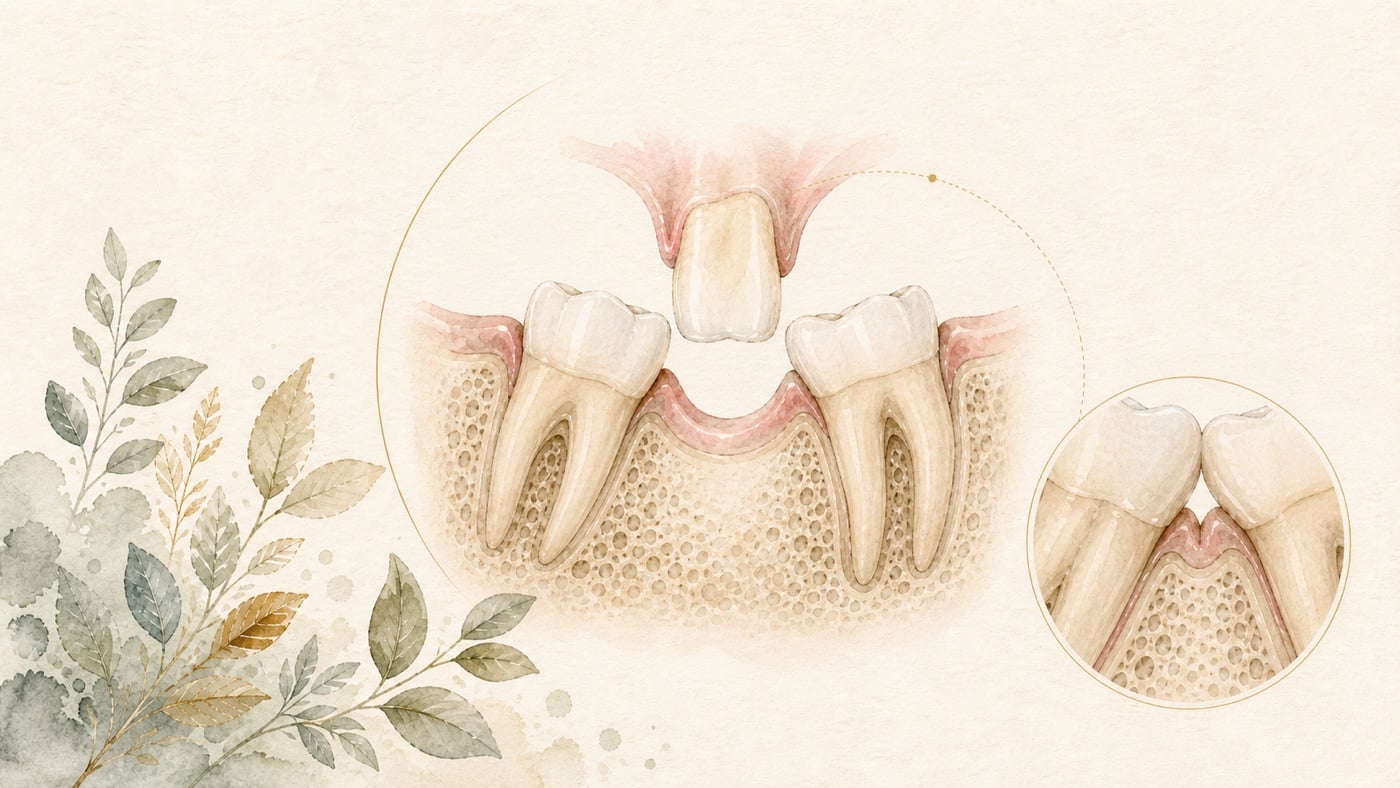
What Happens If You Leave a Single Missing Tooth Unreplaced? Setting Out the Evidence on Drifting, Cleaning and Chewing
Whether to replace a tooth after losing it cannot be settled by the line "the other teeth are bound to fall over". What the existing systematic evidence can better support is this: when posterior occluding pairs are clearly reduced, overall masticatory performance may become worse. Most studies of this kind, however, observe shortened dental arch — that is, several posterior teeth or several occluding pairs missing — which is not a synonym for an adult who has lost a single tooth. At present this corpus contains no direct systematic review showing that the loss of a single permanent tooth in an adult causes adjacent teeth to drift or creates areas that cannot be cleaned; data on the early loss of primary teeth in children cannot be extrapolated to adults. Nor do the existing reviews support treating one or more missing teeth as a settled cause of temporomandibular disorder — in other words, it cannot be written as "missing teeth inevitably lead to TMD".
What Happens If You Leave a Single Missing Tooth Unreplaced? Setting Out the Evidence on Drifting, Cleaning and Chewing
Direct answer: The existing reviews do not support the idea that losing one tooth inevitably causes adjacent teeth to drift, creates areas that cannot be cleaned, or brings on temporomandibular disorder. The review of tooth loss and TMD included six observational studies, five at high risk of bias and one at moderate risk, and concluded that there is no scientific evidence to support the association between one or more tooth loss and the presence of TMD signs and symptoms or diagnostic subgroups [F3]. What is better supported is that masticatory performance is lower when posterior occlusal support is clearly reduced: in subjects with only three to five, or zero to two, posterior occluding pairs, comminution or mixing ability was 28–39% lower than in complete dentitions [F1]. So the task is individual assessment and follow-up, not a decision taken from one frightening conclusion.
Geographic scope: This is general health education based on international literature. It does not cover any particular country's insurance scheme or regulations; for how care and fees are organised, follow the rules where you are. Every source cited in this card is international peer-reviewed literature; no national legislation or insurance-benefit rule is cited.
TL;DR — A missing tooth is worth assessing, but you do not need a frightening conclusion to hurry your decision
Whether to replace a tooth after losing it cannot be settled by the line "the other teeth are bound to fall over". What the existing systematic evidence can better support is this: when posterior occluding pairs are clearly reduced, overall masticatory performance may become worse. Most studies of this kind, however, observe shortened dental arch — that is, several posterior teeth or several occluding pairs missing — which is not a synonym for an adult who has lost a single tooth [F1][F2].
At present this corpus contains no direct systematic review showing that the loss of a single permanent tooth in an adult causes adjacent teeth to drift or creates areas that cannot be cleaned; data on the early loss of primary teeth in children cannot be extrapolated to adults. Nor do the existing reviews support treating one or more missing teeth as a settled cause of temporomandibular disorder — in other words, it cannot be written as "missing teeth inevitably lead to TMD" [F3].
What you genuinely need is individual assessment: where the tooth is missing, how many functional occluding pairs remain, how healthy the adjacent teeth are, whether the edentulous area is easy to clean, whether chewing has already been affected, and which forms of treatment and maintenance you can accept. This information will help you decide far more than any single figure found online.
First, a distinction: one missing tooth is not the same as a shortened dental arch
Shortened dental arch usually describes a dentition in which posterior occlusal support has already been shortened. Studies in this area often classify subjects by the number of posterior occluding pairs, so they can answer "what happens to chewing when posterior functional units are clearly reduced", but they cannot answer precisely "how much function will the one tooth you have lost cost you".
In one systematic review, shortened dental arch meant three to five posterior occluding pairs still present, while extreme shortened dental arch meant zero to two pairs; the comminution or mixing ability of these subjects was around 28–39% lower than that of a complete dentition [F1]. This range cannot be transferred to the effect of a single missing tooth in an adult, nor used to predict how you personally will change.
Another meta-analysis in adults found a pooled correlation between the number of remaining natural teeth and masticatory performance of 0.51, with a confidence interval of 0.48–0.54, though the authors graded the quality of the evidence as very low [F2]. Correlation does not mean that the loss of a single tooth causes a fixed amount of decline; the remaining functional occluding pairs, the muscles, oral moisture, and periodontal and prosthetic status may all take part in the result [F2].
Will the adjacent teeth really always drift?
Within this fixed set of evidence cards, the review that speaks directly about movement of adjacent teeth is the one on space maintainers in children. It included paediatric patients after early loss of primary teeth, and the authors consider that space maintainers help to avoid movement of adjacent teeth and support masticatory and speech function [F4].
Children, however, are still growing, and the relationship between primary and permanent tooth eruption is different. This review cannot be used to claim that an adult who loses a single permanent tooth will certainly see drifting within a given period, and still less does it provide a millimetre figure or an incidence for drifting that could safely be applied to adults. For you, whether tooth position has already changed still has to be confirmed by intra-oral examination, occlusal records and imaging where necessary.
How far can the evidence go on so-called "areas that cannot be cleaned"?
The shape of the edentulous area, tilting of adjacent teeth, the gingival contour and the way you use your cleaning tools may all change how difficult cleaning is; even so, this corpus at present contains no direct systematic review showing that the loss of a single permanent tooth in an adult causes uncleanable areas, caries or periodontal disease. "A missing tooth is bound to become an area that cannot be cleaned" cannot therefore be treated as a conclusion confirmed by meta-analysis.
A more practical approach is to look at the following together with your dentist: whether the proximal surfaces can be brushed, whether floss or an interdental brush passes through smoothly, whether food is repeatedly impacted, whether the adjacent teeth have already tilted, and whether the gum in the edentulous area inflames easily. If it can be cleaned now, that does not mean nothing will change later; if it cannot be cleaned easily now, it is still worth working out first whether the cause is tooth position, the periodontium, caries or cleaning technique.
Is worse chewing the same thing as an "unbalanced bite"?
They are not entirely the same concept. Masticatory performance in research is usually observed with comminution or mixing tests that look at overall performance; the everyday phrase "unbalanced bite" may mix together one-sided chewing, occlusal contacts, muscle fatigue, pain or simply not being used to something. The two cannot be swapped for one another.
Among subjects with shortened dental arch, removable dentures can partly compensate for the reduced masticatory performance, with the abstract estimating compensation of about half; when artificial teeth were added or the occlusal platform extended, comminution and mixing performance were also better in some studies [F1]. This supports the idea that functional units are related to masticatory performance, but it is still not evidence that "losing one tooth brings the same amount of decline".
As for whether missing teeth cause TMD, one systematic review included only six studies, five of them at high risk of bias and one at moderate risk of bias; only one found posterior tooth loss associated with joint sounds or joint pain, and the rest showed no significant association [F3]. Writing tooth loss and TMD as a settled causal chain is therefore not supported.
Not replacing it does not mean nothing needs following up
Some people watch and wait first, some are suited to having the tooth replaced, and others make different trade-offs between function, appearance and maintenance requirements. When a systematic review compared untreated shortened dental arch with different prosthetic approaches, the actual evidence came from four randomised trials and one non-randomised trial, and some of the included studies were still downgraded for methodological problems [F5].
Another review of reduced dentition in adults included only ten studies, and the authors consider that the present evidence is insufficient to recommend any one replacement strategy over another [F6]. This does not mean it makes no difference whether the tooth is replaced; it means the choice has to come back to the site of the loss, function, the condition of the adjacent teeth, cleaning and your own preferences, and cannot be settled by a group average.
If you decide not to replace it for the time being, you can agree with your dentist which items to keep watching: for example the position of the adjacent teeth, contact with the opposing tooth, which side you chew on, food impaction, and periodontal and caries status. Only by leaving a baseline record can you later compare and see whether anything has genuinely changed.
Which questions can you take to your dentist
You might begin by asking: "at this site, is what has been lost appearance, a single contact, or important posterior occlusal support?" Then confirm whether the adjacent teeth are healthy, whether they have already tilted or carry large restorations, and whether the edentulous area can be cleaned reliably.
You can also explain what matters most to you at the moment — chewing, appearance, how invasive the treatment is, cleaning, or future repairs. Once those priorities are clear, the dentist can place monitoring, a fixed bridge, a removable denture and an implant within the same context, instead of simply asking "do you want it replaced or not".
Data anchors — how these figures can be used
| Question | Data anchor | How to read it safely | Source |
|---|---|---|---|
| Clearly reduced posterior occlusal support and chewing | Comminution or mixing performance in the shortened dental arch group was 28–39% lower than in a complete dentition [F1] | Applies to several missing posterior occluding pairs; cannot be transferred to the effect of a single missing tooth | [F1] |
| Number of remaining teeth and masticatory performance in adults | Pooled r=0.51; 95% CI 0.48–0.54, evidence quality very low [F2] | A population-level correlation, not the causal size of each tooth lost | [F2] |
| Missing teeth and TMD | Five of the six studies at high risk of bias and one at moderate risk; only one showed a partial association [F3] | Does not support the view that missing teeth inevitably cause TMD | [F3] |
| Drifting of adjacent teeth in children | Eleven articles, four hundred and seventy-nine children, including four observational studies and seven randomised trials [F4] | Only collateral evidence on early loss of primary teeth; not extrapolable to adult permanent teeth | [F4] |
| Not replacing versus different prosthetic approaches | Twenty-one reports in fact derive from four randomised trials and one non-randomised trial [F5] | Fewer units of evidence than the number of reports, and some studies were downgraded | [F5] |
| Comparing strategies for reduced dentition in adults | The systematic review included ten studies and is still insufficient to recommend a single strategy [F6] | No universal ranking should be drawn from limited data | [F6] |
Conclusion — first establish what your missing tooth has actually caused, then decide whether to replace it
A missing tooth is not something small enough to ignore, but nor does everyone deteriorate along the same script. The existing evidence can prompt you to pay attention to posterior occlusal support and masticatory performance, yet it cannot prove that an adult who loses a single permanent tooth will inevitably suffer drifting of adjacent teeth, uncleanable areas or TMD.
If you are hesitating over whether a missing tooth needs attention, you can bring your existing imaging and your difficulties with cleaning and chewing to your own dentist, and confirm together the site of the loss, the condition of the adjacent teeth and the changes that can be followed. Identifying the problem clearly first, and then discussing monitoring or ways of replacing the tooth, is more solid ground than letting one frightening answer decide for you.
Risk factors (what to know before treatment)
- Neither the chewing data nor the drifting data comes from adults who have lost a single permanent tooth: the range for masticatory performance comes from subjects with only three to five posterior occluding pairs (shortened dental arch) or zero to two pairs (extreme shortened dental arch) [F1], while the data on movement of adjacent teeth come from paediatric patients after early loss of primary teeth [F4]. Treating either set of results as your prognosis already steps outside the evidence.
- The space-maintainer conclusion in children cannot be extrapolated to adults: the total number of patients treated in the included studies was four hundred and seventy-nine, with four observational studies and seven randomised clinical trials, and the review concluded that space maintainers help prevent the migration of adjacent teeth and the need for more invasive orthodontic treatments in the future, and contribute to adequate masticatory function and speech development [F4]. Children are still growing and still exchanging primary for permanent teeth, which is not an adult’s situation; the review likewise gives no millimetre figure or incidence for drifting that could be applied to adults.
- Correlation is not causation, and the authors themselves graded the evidence as very low: in the meta-analysis in adults, the pooled correlation coefficient between the number of natural or remaining teeth and masticatory performance was 0.51 (95% CI 0.48 to 0.54), the strongest positive association among the oral condition factors compared; but the authors state that this is based on the limited evidence available, with a very low quality of evidence [F2]. The included studies were cross-sectional, so no figure for "how much chewing ability each lost tooth costs" can be read back out of them.
- Missing teeth and TMD: the conclusion is “no scientific evidence to support”, not “proven harmless”: the review included six observational studies, five at high risk of bias and one at moderate risk; only one found an association between the loss of posterior teeth and joint sounds and joint pain, and the others found no significant association with TMD signs or diagnostic subgroups [F3]. The authors also state that there are no critical studies on the extent, quantity or location of these losses [F3] — absence of evidence and evidence of absence are two different things.
- In comparisons of replacing versus not replacing, there is far less evidence than there are reports: the review comparing untreated shortened dental arch with different prosthodontic interventions included twenty-one records, which in fact report the outcomes of four randomised controlled trials and one non-randomised clinical trial, and the authors note that some of the included studies had to be downgraded because of methodological errors [F5]. A further review of reduced dentition in adults included ten articles and concluded that there is currently insufficient evidence to recommend one tooth replacement strategy over another [F6].
- This card does not compile a list of contraindications, and does not decide for you whether to replace the tooth: no separate literature search on the indications and contraindications of the various replacement options was run for this card. The site of the loss, the remaining occlusal support, the condition of the adjacent teeth, periodontal and cleaning status, and the trade-offs between monitoring, a fixed bridge, a removable denture and an implant all have to be assessed item by item by a dentist; if you choose to watch and wait, record a baseline first and compare it at intervals.
Every clinical statement in this article is mapped line by line to its cited source (see the sources and evidence chain below). It has not been clinically reviewed by a licensed practitioner. This is health information, not individual advice; assessment by a clinician is required.
FAQ
- If I lose one tooth, will the tooth next to it certainly fall over?
- At present this corpus contains no direct systematic review on the drifting of adjacent teeth after an adult loses a single permanent tooth. The review of early primary tooth loss in children supports space maintenance, but growth, eruption and the adult situation are different, so it cannot be extrapolated directly [F4].
- 歯を一本失ったら、隣の歯は必ず倒れてきますか? — 現時点でこの資料群には、成人が永久歯を一本失ったあとの隣在歯の移動に関する直接のシステマティックレビューはありません。小児の乳歯早期喪失のレビューは保隙を支持していますが、成長、萌出、成人の状況は異なるため、そのまま外挿することはできません [F4]。
- If I lose one tooth, will the tooth next to it certainly fall over? — At present this corpus contains no direct systematic review on the drifting of adjacent teeth after an adult loses a single permanent tooth. The review of early primary tooth loss in children supports space maintenance, but growth, eruption and the adult situation are different, so it cannot be extrapolated directly [F4].
- The gap looks empty — does that necessarily make it harder to clean?
- Not necessarily. Whether it is hard to clean depends on the position of the adjacent teeth, the gingival contour, food impaction and whether you can use suitable tools; the fixed evidence cards at present contain no direct systematic data showing that a single missing tooth in an adult creates an area that cannot be cleaned.
- 欠損部が空いて見えるのですが、必ず清掃しにくくなりますか? — 必ずしもそうではありません。清掃しにくいかどうかは、隣在歯の位置、歯肉の輪郭、食片の圧入、そして適した用具を使えるかによります。現時点の資料群には、成人が一本失うことで清掃の死角が生じるという直接のシステマティックなデータはありません。
- The gap looks empty — does that necessarily make it harder to clean? — Not necessarily. Whether it is hard to clean depends on the position of the adjacent teeth, the gingival contour, food impaction and whether you can use suitable tools; the fixed evidence cards at present contain no direct systematic data showing that a single missing tooth in an adult creates an area that cannot be cleaned.
- If I lose one back tooth, does chewing ability drop by roughly three tenths?
- It cannot be read that way. That range comes from shortened dental arch groups still having three to five, or zero to two, posterior occluding pairs; it does not come from studies of a single missing tooth [F1].
- 臼歯を一本失うと、咀嚼能力は三割ほど落ちるのですか? — そのように読み取ることはできません。この範囲は、臼歯部の咬合ペアが三~五対、あるいはゼロ~二対残っている短縮歯列群に由来するもので、一本の欠損を対象とした研究ではありません [F1]。
- If I lose one back tooth, does chewing ability drop by roughly three tenths? — It cannot be read that way. That range comes from shortened dental arch groups still having three to five, or zero to two, posterior occluding pairs; it does not come from studies of a single missing tooth [F1].
- Do missing teeth cause temporomandibular disorder?
- The existing systematic review does not support that conclusion. The included evidence is at high risk of bias, and most of the studies found no significant association between missing teeth and TMD signs or diagnostic subgroups [F3].
- 歯の欠損は顎関節症を引き起こしますか? — 既存のシステマティックレビューはこの断定を支持していません。組み入れられたエビデンスはバイアスリスクが高く、また多くの研究は歯の欠損と TMD の徴候あるいは診断サブグループとの有意な関連を見いだしていません [F3]。
- Do missing teeth cause temporomandibular disorder? — The existing systematic review does not support that conclusion. The included evidence is at high risk of bias, and most of the studies found no significant association between missing teeth and TMD signs or diagnostic subgroups [F3].
- If there is no discomfort, can I leave it unreplaced for now?
- Whether to watch and wait depends on the site of the loss, occlusal support, the adjacent teeth and cleaning. The systematic review of reduced dentition is still insufficient to recommend the same strategy for everyone, so it is more appropriate to establish a baseline first, set out clearly what will be followed up, and then decide together [F6][F5].
- 不快感がなければ、しばらく補わなくてもよいですか? — 経過を見るかどうかは、欠損の部位、咬合支持、隣在歯と清掃の状態によります。減少歯列のシステマティックレビューは、すべての人に同じ戦略を採るよう推奨するにはなお不十分です。ですから、まず基準を作り、追跡する項目をはっきりさせたうえで、一緒に決めるほうが適しています [F6][F5]。
- If there is no discomfort, can I leave it unreplaced for now? — Whether to watch and wait depends on the site of the loss, occlusal support, the adjacent teeth and cleaning. The systematic review of reduced dentition is still insufficient to recommend the same strategy for everyone, so it is more appropriate to establish a baseline first, set out clearly what will be followed up, and then decide together [F6][F5].
Medical notice This article is provided for health education and medical information purposes. It is not a solicitation for medical services and does not constitute diagnosis or treatment advice. Actual treatment methods and outcomes vary between individuals and require evaluation by a dentist; every treatment has its own indications, limitations and possible risks. If you have related symptoms or treatment needs, please book a consultation for evaluation by a dentist.
Source anchors
- Effects of removable dental prostheses on masticatory performance of subjects with shortened dental arches: A systematic review. [PMID:26066662] · https://pubmed.ncbi.nlm.nih.gov/26066662/ · 在 IDAEO 的其他引用
- Association between masticatory performance and oral conditions in adults: A systematic review and meta-analysis. [PMID:36563840] · https://pubmed.ncbi.nlm.nih.gov/36563840/ · 在 IDAEO 的其他引用
- Updating The General Practitioner on The Association Between Teeth Loss and Temporomandibular Disorders: A Systematic Review. [PMID:36574784] · https://pubmed.ncbi.nlm.nih.gov/36574784/ · 在 IDAEO 的其他引用
- Effectiveness of Space Maintainers in Pediatric Patients: A Systematic Review and Meta-Analysis. [PMID:39851607] · https://pubmed.ncbi.nlm.nih.gov/39851607/ · 在 IDAEO 的其他引用
- Differences in functional outcomes for adult patients with prosthodontically-treated and -untreated shortened dental arches: a systematic review. [PMID:24992473] · https://pubmed.ncbi.nlm.nih.gov/24992473/ · 在 IDAEO 的其他引用
- Effectiveness of prosthodontic interventions and survival of remaining teeth in adult patients with shortened dental arches-A systematic review. [PMID:29476794] · https://pubmed.ncbi.nlm.nih.gov/29476794/ · 在 IDAEO 的其他引用
Cite this article
Lucy・《What Happens If You Leave a Single Missing Tooth Unreplaced? Setting Out the Evidence on Drifting, Cleaning and Chewing》・IDAEO 知識庫・2026-07-20・https://km.idaeo.ai/post/dental/missing-toothUpdated 2026-08-26