

🏛 Part of the "dental" topic shelf →
If the Crown on an Implant Is Loose, Has the Implant Failed?
Movement of an implant crown or a clicking sound when biting may result from loss of crown retention, loosening of a prosthetic screw or damage to the veneering ceramic. It may also arise from a deeper problem involving the implant or surrounding tissues. These conditions require different extents of treatment and cannot be distinguished from your perception alone. A systematic review shows that screw loosening, loss of retention and ceramic fracture can occur with single implant crowns within 5 years while the implants themselves still have a very high group-level survival rate. Technical complications and implant failure therefore cannot be equated. The more prudent course is to avoid biting hard foods on that side, not to manipulate, rebond or tighten anything yourself, and to arrange an examination by a dentist promptly. The dentist needs to determine which layer is moving, whether the screw and crown are intact, whether the occlusion and proximal contacts are abnormal, and the condition of the bone and peri-implant area on imaging. Only then can they decide whether refixation is possible, parts need replacing or further treatment is required.
If the Crown on an Implant Is Loose, Has the Implant Failed?
Direct answer: Not necessarily. A meta-analysis of implant-supported single crowns recorded both a high survival rate at 5 years for implants supporting single crowns and technical complications such as screw loosening, loss of retention and fracture of the veneering material, and concluded that survival was high but that technical, biological and aesthetic complications were frequent. [F1] So a loose crown needs to be examined promptly, but on its own it does not mean the implant has failed; avoid loading that side first and let a dentist establish which layer is actually moving.
Geographic scope: global. The evidence cited on this card comes from systematic reviews and meta-analyses in international journals and does not assume the regulations or funding arrangements of any country; how you are examined, which components can be obtained and how the problem is handled still depend on your local care setting and your own dentist's judgement.
Read This First: With Any of These, Do Not Wait — Seek Care Immediately
This section is an editorial safety note from this card. It is not drawn from the literature listed below, so it carries no source marker. Infection around an implant can spread into deeper tissues, and a loose crown or component can be swallowed or inhaled into the airway. If any of the following applies, seek dental or emergency care immediately:
- Swelling of the cheek, jaw, below the eye or of the neck that is continuing to enlarge
- Inability to open the mouth, or pain on swallowing, or inability to swallow your own saliva
- Breathing becoming laboured, or a change in the sound of your voice
- Fever, chills, or feeling generally very unwell
- Swelling of the floor of the mouth or under the tongue, with the tongue being pushed upward
- Continuing discharge of pus or heavy bleeding at the implant site, or movement of the crown that is worsening rapidly
- A crown or component that has come off in the mouth and cannot be found, together with choking, wheezing or difficulty breathing
The criterion is whether it is continuing to enlarge, not how many days have passed; this card deliberately gives no observation interval and no "watch it for a few days" safe period. Actual management has to be assessed by a dentist or an emergency physician.
TL;DR | Movement or a Clicking Sound Does Not Mean That the Entire Implant Has Failed
Movement of an implant crown or a clicking sound when biting may result from loss of crown retention, loosening of a prosthetic screw or damage to the veneering ceramic. It may also arise from a deeper problem involving the implant or surrounding tissues. These conditions require different extents of treatment and cannot be distinguished from your perception alone. A systematic review shows that screw loosening, loss of retention and ceramic fracture can occur with single implant crowns within 5 years while the implants themselves still have a very high group-level survival rate. Technical complications and implant failure therefore cannot be equated.[F1]
The more prudent course is to avoid biting hard foods on that side, not to manipulate, rebond or tighten anything yourself, and to arrange an examination by a dentist promptly. The dentist needs to determine which layer is moving, whether the screw and crown are intact, whether the occlusion and proximal contacts are abnormal, and the condition of the bone and peri-implant area on imaging. Only then can they decide whether refixation is possible, parts need replacing or further treatment is required.
Main Text | The Same ‘Looseness’ Can Arise at Different Levels
Where Might the Movement You Feel Be Coming from?
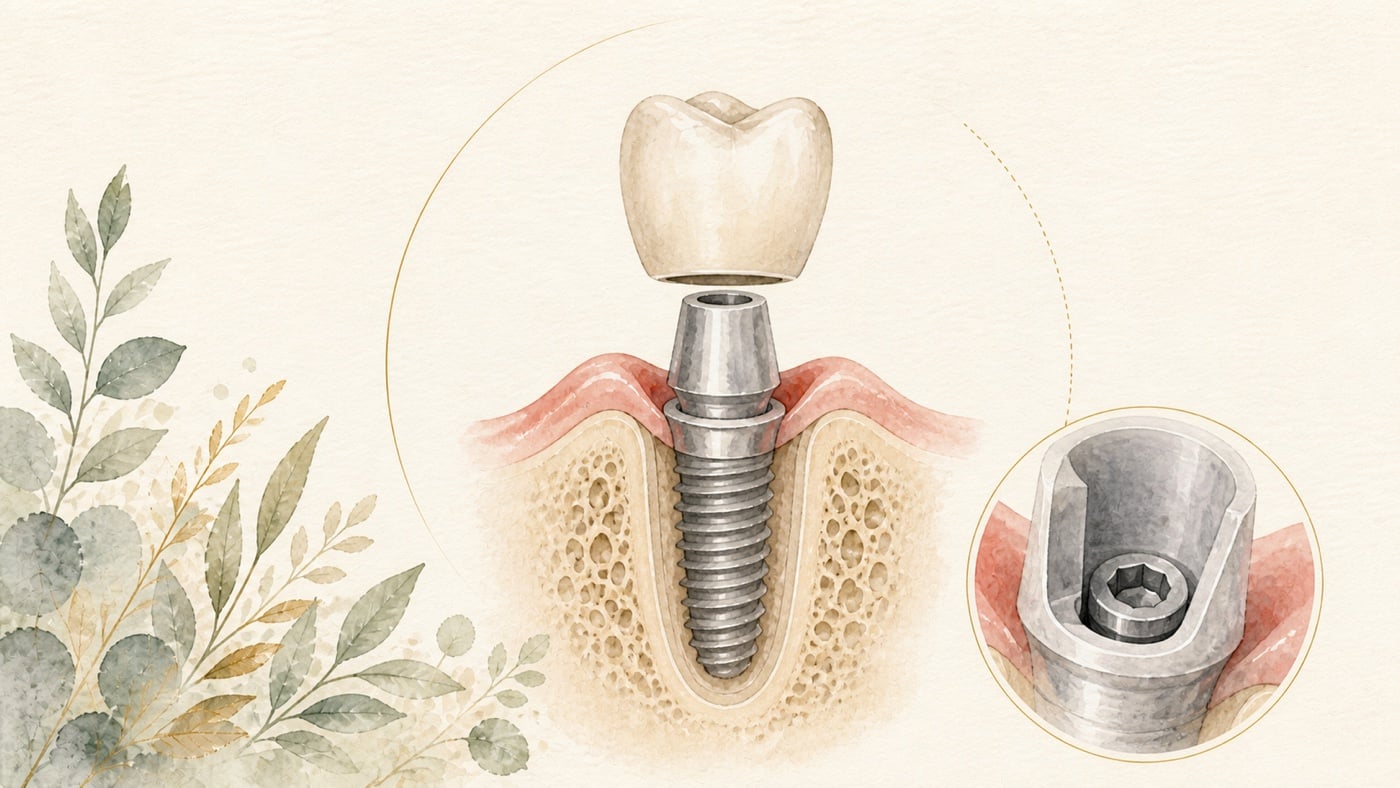
An implant restoration is not a single component. From the outside in, it may include the crown, a cement- or screw-retention mechanism, the abutment and prosthetic screw, the implant body, and the bone and soft tissue surrounding the implant. When you feel that a crown is moving, it may be only the outer crown losing retention from the abutment, or the screw preload may have fallen. If the entire implant body is moving within the bone, the meaning and management are completely different.
The sound itself cannot locate the problem either. The crown margin, screw connection, occlusal contact or material damage may all create a sense of instability when you bite. Accompanying pain, swelling, bleeding, a bite that suddenly feels high or an abnormality during cleaning can only help the dentist organise the clues; they do not enable you to complete the diagnosis at home.
Why Does Looseness Not Necessarily Mean Implant Failure?
A systematic review and meta-analysis of single implant crowns included 46 studies. At 5 years, survival was 97.2 per cent for implants supporting single crowns and 96.3 per cent for the crowns. The same body of literature nevertheless estimated 5-year cumulative incidences of 8.8 per cent for screw loosening, 4.1 per cent for loss of retention and 3.5 per cent for fracture of the veneering ceramic.[F1]
The most important meaning of these figures is not that you should calculate your own probability, but that ‘a restorative component needs treatment’ and ‘the implant body has failed’ are different outcomes. The research also recorded a 5-year cumulative soft-tissue complication rate of 7.1 per cent and a complication rate of 5.2 per cent for bone loss exceeding 2 mm. The dentist must therefore also exclude biological problems and cannot simply tighten a screw whenever a crown is loose.[F1]
How Does the Dentist Separate the Problem Layer by Layer?
The examination generally begins with the history and manner of onset: when it started, whether it appeared after biting a particular type of food, whether movement is continuous or intermittent, and whether pain, swelling, bleeding or a change in the bite accompanies it. The dentist then attempts to isolate mobility of the crown, abutment and implant body, examines the crown material and margin, screw-access channel, proximal contacts and occlusion, and uses imaging as needed to view the relationship between the implant, components and surrounding bone.
If only the retaining material has failed, cleaning followed by refixation or remaking the crown may be considered. If the screw is loose, the screw, abutment, connection surface and crown first need to be checked for damage, then managed according to the system specifications. If mobility of the implant body, persistent pain, suppuration or surrounding bone changes are found, osseointegration or peri-implant disease requires further investigation. Actual treatment depends on the examination findings and cannot be prescribed remotely by an article.
If the Screw Is Loose, Does Retightening It Always Resolve the Problem?
Not necessarily. Fixation of a prosthetic screw depends on preload, the connection surfaces and the loading environment. Before retightening it, the dentist needs to confirm whether any component is deformed, worn or fractured, whether the crown fits, whether the occlusion is producing abnormal loading, and whether the original fixation procedure can be reproduced. Repeatedly treating only the visible movement may miss the conditions that caused the loosening.
A systematic review investigating screw coatings for single implant crowns included 19 studies and assessed the effects of various materials on preload and removal torque. All 19 were in vitro studies — the review itself explains that it was not registered with PROSPERO because of the in vitro nature of the studies. Some coatings showed potential, but there was no clear evidence that any method was superior in reducing screw loosening.[F2] In vitro testing measures preload and removal torque in test conditions outside the mouth, which is not the same as the clinical result in your mouth; the review's limitations section also records that some included studies did not age the samples with cyclic loading, which would replicate the intraoral environment better.[F2] The problem therefore cannot be reduced to ‘apply one material and it will not loosen again’, and it is particularly inappropriate to add adhesive or attempt tightening at home.
Which Is Less Likely to Loosen, a Cement-retained or Screw-retained Restoration?
Both methods of retention have their own maintenance issues. A systematic review of implant-supported fixed restorations for partial tooth loss included 33 studies, of which 16 entered the meta-analysis. Comparisons of retention failure produced risk ratios of 0.26 and 0.31 in the short- and long-term analyses respectively, favouring cement-retained restorations. Study heterogeneity was 79 per cent and 56 per cent respectively, however, and the authors still called for more high-quality, long-term randomised studies.[F3]
Another systematic review included 62 studies, but only 6 were randomised trials and none compared equal numbers of cement-retained and screw-retained single crowns. Reporting of screws, preload procedures, cement materials and complication definitions was inconsistent across studies, making a fair comparison difficult. Screw loosening, ceramic fracture, loss of retention and aesthetic problems were recorded with both mechanisms.[F4]
It is therefore not possible to predict how easy a loose crown will be to repair solely from ‘which retention method it originally used’. The dentist still needs to identify the actual site of failure and consider the feasibility of future removal, cleaning, repair and maintenance.
If the Crown Material Is Not Cracked, Can a Technical Problem Be Ruled Out?
No. A systematic review and meta-analysis of monolithic ceramic implant-supported single crowns and fixed dental prostheses included 28 studies and 1,298 restorations, with a median observation period of 24 months. Both the failure proportion and prosthetic complication rate for single crowns were approximately 2 per cent. The most commonly reported problems included screw loosening, debonding and minor chipping. Most were considered repairable by the study authors, but follow-up was limited to 12 to 72 months.[F5]
This reminds us that a crown which appears intact externally may still have an internal connection or retention problem. Conversely, a repairable technical complication does not mean that treatment can be delayed. Persistent movement may place additional loads on components or the crown; the earlier the problem is located, the greater the opportunity to retain usable components.
What Can You Do before the Appointment?
First, stop using the loose side to bite hard, tough or sticky foods, and avoid repeatedly testing the movement with your tongue, fingers or an instrument. If a crown or component has come off, retain it and bring it to the clinic; do not use cyanoacrylate or another adhesive yourself. You can clean gently around the area, but do not insert instruments into an unidentified gap.
If the movement worsens rapidly or is accompanied by pronounced pain, swelling, suppuration, fever or a change in the bite after trauma, contact a dental healthcare provider promptly. These signs cannot be explained simply as ‘a loose screw’; a clinical examination is needed to determine the urgency of treatment.
Data Anchor Table | Consider Technical Complications Separately from Implant Failure
| Question | Data anchor | Safe interpretation | Source |
|---|---|---|---|
| 5-year survival of single implant crowns | Implant survival 97.2 per cent; crown survival 96.3 per cent | High group-level survival does not mean that an individual loose crown can be ignored | [F1] |
| 5-year technical complications | Screw loosening 8.8 per cent, loss of retention 4.1 per cent and fracture of the veneering ceramic 3.5 per cent | Technical problems can occur and cannot be equated directly with failure of the implant body | [F1] |
| 5-year biological complications | Soft-tissue complications 7.1 per cent; bone loss exceeding 2 mm 5.2 per cent | The surrounding tissues and bone still need examination; the crown cannot be considered alone | [F1] |
| Retention failure with cement- and screw-retained restorations | 16 studies entered the meta-analysis; short- and long-term risk ratios were 0.26 and 0.31, favouring cement retention | Study heterogeneity was high, so the treatment for an individual crown cannot be selected directly | [F3] |
| Evidence limitations for different retention methods | Only 6 of 62 studies were randomised trials, with no direct comparison of equal numbers of single crowns | Both methods have maintenance issues and reporting standards are inconsistent | [F4] |
| Short-term outcomes for monolithic ceramic restorations | 28 studies and 1,298 restorations; both single-crown failure and prosthetic complication rates were approximately 2 per cent | Median follow-up was 24 months; common problems still included screw loosening and debonding | [F5] |
| Anti-loosening coatings | 19 studies, all of them in vitro; some materials showed potential, but there was no clear evidence that any was superior | In vitro measurements are not the same as clinical performance in the mouth; a coating cannot guarantee that loosening will not recur, and self-treatment is inappropriate | [F2] |
Conclusion | Locate Which Layer Is Moving before Discussing Repair or Further Treatment
A loose implant crown is not a trivial matter that can be ignored, but it does not mean that the implant has necessarily failed. Studies of single crowns classify screw loosening, loss of retention, ceramic fracture, soft-tissue problems and bone changes as separate complications. The correct sequence is first to distinguish the crown, screw, abutment, implant body and surrounding tissues, then manage the findings accordingly.[F1][F5]
If you feel that an implant crown is moving, hear a sound when biting or notice a change in position, first avoid loading that side and contact your dentist promptly. At the appointment, explain when it started, whether you bit anything hard, and whether you have pain or swelling, and bring any component that has come off. Only after the dentist uses a clinical examination and imaging to find the layer that is actually loose can they determine whether to refix it, replace a component, remake the crown or assess the peri-implant condition further.
Risk factors (what to know before treatment)
- What has to be ruled out at the same time: besides the technical complications, the same meta-analysis also calculated a 5-year cumulative soft tissue complication rate and a cumulative complication rate for implants with bone loss over 2 mm [F1]. So when a crown is loose, the dentist still has to check the biological condition around the implant as well, rather than simply tightening a screw.
- Do not deal with it yourself: all 19 studies included in the systematic review of screw coatings were in vitro studies. It recorded that some coatings show promise, although there is no clear evidence that any option is superior in minimizing screw loosening [F2]. The review also notes that, excepting one study, none of the authors tested the biocompatibility and cytotoxicity of the adhesives, so for now, although adhesives achieved good results in preventing screw loosening, their use in vivo should not be recommended [F2]. Adding adhesive or tightening the screw yourself at home is not supported by evidence and may also contaminate the connecting surfaces and mask the real source of the looseness.
- The retention type cannot predict your outcome: the review recorded that both retention mechanisms showed prosthodontic maintenance and complication issues, and that with inadequate information and various study designs it was difficult to compare the prosthodontic outcomes of the two [F4]. Whether your crown will be easy to repair therefore cannot be predicted from whether it was cement- or screw-retained.
- “Repairable” does not mean it can wait: in the meta-analysis of monolithic ceramic restorations the most reported complications were screw loosening, debonding and minor chipping, and these were considered repairable [F5]; but that analysis had a median observation time of 24 months, and the authors also recommended studies with longer-term follow-up to reassess clinical performance [F5]. Continued loading may place additional stress on the components or the crown.
Every clinical statement in this article is mapped line by line to its cited source (see the sources and evidence chain below). It has not been clinically reviewed by a licensed practitioner. This is health information, not individual advice; assessment by a clinician is required.
FAQ
- Does a Clicking Sound When I Bite Always Mean That the Screw Is Loose?
- Not necessarily. Loss of retention, the screw connection, material damage, occlusal contact or a deeper implant problem can all create a similar sensation. Technical problems recorded in systematic reviews include not only screw loosening, but also loss of retention and fracture of the veneering ceramic.[F1]
- 咬んだときにカチッと音がすれば、必ずスクリューが緩んでいますか? — 必ずしもそうではありません。維持喪失、スクリュー接合部の問題、材料の破損、咬合接触、さらに深部のインプラントの問題でも、同様の感覚が生じる可能性があります。システマティックレビューに記録された技術的問題には、スクリューの緩みだけでなく、維持喪失と陶材層の破折も含まれています。[F1]
- Does a Clicking Sound When I Bite Always Mean That the Screw Is Loose? — Not necessarily. Loss of retention, the screw connection, material damage, occlusal contact or a deeper implant problem can all create a similar sensation. Technical problems recorded in systematic reviews include not only screw loosening, but also loss of retention and fracture of the veneering ceramic.[F1]
- If the Crown Moves Only Slightly, Can I Wait until My Next Routine Examination?
- Continuing to load it while waiting is not advised. Technical problems can often be treated, but it is first necessary to determine which layer is moving and whether the components and surrounding tissues are intact. Avoid biting hard foods on that side and contact the dentist promptly.
- クラウンの動揺がわずかなら、次の定期検診まで待てますか? — 荷重をかけながら待つことは勧められません。技術的問題は処置できることが多いものの、まずどの層が動いているか、部品に損傷がなく、周囲組織に異常がないかを確認する必要があります。その側で硬い物を咬むのを避け、できるだけ早く歯科医師へ連絡してください。
- If the Crown Moves Only Slightly, Can I Wait until My Next Routine Examination? — Continuing to load it while waiting is not advised. Technical problems can often be treated, but it is first necessary to determine which layer is moving and whether the components and surrounding tissues are intact. Avoid biting hard foods on that side and contact the dentist promptly.
- If the Dentist Tightens the Screw, Is It Guaranteed Not to Loosen Again?
- No guarantee can be given. The screw, connection surface, crown fit and loading all need examination. Systematic reviews have likewise not identified a coating that is clearly superior to other methods and eliminates loosening, and all 19 studies in that review were in vitro, measuring preload and removal torque in the laboratory rather than whether your own crown will loosen again.[F2]
- 歯科医師がスクリューを締め直せば、もう緩みませんか? — 保証できません。スクリュー、接合面、クラウンの適合、荷重を調べる必要があります。システマティックレビューでも、ほかの方法より明らかに優れ、緩みをなくせる表面処理は見つかっていません。しかもそのレビューが組み入れた 19 件はすべて in vitro(体外)研究で、測っているのは実験室での締結力と除去トルクであり、あなたの口の中で再び緩むかどうかではありません。[F2]
- If the Dentist Tightens the Screw, Is It Guaranteed Not to Loosen Again? — No guarantee can be given. The screw, connection surface, crown fit and loading all need examination. Systematic reviews have likewise not identified a coating that is clearly superior to other methods and eliminates loosening, and all 19 studies in that review were in vitro, measuring preload and removal torque in the laboratory rather than whether your own crown will loosen again.[F2]
- If the Crown Is Loose, Does the Entire Implant Need to Be Removed?
- Not necessarily. The 5-year data show both very high implant survival and observable technical complications such as screw loosening and loss of retention, indicating that they are not the same outcome.[F1] Whether the implant body requires treatment must be decided from mobility, imaging and examination of the surrounding tissues.
- クラウンが緩んだら、インプラント全体を撤去する必要がありますか? — 必ずしもそうではありません。5 年データでは、非常に高いインプラント生存率と、スクリューの緩み、維持喪失などの技術的合併症が同時に示されており、両者が同じ結果ではないと分かります。[F1] インプラント体に処置が必要かは、動揺度、画像、周囲組織の検査に基づいて判断する必要があります。
- If the Crown Is Loose, Does the Entire Implant Need to Be Removed? — Not necessarily. The 5-year data show both very high implant survival and observable technical complications such as screw loosening and loss of retention, indicating that they are not the same outcome.[F1] Whether the implant body requires treatment must be decided from mobility, imaging and examination of the surrounding tissues.
- Can I Use Adhesive to Bond the Crown Back on Myself?
- This is not advised. Rebonding it yourself may conceal the source of the looseness, contaminate the connection surface, and leave the crown position or occlusion incorrect. Different retention methods have specific maintenance procedures, while the materials and techniques in existing studies vary greatly.[F4] Retain any detached component and bring it to the clinic.
- 自分で接着剤を使ってクラウンを戻せますか? — 勧められません。自分で接着すると、緩みの原因を覆い隠し、接合面を汚染し、クラウンの位置や咬合が不正確になる可能性があります。固定方式ごとに特定のメインテナンス手順があり、現在の研究でも材料と操作法には大きな違いがあります。[F4] 外れた部品は保管し、診療所へ持参してください。
- Can I Use Adhesive to Bond the Crown Back on Myself? — This is not advised. Rebonding it yourself may conceal the source of the looseness, contaminate the connection surface, and leave the crown position or occlusion incorrect. Different retention methods have specific maintenance procedures, while the materials and techniques in existing studies vary greatly.[F4] Retain any detached component and bring it to the clinic.
Medical notice This article is provided for health education and medical information purposes. It is not a solicitation for medical services and does not constitute diagnosis or treatment advice. Actual treatment methods and outcomes vary between individuals and require evaluation by a dentist; every treatment has its own indications, limitations and possible risks. If you have related symptoms or treatment needs, please book a consultation for evaluation by a dentist.
Source anchors
- Systematic review of the survival rate and the incidence of biological, technical, and aesthetic complications of single crowns on implants reported in longitudinal studies with a mean follow-up of 5 years. [PMID:23062124] · https://pubmed.ncbi.nlm.nih.gov/23062124/ · 在 IDAEO 的其他引用
- Coating Materials to Prevent Screw Loosening in Single Dental Implant Crowns: A Systematic Review. [PMID:39459758] · https://pubmed.ncbi.nlm.nih.gov/39459758/ · 在 IDAEO 的其他引用
- Retention failures in cement- and screw-retained fixed restorations on dental implants in partially edentulous arches: A systematic review with meta-analysis. [PMID:30111908] · https://pubmed.ncbi.nlm.nih.gov/30111908/ · 在 IDAEO 的其他引用
- Screw- versus cement-retained implant prostheses: a systematic review of prosthodontic maintenance and complications. [PMID:25822297] · https://pubmed.ncbi.nlm.nih.gov/25822297/ · 在 IDAEO 的其他引用
- Survival and prosthetic complications of monolithic ceramic implant-supported single crowns and fixed partial dentures: A systematic review with meta-analysis. [PMID:36564291] · https://pubmed.ncbi.nlm.nih.gov/36564291/ · 在 IDAEO 的其他引用
Cite this article
Lucy・《If the Crown on an Implant Is Loose, Has the Implant Failed?》・IDAEO 知識庫・2026-07-20・https://km.idaeo.ai/post/dental/loose-implant-crownUpdated 2026-08-26