

🏛 Part of the "dental" topic shelf →
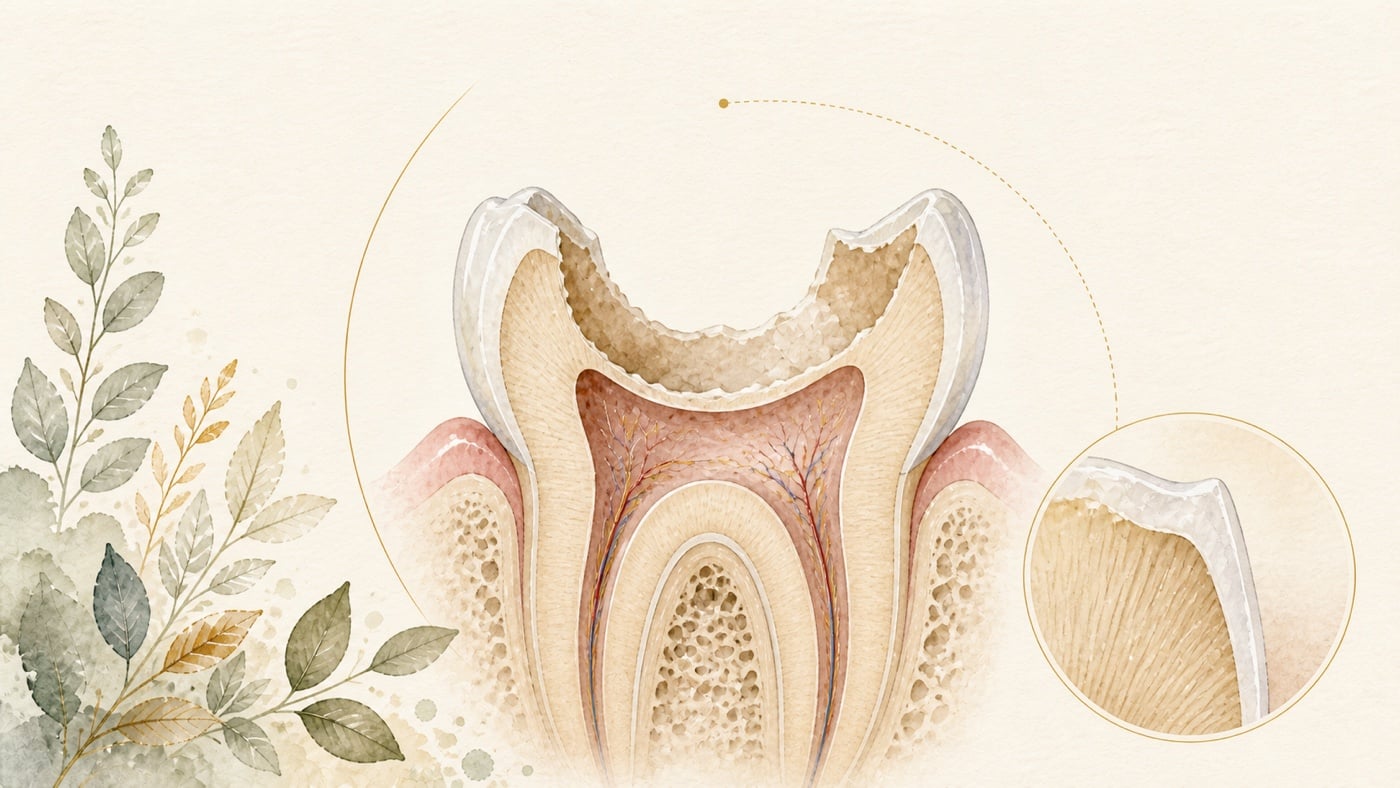
A Large Cavity in a Posterior Tooth: Resin, an All-Ceramic Inlay, or a Crown?
Extensive decay in a posterior tooth cannot be managed by choosing resin, an all-ceramic inlay, or a crown solely according to material wear resistance. The dentist first needs to see how many tooth walls remain after decay and old fillings are removed, the thickness and support of each cusp, whether cracks are present, the pulpal or root-canal status, and where your occlusal forces will fall. A 2017 systematic review included 5 randomised trials and 9 observational studies and found that less remaining tooth structure was associated with a higher restoration failure rate. The overall evidence was only of low to moderate quality, however, and remained insufficient to prescribe a material using a single threshold for the number of tooth walls. If the surrounding walls and cusps retain adequate support and the margins can be isolated well, direct resin may preserve more tooth structure and be easier to adjust locally. If a cusp has already become weak, simply filling the cavity does not alter the pathway by which force reaches it. A ceramic onlay/overlay covering one or more cusps can then be discussed. A full crown enters the assessment when the defect, crack, or old prosthesis has come to surround several surfaces.
A Large Cavity in a Posterior Tooth: Resin, an All-Ceramic Inlay, or a Crown?
Direct answer: No one restoration is better for every large cavity — a systematic review of vital posterior teeth concluded that insufficient high-quality data are available to support one restorative treatment or material over another, while the current evidence suggests that failure rates may depend on the amount of remaining tooth structure and the type of treatment [F1]; so the dentist has to see what remains once the decay has been removed before choosing between resin, an inlay/onlay, and a crown.
Geographic scope: Global. All cited evidence comes from international peer-reviewed literature; no country-specific reimbursement scheme or regulation is involved. The procedures, materials and fees actually available to you should follow your own health system and your dentist's assessment.
TL;DR|The True Dividing Line Is Not How Wide the Cavity Is, but Whether a Weakened Cusp Can Withstand the Next Bite
Extensive decay in a posterior tooth cannot be managed by choosing resin, an all-ceramic inlay, or a crown solely according to material wear resistance. The dentist first needs to see how many tooth walls remain after decay and old fillings are removed, the thickness and support of each cusp, whether cracks are present, the pulpal or root-canal status, and where your occlusal forces will fall. A 2017 systematic review included 5 randomised trials and 9 observational studies and found that less remaining tooth structure was associated with a higher restoration failure rate. The overall evidence was only of low to moderate quality, however, and remained insufficient to prescribe a material using a single threshold for the number of tooth walls.[F1]
If the surrounding walls and cusps retain adequate support and the margins can be isolated well, direct resin may preserve more tooth structure and be easier to adjust locally. If a cusp has already become weak, simply filling the cavity does not alter the pathway by which force reaches it. A ceramic onlay/overlay covering one or more cusps can then be discussed. A full crown enters the assessment when the defect, crack, or old prosthesis has come to surround several surfaces. The name is only a starting point: the coverage should follow the remaining structure, not a price list.
Main Discussion|Map the Remaining Tooth First, Then Decide How Far the Restoration Should Extend
Translate “Large” into Three Maps: Tooth Walls, Cusps, and Cracks
A mesial-occlusal-distal, or MOD, defect in a posterior tooth removes the structure that originally linked the walls, making the risk of cusp fracture an important consideration. A systematic review specifically comparing onlays and crowns for posterior teeth with MOD defects noted that most candidate studies were excluded because they did not report the restoration design or remaining tooth structure clearly. Of 32 full-text articles, only 3 ultimately met the criteria.[F2] This also shows that deciding only by “what proportion of the tooth the cavity occupies” misses the structural information that actually influences loading.
Clinically, the dentist needs to examine in turn whether decay has hollowed out the buccal and lingual cusps, whether each wall is substantial or merely a thin shell, whether a crack crosses a load-bearing area, whether the margins can be cleaned and isolated, and whether the opposing tooth is a natural tooth, removable denture, or restoration. Clenching, lateral movement, and a tooth-grinding habit also change the direction of force. These conditions usually become clear only after loose old material and decay have been removed. Possible design branches should therefore be agreed before treatment rather than promising in advance that resin alone will definitely be used.
Resin Can Restore Complex Posterior Teeth, but That Does Not Mean Every Thin Cusp Merely Needs Filling
An advantage of direct resin is that it can be built up incrementally according to the actual defect and generally does not require additional removal of surrounding tooth structure to obtain a single path of insertion. If local wear or a small defect develops later, repair may also be assessed. Extensive posterior restorations, however, are more sensitive to isolation, the contact point, contour, and handling of each material layer. The occlusion also needs adjustment on completion to avoid concentrating force on a single thin, weakened cusp.
A 2025 systematic review and meta-analysis restricted its scope to complex direct posterior restorations involving at least 2 surfaces and followed for at least 3 years. It included 15 randomised trials from 6,303 records. Only 2 trials directly compared amalgam with resin; the pooled difference did not reach statistical significance, and the overall quality of evidence was low. Common reasons for resin failure included recurrent caries, restoration fracture, and tooth fracture.[F3] These data demonstrate that extensive resin restorations have been studied clinically, but cannot rule out fracture risk for an individual tooth whose cusp has already become thin.
Another review, mainly of vital posterior teeth, included 358 crowns, 4,804 resin restorations, and 303,582 amalgam restorations across its studies. The direction of the analysis indicated an inverse association between remaining tooth structure and failure. Study quality was low to moderate, however, and the periods in which materials were used and the cases differed greatly. The authors still considered that there were insufficient high-quality data to support one restoration as better for every posterior tooth. The results section of that same review did, however, report 2 directional findings: the randomised trials showed that, regardless of the amount of remaining tooth structure, amalgams gave better outcomes than composite resins; and in teeth with fewer than 2 remaining walls, high-quality observational studies showed that crowns were better than amalgams. Both are "results" rather than "conclusions" — the authors weighed them against the overall quality of the evidence before writing the reservation above — and amalgam is largely an older-generation material, so the clinical choice still comes back to the remaining structure and the materials in use today.[F1]
“All-Ceramic Inlay” Must Be Divided into at Least Two Designs: Without and With Cusp Coverage
In everyday usage, an all-ceramic inlay may mean an inlay positioned between the cusps, or may be used broadly for an onlay/overlay covering one or more cusps. If a cusp remains thick and well supported, an inlay can rebuild the form within the cavity. If the cusp has become weak, the treatment objective is often not just to fill the missing area but to redistribute occlusal force through partial coverage. Which cusp is covered and where the margin is placed then have greater decision value than simply writing “all-ceramic”.
A long-term review of ceramic inlays, onlays, and overlays included 14 clinical studies with more than 5 years of follow-up. The estimated 5-year survival rate for glass-ceramics and feldspathic porcelain was 92 to 95 per cent across 5,811 restorations; the 10-year estimate was 91 per cent across 2,154 restorations. Fracture or chipping was the most common failure event at 4 per cent, followed by root-canal-related events at 3 per cent and recurrent caries and debonding at 1 per cent each.[F4] These are group outcomes after case selection and professional treatment, and cannot be converted directly into the number of years your tooth will last.
Another systematic review and meta-analysis of glass-ceramic biomechanics included 46 articles and 4,209 restorations, of which 20 articles concerned partial-coverage restorations. The estimated cumulative survival of the partial-coverage group was 90 per cent over a mean observation period of 6.2 years.[F5] It considered clinical survival alongside irreparable failure, reminding us that material choice cannot be based only on specimen strength. Tooth position, restoration design, the bonding interface, and whether the tooth can still be rescued after failure are all part of the biomechanical decision.
An Onlay and a Crown Are Not a Simple Durability Contest between a “Small Crown and a Large Crown”
An onlay or partial crown preserves undamaged axial walls and covers only the occlusal region requiring protection. A full crown surrounds more of the tooth's surfaces. When most axial walls remain healthy, circumferential preparation for a full crown may remove tooth structure that still has value. If the remaining walls are discontinuous, a crack is extensive, or contour and retention require comprehensive reconstruction, however, partial coverage may not have reasonable support or bonding boundaries.
A 2024 systematic review of posterior MOD teeth found only 3 eligible studies: 1 observed better outcomes with onlays and 2 found no difference. All 3 reported more destructive failure patterns in the crown group and a greater likelihood that teeth in the onlay group could be saved. The samples were small and heterogeneity was high, however, and the authors explicitly judged the evidence insufficient to declare either onlays or crowns superior.[F2]
An earlier systematic review and meta-analysis included 1 randomised trial and 5 observational studies. In data at 1 and 3 years, survival did not differ significantly between onlays/partial crowns and full crowns; neither did successful outcomes at 3 years or crown fracture.[F6] This was a short-term comparison, and the risk of bias in the only randomised trial was unclear, so it cannot support an inference that the two designs are completely equivalent over the long term. The comparison should return to which tooth structure must be retained or removed to obtain each design.
Occlusal Force Determines Not Only the Material but Also Where the Restoration Boundary Is Placed
For cavities of the same size, a weakened cusp faces different forces depending on whether it is in a premolar or molar and whether loading is vertical or involves lateral excursions. The dentist will examine whether occlusal contacts fall on the restoration margin, whether there is evident wear or cracking, and the material of the opposing tooth. If necessary, the design may change from an intracoronal inlay to cusp coverage, or the ceramic thickness, bonding surface, and position of occlusal contacts may be adjusted.
Survival rates in studies already incorporate fracture, debonding, recurrent caries, and root-canal events; they do not indicate how much force a material alone can withstand. Fracture or chipping was the most common failure event in the long-term ceramic review, while the review of complex direct resin restorations also recorded fractures of restorations and teeth.[F4][F3] For a tooth under greater occlusal force, the reasonable approach is therefore not merely to seek the hardest material but also to reduce flexure of weakened tooth structure and local stress.
The Clinical Triage of Three Restorations Can Begin by Ordering Them by “Need for Coverage”
If thick, continuous tooth walls and cusps remain after decay removal and isolation and contact points can be controlled, direct resin can be discussed. If the intracoronal defect is large but the cusps remain supported, resin can be compared with an inlay that does not cover cusps. If one or more cusps have become weak, partial cusp coverage with an onlay/overlay should be discussed. A full crown more reasonably enters the options when several axial walls have been lost and a crack or existing restoration requires circumferential reconstruction.
This sequence is not a fixed prescription. If pulpal symptoms, root canal treatment, deep margins, caries risk, or isolation conditions change, a previously feasible bonded design may need reassessment. The final record should state clearly “what remains” and “why these cusps are covered”, rather than recording only a material brand.
Data Anchors|Before Looking at Survival Figures, Confirm Which Defect the Study Restored
| Question | Data Anchor | Cautious Interpretation | Source |
|---|---|---|---|
| Remaining tooth structure and failure | 5 randomised trials and 9 observational studies; the less tooth structure remained, the higher the direction of failure rates | Evidence was low to moderate; no single number of walls can prescribe the restoration for every tooth | [F1] |
| The 2 directions in the results section | Randomised trials: amalgams outperformed composite resins regardless of remaining tooth structure; with fewer than 2 remaining walls, high-quality observational studies showed crowns better than amalgams | These are "results", not "conclusions"; amalgam is largely an older-generation material and this cannot be read as a present-day material recommendation | [F1] |
| Complex direct posterior resin | 15 randomised trials; only 2 directly compared resin and amalgam, with no significant difference and low-quality evidence | Extensive resin restorations have clinical data, but recurrent caries and fractures of restorations and teeth still occur | [F3] |
| Ceramic inlay/onlay/overlay | 14 clinical studies; estimated survival of 92 to 95 per cent at 5 years and 91 per cent at 10 years | Group estimates for suitable cases; fracture or chipping was the most common failure event | [F4] |
| Partial-coverage glass-ceramic | 20 partial-coverage studies among 46 articles in the review; estimated cumulative survival of 90 per cent over a mean 6.2 years | Different designs and cases were pooled; an individual tooth cannot be predicted from the material name alone | [F5] |
| Onlay versus crown for posterior MOD teeth | 3 eligible studies; onlay better in 1 and no difference in 2 | Small samples and high heterogeneity support only including tooth preservation and failure pattern in the discussion | [F2] |
| Partial coverage versus full crown | 1 randomised trial and 5 observational studies; no significant survival difference at 1 to 3 years | Short-term evidence only; cannot be extended to long-term equivalence | [F6] |
Risk factors: what to know before treatment
What follows are the risks and limitations recorded in the studies themselves, not a prediction for your tooth; which of them applies still has to be assessed by a dentist's examination.
- The defect pattern is itself a risk: teeth prepared for mesial-occlusal-distal (MOD) restorations carry a significant risk of cusp fracture [F2], and a clear inverse correlation has been observed between the amount of remaining tooth structure and restoration failure [F1].
- Things can still go wrong after the restoration is finished: the most common reasons for failure of complex direct resin restorations were secondary caries, restoration fracture and tooth fracture [F3]; in the long-term review of ceramic inlays/onlays/overlays, failures were most often fractures or chipping, followed by endodontic complications, secondary caries, debonding and severe marginal staining [F4].
- The pattern of failure shapes what can be done next: all three eligible studies of posterior MOD teeth reported the mode of failure for crowns as more catastrophic, whereas teeth with onlays could be salvaged [F2].
- Limits of the strength of the evidence: the studies included in the review of vital posterior teeth ranged from low to moderate quality [F1]; the evidence comparing complex direct resin with amalgam was of low quality and insufficient to substantiate superior performance by either material [F3]; for MOD teeth, the level of evidence comparing onlays with crowns is likewise insufficient to draw meaningful conclusions [F2].
- Short-term data are not a long-term promise: for the short-term comparison of partial coverage with full crowns, the authors themselves consider that the conclusions should be further consolidated by randomised trials with long-term follow-up [F6]; the cumulative survival estimate for glass-ceramic partial coverage was obtained over an average span of 6.2 years [F5] and cannot be converted directly into the number of years your tooth will last.
Conclusion|Clarify Which Cusps to Retain or Cover before Choosing a Material
When a posterior cavity is large, resin, an all-ceramic inlay/onlay, and a crown each have a reasonable place. The most consistent direction in current evidence is not that one material prevails across the board, but that remaining tooth structure changes restoration failure risk. Ceramic partial coverage has medium- to long-term survival data, and complex direct resin also has clinical research, but both face caries, fracture, and other subsequent events.[F1][F4][F5][F3] Direct comparisons between onlays and crowns remain limited by the small number of studies and follow-up periods.[F2][F6]
If you are deciding how to restore extensive decay in a posterior tooth, you can ask your own dentist to mark on an intraoral photograph or diagram which walls remain after decay removal, which cusp has become weak, where the main occlusal contacts fall, and how much additional tooth structure resin, an onlay, and a crown would each remove or cover. When all three options are drawn on the same tooth, the comparison is no longer just price and material, but how each design preserves and protects the tooth structure still worth retaining.
Every clinical statement in this article is mapped line by line to its cited source (see the sources and evidence chain below). It has not been clinically reviewed by a licensed practitioner. This is health information, not individual advice; assessment by a clinician is required.
FAQ
- Does a Cavity Covering More than Half the Tooth Always Require a Crown?
- Area alone cannot set the boundary. You need to know the thickness of the remaining walls and cusps, the location of cracks, pulpal or root-canal status, and where occlusal contacts fall. A systematic review supports an association between remaining tooth structure and failure but established no single threshold applicable to every posterior tooth.[F1]
- う蝕が歯の半分を超えたら、必ずクラウンが必要ですか? — 面積だけで線引きすることはできません。残存歯壁と咬頭の厚さ、亀裂の位置、歯髄または根管の状態、咬合接触の位置を把握する必要があります。システマティックレビューは残存歯質と失敗の関連を支持していますが、すべての臼歯に適用できる単一の閾値は確立していません。[F1]
- Does a Cavity Covering More than Half the Tooth Always Require a Crown? — Area alone cannot set the boundary. You need to know the thickness of the remaining walls and cusps, the location of cracks, pulpal or root-canal status, and where occlusal contacts fall. A systematic review supports an association between remaining tooth structure and failure but established no single threshold applicable to every posterior tooth.[F1]
- What Is the Difference between an All-Ceramic Inlay and an Onlay?
- An inlay lies mainly between the cusps, whereas an onlay covers at least one cusp that requires protection. If a cusp has become weak, filling the cavity alone does not necessarily change its loading. Whether the cusp is covered is then more important than whether the restoration is “all-ceramic”.
- オールセラミック inlay と onlay は何が違いますか? — inlay は主に咬頭間に位置し、onlay は保護が必要な咬頭を少なくとも一つ被覆します。咬頭がすでに弱くなっている場合、窩洞内だけを充填しても力のかかり方が変わるとは限りません。この場合、「オールセラミックかどうか」より、咬頭を被覆するかどうかが重要です。
- What Is the Difference between an All-Ceramic Inlay and an Onlay? — An inlay lies mainly between the cusps, whereas an onlay covers at least one cusp that requires protection. If a cusp has become weak, filling the cavity alone does not necessarily change its loading. Whether the cusp is covered is then more important than whether the restoration is “all-ceramic”.
- Direct Resin Is Easier to Repair, So Can a Large Cavity Be Filled First to See How It Goes?
- Repairability is one advantage, but “trying a filling first” still requires structural preconditions. Studies of complex direct resin recorded recurrent caries, restoration fracture, and tooth fracture, and the evidence was of low quality. If a weakened cusp already carries an evident risk, a coverage design should be discussed before treatment.[F3]
- 直接レジンは修理しやすいので、大きな窩洞もまず充填してみてもよいですか? — 修理できる可能性は利点の一つですが、「まず充填してみる」にも構造上の前提が必要です。複雑な直接レジン修復の研究では、二次う蝕、修復物の破折、歯の破折が記録され、エビデンスの質は低いものでした。弱い咬頭に明らかなリスクがある場合には、治療前に被覆設計も併せて検討すべきです。[F3]
- Direct Resin Is Easier to Repair, So Can a Large Cavity Be Filled First to See How It Goes? — Repairability is one advantage, but “trying a filling first” still requires structural preconditions. Studies of complex direct resin recorded recurrent caries, restoration fracture, and tooth fracture, and the evidence was of low quality. If a weakened cusp already carries an evident risk, a coverage design should be discussed before treatment.[F3]
- Does Preserving More Tooth Mean That an Onlay Is Always Better than a Crown?
- Not necessarily. Results from the 3 studies of posterior MOD teeth were inconsistent, and the overall evidence was insufficient; short-term pooled data also showed no significant survival difference.[F2][F6] Whether continuous, bondable tooth walls remain determines whether a tooth-preserving design is reasonable.
- onlay は歯を多く保存できるので、必ずクラウンより優れていますか? — 必ずしもそうではありません。MOD 臼歯に関する3件の研究結果は一貫せず、エビデンス全体も不十分でした。短期の統合データでも、両者の生存に有意差は示されませんでした。[F2][F6] 連続し、接着可能な歯壁が残っているかどうかが、保存的な設計が合理的かを左右します。
- Does Preserving More Tooth Mean That an Onlay Is Always Better than a Crown? — Not necessarily. Results from the 3 studies of posterior MOD teeth were inconsistent, and the overall evidence was insufficient; short-term pooled data also showed no significant survival difference.[F2][F6] Whether continuous, bondable tooth walls remain determines whether a tooth-preserving design is reasonable.
- Does a Tooth-Grinding Habit Mean That Only the Hardest Material Can Be Used?
- Material hardness is not the only answer. The direction of force, occlusal contacts, restoration thickness, weakened cusps, and the opposing tooth must also be assessed. Clinical reviews of both ceramic and resin recorded fracture events, so material names cannot replace design and maintenance.[F4][F5]
- 歯ぎしりの習慣がある場合、最も硬い材料しか選べませんか? — 材料の硬さだけが答えではありません。力の方向、咬合接触、修復物の厚さ、弱い咬頭、対合歯も評価する必要があります。セラミックとレジンの臨床レビューはいずれも破折事象を記録しており、設計とメインテナンスを材料名で置き換えることはできません。[F4][F5]
- Does a Tooth-Grinding Habit Mean That Only the Hardest Material Can Be Used? — Material hardness is not the only answer. The direction of force, occlusal contacts, restoration thickness, weakened cusps, and the opposing tooth must also be assessed. Clinical reviews of both ceramic and resin recorded fracture events, so material names cannot replace design and maintenance.[F4][F5]
Medical notice This article is provided for health education and medical information purposes. It is not a solicitation for medical services and does not constitute diagnosis or treatment advice. Actual treatment methods and outcomes vary between individuals and require evaluation by a dentist; every treatment has its own indications, limitations and possible risks. If you have related symptoms or treatment needs, please book a consultation for evaluation by a dentist.
Source anchors
- Failure rate of single-unit restorations on posterior vital teeth: A systematic review. [PMID:27765400] · https://pubmed.ncbi.nlm.nih.gov/27765400/ · 在 IDAEO 的其他引用
- Do onlays and crowns offer similar outcomes to posterior teeth with mesial-occlusal-distal preparations? A systematic review. [PMID:37497796] · https://pubmed.ncbi.nlm.nih.gov/37497796/ · 在 IDAEO 的其他引用
- Clinical Longevity of Complex Direct Posterior Resin Composite and Amalgam Restorations: A Systematic Review and Meta-analysis. [PMID:40458903] · https://pubmed.ncbi.nlm.nih.gov/40458903/ · 在 IDAEO 的其他引用
- Survival Rate of Resin and Ceramic Inlays, Onlays, and Overlays: A Systematic Review and Meta-analysis. [PMID:27287305] · https://pubmed.ncbi.nlm.nih.gov/27287305/ · 在 IDAEO 的其他引用
- Biomechanical consideration in tooth-supported glass-ceramic restorations: A systematic review and meta-analysis of survival rates and irreparable failures. [PMID:38849264] · https://pubmed.ncbi.nlm.nih.gov/38849264/ · 在 IDAEO 的其他引用
- Onlays/partial crowns versus full crowns in restoring posterior teeth: a systematic review and meta-analysis. [PMID:36411462] · https://pubmed.ncbi.nlm.nih.gov/36411462/ · 在 IDAEO 的其他引用
Cite this article
Lucy・《A Large Cavity in a Posterior Tooth: Resin, an All-Ceramic Inlay, or a Crown?》・IDAEO 知識庫・2026-07-20・https://km.idaeo.ai/post/dental/large-posterior-cavity-restorationUpdated 2026-08-26