

🏛 Part of the "dental" topic shelf →
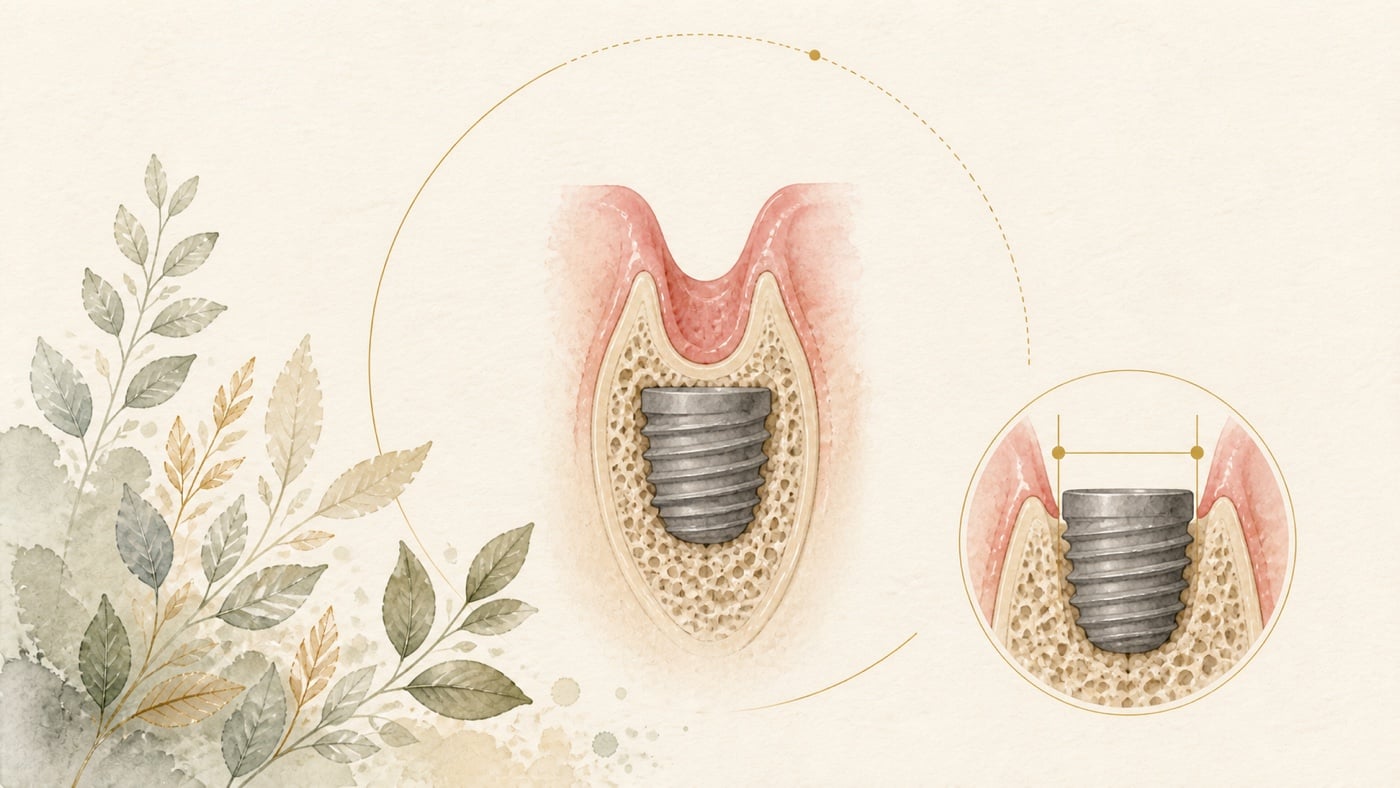
Is bone grafting always necessary when there is insufficient bone for an implant? Choosing grafting, a different implant size or another treatment
Insufficient bone does not mean that every patient must follow the same grafting process. Current systematic reviews indicate that lateral bone augmentation can increase bone width and make subsequent implant placement feasible. In selected posterior conditions, however, short implants may reduce the need for vertical augmentation, while narrow-diameter implants may be assessed in some anterior cases. These approaches are not shortcuts that can be interchanged freely. Each body of research is limited to particular defect directions, sites and case conditions. If the surgical burden or restorative conditions of an implant route are unsuitable, a tooth-supported fixed bridge can also be discussed as a separate treatment route. The central comparison is which route can accommodate implant or abutment position, prosthetic design, risk and subsequent maintenance in your circumstances.
Is bone grafting always necessary when there is insufficient bone for an implant? Choosing grafting, a different implant size or another treatment
Direct answer: Not necessarily. Lateral bone augmentation can increase bone width and make subsequent implant placement feasible, but the quality of evidence in that review ranged from very low to moderate [F1]. At atrophic posterior mandibular sites with a residual ridge height of 5 to 8 millimetres, short implants and vertical augmentation showed no significant difference in implant or prosthesis failure after 12 months of loading, while complications at the treated sites increased with the augmentation procedures [F4]. Which route suits you depends on whether the direction of the defect and the site fall within the scope of each body of evidence [F1][F4].
Geographic scope: This is general health education based on international literature. It does not cover any particular country's insurance scheme or regulations; for how care and fees are organised, follow the rules where you are. Every source cited in this card is international peer-reviewed literature; no national legislation or insurance-benefit rule is cited.
TL;DR | Insufficient bone has more than the two answers “graft” or “do not graft”
Insufficient bone does not mean that every patient must follow the same grafting process. Current systematic reviews indicate that lateral bone augmentation can increase bone width and make subsequent implant placement feasible. In selected posterior conditions, however, short implants may reduce the need for vertical augmentation, while narrow-diameter implants may be assessed in some anterior cases [F1][F2][F3].
These approaches are not shortcuts that can be interchanged freely. Each body of research is limited to particular defect directions, sites and case conditions. If the surgical burden or restorative conditions of an implant route are unsuitable, a tooth-supported fixed bridge can also be discussed as a separate treatment route [F4][F5]. The central comparison is which route can accommodate implant or abutment position, prosthetic design, risk and subsequent maintenance in your circumstances.
Ask “where is the deficiency?” before asking “must it be grafted?”
Insufficient width and insufficient height lead to different evidence and management. Reviews of lateral bone augmentation concern width, whereas reviews of the atrophic posterior mandible compare vertical augmentation with short-implant alternatives [F1][F4]. The phrase “not enough bone” is therefore not sufficient to determine treatment.
After imaging and intra-oral assessment, you can first ask the dentist to explain the direction of the deficiency, the position needed for the planned implant and future crown, and which conditions would change if bone were not grafted. Separating the questions prevents group averages from a different site being applied directly.
Route one | Graft bone to create a more suitable contour at the planned position
A systematic review of lateral bone augmentation before implant placement included 25 trials and 553 patients. In the populations studied, different augmentation methods made later implant placement feasible [F1]. Pooled clinical gain in bone width was 3.45 plus or minus 1.18 millimetres, and radiographic gain was 2.90 plus or minus 0.83 millimetres; the difference between them was not statistically significant [F1].
However, the quality of evidence in this review ranged from very low to moderate and was limited by the number of studies, bias and precision [F1]. The average gain helps explain what augmentation can do, but cannot promise your actual gain or select a material or technique from the average alone.
Route two | A shorter implant may avoid some vertical augmentation
Short implants are discussed most often when vertical bone height is limited in a posterior region. A review comparing short implants without grafting with standard-length implants plus augmentation found no statistically significant between-group differences in implant loss or marginal bone loss at 1, 3 or 5 years. At 1 year, the augmented control group had more complications [F2]. The authors therefore considered short implants a potentially suitable alternative in selected settings [F2].
Another meta-analysis confined to the atrophic posterior mandible included 14 randomised trials. Four trials compared 5- to 8-millimetre short implants with vertical augmentation at sites with a residual ridge height of 5 to 8 millimetres [F4]. After 12 months of loading, no significant difference was found in implant or prosthesis failure. The odds ratio for complications at augmented sites was 8.33, with a 95 per cent confidence interval from 3.85 to 20 [F4].
These results support only including short implants in comparisons for selected posterior cases. They do not mean that every bone deficiency can be solved by shortening the implant. Implant diameter, position, occlusion and prosthetic design still require joint planning, and the figures cannot be extrapolated directly to different sites [F4][F2].
Route three | A narrow-diameter implant applies only to some width-limited settings
When anterior bone width is limited, a narrow-diameter implant may be assessed. A review comparing narrow-diameter implants in the anterior maxilla with regular-diameter implants accompanied by bone grafting included 5 studies, 282 narrow implants and 100 regular implants [F3]. At 36 months, no significant difference was found between the groups in implant survival, marginal bone loss or probing depth [F3].
This evidence is confined to the anterior maxilla, and the number of studies is small [F3]. A narrow-diameter implant is therefore not a universal answer to insufficient bone. Suitability still depends on the site and the overall restorative design, and anterior findings cannot be applied directly to posterior teeth.
Route four | Change the reconstruction and compare a bridge as a separate route
If the grafting burden, anatomy or treatment schedule required by the implant route does not fit your situation, a tooth-supported fixed bridge can be compared separately with the dentist. This does not treat a bridge as a simplified implant, but re-examines the source of support, adjacent teeth, cleaning and repair pathway.
A systematic review and meta-analysis of three-unit fixed bridges included 1,973 tooth-supported and 765 implant-supported bridges. Annual abutment survival was 99 and 98.7 per cent, and annual prosthesis survival was 96.4 and 97.4 per cent, respectively, with no significant differences [F5]. Reporting of hard- and soft-tissue conditions and patient-reported outcomes was insufficient, however, and these were three-unit bridges rather than every possible design [F5].
The value of this evidence is the reminder that changing treatment can be a formal shared decision rather than a reluctant second-best option. Whether adjacent teeth are suitable abutments still requires individual examination and cannot be decided from group survival alone.
Putting the four routes on one decision map
You can ask the dentist to answer each of the following:
- Is the principal deficiency in width, height, or the contour around the planned implant position? [F1][F4]
- If grafting is proposed, what is this step intended to improve, and to which defect does the evidence apply? [F1]
- If a short implant is considered, is your site comparable to the atrophic posterior sites studied? [F2][F4]
- If a narrow-diameter implant is considered, is this a setting to which the anterior-maxillary evidence can reasonably apply? [F3]
- If a fixed bridge is chosen, how will the condition of adjacent teeth, cleaning and future repair change? [F5]
The map is not intended for you to select a technique unaided. Its purpose is to make the assumptions, costs and alternatives of every option explicit.
Data anchors | The studies actually answer different bone-volume questions
| Option | Data anchor | Cautious interpretation | Source |
|---|---|---|---|
| Lateral bone augmentation before implants | 25 trials and 553 patients; clinical bone-width gain 3.45 plus or minus 1.18 millimetres [F1] | Width can increase, but evidence quality ranges from very low to moderate | [F1] |
| Short implant without grafting versus longer implant with grafting | No significant between-group difference in implant loss or marginal bone loss at 1, 3 and 5 years [F2] | Supports inclusion in selected comparisons, not a universal conclusion for the whole mouth | [F2] |
| Short posterior mandibular implant versus vertical augmentation | 4 short-implant trials; complication odds ratio at augmented sites 8.33, 95 per cent confidence interval 3.85 to 20 [F4] | Applies only when residual height and site resemble the study conditions | [F4] |
| Narrow implant in the anterior maxilla | 5 studies; 282 narrow versus 100 regular-diameter implants, with no significant difference at 36 months [F3] | The site is limited to the anterior maxilla and cannot be generalised across regions | [F3] |
| Tooth-supported three-unit fixed bridge | Annual abutment survival was 99 per cent for tooth support and 98.7 per cent for implant support [F5] | Only three-unit fixed bridges were compared, with insufficient patient-reported data | [F5] |
Conclusion | First define what is deficient, then compare grafting, shortening, narrowing or changing route
Insufficient bone is not a one-way road automatically leading to grafting. Grafting can rebuild width; selected posterior conditions may permit discussion of short implants; some anterior-maxillary conditions may permit a narrow-diameter implant; and if an implant route is unsuitable, a tooth-supported fixed bridge can be considered as a separate reconstruction [F1][F2][F3][F5].
If you are facing an assessment of “not enough bone”, bring existing imaging and treatment information to a discussion with your own dentist. Ask the dentist to explain the direction of the defect, the sites to which each option applies, the additional procedures involved and the alternatives if no graft is performed. Once the trade-offs are understood, you and the dentist can choose an arrangement that fits your circumstances.
Risk factors (what to know before treatment)
- Each route carries a site restriction with it: the lateral augmentation data concern insufficient bone width before implant placement [F1]; the short-implant alternative data are confined to atrophic posterior mandibular sites with a residual ridge height of 5 to 8 millimetres [F4]; the narrow-diameter comparison is confined to the anterior maxilla [F3]. The three sets of results cannot be transferred to one another’s sites.
- Augmentation surgery itself adds complications: the meta-analysis in the atrophic posterior mandible recorded that complications at treated sites increased with the augmentation procedures, with an odds ratio of 8.33 (95 per cent confidence interval 3.85 to 20, P < 0.001) [F4]. A separate review comparing short implants with standard-length implants plus grafting recorded that the number of complications after 1 year was statistically significantly higher in the control group, and concluded that the risk of complications with short implants is possibly lower because of the lack of need for bone augmentation [F2].
- Grafts resorb, and resorption relates to age and recipient site: the lateral augmentation review recorded that percentage graft resorption was associated with patient age, and concluded that both patients’ age and the recipient site (maxilla or mandible) seem to influence graft resorption [F1]. This is one of the variables worth clarifying before surgery.
- The average gain is a group figure, not a promise to you: pooled clinical gain in bone width was 3.45 plus or minus 1.18 millimetres and radiographic gain 2.90 plus or minus 0.83 millimetres, a difference that was not statistically significant; bone-width gain was significantly inversely associated with baseline bone width [F1]. The quality of evidence in that review ranged from very low to moderate and was limited by bias and imprecision [F1].
- “No significant difference” is not the same as “the two are equivalent”: the narrow- versus regular-diameter comparison included only 5 studies, 282 narrow and 100 regular-diameter implants, followed to 36 months, and the same review recorded soft tissue dehiscence as the most common complication found in the regular-diameter group [F3]. The three-unit bridge review recorded a low level of reporting of hard and soft tissue conditions and patient-reported outcomes [F5]. With this few studies, failing to detect a difference cannot be turned round into proof that no difference exists.
- This card does not compile a list of contraindications: no separate literature search on contraindications was run for this card. Whether to graft, which technique or implant size to choose, and whether to switch to a tooth-supported fixed bridge, has to be assessed by a dentist from the imaging, the direction of the defect, the site, the condition of the adjacent teeth and the overall prosthetic design.
Every clinical statement in this article is mapped line by line to its cited source (see the sources and evidence chain below). It has not been clinically reviewed by a licensed practitioner. This is health information, not individual advice; assessment by a clinician is required.
FAQ
- If the dentist says there is not enough bone, must it be grafted?
- Not necessarily. Lateral grafting can increase width, but short implants may be compared in selected posterior cases and narrow-diameter implants assessed in some anterior-maxillary cases [F1][F4][F3]. Whether they can substitute depends on whether the defect and site fit the evidence.
- 骨が足りないと言われたら、必ず骨造成が必要ですか? — 必ずしもそうではありません。水平的造成は骨幅を増やせますが、特定の臼歯部ではショートインプラント、一部の上顎前歯部では狭径インプラントが検討される場合があります [F1][F4][F3]。代替できるかは欠損と部位が研究範囲に合うかで決まります。
- If the dentist says there is not enough bone, must it be grafted? — Not necessarily. Lateral grafting can increase width, but short implants may be compared in selected posterior cases and narrow-diameter implants assessed in some anterior-maxillary cases [F1][F4][F3]. Whether they can substitute depends on whether the defect and site fit the evidence.
- Is a short implant safer than bone grafting?
- That cannot be generalised to every site. A meta-analysis in the posterior mandible found more complications in vertical augmentation groups, but the studies had defined residual-height and site conditions [F4]. A dentist still needs to assess your individual risk.
- ショートインプラントは骨造成より安全ですか? — 全ての部位に一般化できません。臼歯部下顎のメタアナリシスは垂直的骨造成群で合併症が多いことを観察しましたが、残存骨高と部位の条件が明確でした [F4]。個人のリスクは歯科医師の評価が必要です。
- Is a short implant safer than bone grafting? — That cannot be generalised to every site. A meta-analysis in the posterior mandible found more complications in vertical augmentation groups, but the studies had defined residual-height and site conditions [F4]. A dentist still needs to assess your individual risk.
- Can a narrow-diameter implant be used at every site with insufficient width?
- No. The comparative data cited here came from the anterior maxilla and only 5 studies [F3]. Loading and restorative conditions at another site cannot be inferred directly from this summary.
- 骨幅不足なら、どの部位にも狭径インプラントを使えますか? — 使えません。ここで引用した比較データは上顎前歯部の 5 件だけです [F3]。異なる部位の荷重と補綴条件をこの要約から直接推論できません。
- Can a narrow-diameter implant be used at every site with insufficient width? — No. The comparative data cited here came from the anterior maxilla and only 5 studies [F3]. Loading and restorative conditions at another site cannot be inferred directly from this summary.
- How much bone width can grafting add on average?
- The pooled clinical average in a lateral bone-augmentation review was 3.45 plus or minus 1.18 millimetres [F1]. This is a study-population average with limited evidence quality, not your predicted result.
- 骨造成で平均どの程度骨幅を増やせますか? — 水平的骨造成レビューの臨床統合平均は 3.45 ± 1.18 ミリメートルでした [F1]。限定的な質のエビデンスに基づく集団平均で、ご自身の予測値ではありません。
- How much bone width can grafting add on average? — The pooled clinical average in a lateral bone-augmentation review was 3.45 plus or minus 1.18 millimetres [F1]. This is a study-population average with limited evidence quality, not your predicted result.
- If I do not want grafting, can I simply choose a bridge?
- A bridge can be discussed as another treatment route, but adjacent teeth must still be assessed as potential abutments. A three-unit bridge review found similar annual survival for tooth- and implant-supported bridges, but tissue and patient-reported data were insufficient [F5]. One number cannot decide the treatment.
- 骨造成を望まなければ、そのままブリッジにできますか? — ブリッジを別の治療案として比較できますが、隣在歯が支台に適するかを先に評価します。三ユニットブリッジのレビューでは天然歯支持とインプラント支持の年間生存率は近い一方、組織と患者報告データが不足しました [F5]。一つの数値だけでは決められません。
- If I do not want grafting, can I simply choose a bridge? — A bridge can be discussed as another treatment route, but adjacent teeth must still be assessed as potential abutments. A three-unit bridge review found similar annual survival for tooth- and implant-supported bridges, but tissue and patient-reported data were insufficient [F5]. One number cannot decide the treatment.
Medical notice This article is provided for health education and medical information purposes. It is not a solicitation for medical services and does not constitute diagnosis or treatment advice. Actual treatment methods and outcomes vary between individuals and require evaluation by a dentist; every treatment has its own indications, limitations and possible risks. If you have related symptoms or treatment needs, please book a consultation for evaluation by a dentist.
Source anchors
- Efficacy of lateral bone augmentation prior to implant placement: A systematic review and meta-analysis. [PMID:30624791] · https://pubmed.ncbi.nlm.nih.gov/30624791/ · 在 IDAEO 的其他引用
- Short implants without bone augmentation vs. long implants with bone augmentation: systematic review and meta-analysis. [PMID:34037243] · https://pubmed.ncbi.nlm.nih.gov/34037243/ · 在 IDAEO 的其他引用
- Clinical outcomes of narrow- and regular-diameter implants with bone augmentation in the anterior maxilla: a systematic review and meta-analysis. [PMID:38443497] · https://pubmed.ncbi.nlm.nih.gov/38443497/ · 在 IDAEO 的其他引用
- Interventions for Dental Implant Placement in Atrophic Edentulous Mandibles: Vertical Bone Augmentation and Alternative Treatments. A Meta-Analysis of Randomized Clinical Trials. [PMID:27468794] · https://pubmed.ncbi.nlm.nih.gov/27468794/ · 在 IDAEO 的其他引用
- A systematic review and meta-analysis of 3-unit fixed dental prostheses: Are the results of 2 abutment implants comparable to the results of 2 abutment teeth? [PMID:28940725] · https://pubmed.ncbi.nlm.nih.gov/28940725/ · 在 IDAEO 的其他引用
Cite this article
Lucy・《Is bone grafting always necessary when there is insufficient bone for an implant? Choosing grafting, a different implant size or another treatment》・IDAEO 知識庫・2026-07-20・https://km.idaeo.ai/post/dental/insufficient-bone-optionsUpdated 2026-08-26