

🏛 Part of the "dental" topic shelf →
Immediate Implant Placement in an Infected Extraction Socket: What Role Does the Er,Cr:YSGG Water Laser Play?
In this article, “water laser” refers only to the 2,780 nm Er,Cr:YSGG device explicitly identified in the studies. It does not include a generic laser, Er:YAG, or other wavelengths. Existing clinical studies have used Er,Cr:YSGG for adjunctive decontamination of an infected socket after extraction, but every protocol also includes removal of the source of infection, mechanical debridement, and irrigation; some additionally include hydrogen peroxide, bone augmentation, regenerative membranes, and medication. It is therefore impossible to isolate from the outcomes how much effect Er,Cr:YSGG itself added. A retrospective cohort analysed 149 implants. There was one failure (1%) in the Er,Cr:YSGG infected-socket group and none in the control group of established edentulous sites. The difference between the groups in marginal bone-level change was 0.2 mm, with P = 0.058, which was not statistically significant. This was not a randomised trial, and the groups also differed at baseline. The cautious conclusion is that “clinical-use data exist within a complete protocol and strict case selection”, not that “Er,Cr:YSGG makes an infected socket equivalent to a healthy edentulous site”.
Immediate Implant Placement in an Infected Extraction Socket: What Role Does the Er,Cr:YSGG Water Laser Play?
Direct answer: In the existing research, Er,Cr:YSGG is one decontamination step within a multi-step protocol, not a method that decides the outcome on its own. One consecutive-case study combined it with an in situ hardening bone-graft material and non-submerged healing into a standardised protocol [F3]; another 3-year study placed it among debridement, curettage, hydrogen peroxide, sterile irrigation and guided bone regeneration [F4]; and the authors of the retrospective cohort state that peri-implantitis and associated problems must be avoided by following a certain set of protocols and procedures [F1]. Whether a water laser is available is therefore not the criterion for immediate placement, which still has to be assessed by a dentist for the individual site.
Geographic scope: This is general health education based on international literature. It does not cover any particular country's insurance scheme or regulations; for how care and fees are organised, follow the rules where you are. Every source cited in this card is international peer-reviewed literature; no national legislation or insurance-benefit rule is cited.
Scope of this card: this discussion is limited to the role of the device as an adjunct within the group of studies on immediate implant placement after treating infected extraction sockets with Er,Cr:YSGG. It is not extended to lasers in general or to other wavelengths, and it is not a promise of treatment effect.
Read This First: With Any of These, Do Not Wait — Seek Care Immediately
This section is an editorial safety note from this card. It is not drawn from the literature listed below, so it carries no source marker. Infection in an extraction socket can spread into the deep spaces of the face and neck, so if any of the following applies, seek dental or emergency care immediately:
- Swelling at the extraction or implant site that is continuing to enlarge, or spreading to the cheek, jaw, below the eye or the neck
- Pus that keeps draining or is increasing in amount, with the redness and swelling spreading outward
- Inability to open the mouth (trismus), or pain on swallowing, or inability to swallow your own saliva
- Breathing becoming laboured, or a change in the sound of your voice
- Fever, chills, or feeling generally very unwell
- Swelling of the floor of the mouth or under the tongue, with the tongue being pushed upward
- Heavy bleeding from the wound that continues despite pressure with gauze
The criterion is whether it is continuing to enlarge, not how many days have passed; this card deliberately gives no observation interval and no "watch it for a few days" safe period. Actual management has to be assessed by a dentist or an emergency physician.
TL;DR|It Is One Part of the Debridement Protocol, Not a Permit That Automatically Makes Infection Disappear
In this article, “water laser” refers only to the 2,780 nm Er,Cr:YSGG device explicitly identified in the studies. It does not include a generic `laser`, Er:YAG, or other wavelengths. Existing clinical studies have used Er,Cr:YSGG for adjunctive decontamination of an infected socket after extraction, but every protocol also includes removal of the source of infection, mechanical debridement, and irrigation; some additionally include hydrogen peroxide, bone augmentation, regenerative membranes, and medication. It is therefore impossible to isolate from the outcomes how much effect Er,Cr:YSGG itself added.
A retrospective cohort analysed 149 implants. There was one failure (1%) in the Er,Cr:YSGG infected-socket group and none in the control group of established edentulous sites. The difference between the groups in marginal bone-level change was 0.2 mm, with P = 0.058, which was not statistically significant.[F1] This was not a randomised trial, and the groups also differed at baseline. The cautious conclusion is that “clinical-use data exist within a complete protocol and strict case selection”, not that “Er,Cr:YSGG makes an infected socket equivalent to a healthy edentulous site”.
Main Discussion|Whether Immediate Implant Placement Is Viable Depends First on Infection Control and Primary Stability
First Confirm That Infected Sockets Are Not a Single Category
Infection may arise from an apical lesion, periodontal destruction, root fracture, or acute suppuration, and the integrity of the socket walls after extraction also varies. The dentist needs to establish the extent of infection, whether granulation tissue can be removed completely, the condition of the facial bone plate and soft tissues, and whether primary implant stability can be obtained outside the infected area. If stability cannot be established, infection is spreading into surrounding tissues, or the defect is unfavourable for immediate reconstruction, staged treatment may be more prudent.
The question is therefore not “Can a water laser be used for immediate implant placement when infection is present?” but “Even after extraction and debridement are completed, does this socket still have the anatomical and biological conditions required for immediate implant placement?” Er,Cr:YSGG can address only part of the decontamination protocol.
What Did Er,Cr:YSGG Actually Do in the Study Protocols?
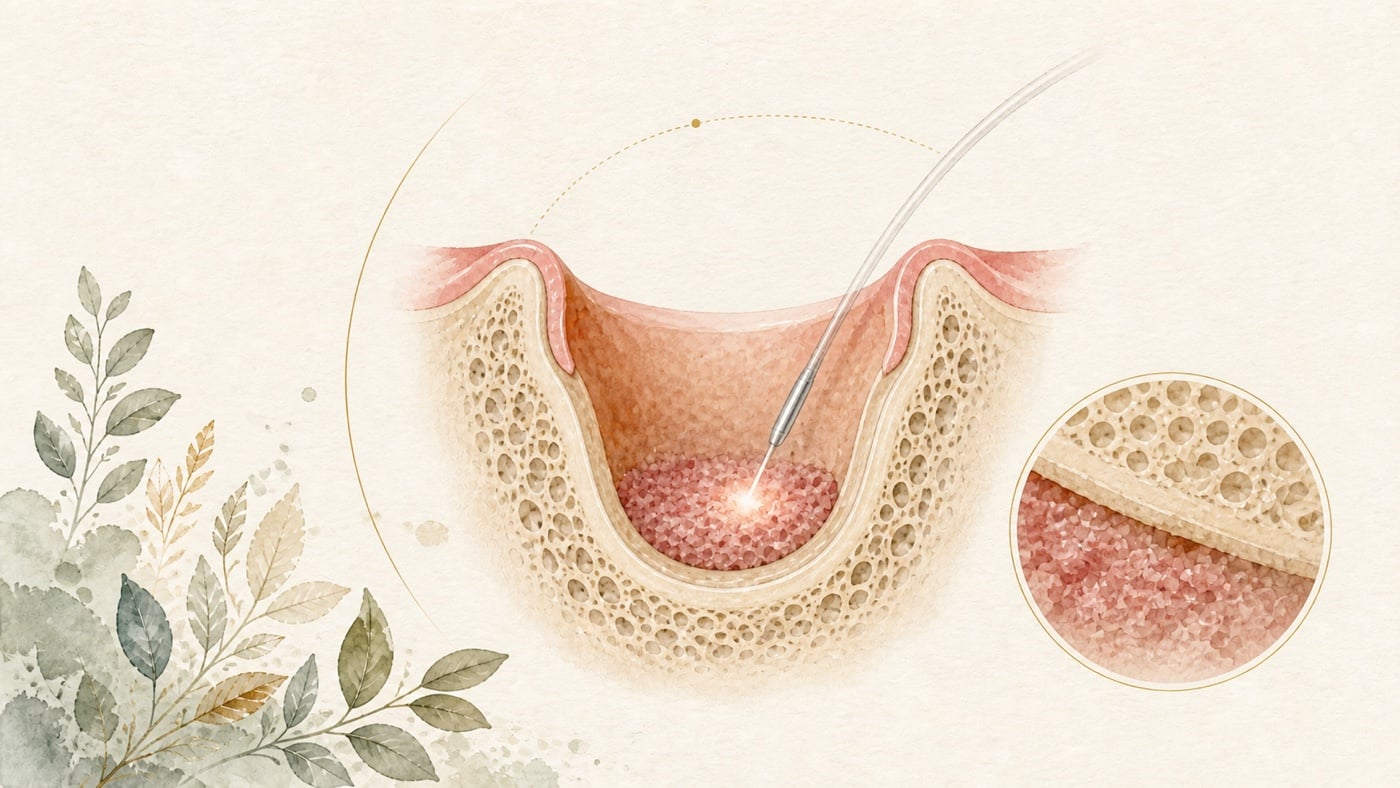
The studies describe irradiating an infected extraction socket with Er,Cr:YSGG after extraction of the affected tooth and mechanical debridement, with the aim of reducing the local microbial load before implant placement. The 2024 clinical protocol was a single case. A tooth that served as an abutment for a fixed bridge and showed clinical and radiographic signs of infection was extracted, decontaminated with Er,Cr:YSGG, and replaced at the same visit by 2 implants, with biomaterials used for tissue regeneration.[F2]
A case report can demonstrate the sequence of procedures and details of case selection. It cannot estimate outcomes for patients in general or show that the protocol will reproduce the same result. In particular, when several interventions are used together, a favourable follow-up outcome cannot be attributed to a single device.
What Limitations Remain in the Larger Clinical Data?
A retrospective consecutive-case study included 68 patients and 126 implants; the protocol comprised Er,Cr:YSGG decontamination, an in situ hardening bone-graft material, and non-submerged healing. A total of 8 patients with 16 implants were lost to follow-up. Among the remaining 110 implants, 105 survived after prosthetic loading, a rate of 95.45%.[F3]
This 105/110 is the survival outcome of the complete protocol. Loss to follow-up may alter the estimate, and the study did not randomly separate mechanical debridement, Er,Cr:YSGG, bone grafting, and healing method into individual components. It cannot answer “What would happen without Er,Cr:YSGG?”, still less guarantee an individual implant outcome.
Another 3-year within-patient comparative study placed 36 immediate implants: 18 in non-infected sockets and 18 in infected sockets. Infected sockets received debridement, curettage, 90% hydrogen peroxide, Er,Cr:YSGG, sterile irrigation, guided bone regeneration, and medication. The 3-year survival rates were 94.44% versus 100%, with no significant between-group differences in clinical or radiographic variables at 36 months.[F4]
This study has the advantages of prospective follow-up and within-patient comparison, but it likewise involved multiple interventions and only 18 paired sites. It supports that a particular protocol “can be studied”; it does not support reducing the result to an independent effect of Er,Cr:YSGG.
How Should the 0.2 mm in the Retrospective Cohort Be Interpreted Cautiously?
The retrospective cohort of 149 implants compared an Er,Cr:YSGG protocol in infected extraction sockets with conventional implant placement in established edentulous sites. Over follow-up of at least 1 year and more than 4 years at the longest, mean marginal bone level increased by 0.1 mm from baseline in the infected-socket group and decreased by 0.1 mm in the control group. The P value for the 0.2 mm between-group difference was 0.058.[F1]
P = 0.058 should not be presented as showing that the infected-socket group was better, nor does it mean that the groups have been proved equivalent. The retrospective design, different starting conditions, case selection, and other concomitant procedures may all affect the results. Without a confidence interval, the precision of the estimate also cannot be judged. The only reasonable statement is that the study did not observe a statistically significant between-group difference in this bone-level outcome.
Which Questions Take Priority over the Name of the Device?
Preoperative discussion should cover at least whether the source of infection can be removed; bone-wall and soft-tissue defects; the source of primary implant stability; whether bone augmentation is needed; risks such as smoking and blood glucose; capacity for subsequent cleaning; and whether treatment will be staged if conditions after extraction are less favourable than expected. None of these conditions will automatically be met by adding Er,Cr:YSGG.
The studies also provide insufficient randomised data to compare different Er,Cr:YSGG parameters, operator learning curves, or broad patient populations. When incorporating the device into a plan, ask for clarity about its role within the complete protocol, the alternatives, and the contingency if treatment fails, rather than merely asking whether a “water laser” is available.
Data Anchors|All Figures Come from Studies Specific to Er,Cr:YSGG
| Evidence question | Data anchor | Cautious interpretation | Source |
|---|---|---|---|
| Clinical sequence of procedures | Single case; extraction of infected tooth, Er,Cr:YSGG decontamination, 2 implants at the same visit, and tissue regeneration | Demonstration of a protocol; provides neither a comparative effect nor a general outcome rate | [F2] |
| Retrospective comparative cohort | 149 implants; one failure (1%) in the infected-socket group, none in the control group | Non-randomised with different starting conditions; cannot prove equivalence | [F1] |
| Marginal bone level | +0.1 mm versus −0.1 mm; between-group difference 0.2 mm, P = 0.058 | Not significant and not proof of equivalence; no confidence interval | [F1] |
| Complete consecutive-case protocol | 68 patients, 126 implants; 16 lost to follow-up; 105/110 survived (95.45%) | Er,Cr:YSGG used together with bone augmentation and other measures; its independent effect cannot be isolated | [F3] |
| 3-year within-patient comparison | 18 infected sockets versus 18 non-infected sockets; 94.44% versus 100% | Small sample and multiple interventions; no significant difference does not mean the groups are identical | [F4] |
Conclusion|Keep Er,Cr:YSGG in the Role for Which Data Actually Exist
In studies of immediate implant placement in infected extraction sockets, Er,Cr:YSGG is an adjunct in a multistep decontamination protocol. Existing data include a single protocol, retrospective cohorts, consecutive cases, and a small prospective comparison. They have not isolated the independent effect of Er,Cr:YSGG from mechanical debridement, irrigation, bone grafting, and case selection, and they provide no randomised evidence.[F2][F1][F4]
If you are considering immediate implant placement after extraction of an infected tooth, you can bring your existing images and treatment records to a discussion with your own dentist. During discussion, the source of infection, bone walls, primary stability, bone-augmentation needs, the specific purpose of Er,Cr:YSGG in the protocol, and the staged contingency if conditions are unsuitable on the day can be checked one by one. This places the device back within the complete diagnosis and surgical plan.
Risk factors (what to know before treatment)
- These data are not randomised comparisons: the retrospective cohort of 149 implants compared infected sites treated with the laser against conventional implants in edentulous sites, so the two groups were different sites by design. The authors' conclusion states only that immediate implants in infected sockets debrided and decontaminated with Er,Cr:YSGG do not appear to enhance the likelihood of failure, while stressing that peri-implantitis and associated problems must be avoided by following a certain set of protocols and procedures [F1].
- Small samples and gaps in follow-up: of the 68 patients and 126 implants in the consecutive-case study, 8 patients with 16 implants were lost to follow-up, and the 95.45% survival was calculated from the remaining 110 implants; the 3-year within-patient comparison had only 18 paired sites [F3][F4]. Loss to follow-up and small samples both affect the estimate, and a non-significant result does not mean the groups are the same.
- A single case can only demonstrate a sequence: the 2024 clinical protocol involved one tooth that served as an abutment for a fixed bridge and showed clinical and radiographic signs of infection. The authors themselves note that patient selection is very important for this type of protocol, because the presence of contraindications can lead to failure [F2].
- The effect of the device itself cannot be isolated: every included study used several interventions at the same time, and none of them randomly separated mechanical debridement, Er,Cr:YSGG, bone grafting and the healing method into individual components [F1][F2][F3][F4]. The available abstracts also contain no randomised data comparing different laser parameters or different operators.
- This card does not compile lists of indications or contraindications: the available abstracts do not provide inclusion or exclusion criteria that a reader could apply to themselves. Whether immediate placement in an infected extraction socket is possible, or whether ridge preservation and staged placement should be used instead, has to be assessed by a dentist against the extent of infection, the bone walls, the soft tissues, primary stability and other individual conditions.
Every clinical statement in this article is mapped line by line to its cited source (see the sources and evidence chain below). It has not been clinically reviewed by a licensed practitioner. This is health information, not individual advice; assessment by a clinician is required.
FAQ
- Does Having Er,Cr:YSGG Allow Immediate Implant Placement in Any Infected Socket?
- No. The extent of infection, bone walls, soft tissues, and primary stability remain prerequisites. Existing studies concern complete protocols after case selection, not a permit conferred by a device.
- Er,Cr:YSGG があれば、どの感染窩にも即時インプラント埋入ができますか? — できません。感染範囲、骨壁、軟組織、初期固定は依然として前提条件です。既存研究はいずれも症例選択後の一連の手順であり、装置が与える通行証ではありません。
- Does Having Er,Cr:YSGG Allow Immediate Implant Placement in Any Infected Socket? — No. The extent of infection, bone walls, soft tissues, and primary stability remain prerequisites. Existing studies concern complete protocols after case selection, not a permit conferred by a device.
- Can Er,Cr:YSGG Replace Mechanical Debridement?
- Every included study uses it within a sequence that includes removal of the infection source, curettage, irrigation, and other steps. There is no evidence that it can replace these core measures.[F3][F4]
- Er,Cr:YSGG は機械的デブライドメントに代わりますか? — 採用された既存研究はいずれも、感染源の除去、掻爬、洗浄などの工程の中に Er,Cr:YSGG を組み込んでおり、これらの中心的処置を代替できることを支持するエビデンスはありません。[F3][F4]
- Can Er,Cr:YSGG Replace Mechanical Debridement? — Every included study uses it within a sequence that includes removal of the infection source, curettage, irrigation, and other steps. There is no evidence that it can replace these core measures.[F3][F4]
- The Study Saw Only One Failure in the Infected-Socket Group. Does That Mean the Risk Is Very Low?
- That statement can describe only this retrospective cohort. Group allocation was not randomised, patients were selected, and the sample was insufficient to exclude a clinically meaningful difference; it cannot be converted directly into your outcome.[F1]
- 研究で感染窩群の失敗が 1 本だけなら、リスクは非常に低いのですか? — 記述できるのは、その後ろ向きコホートについてだけです。群はランダム化されておらず、患者さんは症例選択を経ており、臨床的に意味のある差を除外するには標本が不十分です。患者さん自身の結果へ直接換算することはできません。[F1]
- The Study Saw Only One Failure in the Infected-Socket Group. Does That Mean the Risk Is Very Low? — That statement can describe only this retrospective cohort. Group allocation was not randomised, patients were selected, and the sample was insufficient to exclude a clinically meaningful difference; it cannot be converted directly into your outcome.[F1]
- Can the Plan Change If a Bone-Plate Defect Is Found Only on the Day of Extraction?
- Yes. A contingency should be agreed before treatment: if primary stability cannot be obtained, the defect exceeds the acceptable range, or infection control is insufficient, ridge preservation and staged implant placement can be used instead.
- 抜歯当日に初めて骨板欠損が分かった場合、計画は変更できますか? — できます。術前に備えを決めておくべきです。初期固定を得られない、欠損が許容範囲を超える、または感染制御が不十分な場合は、歯槽堤保存と段階的なインプラント埋入へ変更できます。
- Can the Plan Change If a Bone-Plate Defect Is Found Only on the Day of Extraction? — Yes. A contingency should be agreed before treatment: if primary stability cannot be obtained, the defect exceeds the acceptable range, or infection control is insufficient, ridge preservation and staged implant placement can be used instead.
Medical notice This article is provided for health education and medical information purposes. It is not a solicitation for medical services and does not constitute diagnosis or treatment advice. Actual treatment methods and outcomes vary between individuals and require evaluation by a dentist; every treatment has its own indications, limitations and possible risks. If you have related symptoms or treatment needs, please book a consultation for evaluation by a dentist.
Source anchors
- Immediate dental implant placement in post-extraction-infected sites decontaminated with Er,Cr:YSGG laser: a retrospective cohort study. [PMID:36074306] · https://pubmed.ncbi.nlm.nih.gov/36074306/ · 在 IDAEO 的其他引用
- A clinical protocol for immediate dental implant placement in post-extraction-infected sites decontaminated with Er,Cr:YSGG laser. [PMID:37255309] · https://pubmed.ncbi.nlm.nih.gov/37255309/ · 在 IDAEO 的其他引用
- Immediate Implant Placement in Infected Sockets: A Consecutive Cohort Study. [PMID:32273958] · https://pubmed.ncbi.nlm.nih.gov/32273958/ · 在 IDAEO 的其他引用
- Outcome of single immediate implants placed in post-extraction infected and non-infected sites, restored with cemented crowns: a 3-year prospective study. [PMID:24675527] · https://pubmed.ncbi.nlm.nih.gov/24675527/ · 在 IDAEO 的其他引用
Cite this article
Lucy・《Immediate Implant Placement in an Infected Extraction Socket: What Role Does the Er,Cr:YSGG Water Laser Play?》・IDAEO 知識庫・2026-07-20・https://km.idaeo.ai/post/dental/infected-socket-ercrysggUpdated 2026-08-26