

🏛 Part of the "dental" topic shelf →
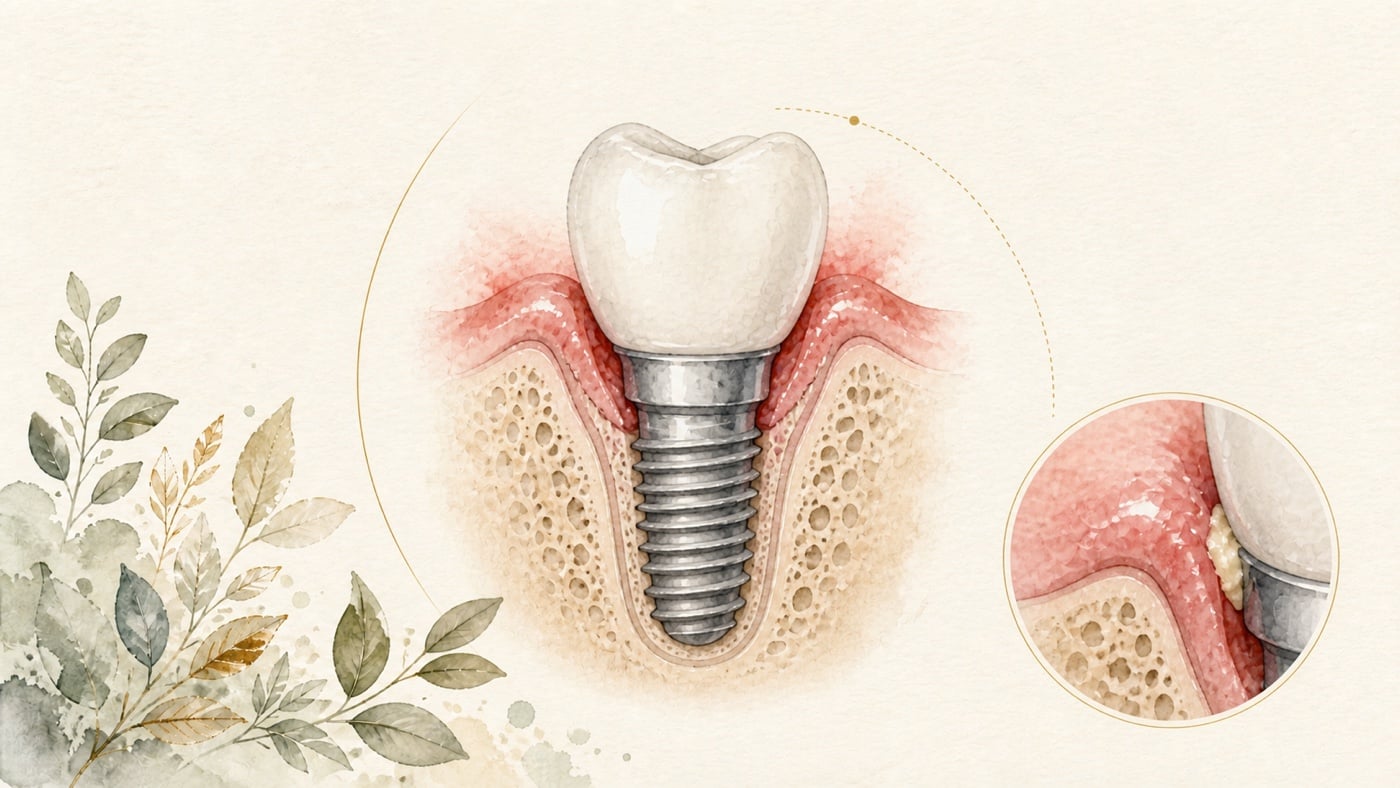
Which Pain and Swelling After an Implant Count as Warning Signs? Separate the "Call the Clinic" Signals From the Timeline
Pain and swelling after surgery do not, in themselves, separate safe from dangerous. What really calls for you to contact the clinic is a handful of sensations that are different in nature, together with a few changes that are wrong in their timing. Where the research helps is in linking these signals to specific anatomical locations and risk factors. Take the distance between the implant and the mandibular canal: at a distance of 1 to 2 mm, the incidence of neurosensory disturbance observed across the included studies was 0%; but when the distance narrowed to 0 to 1 mm, the incidence was 68%, and where the implant encroached on the canal it was 53% . This means that "persistent numbness of the lip or chin" and "a dull ache at the wound" are not the same thing: the former corresponds to nerve, the latter to soft-tissue healing. Seeing them separately is what tells you when to pick up the phone. This article is about deciding whether to go back to the clinic. The normal pain curve over the first few days after surgery, and home care, are a separate subject.
Which Pain and Swelling After an Implant Count as Warning Signs? Separate the "Call the Clinic" Signals From the Timeline
Direct answer: Pain and swelling after surgery do not by themselves separate safe from dangerous; what should prompt you to contact your dentist is a change in the nature of the sensation and a change in its timing — numbness, tingling or dulled sensation in the lower lip or chin, bleeding that will not stop, one-sided sinus symptoms after an upper posterior implant, and symptoms that improve and then get worse again. Nerve symptoms in particular are not something to watch and wait on: the systematic review on this topic states repeatedly that early diagnosis and treatment matter [F2]. If you have heavy bleeding that cannot be stopped, or difficulty breathing or swallowing, do not wait for the clinic to call back — go to an emergency department.
Geographic scope: This is general health education based on international literature. It does not cover any particular country's insurance scheme or regulations; for how care and fees are organised, follow the rules where you are. Every source cited in this card is international peer-reviewed literature; no national legislation or insurance-benefit rule is cited.
TL;DR — What matters in a warning sign is not "how much it hurts" but the nature of the pain and when it appears
Pain and swelling after surgery do not, in themselves, separate safe from dangerous. What really calls for you to contact the clinic is a handful of sensations that are different in nature, together with a few changes that are wrong in their timing.
Where the research helps is in linking these signals to specific anatomical locations and risk factors. Take the distance between the implant and the mandibular canal: at a distance of 1 to 2 mm, the incidence of neurosensory disturbance observed across the included studies was 0%; but when the distance narrowed to 0 to 1 mm, the incidence was 68%, and where the implant encroached on the canal it was 53% [F1].
This means that "persistent numbness of the lip or chin" and "a dull ache at the wound" are not the same thing: the former corresponds to nerve, the latter to soft-tissue healing. Seeing them separately is what tells you when to pick up the phone.
This article is about deciding whether to go back to the clinic. The normal pain curve over the first few days after surgery, and home care, are a separate subject.
Warning sign one: numbness, tingling or loss of sensation
Why this group takes priority
The inferior alveolar nerve runs within the mandible and supplies sensation to the lower lip and chin. A systematic review and meta-analysis grouped cases by "the distance between the implant and the mandibular canal" and tabulated the incidence of neurosensory disturbance [F1]:
- Distance ≥ 2 mm: incidence 0% [F1]
- Distance 1 to 2 mm: incidence 0% [F1]
- Distance 0 to 1 mm: incidence 68% [F1]
- Implant encroaching on the canal: incidence 53% [F1]
The review concluded that a distance of 1 mm may be the safe limit, that neurosensory disturbance appeared below 1 mm, and that careful planning and three-dimensional imaging are therefore needed before surgery [F1].
Why timing matters
Another systematic review, on inferior alveolar nerve injury after implant placement, took as its very subject "the importance of early diagnosis and early treatment". The review retrieved 33 articles, excluded 27 against its inclusion criteria and selected 6; it assessed how much time elapsed between the nerve injury and its diagnosis, and compared outcomes managed with early versus delayed diagnosis, with conclusions that repeatedly point to the importance of early diagnosis and treatment [F2].
In other words, this group of sensations is not the kind you "watch for a while longer". Numbness, tingling, and blunted or absent sensation in one area are all best brought to your dentist's attention as early as possible.
Warning sign two: bleeding that will not stop
If you are taking anticoagulant or antiplatelet medication, post-operative bleeding is managed differently.
A systematic review and meta-analysis included 15 observational studies, 3,101 participants and about 2,300 implants, covering vitamin K antagonists, direct oral anticoagulants and antiplatelet drugs [F3]. The primary analysis (8 studies) showed a pooled risk ratio for post-operative bleeding in the medicated group of 4.47 (95% CI 2.35 to 8.51; P < 0.00001; I² = 28%) [F3].
The same paper, however, carried out a sensitivity analysis: keeping only the 4 studies at low risk of bias, the association became non-significant (RR = 1.61; 95% CI 0.93 to 2.79; P = 0.09; I² = 0%), and the authors judged that the main effect had been pulled upwards by a small number of studies at moderate to serious risk of bias, dominated by warfarin users and full-arch surgery [F3].
Bleeding rates across the studies ranged from below 1% to 27.5%, depending on the class of anticoagulant and how invasive the surgery was [F3]. And this is the important part: every bleeding event recorded in the review was successfully controlled with local haemostatic measures, and no life-threatening event occurred [F3].
You can think of it this way: bleeding is not something that cannot be managed — it is something the people managing it need to know about. So telling your dentist about your medication before surgery, and going back to the clinic when bleeding will not stop afterwards, is the point of this section.
Warning sign three: sinus symptoms in the upper posterior region
Implants in the upper posterior region sit next to the floor of the maxillary sinus. Sinusitis is an occasional complication after implant placement or sinus floor elevation.
A systematic review and meta-analysis selected 8 studies and 181 patients from 581 records and assessed how sinusitis after implant placement is managed, and with what success rate [F4]. All the included studies used endoscopic sinus surgery, with a pooled treatment success rate of 94.7% (95% CI 91.5% to 98%) [F4]. Of the 15 cases in which treatment fell short, 7 were managed with subsequent antibiotic therapy and another 7 with repeat surgery; a further 1 patient was lost to follow-up [F4].
The review also points out that 7 of the 8 included articles were retrospective case series, that the clinical picture varied widely, and that diagnosis and definitions in this field need standardising [F4].
So this is not a common situation; but if your implant was in the upper posterior region and you develop one-sided nasal blockage, foul-smelling nasal discharge or a feeling of pressure in the cheek after surgery, it is worth raising so that your dentist can assess it.
Clue four: the timeline itself
An analysis reviewing 7 years of clinical experience and including 213 patients assessed early implant failure by age, sex, site of placement, implant type and general health; in that study's records, no implant rejection during the healing period occurred at 10 days after surgery or later [F5].
These data need reading with care: they are retrospective data from 7 years of experience and 213 patients; the abstract does not state how many centres contributed, nor does it report the timing distribution of the failures. The authors position the work as "confirming and reinforcing data already present in the literature", particularly on implant loss in patients with systemic disease [F5].
What it can give you is a sense of direction rather than a guarantee: if symptoms ease gradually over time, they are usually moving in the direction of healing; if symptoms worsen again after a settled period, that "worsening again" is itself a reason to go back.
How you can describe it to the clinic
When you phone or return to the clinic, setting out the following is more helpful than describing it as "very painful":
- Is it a dull ache, or is it numbness, tingling or blunted sensation? Where is the numb area (lower lip, chin, tongue)?
- Are the symptoms continuing to improve, staying level, or improving and then getting worse again?
- Is there bleeding that will not stop? Are you currently taking anticoagulant or antiplatelet medication?
- After an upper implant, is there one-sided nasal blockage, foul-smelling discharge or pressure in the cheek?
- How many days is it since the surgery?
Data anchors — how these figures should be read
| Question | Data anchor | How to read it safely | Source |
|---|---|---|---|
| Neurosensory disturbance and distance | 0% at ≥ 2 mm, 0% at 1–2 mm, 68% at 0–1 mm, 53% where the canal was encroached upon [F1] | A pooled incidence grouped by "distance between implant and mandibular canal", not a probability forecast for your own surgery | [F1] |
| Why nerve symptoms should be reported early | The review selected 6 articles from 33, and its subject is precisely the importance of early diagnosis and treatment [F2] | Only 6 articles were included; the direction of the conclusion is clear but the evidence base is limited in size | [F2] |
| Post-operative bleeding on anticoagulants | Primary analysis RR 4.47 (95% CI 2.35–8.51); with only low-risk-of-bias studies, RR 1.61 (95% CI 0.93–2.79, non-significant) [F3] | The two figures have to be read together; the higher estimate is driven by a small number of studies at higher risk of bias | [F3] |
| What actually happened with the bleeding | Bleeding rates across studies < 1% to 27.5%; all events controlled with local haemostatic measures, no life-threatening events [F3] | The range is wide because drug class and surgical invasiveness differ; it is not a single expected value | [F3] |
| Managing sinusitis after implant placement | 8 studies, 181 patients; pooled success rate of endoscopic sinus surgery 94.7% (95% CI 91.5–98%) [F4] | 7 of the 8 articles were retrospective case series; diagnosis and definitions are not yet standardised | [F4] |
| Observation on the timing of early failures | In a 7-year review of 213 patients, no implant rejection during healing occurred at 10 days after surgery or later [F5] | This is "none observed", not a statistic on how failures are distributed over time; retrospective data, useful only as a sense of direction | [F5] |
Conclusion — Telling a warning sign apart rests on nature and timing, not on how much you can bear
Numbness, bleeding that will not stop, sinus symptoms in the upper posterior region, and the change over time captured by "better and then worse again" — what these four have in common is that each points to a different anatomical and management pathway [F1][F3][F4][F5], and for each there is already research explaining why dealing with it earlier is more favourable [F2].
The intensity of pain is subjective, but the nature of these signals can be described. Describing them clearly is what allows your dentist to judge quickly whether this is the healing process or a situation requiring intervention.
If you are in the recovery period after surgery, note down the items above and take them straight to the dentist or clinic that carried out the surgery when you need to. Rather than deciding for yourself how serious it is, hand the facts you have observed to someone who can judge them.
Risk factors (what to know before treatment)
- What to do now (emergencies first): if you have heavy bleeding that cannot be stopped, or difficulty breathing or swallowing, go straight to an emergency department and do not wait for the clinic to call back. For the other warning signs — numbness or dulled sensation, bleeding that will not stop, one-sided sinus symptoms after an upper posterior implant, or symptoms that improve and then worsen — contact the dentist or clinic that carried out the surgery immediately; if you cannot reach them, contact another dental or medical facility. Nerve symptoms in particular are not something to wait on [F2].
- Neurosensory alteration is related to where the implant sits: in the pooled results grouped by the distance between the implant and the mandibular canal, the incidence was 0% at ≥ 2 mm and 0% at 1 to 2 mm, 68% at 0 to 1 mm, and 53% where the implant intruded into the canal; the authors concluded that 1 mm might be a safe distance and reminded clinicians to use meticulous preoperative planning and three-dimensional imaging [F1]. These are pooled incidences by distance group, not a prediction of your own probability after surgery.
- For people on anticoagulant or antiplatelet therapy, the two figures have to be read together: the primary analysis (8 studies) gave a pooled risk ratio of 4.47 (95% CI 2.35 to 8.51; I² = 28%), but when only the 4 low risk-of-bias studies were kept the association became non-significant (RR 1.61; 95% CI 0.93 to 2.79; P = 0.09; I² = 0%); every bleeding incident recorded in that review was successfully managed with local haemostatic measures, and no life-threatening event was reported [F3]. Whether medication should be adjusted is a clinical decision: discuss it with the doctor who prescribed it and with your dentist, and do not stop or change it yourself.
- An upper posterior implant can be complicated by sinusitis, but the evidence base is small: that review selected 8 studies with 181 patients from 581 citations, and 7 of them were retrospective case series; the authors noted that the clinical picture was highly heterogeneous and that diagnostics and definitions in this field need to be standardised [F4].
- The timing data on early failure indicate a direction, not a safe period: in a retrospective review of 213 patients over 7 years of experience, there was no case in which the implant was rejected during healing at 10 days after surgery or later [F5]. That is "none observed at 10 days or later", not a statistic on how failures are distributed over time — the study reports no such distribution, and the abstract does not state how many centres contributed. This retrospective data cannot be read the other way round as "after a certain number of days nothing can go wrong"; symptoms that improve and then worsen are worth a review appointment at any point in time.
- This card does not compile a list of contraindications: none of the reviews cited here has indications or contraindications as its subject, so no such list is given. Whether your symptom is a warning sign and whether it needs treatment has to be judged by a dentist from examination and imaging.
Every clinical statement in this article is mapped line by line to its cited source (see the sources and evidence chain below). It has not been clinically reviewed by a licensed practitioner. This is health information, not individual advice; assessment by a clinician is required.
FAQ
- My lip is still numb — can I wait and see?
- Waiting on your own is not advisable. The subject of the systematic review on inferior alveolar nerve injury after implant placement is precisely the importance of early diagnosis and early treatment [F2]. If you have altered sensation, contact the clinic directly so your dentist can assess it; waiting does not make the assessment any easier.
- 唇がまだしびれていますが、もう少し待ってもよいですか — 自分で様子を見ることはおすすめできません。インプラント後の下歯槽神経損傷を対象としたシステマティックレビューの主題は、まさに早期診断と早期治療の重要性です [F2]。知覚異常があれば、直接歯科医院に連絡して歯科医師に評価してもらってください。待っても判断が容易になるわけではありません。
- My lip is still numb — can I wait and see? — Waiting on your own is not advisable. The subject of the systematic review on inferior alveolar nerve injury after implant placement is precisely the importance of early diagnosis and early treatment [F2]. If you have altered sensation, contact the clinic directly so your dentist can assess it; waiting does not make the assessment any easier.
- I take an anticoagulant — is oozing after surgery dangerous?
- The research does show a higher pooled risk of post-operative bleeding in people on these drugs, but in the sensitivity analysis that association was not significant among the studies at low risk of bias [F3]. Every bleeding event recorded in that review was successfully controlled with local haemostatic measures, with no life-threatening events [F3]; the authors, however, state that conclusion conditionally — continuing antithrombotic agents is generally safe when local protocols for implant placement are rigorously followed, and individualised patient risk stratification remains crucial [F3]. Do make sure your dentist knows about your medication and let them decide how to manage it; do not stop or change a drug on your own.
- 抗凝固薬を飲んでいます。術後のにじむような出血は危険でしょうか — 研究では、服用者の術後出血の統合リスクが確かに高く出ています。ただし感度分析では、この関連はバイアスリスクの低い研究のなかでは有意ではありませんでした [F3]。このレビューが記録した出血事象はすべて局所止血処置で問題なく管理され、生命を脅かす事象はありませんでした [F3]。ただし著者はこの結論を条件つきで述べています——抗血栓薬の継続が一般に安全といえるのは、インプラント埋入の局所プロトコルが厳格に守られる場合であり、個別の患者リスク層別化はなお不可欠です [F3]。服用中の薬は必ず歯科医師に伝え、対処の仕方はその判断に委ねてください。自己判断で中止・変更しないでください。
- I take an anticoagulant — is oozing after surgery dangerous? — The research does show a higher pooled risk of post-operative bleeding in people on these drugs, but in the sensitivity analysis that association was not significant among the studies at low risk of bias [F3]. Every bleeding event recorded in that review was successfully controlled with local haemostatic measures, with no life-threatening events [F3]; the authors, however, state that conclusion conditionally — continuing antithrombotic agents is generally safe when local protocols for implant placement are rigorously followed, and individualised patient risk stratification remains crucial [F3]. Do make sure your dentist knows about your medication and let them decide how to manage it; do not stop or change a drug on your own.
- Is the implant better off as far from the nerve as possible?
- In that review's grouped data, both the ≥ 2 mm group and the 1–2 mm group had a 0% incidence of neurosensory disturbance, and the authors consider 1 mm a possible safe limit [F1]. But distance is only one factor within the plan; how much room can actually be preserved is determined by the imaging and the bone conditions, and that falls within your dentist's assessment.
- インプラント体は神経から遠いほどよいのでしょうか — このレビューの群分けデータでは、距離 ≥ 2 mm の群と 1–2 mm の群はいずれも知覚異常の発生率が 0% であり、著者は 1 mm が安全域の境目となりうると考えています [F1]。ただし距離は計画のなかの一つの要因にすぎず、実際にどれだけの余裕を確保できるかは画像と骨の条件によって決まります。これは歯科医師が評価する範囲です。
- Is the implant better off as far from the nerve as possible? — In that review's grouped data, both the ≥ 2 mm group and the 1–2 mm group had a 0% incidence of neurosensory disturbance, and the authors consider 1 mm a possible safe limit [F1]. But distance is only one factor within the plan; how much room can actually be preserved is determined by the imaging and the bone conditions, and that falls within your dentist's assessment.
- If my nose is blocked after an upper implant, is the implant necessarily the cause?
- That inference cannot be drawn directly. Sinusitis after implant placement does occur, but the review included only 8 studies and 181 patients, and states plainly that the clinical picture is highly heterogeneous and that the diagnostic definitions still need standardising [F4]. Whether the symptoms are related to the implant needs your dentist's judgement alongside an examination.
- 上顎のインプラントの後に鼻がつまるのは、必ずインプラントのせいですか — そのように直接結論づけることはできません。インプラント後の副鼻腔炎は確かに存在しますが、このレビューが組み入れた研究は 8 編、181 名の患者にとどまり、臨床像の異質性が高く診断の定義には標準化の余地があると明確に指摘されています [F4]。症状がインプラントと関係するかどうかは、歯科医師が検査と合わせて判断する必要があります。
- If my nose is blocked after an upper implant, is the implant necessarily the cause? — That inference cannot be drawn directly. Sinusitis after implant placement does occur, but the review included only 8 studies and 181 patients, and states plainly that the clinical picture is highly heterogeneous and that the diagnostic definitions still need standardising [F4]. Whether the symptoms are related to the implant needs your dentist's judgement alongside an examination.
- It hurt for a few days and then suddenly got worse — should I go back?
- It is worth going back. In the records of that retrospective study, no implant rejection during healing occurred at 10 days after surgery or later; that is "none observed", not a statistic on how failures are distributed over time, and it cannot be read the other way round as "after a certain number of days nothing can go wrong" [F5]. The direction of change captured by "better and then worse again" is in itself a reasonable ground for your dentist to re-examine you; there is no need to wait until symptoms are severe before making contact.
- 数日痛んだ後に急に強くなりました。受診は必要でしょうか — 受診する価値があります。その後ろ向き研究の記録では、術後 10 日目以降に治癒期間中の脱落は現れていません。これは「観察されなかった」ということであり、失敗の時間分布の統計ではなく、「ある日数を過ぎれば何も起こらない」と逆に読むこともできません [F5]。「良くなった後に悪化する」という変化の方向そのものが、歯科医師に改めて調べてもらう合理的な理由です。症状が重くなるまで待ってから連絡する必要はありません。
- It hurt for a few days and then suddenly got worse — should I go back? — It is worth going back. In the records of that retrospective study, no implant rejection during healing occurred at 10 days after surgery or later; that is "none observed", not a statistic on how failures are distributed over time, and it cannot be read the other way round as "after a certain number of days nothing can go wrong" [F5]. The direction of change captured by "better and then worse again" is in itself a reasonable ground for your dentist to re-examine you; there is no need to wait until symptoms are severe before making contact.
Medical notice This article is provided for health education and medical information purposes. It is not a solicitation for medical services and does not constitute diagnosis or treatment advice. Actual treatment methods and outcomes vary between individuals and require evaluation by a dentist; every treatment has its own indications, limitations and possible risks. If you have related symptoms or treatment needs, please book a consultation for evaluation by a dentist.
Source anchors
- Inferior alveolar nerve damage related to dental implant placement. A systematic review and meta-analysis. [PMID:40192114] · https://pubmed.ncbi.nlm.nih.gov/40192114/ · 在 IDAEO 的其他引用
- Inferior alveolar nerve injuries following implant placement - importance of early diagnosis and treatment: a systematic review. [PMID:25635209] · https://pubmed.ncbi.nlm.nih.gov/25635209/ · 在 IDAEO 的其他引用
- Postoperative Bleeding Complications Associated With Dental Implant Placement in Patients Receiving Antithrombotic Therapy: A Systematic Review and Meta-Analysis. [PMID:41503325] · https://pubmed.ncbi.nlm.nih.gov/41503325/ · 在 IDAEO 的其他引用
- Treatment of Sinusitis Following Dental Implantation: A Systematic Review and Meta-Analysis. [PMID:35244478] · https://pubmed.ncbi.nlm.nih.gov/35244478/ · 在 IDAEO 的其他引用
- Early Implant Failure: A Meta-Analysis of 7 Years of Experience. [PMID:38610652] · https://pubmed.ncbi.nlm.nih.gov/38610652/ · 在 IDAEO 的其他引用
Cite this article
Lucy・《Which Pain and Swelling After an Implant Count as Warning Signs? Separate the "Call the Clinic" Signals From the Timeline》・IDAEO 知識庫・2026-07-20・https://km.idaeo.ai/post/dental/implant-warning-signsUpdated 2026-08-26