

🏛 Part of the "dental" topic shelf →
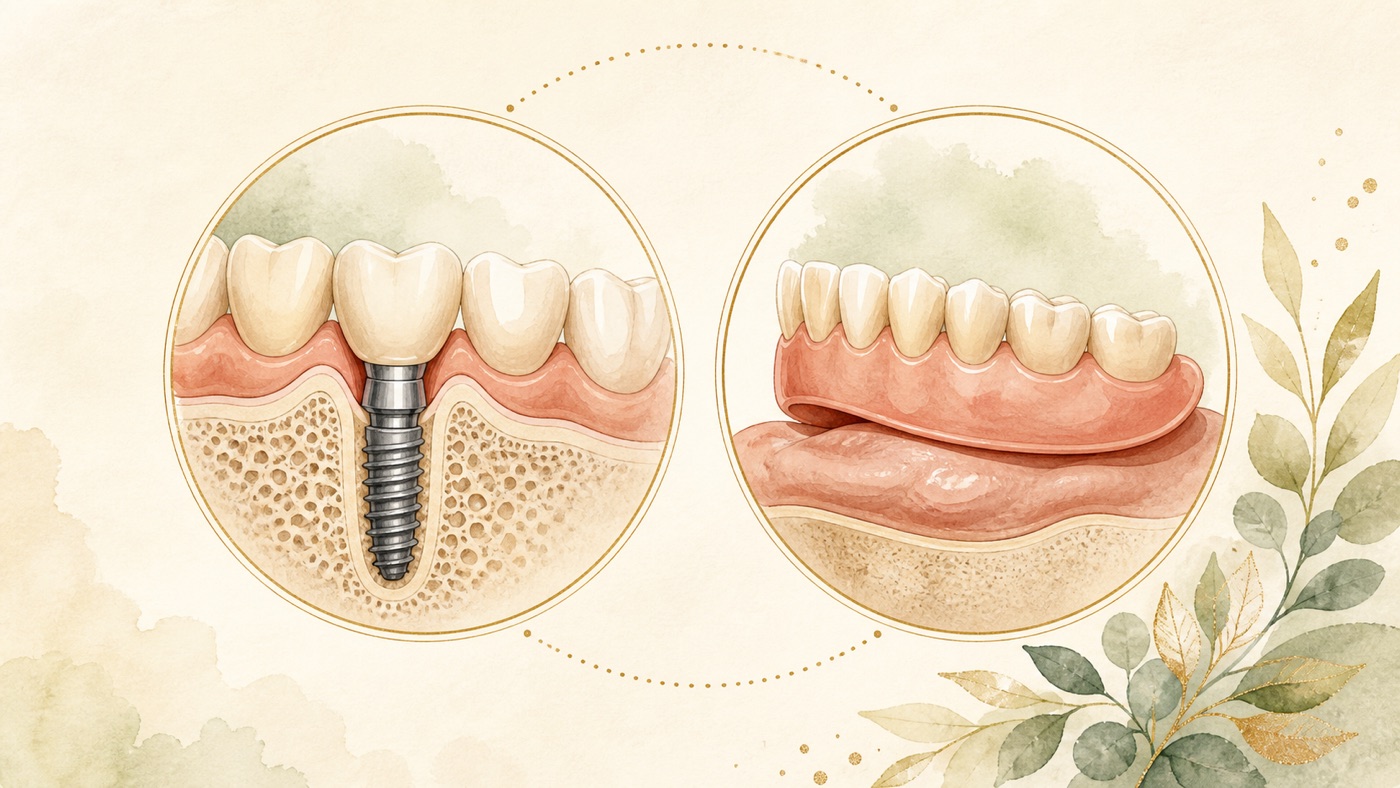
Implant or denture for a missing tooth? Seven conditions decide—not a comparison chart
No chart can choose for you. A current systematic review concludes that evidence is insufficient to recommend one tooth-replacement strategy over another, while the Cochrane review most closely matching this question has been withdrawn and offers no current valid conclusion. When the literature gives no winner, the decision returns to your individual circumstances. This card does not repeat survival figures or costs for each option; those belong to other cards on this site. It does one thing: breaks down the seven conditions a dentist evaluates—adjacent teeth, location and distribution of missing teeth, bone quantity and quality, general health and medication, feasibility of cleaning and follow-up, time, and your preferences and access. It explains how each condition moves options forward or back and where the population limits of the evidence lie. No prices appear anywhere in the article.
Implant or denture for a missing tooth? Seven conditions decide—not a comparison chart
Direct answer in 60 characters
There is no universal answer. For adults with reduced dentitions, a systematic review found insufficient evidence to recommend one replacement strategy over another [F2]. Adjacent teeth, bone, general health, and ability to maintain the result must be assessed by a dentist.
Geographic scope: This guide is specific to Taiwan's healthcare system (National Health Insurance and Taiwan's Medical Care Act). Medical-evidence sections cite international literature and professional guidelines and mark each F-Unit geo: universal; sections on cost, benefits, and verification channels are marked geo: TW. Readers elsewhere should use the rules of their own jurisdiction.
Why a single comparison chart usually cannot answer this question
People searching for “implant or denture” often want a two-column chart that produces an immediate winner. Many such charts exist, but they share a structural problem: they assume the winner in each row is the same for everyone. The variables that decide the answer are not in the chart; they are in your mouth and medical history.
The evidence points the same way. A systematic review of 10 articles states that current evidence is insufficient to recommend one tooth-replacement strategy over another. Its population was adults with shortened or reduced dentitions, not every missing-tooth situation [F2]. A broader Cochrane review of people with partially absent dentitions is now WITHDRAWN and is marked “Retracted Publication” in PubMed. Under this site’s rules it is not clinical evidence. It is listed only to document honestly that a current claim such as “Cochrane says one denture is better” has no valid source in that review [F3].
This card therefore takes a different form: it does not rank treatments; it lays out, one by one, the conditions a dentist considers, and explains how each condition may move options forward or backward. This is an editorial communication framework, not a clinical criterion or diagnostic tool [F1].
First align the terms: “denture” covers three different things here
Many disagreements begin with mismatched terms. In dental classification:
- Fixed dental prosthesis: cemented or bonded to teeth and not removable by the patient. This includes a single crown, a conventional bridge supported by prepared adjacent teeth, and a resin-bonded bridge that removes less tooth tissue.
- Removable denture: a partial or complete denture that the patient can remove for cleaning.
- Implant-supported prosthesis: the implant is the support, but a crown or prosthesis is still placed on it. Strictly speaking, an “implant” is not the opposite of a “denture”; it is another way to support a prosthesis. Support may come from an implant, adjacent teeth, or mucosa and remaining teeth [F1].
That distinction matters. When you ask “implant or denture,” the real comparison is between support methods, and whether a support method is feasible depends directly on the seven conditions below [F1].
How this card divides work with other cards
This site has several cards for this group of questions. Each has its own job; this card points to them rather than duplicating them:
- Survival and complication figures for each option, plus the full answers to “Do I have to get an implant?” and “What if I cannot afford replacement?” belong to KM-DENTAL-35. This card does not repeat any option-specific survival figures [F1].
- What can change if a tooth is not replaced, and the full shortened-dental-arch discussion belong to KM-DENTAL-34 [F1].
- The components of fixed-prosthesis costs and how to read a quotation belong to KM-DENTAL-3; removable dentures to KM-DENTAL-13; implant costs to KM-DENTAL-9 [F1].
- The cost of preparing adjacent teeth belongs to KM-DENTAL-45 and KM-DENTAL-22.
This card addresses the gap between them: how conditions rule options in or out.
Condition 1: the adjacent teeth
A conventional bridge requires irreversible preparation of the teeth beside the gap as abutments. The full discussion belongs to KM-DENTAL-45; here are two facts directly relevant to the decision [F1].
- A systematic review of 26 studies found that the 5-year survival of fixed dental prostheses on vital abutments (84.9%) was significantly higher than on non-vital abutments (81.3%, P = 0.049), regardless of post presence or type and prosthesis material. The authors also state that the result is limited by few studies and uncontrolled clinical confounders [F5].
- Another review selected 20 studies from 10,075 records, with 7 entering meta-analysis. For vital teeth used as fixed-prosthesis abutments, clinical and radiographic success ranged from 92% to 98% across follow-up periods of 5 to 20 years [F4]. This outcome is pulpal and periapical status, not survival of the bridge itself; all included studies were observational and heterogeneity was high [F4].
How this condition changes the options:
- If adjacent teeth already need crowns because of large restorations, prior root-canal treatment, or crowns that need replacement, incorporating them into a bridge has a smaller marginal cost because those teeth already require treatment.
- If adjacent teeth are intact, healthy, and unrestored, the irreversible loss of tooth tissue must be counted among the costs of a fixed option. Directions discussed in the literature include a resin-bonded bridge with less preparation (KM-DENTAL-22) and an implant-supported crown that does not use adjacent teeth. Each has its own indications and limits [F1].
- A review spanning prosthodontics and periodontology states that planning must consider prosthesis design, the number and quality of abutment teeth, preparation and pontic, occlusion, and material [F6]. Whether a tooth can serve as an abutment is therefore not judged by appearance alone; a dentist must assess periodontal support and remaining tooth structure.
Condition 2: location and distribution of the missing teeth
- One tooth missing between teeth on both sides: all three support approaches may be anatomically possible. Conditions 1 and those below then carry more weight.
- A distal-extension gap at the end of the arch: there is no posterior tooth to serve as an abutment, so a conventional bridge is structurally unavailable. Options discussed in the literature include a removable partial denture and an implant-assisted removable partial denture. A systematic review of 19 studies on implant-assisted removable partial dentures for distal-extension areas reported marginal bone loss from 0.3 mm to 2.30 mm and higher patient satisfaction than with conventional removable partial dentures or before treatment. Prosthetic-complication findings were heterogeneous and inconclusive, and most included studies concerned Kennedy Class I [F7]. This card does not use that review’s survival figures; option-specific survival belongs to KM-DENTAL-35 [F1]. The evidence shows that this is not necessarily a binary “implant versus denture” choice; the two can be combined.
- Several consecutive teeth missing with few opposing pairs remaining: masticatory performance may be affected. A systematic review found comminution or mixing ability 28% to 39% lower in shortened and extremely shortened dental arches than in complete dentitions; distal-extension removable dentures could recover part of that gap (about half) [F8]. This summary is anchored to KM-DENTAL-34 and KM-DENTAL-35; their full analyses are not repeated here [F1].
- Complete or extensive tooth loss belongs to the full-mouth rehabilitation scope of KM-DENTAL-32 and is not covered here [F1].
Condition 3: bone quantity and quality
An implant is placed in bone, so bone quantity and quality are thresholds specific to that pathway. Fixed and removable prostheses do not require an implant, so bone carries much less weight for those routes.
- When bone is insufficient, one direction in the literature is bone augmentation. A systematic review of 11 prospective studies, limited to residual bone height of 6 mm or less and follow-up of at least 5 years, estimated an annual implant-loss rate of 0.43% (95% confidence interval 0.37% to 0.49%) after lateral-window maxillary sinus floor augmentation. Meta-regression found no significant difference between simultaneous and delayed implant placement [F9].
- Another direction is a shorter implant. A GRADE-rated systematic review of 19 randomized trials, 40 reports, and 2214 implants found moderate- to high-certainty evidence of similar 5-year survival for implants 6 mm or shorter versus 10 mm or longer in non-augmented native bone and full-mouth rehabilitation, and that a 6-mm implant could substitute for sinus augmentation in the maxilla. The same review also states that evidence remains inconclusive or insufficient for 4-mm and 5-mm implants as alternatives to sinus augmentation and for implants 6 mm or shorter instead of vertical ridge augmentation [F10].
How this condition changes the options: insufficient bone does not mean “bone grafting is the only choice,” “implant treatment is impossible,” or “you should get an implant.” It turns a simple binary choice into branches with different prerequisites. A dentist must use imaging to assess actual bone height, width, and tooth location. If you do not want or are not suited to additional bone-augmentation surgery, fixed and removable prostheses do not require that step and remain directions discussed in the literature [F1].
Condition 4: general health and current medication
This condition is often overlooked, yet it may change the answer most. Every item below must be read together with its population.
Diabetes and glycaemic control: a systematic review and meta-analysis of 48 studies found that, among patients with diabetes, those with good glycaemic control had a significantly lower risk of peri-implantitis than those with poor control (odds ratio 0.16, 95% confidence interval 0.03 to 0.96) [F11]. The authors classified this as indirect evidence and noted limitations. This is a within-diabetes comparison; it does not mean that diabetes rules out implants or that good control removes all risk.
Antiresorptive drugs used for osteoporosis or cancer: dose and indication must be separated, or the conclusions point in opposite directions.
- A review of medical and geriatric factors states that implant therapy cannot be recommended under high-dose bisphosphonate and antibody therapy and that bone grafting should be avoided under antiresorptive therapy. The same review states that age over 75 does not affect implant survival in short follow-up of 1 to 5 years and concludes that risk assessment should be based not on age but on patient-specific factors such as diseases and medication [F12]. Its methods describe a narrative literature review, with searches only through 2019-02 [F12].
- A 2025 systematic review and meta-analysis limited to people with osteoporosis or osteopenia—the low-dose setting reported a relative risk of implant failure of 0.82 (95% confidence interval 0.52 to 1.28; very low certainty) among those exposed to antiresorptives. It identified 186 cases of implant-related medication-related osteonecrosis of the jaw. The pooled post-implantation rate from 21 cohorts was 0.5%. One risk-adjusted report found 3 additional cases per 1000 patients with bisphosphonates (adjusted hazard ratio 4.09, 95% confidence interval 2.75 to 6.09; moderate certainty) [F13].
- The honest synthesis is that osteoporosis dosing and high-dose cancer treatment are different risk levels, and figures from one must not be applied to the other. Even at the low-dose end, osteonecrosis of the jaw is a documented complication with risk-adjusted evidence [F12][F13]. This card gives no advice to stop, switch, or adjust medication. Medication changes are the prescriber’s responsibility; surgical suitability must be assessed jointly by your dentist and treating physician.
History of head-and-neck radiotherapy: a 2025 systematic review identified 9 studies and included 7 in meta-analysis. Among patients with head-and-neck cancer, implant survival was significantly lower in irradiated patients (85.6%) than in non-irradiated patients (90.0%) (relative risk 1.62, 95% confidence interval 1.33 to 1.98). In the head-and-neck-cancer population of the same review, failure risk was higher in grafted bone than in native bone (relative risk 2.03, 95% confidence interval 1.39 to 2.96) [F14]. Both figures are limited to patients with head-and-neck cancer and must not be extrapolated to bone grafting for the general population. The source did not limit the latter comparison to the irradiated subgroup, so this card reads it directly as applying to the review’s overall study population, neither narrowing nor broadening it [F14].
Smoking and history of periodontitis: an umbrella review of 12 articles and 41 meta-analyses rated none of the 41 associations as convincing. The two rated “highly suggestive” were presence of periodontitis (odds ratio 3.84) and cigarette smoking (relative risk 2.07) [F15]. This is a summary anchored to KM-DENTAL-35 [F1].
The other side matters too: these conditions mainly affect risk assessment for the implant route, but other options also have conditions. Fixed prostheses depend on the number and quality of abutment teeth [F6], while removable dentures depend on support from mucosa and remaining teeth. In patients with a history of periodontitis, two retrospective studies in a systematic review indicated greater tooth-loss risk with removable than fixed prostheses, and several studies indicated more plaque accumulation. Yet the review’s conclusion also states that there is no strong evidence that removable partial dentures themselves cause periodontal destruction, including tooth loss [F16].
Condition 5: feasibility of cleaning and follow-up
- The same 48-study review found a lower risk of overall peri-implant diseases among people who regularly received supportive periodontal or peri-implant care (odds ratio 0.42, 95% confidence interval 0.24 to 0.75). Implant-failure risk appeared higher with irregular or no supportive care (odds ratio 3.76, 95% confidence interval 1.50 to 9.45) [F11].
- A 2026 systematic review of 25 studies—9 randomized trials, 13 cohort studies, and 3 case-control studies—reported that supportive peri-implant therapy, particularly individualized risk-based recall intervals, consistently improved clinical outcomes such as probing depth and bleeding on probing compared with standard or no maintenance. The authors also said that high clinical and methodological heterogeneity, inconsistent documentation of systemic conditions, and variation in adjunctive therapy limited firm conclusions and generalizability [F17].
- The European Federation of Periodontology S3 guideline states that once implants are loaded and functioning, a structured supportive peri-implant care program should include periodic assessment of peri-implant tissue health [F18].
Both sides must be stated:
- Patient-reported evidence has recorded a cleaning advantage for a removable design, but the population must be read carefully. A consensus report says edentulous patients highly rated both removable and fixed implant-supported prostheses, while rating their own ability to maintain oral hygiene significantly higher with the removable one [F19]. Both comparators were implant-supported and the population was edentulous, so this cannot be read as “an ordinary removable partial denture is easier to clean than a bridge.” It supports only higher self-rated cleaning ability in that population and comparison [F19]. Whether it applies to you requires individual assessment.
- A fixed prosthesis need not be removed, but cleaning beneath a pontic requires tools and technique. A prosthodontic-periodontal review states that even an optimal pontic design cannot prevent inflammation of adjacent mucosa if plaque is not removed and pontic hygiene is not maintained [F6].
How this condition changes the options: if limited hand dexterity, vision, or daily routine makes consistent cleaning difficult, or regular follow-up is hard to attend, the long-term result of every option can be affected. This does not push everyone toward one treatment. It means maintenance burden belongs in the comparison and your actual circumstances should be described honestly in the clinic.
Condition 6: time
- After implant placement, osseointegration takes time; the wait depends in part on loading timing. A 2026 meta-analysis extracted 40 unique trials and more than 1200 single implants, followed for 1 to 10 years, from 7 systematic reviews and 2 additional randomized trials. It found no statistically significant difference in implant survival between immediate and conventional loading at 1, 2, 3, or 5 years (relative risk about 1.00); marginal-bone-loss differences were small and clinically negligible, and patient satisfaction did not differ significantly. Certainty was moderate for survival and low to very low for secondary outcomes [F20]. The review’s conclusion includes the condition “when applied under appropriate clinical conditions” [F20].
- Change the population and the direction is not identical. A 2019 meta-analysis of 39 trials (49 articles) covering varied fixed-prosthesis settings reported statistically lower survival with immediate than conventional loading when the implant was the statistical unit (relative risk 0.974, 95% confidence interval 0.954 to 0.994), while immediate and early loading were comparable [F21].
- The honest synthesis: the reviews differ in population and eligibility—the 2026 review is limited to single implants, while the 2019 review covers varied fixed prostheses—so their directions are not identical. The shared message for a consultation is: treatment can sometimes be shortened, but only under conditions. Whether it can be shortened depends on bone conditions and initial implant stability and must be decided by a dentist. This card estimates no individual treatment duration [F1].
- If bone augmentation is needed, treatment takes longer; the sinus-floor-augmentation review above included both simultaneous and delayed placement [F9].
- Fixed and removable prostheses also require their own impression, try-in, and adjustment visits. Those workflows belong to KM-DENTAL-3 and KM-DENTAL-13 and are not repeated here [F1].
Condition 7: your preferences and access
When the literature gives no winner, the question is not “Which is objectively best?” but “Which fits your life?”
- A current systematic review concludes that evidence is insufficient to recommend one tooth-replacement strategy over another, within adults with shortened or reduced dentitions [F2]. The Cochrane-level review has been withdrawn and offers no current valid conclusion [F3].
- A consensus report says patient-reported outcomes—including satisfaction and oral-health-related quality of life—should be collected in every clinical study of implant rehabilitation and should supplement other clinical parameters in the clinical definition of success [F19].
What matters most to you is therefore not an optional extra in the literature; it is part of assessment [F19]. Before the appointment, consider whether you most want to avoid surgery, avoid preparing adjacent teeth, remove the prosthesis for cleaning, shorten treatment, or reduce maintenance visits. Stating those priorities allows the dentist to rank the options that remain feasible for you [F1].
How to ask about cost (this card lists no prices)
This section concerns Taiwan’s system and is marked geo: TW. Readers elsewhere should use the rules of their own jurisdiction.
- Taiwan has no single nationwide dental price list. Under Article 21 of Taiwan’s Medical Care Act, the fee standards charged by medical care institutions are approved by the competent authority of each special municipality or county/city [F22]. The system-level way to ask “How much?” is therefore: how does the approved fee schedule in the municipality or county/city where you receive care itemize the charges?
- The prosthesis itself is generally self-paid. Article 51 of Taiwan’s National Health Insurance Act excludes dentures and other appliances without active therapeutic function from benefit coverage [F23]. Whether an individual diagnostic or treatment service is covered, and under what conditions, depends on current National Health Insurance Administration announcements. This card makes no coverage determination.
- A verifiable channel: Taiwan’s Government Data Open Platform lists the “Taipei City Medical Fee Standards,” provided by the Taipei City Government Department of Health and updated irregularly [F24]. For self-paid items, ask the provider for a written itemized statement.
- Avoid an unnecessary search: neither of the two category tracks in the National Health Insurance Administration’s “Medical Device Price Comparison” site contains dental items, so dental self-paid items cannot be checked there [F25].
- You may ask for an explanation. Article 81 of Taiwan’s Medical Care Act requires a medical care institution, when treating a patient, to inform the patient or specified related person about the condition, treatment policy, disposition, medication, prognosis, and possible adverse reactions [F26]. State your budget and ask the dentist to explain a feasible treatment sequence on that basis.
- Cost components and how to read a quotation belong respectively to KM-DENTAL-9 (implants), KM-DENTAL-3 (fixed prostheses), and KM-DENTAL-13 (removable dentures). This card neither repeats them nor ranks options by expense [F1].
For the official English translation of Taiwan’s Medical Care Act, see the Laws & Regulations Database of the Republic of China (Taiwan): https://law.moj.gov.tw/ENG/LawClass/LawAll.aspx?pcode=L0020021
Risk factors and limitations
Every route has tradeoffs; they are listed symmetrically here:
- Implant-supported: requires surgery and adequate bone. Periodontitis and smoking are highly suggestive risk factors for peri-implantitis [F15]; glycaemic control is associated with peri-implantitis risk among patients with diabetes [F11]; the literature does not recommend implant therapy under high-dose antiresorptive treatment and says bone grafting should be avoided under antiresorptive therapy [F12], while osteonecrosis of the jaw is still recorded at the low-dose end [F13]; survival is lower among those with a history of head-and-neck radiotherapy [F14]; and structured long-term supportive care is needed after loading [F18].
- Conventional bridge (fixed prosthesis): requires irreversible preparation of adjacent teeth, discussed fully in KM-DENTAL-45 [F1]. Five-year survival is lower on non-vital than vital abutments [F5], and adjacent mucosa may still become inflamed if cleaning beneath the pontic is not maintained [F6].
- Removable denture: increases plaque accumulation. In people with a history of periodontitis, retrospective studies found higher tooth-loss risk than with fixed prostheses, but the same review concluded that strong evidence is lacking that removable dentures themselves cause periodontal destruction [F16]. Masticatory compensation is incomplete; a distal-extension removable denture recovered about half of the gap [F8].
- Implant-assisted removable denture: the review reported a favorable direction for patient satisfaction, but prosthetic-complication findings were heterogeneous and inconclusive and most studies involved Kennedy Class I [F7].
- Shared premise: all of the above are study-level population figures and associations. They cannot predict your individual result and cannot replace clinical diagnosis. Missing-tooth rehabilitation—including implants, bridges, and removable dentures—has risks and contraindications; the actual method and outcome vary by person and require a dentist’s assessment.
- Evidence limits of this card: most conditions rely on observational studies and systematic reviews, some of which report high heterogeneity or low certainty, including very low certainty in [F13] and high heterogeneity in [F17]. This card does not conclude that one option is more effective than another.
Checklist before your appointment (8 questions)
- Which support methods are clinically feasible at the location of my missing tooth, and why is each retained or ruled out?
- What is the current condition of the adjacent teeth—are they vital or root-canal-treated, and do existing restorations need replacement [F4][F5]?
- Is the gap at the end of the arch? If so, which options do not require a distal abutment [F7]?
- Are my bone height and width sufficient? If not, what directions are feasible and how long does each take [F9][F10]?
- I have diabetes, use osteoporosis- or cancer-related medication, have a history of head-and-neck radiotherapy, or smoke. How do these conditions change your recommendation [F11][F12][F13][F14][F15]? If taking medication, bring the packages or a complete list; only the prescriber decides whether medication should change.
- This is the level of cleaning I can realistically maintain each day. Which option is most maintainable, and how often would follow-up be needed [F11][F17][F18]?
- Starting today, approximately how many visits and how much total time would each plan require? Can any route be shortened, and under what conditions [F20][F21]?
- Which items are included in this treatment plan and which might be added? May I have a written itemized statement? Article 81 of Taiwan’s Medical Care Act requires disclosure of treatment policy and disposition [F26].
How to find a clinic that provides this service
This site lists no clinics and does not recommend, rate or compare any medical institution.
To find a clinic that provides this service, use the following official lookup channels yourself —
they are maintained by the competent authorities and are more current than any list:
>
- The Ministry of Health and Welfare's medical-institution lookup: search by city or county,
township and specialty (dentistry) for institutions that have completed practice registration.
The results show the institution's name, address and registered specialty. This is the first place
to confirm whether a clinic is lawfully registered.
- The National Health Insurance Administration's contracted-institution lookup: check whether a
clinic is under contract with National Health Insurance. This determines which items are covered
and which are self-paid, and therefore what kind of fee explanation you will be given.
>
Both systems are on the respective authorities' official websites; searching for the
medical-institution lookup or the contracted-institution lookup will find them. This site does not
reproduce the URLs, because they change; use whichever entry point the authority currently publishes.
>
In an emergency, do not spend time looking up lists. If your breathing, swallowing or speech is
affected, or swelling is spreading, go to the nearest emergency department.
Chinese labels to look for on the official pages
These official systems, datasets and files are published in Chinese only. The English names above are this site's renderings; on the page itself you will see the following strings, so search for these:
>
- 「醫事機構查詢」
- 「特約醫事機構查詢」
- 「特約院所查詢」
Compliance note
This article is patient health education under Article 87 of Taiwan’s Medical Care Act [F28], not a medical advertisement. It does not recommend a provider or state any price or price range. Missing-tooth rehabilitation—including implants, bridges, removable dentures, and implant-assisted removable dentures—has risks and contraindications; treatment and outcomes vary by person and require assessment by a dentist. Survival, incidence, and association figures cited here are study-level population data and cannot predict an individual result or replace clinical diagnosis. This card gives no advice on medication, discontinuation, or dosage changes; medication is the prescriber’s responsibility. This article provides no insurance-claim or legal opinion. Insurance matters depend on the terms of the policy.
Every clinical statement in this article is mapped line by line to its cited source (see the sources and evidence chain below). It has not been clinically reviewed by a licensed practitioner. This is health information, not individual advice; assessment by a clinician is required.
FAQ
- Is an implant or a denture better?
- **Current literature gives no universal winner.** One systematic review concludes that evidence is insufficient to recommend one tooth-replacement strategy over another, within adults with shortened or reduced dentitions [F2]. The broader Cochrane review of partially absent dentitions has been withdrawn and offers no current valid conclusion [F3]. A more useful question is which options remain feasible given your adjacent teeth, bone, general health, cleaning ability, and available time. Option-specific survival and complication figures belong to KM-DENTAL-35 and are not repeated here [F1]. A dentist must assess which is suitable for you.
- インプラントと義歯は、結局どちらがよいですか — **現行文献に万人共通の勝者はありません。** 系統的レビューは、短縮歯列・歯列縮減の成人では一つの補綴戦略を他より推奨するエビデンスが不十分としています [F2]。部分欠損歯列を広く扱った Cochrane レビューは撤回され、現行で有効な結論がありません [F3]。「どちらが上か」でなく、隣在歯、骨、全身状態、清掃能力、時間から、どの選択肢が残るかを尋ねる方が有用です。生存率と合併症数値は KM-DENTAL-35 の担当で再掲しません [F1]。適否は歯科医師が評価します。
- Is an implant or a denture better? — **Current literature gives no universal winner.** One systematic review concludes that evidence is insufficient to recommend one tooth-replacement strategy over another, within adults with shortened or reduced dentitions [F2]. The broader Cochrane review of partially absent dentitions has been withdrawn and offers no current valid conclusion [F3]. A more useful question is which options remain feasible given your adjacent teeth, bone, general health, cleaning ability, and available time. Option-specific survival and complication figures belong to KM-DENTAL-35 and are not repeated here [F1]. A dentist must assess which is suitable for you.
- I have osteoporosis and take medication for it. Does that rule out implants?
- **First separate dose and indication.** A review states that implant therapy cannot be recommended under high-dose bisphosphonate and antibody treatment and that bone grafting should be avoided under antiresorptive treatment [F12]. A 2025 meta-analysis limited to people with osteoporosis or osteopenia reported a relative risk of implant failure of 0.82 with very low certainty, a pooled post-implantation osteonecrosis-of-the-jaw rate of 0.5%, and one risk-adjusted report of 3 additional cases per 1000 patients with bisphosphonates, with moderate certainty [F13]. Figures from these two levels must not be interchanged. **This card gives no advice to stop or adjust medication.** Bring a complete medication list; your dentist and prescriber should assess the situation together.
- 骨粗鬆症の薬を飲んでいると、インプラントはできませんか — **まず用量と適応を分けます。** レビューは高用量ビスホスホネートと抗体治療下ではインプラント治療を推奨できず、骨吸収抑制治療下では骨移植を避けるべきとしています [F12]。骨粗鬆症・骨減少症に限定した 2025 年のメタ解析は、失敗相対リスク 0.82(確実性は非常に低い)、埋入後顎骨壊死率 0.5%、単一リスク調整報告でビスホスホネートにより 1000 人あたり 3 例増加(確実性は中等度)を記録しました [F13]。両層の数値は相互適用できません。**休薬や調整は本カードでは勧めません。** 完全な服薬一覧を持参し、歯科医師と処方医が共同評価します。
- I have osteoporosis and take medication for it. Does that rule out implants? — **First separate dose and indication.** A review states that implant therapy cannot be recommended under high-dose bisphosphonate and antibody treatment and that bone grafting should be avoided under antiresorptive treatment [F12]. A 2025 meta-analysis limited to people with osteoporosis or osteopenia reported a relative risk of implant failure of 0.82 with very low certainty, a pooled post-implantation osteonecrosis-of-the-jaw rate of 0.5%, and one risk-adjusted report of 3 additional cases per 1000 patients with bisphosphonates, with moderate certainty [F13]. Figures from these two levels must not be interchanged. **This card gives no advice to stop or adjust medication.** Bring a complete medication list; your dentist and prescriber should assess the situation together.
- If there is not enough bone, is bone grafting always required before an implant?
- **Not always, and “bone grafting” is not the only branch.** A GRADE-rated systematic review of 19 randomized trials and 2214 implants found similar 5-year survival for implants 6 mm or shorter and 10 mm or longer in non-augmented native bone and full-mouth rehabilitation, and found that a 6-mm implant could replace sinus augmentation in the maxilla. Evidence remained inconclusive or insufficient for 4-mm and 5-mm implants as alternatives to sinus augmentation and for implants 6 mm or shorter as alternatives to vertical ridge augmentation [F10]. In people receiving maxillary sinus floor augmentation, a review with at least 5 years of follow-up and residual bone height of 6 mm or less estimated annual implant loss at 0.43% [F9]. Fixed and removable prostheses do not require the bone threshold for an implant [F1]. A dentist must assess your bone by imaging.
- 骨が足りない場合、必ず先に骨造成が必要ですか — **必ずではなく、骨造成にも複数経路があります。** 19 無作為化比較試験、2214 本を GRADE 評価したレビューでは、骨造成なしの既存骨と全顎的再建で 6 mm 以下と 10 mm 以上の 5 年生存率が同程度で、上顎 6 mm は上顎洞底挙上術の代替になり得ました。一方、4 mm・5 mm を同術式の代替とする場合、6 mm 以下を垂直的歯槽堤増大の代替とする場合のエビデンスは不確実または不十分です [F10]。残存骨高 6 mm 以下、追跡 5 年以上の上顎洞底挙上術レビューは年間喪失率 0.43% を示しました [F9]。固定性・可撤性補綴装置にはインプラントの骨条件がありません [F1]。画像評価が必要です。
- If there is not enough bone, is bone grafting always required before an implant? — **Not always, and “bone grafting” is not the only branch.** A GRADE-rated systematic review of 19 randomized trials and 2214 implants found similar 5-year survival for implants 6 mm or shorter and 10 mm or longer in non-augmented native bone and full-mouth rehabilitation, and found that a 6-mm implant could replace sinus augmentation in the maxilla. Evidence remained inconclusive or insufficient for 4-mm and 5-mm implants as alternatives to sinus augmentation and for implants 6 mm or shorter as alternatives to vertical ridge augmentation [F10]. In people receiving maxillary sinus floor augmentation, a review with at least 5 years of follow-up and residual bone height of 6 mm or less estimated annual implant loss at 0.43% [F9]. Fixed and removable prostheses do not require the bone threshold for an implant [F1]. A dentist must assess your bone by imaging.
- Is a removable denture the worst option?
- **That question assumes a ranking the literature does not support.** A consensus report found high ratings for both removable and fixed **implant-supported** prostheses among edentulous patients, with significantly higher self-rated ability to maintain oral hygiene for the removable one [F19]. Both were implant-supported and the population was edentulous, so this is not evidence that an ordinary removable partial denture is easier to clean than a bridge [F19]. Removable dentures also have tradeoffs: a systematic review reported more plaque, and greater tooth-loss risk than fixed prostheses in people with a history of periodontitis, but concluded that strong evidence is lacking that removable dentures themselves cause periodontal destruction [F16]. A distal-extension removable denture recovered about half of the masticatory gap in shortened dental arches [F8]. A dentist must assess whether it suits your mouth.
- 可撤性義歯は最も悪い選択ですか — **その質問自体が、文献の支持しない順位を前提にしています。** 無歯顎患者は可撤性と固定性の**インプラント支持**補綴装置をともに高く評価し、口腔衛生維持能力の自己評価は可撤性で有意に高かったとの報告があります [F19]。両方がインプラント支持で対象は無歯顎のため、「一般の部分床義歯がブリッジより清掃しやすい」とは外挿できません [F19]。可撤性義歯はプラークを増やし、歯周炎歴のある人では固定式より歯の喪失リスク増加が記録されましたが、同レビューは義歯自体が歯周組織破壊を起こす強いエビデンスはないとも述べます [F16]。遊離端義歯は咀嚼差の約半分を補いました [F8]。適否は口腔内条件で評価します。
- Is a removable denture the worst option? — **That question assumes a ranking the literature does not support.** A consensus report found high ratings for both removable and fixed **implant-supported** prostheses among edentulous patients, with significantly higher self-rated ability to maintain oral hygiene for the removable one [F19]. Both were implant-supported and the population was edentulous, so this is not evidence that an ordinary removable partial denture is easier to clean than a bridge [F19]. Removable dentures also have tradeoffs: a systematic review reported more plaque, and greater tooth-loss risk than fixed prostheses in people with a history of periodontitis, but concluded that strong evidence is lacking that removable dentures themselves cause periodontal destruction [F16]. A distal-extension removable denture recovered about half of the masticatory gap in shortened dental arches [F8]. A dentist must assess whether it suits your mouth.
- Can implant treatment be completed quickly?
- **Duration depends on clinical conditions, not the treatment label.** A 2026 meta-analysis of 40 trials and more than 1200 single implants found no statistically significant survival difference between immediate and conventional loading from 1 through 5 years; marginal-bone-loss differences were small and satisfaction did not differ significantly, but the conclusion applies **when used under appropriate clinical conditions** [F20]. A 2019 meta-analysis of 39 trials across varied fixed-prosthesis settings reported statistically lower survival with immediate than conventional loading [F21]. Bone augmentation can extend treatment [F9]. Only after examining bone conditions and initial stability can a dentist estimate duration; this card makes no estimate.
- インプラントは短期間で完成しますか — **期間は名称でなく臨床条件で決まります。** 2026 年の 40 試験、1200 本超の単独歯インプラントのメタ解析では、即時荷重と従来荷重の 1〜5 年生存率に統計学的有意差がなく、辺縁骨喪失差は小さく、満足度にも有意差がありませんでした。ただし**適切な臨床条件下で行う場合**という前提があります [F20]。各種固定性補綴装置を含む 2019 年の 39 試験のメタ解析では、即時荷重の生存率が従来荷重より統計学的に低い結果でした [F21]。骨造成が必要なら期間は延びます [F9]。骨条件と初期固定を診察した後でなければ期間は推定できず、本カードは予測しません。
- Can implant treatment be completed quickly? — **Duration depends on clinical conditions, not the treatment label.** A 2026 meta-analysis of 40 trials and more than 1200 single implants found no statistically significant survival difference between immediate and conventional loading from 1 through 5 years; marginal-bone-loss differences were small and satisfaction did not differ significantly, but the conclusion applies **when used under appropriate clinical conditions** [F20]. A 2019 meta-analysis of 39 trials across varied fixed-prosthesis settings reported statistically lower survival with immediate than conventional loading [F21]. Bone augmentation can extend treatment [F9]. Only after examining bone conditions and initial stability can a dentist estimate duration; this card makes no estimate.
Medical notice This article is provided for health education and medical information purposes. It is not a solicitation for medical services and does not constitute diagnosis or treatment advice. Actual treatment methods and outcomes vary between individuals and require evaluation by a dentist; every treatment has its own indications, limitations and possible risks. If you have related symptoms or treatment needs, please book a consultation for evaluation by a dentist.
Source anchors
- Fueki K, Baba K. Shortened dental arch and prosthetic effect on oral health-related quality of life:關於補牙策略之系統性回顧。PMID 29476794.… · https://pubmed.ncbi.nlm.nih.gov/29476794/ · 在 IDAEO 的其他引用
- Withdrawn record (not evidence; reason: out of date): WITHDRAWN: Interventions for replacing missing teeth: partially absent dentition. Cochrane Database Syst Rev. PMID 31425605.… · https://pubmed.ncbi.nlm.nih.gov/31425605/ · 在 IDAEO 的其他引用
- Kohli S, Bhatia S, Al-Haddad A, Pulikkotil SJ, Jamayet NB. Pulpal and Periapical Status of the Vital Teeth Used as Abutment for Fixed Prosthesis—A Systematic… · https://pubmed.ncbi.nlm.nih.gov/34516686/ · 在 IDAEO 的其他引用
- Hawthan M, Larsson C, Chrcanovic BR. Survival of fixed prosthetic restorations on vital and nonvital teeth: A systematic review. J Prosthodont.… · https://pubmed.ncbi.nlm.nih.gov/37455556/ · 在 IDAEO 的其他引用
- Abduo J, Lyons KM. Interdisciplinary interface between fixed prosthodontics and periodontics. Periodontol 2000. 2017;74(1):40-62. PMID 28429481.… · https://pubmed.ncbi.nlm.nih.gov/28429481/ · 在 IDAEO 的其他引用
- Putra Wigianto AY, Goto T, Iwawaki Y, Ishida Y, Watanabe M, Ichikawa T. Treatment outcomes of implant-assisted removable partial denture with distal… · https://pubmed.ncbi.nlm.nih.gov/34773513/ · 在 IDAEO 的其他引用
- Kosuru KRV 等。Comminution/mixing ability in shortened dental arches:系統性回顧。PMID 26066662 · https://pubmed.ncbi.nlm.nih.gov/26066662/ · 在 IDAEO 的其他引用
- Raghoebar GM, Onclin P, Boven GC, Vissink A, Meijer HJA. Long-term effectiveness of maxillary sinus floor augmentation: A systematic review and… · https://pubmed.ncbi.nlm.nih.gov/30624789/ · 在 IDAEO 的其他引用
- Ravidà A, Serroni M, Borgnakke WS, et al. Short (≤6 mm) compared with ≥10-mm dental implants in different clinical scenarios: A systematic review of… · https://pubmed.ncbi.nlm.nih.gov/38764386/ · 在 IDAEO 的其他引用
- Carra MC, Blanc-Sylvestre N, Courtet A, Bouchard P. Primordial and primary prevention of peri-implant diseases: A systematic review and meta-analysis. J Clin… · https://pubmed.ncbi.nlm.nih.gov/36807599/ · 在 IDAEO 的其他引用
- Fretwurst T, Nelson K. Influence of Medical and Geriatric Factors on Implant Success: An Overview of Systematic Reviews. Int J Prosthodont.… · https://pubmed.ncbi.nlm.nih.gov/33571324/ · 在 IDAEO 的其他引用
- Mirza R, El Rabbany M, Ali DS, et al. Dental Implant Failure and Medication-Related Osteonecrosis of the Jaw Related to Dental Implants in Patients Taking… · https://pubmed.ncbi.nlm.nih.gov/40505730/ · 在 IDAEO 的其他引用
- Fan S, Diaz L, Sáenz-Ravello G, Valmaseda-Castellon E, Al-Nawas B, Schiegnitz E. Comprehensive Update on Implants in Patients With Head and Neck Cancer… · https://pubmed.ncbi.nlm.nih.gov/40530953/ · 在 IDAEO 的其他引用
- Peri-implantitis 風險因子傘狀回顧。PMID 38762079 · https://pubmed.ncbi.nlm.nih.gov/38762079/ · 在 IDAEO 的其他引用
- Removable partial dentures and periodontal health:系統性回顧。PMID 34761421 · https://pubmed.ncbi.nlm.nih.gov/34761421/ · 在 IDAEO 的其他引用
- Efficacy of supportive peri-implant therapy in the management of peri-implant mucositis and peri-implantitis: A systematic review. J Am Dent Assoc. 2026.… · https://pubmed.ncbi.nlm.nih.gov/41204923/ · 在 IDAEO 的其他引用
- Herrera D, Berglundh T, Schwarz F, et al. Prevention and treatment of peri-implant diseases—The EFP S3 level clinical practice guideline. J Clin Periodontol.… · https://pubmed.ncbi.nlm.nih.gov/37271498/ · 在 IDAEO 的其他引用
- Feine J, Abou-Ayash S, Al Mardini M, et al. Group 3 ITI Consensus Report: Patient-reported outcome measures associated with implant dentistry. Clin Oral… · https://pubmed.ncbi.nlm.nih.gov/30328187/ · 在 IDAEO 的其他引用
- Pachiou A, Strauss FJ, Pagkalidou E, et al. Clinical outcomes of immediate versus early or conventional loading of single implants: A de novo RCT-level… · https://pubmed.ncbi.nlm.nih.gov/42386429/ · 在 IDAEO 的其他引用
- Chen J, Cai M, Yang J, Aldhohrah T, Wang Y. Immediate versus early or conventional loading dental implants with fixed prostheses: A systematic review and… · https://pubmed.ncbi.nlm.nih.gov/31421892/ · 在 IDAEO 的其他引用
- 《醫療法》第 21 條、第 81 條、第 87 條,全國法規資料庫 · https://law.moj.gov.tw/LawClass/LawSingle.aspx?pcode=L0020021&flno=21 · 在 IDAEO 的其他引用
- 《全民健康保險法》第 51 條,全國法規資料庫 · https://law.moj.gov.tw/LawClass/LawSingle.aspx?pcode=L0060001&flno=51 · 在 IDAEO 的其他引用
- 政府資料開放平臺資料集「臺北市醫療收費標準」(提供機關:臺北市政府衛生局) · https://data.gov.tw/dataset/121913 · 在 IDAEO 的其他引用
- 本文證據鏈:逐條出處、行號與原文引句 · https://km.idaeo.ai/reports/dental-implant-vs-denture-evidence · 在 IDAEO 的其他引用
Cite this article
Lucy・《Implant or denture for a missing tooth? Seven conditions decide—not a comparison chart》・IDAEO 知識庫・2026-08-13・https://km.idaeo.ai/post/dental/implant-vs-dentureUpdated 2026-08-27