

🏛 Part of the "dental" topic shelf →
How long after tooth extraction can a dental implant be placed? Assessing immediate, early and delayed placement
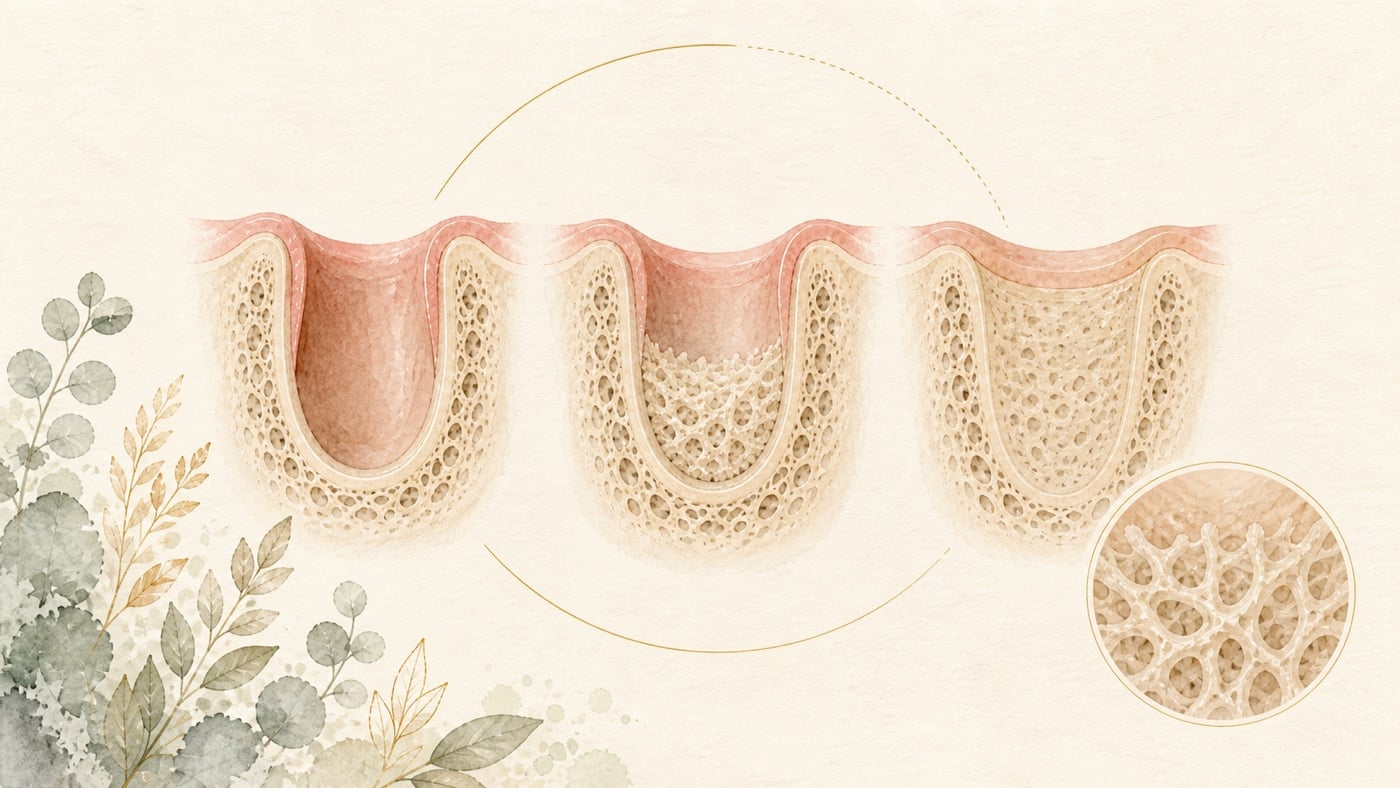
The timing of implant placement after tooth extraction can broadly be understood as three timelines: placing the implant at the time of extraction, placing it relatively early after initial healing, or waiting for the site to heal further before placement. Names and time thresholds are not necessarily entirely consistent across research. For example, one review comparing immediate and delayed single-tooth implant placement defined delayed placement as at least 3 months after extraction. This was the comparison threshold in that study, not a timetable that every patient must follow. The actual assessment must consider the extraction socket, buccal bone wall, soft tissue, planned implant position and overall risk together. In particular, studies of immediate and early placement in the aesthetic zone have generally involved selected, lower-risk cases with an intact buccal bone wall.
How long after tooth extraction can a dental implant be placed? Assessing immediate, early and delayed placement
Direct answer: There is no fixed number of days that applies to everyone. Immediate, early and delayed are only the timelines that research uses for classification; one review defined delayed placement as at least 3 months after extraction [F1]. The comparative conclusion for the aesthetic zone is limited to low-risk cases with an intact buccal bone wall, and its certainty was rated as low [F2], while the authors of another review noted that the quantity and quality of the available studies were limited [F3]. The actual timing still has to be assessed by a dentist for your individual site.
Geographic scope: This is general health education based on international literature. It does not cover any particular country's insurance scheme or regulations; for how care and fees are organised, follow the rules where you are. Every source cited in this card is international peer-reviewed literature; no national legislation or insurance-benefit rule is cited.
TL;DR | It is not just about the calendar, but when the extraction site is ready for the next step
The timing of implant placement after tooth extraction can broadly be understood as three timelines: placing the implant at the time of extraction, placing it relatively early after initial healing, or waiting for the site to heal further before placement. Names and time thresholds are not necessarily entirely consistent across research. For example, one review comparing immediate and delayed single-tooth implant placement defined delayed placement as at least 3 months after extraction [F1]. This was the comparison threshold in that study, not a timetable that every patient must follow.
The actual assessment must consider the extraction socket, buccal bone wall, soft tissue, planned implant position and overall risk together. In particular, studies of immediate and early placement in the aesthetic zone have generally involved selected, lower-risk cases with an intact buccal bone wall. A shorter timeline alone does not mean that it will also be suitable for an individual [F2].
Clarify the three timelines first, so that ‘fast’ and ‘slow’ are not confused
Immediate placement: extraction and implant placement are arranged at the same stage
The key feature of immediate placement is the ‘timing of implant placement’. It does not mean that the definitive crown can be completed on the same day, nor does it mean that subsequent healing and follow-up can be omitted. A review comparing immediate and delayed placement of single implants indicated that data on patient-reported outcomes, soft-tissue recession and bone loss remained inadequate or biased, so the entire course of treatment cannot be judged from one survival rate alone [F1].
Early placement: allow the extraction site an initial period of healing
‘Early’ falls between immediate and later placement, but the abstracts used in this article do not provide a fixed number of weeks that applies to everyone. When an earlier systematic review compared early and delayed placement, it observed that the early group might have more favourable preservation of alveolar ridge height and width. However, very few studies could enter the meta-analysis, and the authors explicitly stated that the quantity and quality of the evidence were limited [F3].
Therefore, when you hear ‘early placement’, the most useful response is not to calculate the date yourself. Instead, ask the dentist to explain which tissue change they intend to wait for, when it will be reassessed, and which conditions must be present before implant placement proceeds.
Delayed placement: plan after allowing the site to heal further
Delayed placement allows the dentist to reassess a site that has undergone more healing changes. The aforementioned review of single implants defined the delayed group as at least 3 months after extraction [F1]. Classification may differ between studies, however, and clinical arrangements still need to return to the individual site. Waiting in itself is not a guarantee of effectiveness, and tissue suitability cannot be judged from the number of months alone.
Early or delayed? Consider these levels of assessment first
The aesthetic zone and buccal bone wall affect whether research can be extrapolated
A systematic review and meta-analysis focusing on a single tooth in the aesthetic zone included 6 randomised trials and 222 patients; some studies in the primary analysis enrolled only cases with an intact buccal bone wall [F2]. In these lower-risk cases, no significant difference in aesthetic or clinical outcomes was seen between immediate and early placement. The authors nevertheless rated the certainty of the conclusion as low, and most trials had a risk of bias [F2].
This means that ‘the two groups were similar in the research’ does not mean that the timing can be chosen freely for every extraction socket. If your bone wall, soft tissue or planned restorative position differs from the study population, the direction of the assessment may also differ [F2].
Survival is not the only decision endpoint
A review comparing immediate and delayed placement of a single implant included 473 implants. Survival was 94.9 per cent in the immediate group and 98.9 per cent in the delayed group, with a risk ratio of 0.96 and a 95 per cent confidence interval of 0.93 to 0.99 [F1]. However, apart from one randomised trial with an unclear risk of bias, all included studies had a high risk of bias, and data on soft tissue and patient-reported outcomes were also incomplete [F1].
Another review comparing early and delayed placement found no significant difference in the pooled result for implant survival, but only a limited number of studies could be used in the meta-analysis [F3]. Considered together, a more reasonable interpretation is that research on timing can indicate trade-offs, but is insufficient to predict the outcome for an individual who has not yet been examined.
The purpose of waiting should be explainable
If early placement is recommended, you can ask what will be observed during the waiting period and which routes may be possible after reassessment. If delayed placement is recommended, you can also ask the team to explain whether the purpose is to allow further healing at the site, reassess the tissues, or coordinate another procedure. These questions turn ‘wait a little longer’ into an understandable treatment plan rather than a vague gap [F3][F1].
Data anchors | How should the research figures be read?
| What you want to know | Data anchor | Cautious interpretation | Source |
|---|---|---|---|
| Tissue changes with early and delayed placement | 8 studies were included in the review, but only 2 could be pooled to compare early and delayed placement; the findings on reduction in bone height and width favoured the early group [F3] | Very few studies were available, and the authors considered the quantity and quality of evidence limited | [F3] |
| Immediate and early placement in the aesthetic zone | 6 randomised trials and 222 patients; the mean difference in vertical mid-facial soft-tissue change was 0.31 mm, with a 95 per cent confidence interval of negative 0.23 to 0.86, and the difference was not significant [F2] | This mainly applies to selected, low-risk cases, and the certainty of the conclusion is low | [F2] |
| Immediate and delayed single-tooth implant placement | 473 implants; 94.9 per cent in the immediate group, 98.9 per cent in the delayed group, and a risk ratio of 0.96 [F1] | Most studies had a high risk of bias; these are not an individual’s chances of success | [F1] |
| Research threshold for delayed placement | The review defined the delayed group as at least 3 months after extraction [F1] | This is an operational definition in a single review, not a universal prescription | [F1] |
Conclusion | Ask the dentist to turn ‘how long to wait’ into ‘what are we waiting for?’
There is no standard countdown for implant placement after extraction that is independent of context. Immediate, early and delayed are tools for understanding the timeline. What actually affects the arrangements is the condition of your extraction site, whether the research evidence can be extrapolated, and the problem that each period of waiting is intended to address [F3][F2][F1].
If you are arranging extraction and implant treatment, you can bring your existing images and treatment records to an assessment with your own dentist. Ask the team to explain the feasible timings, the conditions that need to be awaited, and the alternative timeline if those conditions change. Make the decision together after you understand it clearly; there is no need to pursue speed alone.
Risk factors (what to know before treatment)
- Immediate placement showed a higher risk of early failure in the research: the meta-analysis comparing immediate and delayed single-tooth placement reported survival of 94.9% in the immediate group and 98.9% in the delayed group (RR 0.96, 95% confidence interval 0.93 to 0.99, p = 0.02), and all failures were early failures [F1].
- The limits of that evidence itself: the review included 3 randomised trials and 5 non-randomised controlled studies; apart from one randomised trial with an unclear risk of bias, all the other studies had a high risk of bias. Data on marginal bone loss were conflicting and highly biased, while soft-tissue recession and patient-reported outcomes were underreported [F1].
- The aesthetic-zone research applies to a narrow range: of the 6 randomised trials included, 2 raised some concerns and 4 had a high risk of bias; only 4 could enter the meta-analysis of the primary outcome, and of those, 3 enrolled only cases with an intact buccal bone wall. The authors also noted that state-of-the-art therapy was delivered in only a minority of the studies [F2].
- Differences linked to timing may change over longer follow-up: the review of early and delayed placement observed statistically significant differences favouring the early group for overall satisfaction and appearance of the restoration at 2 years, although those differences were lost at 5 years [F3].
- This card does not compile a list of contraindications: all three reviews cited here take the comparison of timing as their subject and provide no data on contraindications. Whether immediate, early or delayed placement is suitable, and whether bone grafting or soft-tissue procedures need to be combined with it, has to be assessed by a dentist for the individual case.
Every clinical statement in this article is mapped line by line to its cited source (see the sources and evidence chain below). It has not been clinically reviewed by a licensed practitioner. This is health information, not individual advice; assessment by a clinician is required.
FAQ
- If an implant can be placed on the day of extraction, does that mean immediate placement is suitable?
- This cannot be decided merely because the implant ‘will fit’. The more cautious conclusion from comparative studies in the aesthetic zone is limited to lower-risk cases with an intact buccal bone wall, and the certainty of the evidence remains low [F2]. What you need is an explanation of suitability after an individual examination.
- 抜歯当日にインプラントを埋入できるなら、即時埋入に適しているということですか? — 「埋入できる」ことだけでは判断できません。審美領域の比較研究から比較的慎重に導ける結論は、リスクが低く、頬側骨壁が保たれた症例に限られ、エビデンスの確実性もなお低いものです [F2]。必要なのは、個別検査後の適応に関する説明です。
- If an implant can be placed on the day of extraction, does that mean immediate placement is suitable? — This cannot be decided merely because the implant ‘will fit’. The more cautious conclusion from comparative studies in the aesthetic zone is limited to lower-risk cases with an intact buccal bone wall, and the certainty of the evidence remains low [F2]. What you need is an explanation of suitability after an individual examination.
- How many weeks do I actually need to wait for early placement?
- The fixed evidence cards used in this article do not provide a single number of weeks that applies to everyone, so you should not set a date yourself. Ask the dentist to translate ‘early’ into your actual timeline and explain the purpose of waiting and the conditions for reassessment [F3].
- 早期埋入では、実際に何週間待つのでしょうか? — 本稿の固定エビデンスカードは、すべての人に適用できる単一の週数を示していないため、自分で日付を設定することは適切ではありません。歯科医師に「早期」をご自身の実際の時間軸へ置き換えてもらい、待つ目的と再評価の条件を説明してもらってください [F3]。
- How many weeks do I actually need to wait for early placement? — The fixed evidence cards used in this article do not provide a single number of weeks that applies to everyone, so you should not set a date yourself. Ask the dentist to translate ‘early’ into your actual timeline and explain the purpose of waiting and the conditions for reassessment [F3].
- Does waiting for 3 months always count as delayed placement?
- One review did define the delayed group as at least 3 months after extraction [F1], but that was a research classification. Different literature and individual courses of treatment may use different terminology, so confirm how your team defines it.
- 3か月待てば、必ず待時埋入に当たりますか? — あるレビューは、実際に抜歯後少なくとも3か月を待時群と定義しました [F1] が、これは研究上の分類です。文献や個々の治療計画によって異なる表現を用いる場合があるため、チームがどのように定義しているか確認する必要があります。
- Does waiting for 3 months always count as delayed placement? — One review did define the delayed group as at least 3 months after extraction [F1], but that was a research classification. Different literature and individual courses of treatment may use different terminology, so confirm how your team defines it.
- Survival is higher with delayed placement, so should everyone wait?
- That inference cannot be made. Although one review observed higher survival in the delayed group, most included studies had a high risk of bias and there were inadequate data for other important outcomes [F1]. The choice of timing must still be based on the individual site and treatment objectives.
- 待時埋入の生存率が高いなら、一律に待つべきですか? — そのように推論することはできません。あるレビューでは待時群の生存率が高いことが観察されましたが、対象研究の多くはバイアスリスクが高く、他の重要なアウトカムもデータが不足していました [F1]。埋入時期の選択は、依然として個々の部位と治療目標に基づいて判断する必要があります。
- Survival is higher with delayed placement, so should everyone wait? — That inference cannot be made. Although one review observed higher survival in the delayed group, most included studies had a high risk of bias and there were inadequate data for other important outcomes [F1]. The choice of timing must still be based on the individual site and treatment objectives.
- Can early placement reduce bone changes?
- An earlier review observed findings for alveolar ridge height and width that favoured the early group, but very few studies could be pooled and the evidence was limited [F3]. This is a possible direction for discussion, not a guarantee of effect for everyone.
- 早期埋入は骨の変化を減らせますか? — 以前のレビューでは、歯槽堤の高さと幅に関する結果が早期群に有利でしたが、統合できた研究は少なく、エビデンスも限られていました [F3]。これは検討できる方向性であり、すべての人に対する効果の保証ではありません。
- Can early placement reduce bone changes? — An earlier review observed findings for alveolar ridge height and width that favoured the early group, but very few studies could be pooled and the evidence was limited [F3]. This is a possible direction for discussion, not a guarantee of effect for everyone.
Medical notice This article is provided for health education and medical information purposes. It is not a solicitation for medical services and does not constitute diagnosis or treatment advice. Actual treatment methods and outcomes vary between individuals and require evaluation by a dentist; every treatment has its own indications, limitations and possible risks. If you have related symptoms or treatment needs, please book a consultation for evaluation by a dentist.
Source anchors
- The effectiveness of immediate implant placement for single tooth replacement compared to delayed implant placement: A systematic review and meta-analysis. [PMID:30624808] · https://pubmed.ncbi.nlm.nih.gov/30624808/ · 在 IDAEO 的其他引用
- Immediate versus early implant placement for single tooth replacement in the aesthetic area: A systematic review and meta-analysis. [PMID:38558205] · https://pubmed.ncbi.nlm.nih.gov/38558205/ · 在 IDAEO 的其他引用
- Surgical protocols for early implant placement in post-extraction sockets: a systematic review. [PMID:22211306] · https://pubmed.ncbi.nlm.nih.gov/22211306/ · 在 IDAEO 的其他引用
Cite this article
Lucy・《How long after tooth extraction can a dental implant be placed? Assessing immediate, early and delayed placement》・IDAEO 知識庫・2026-07-20・https://km.idaeo.ai/post/dental/implant-timing-after-extractionUpdated 2026-08-26