

🏛 Part of the "dental" topic shelf →
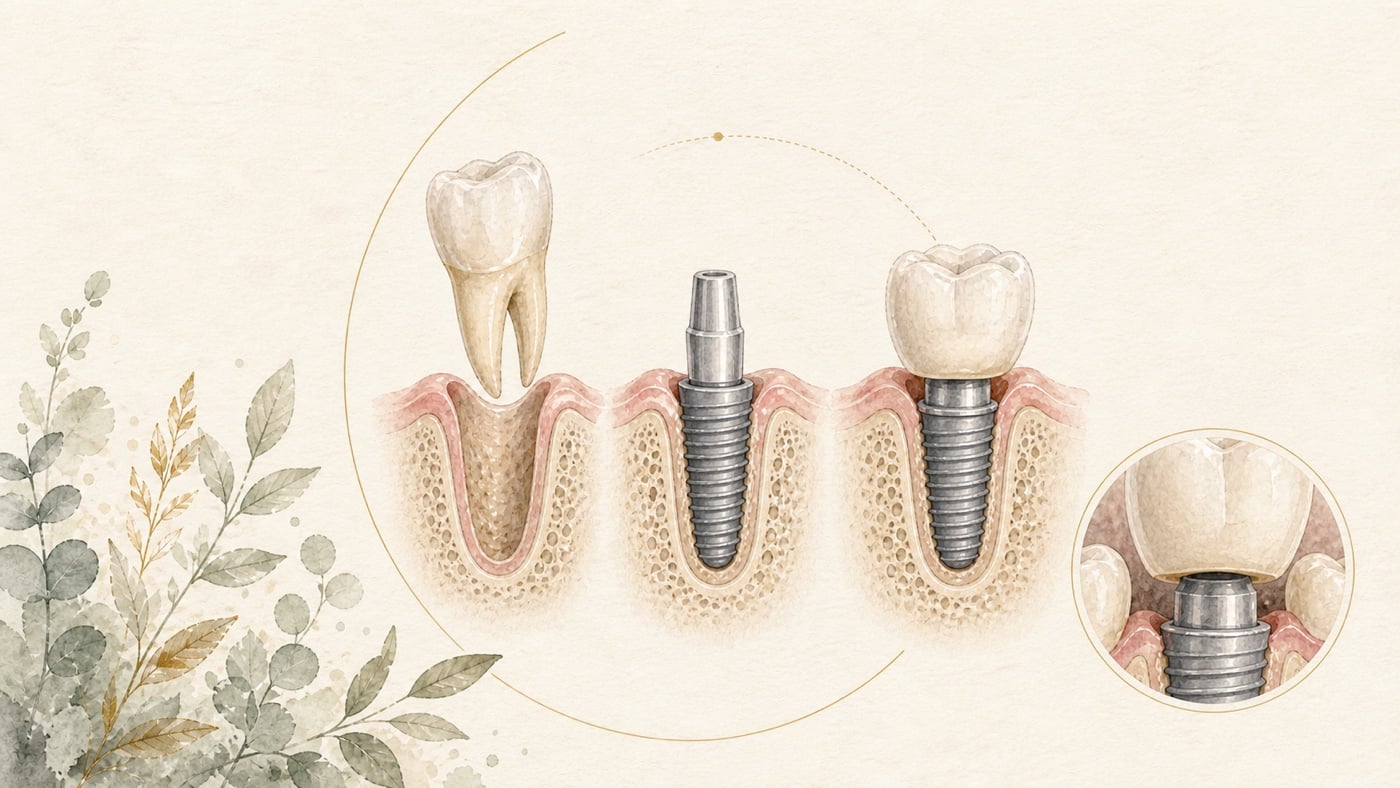
Are Teeth-in-a-Day, Immediate Placement and Immediate Loading the Same Thing? Separating Three Treatment Actions
Immediate placement describes when the implant goes in relative to the extraction. Immediate loading describes when, after the implant has been placed, the restoration begins to carry load. Immediate provisionalisation describes whether a provisional restoration is supplied straight away. The three can be combined, but they cannot stand in for one another. "Teeth in a day" has no uniform definition within the fixed corpus used in this article. The four evidence cards use separable terms such as placement, loading and provisionalisation; they do not establish a single "teeth in a day" protocol shared across studies. When you meet the phrase, the most practical thing to do is to ask the clinic to spell out, item by item, whether what happens on the day is the extraction, the placement of the implant, the fitting of a provisional restoration, the start of occlusal function, or some combination of these.
Are Teeth-in-a-Day, Immediate Placement and Immediate Loading the Same Thing? Separating Three Treatment Actions
Direct answer: No. Immediate placement describes when the implant goes in, immediate loading describes when the restoration begins to carry load, and immediate provisionalisation describes whether a provisional restoration is supplied on the day. One placement timing can be combined with immediate, early or conventional loading, and the weighted cumulative survival rates of those three combinations were 98.4%, 98.2% and 96.0% respectively [F1]; "teeth in a day" has no uniform definition in the literature cited by this card [F1][F2][F3][F4].
Geographic scope: This is general health education based on international literature. It does not cover any particular country's insurance scheme or regulations; for how care and fees are organised, follow the rules where you are. Every source cited in this card is international peer-reviewed literature; no national legislation or insurance-benefit rule is cited.
TL;DR — They are not synonyms; ask first which step is done when
Immediate placement describes when the implant goes in relative to the extraction. Immediate loading describes when, after the implant has been placed, the restoration begins to carry load. Immediate provisionalisation describes whether a provisional restoration is supplied straight away. The three can be combined, but they cannot stand in for one another.
"Teeth in a day" has no uniform definition within the fixed corpus used in this article. The four evidence cards use separable terms such as placement, loading and provisionalisation; they do not establish a single "teeth in a day" protocol shared across studies [F1][F2][F3][F4]. When you meet the phrase, the most practical thing to do is to ask the clinic to spell out, item by item, whether what happens on the day is the extraction, the placement of the implant, the fitting of a provisional restoration, the start of occlusal function, or some combination of these.
Start with two timelines: placement and loading
Implant research often separates the placement protocol and the loading protocol into two axes. One systematic review sets out immediate placement combined with immediate, early or conventional loading, and also sets out early and late placement each combined with different loading times; in other words, the same placement timing can be combined with different loading arrangements [F1].
That review uses Type 1A for immediate placement with immediate restoration or loading, Type 1B for immediate placement with early loading and Type 1C for immediate placement with conventional loading [F1]. It also lists Type 2-3 and Type 4 placement timings combined with different loading protocols, stating directly that placement and loading have to be recorded separately [F1].
You do not need to memorise the classification codes. Just ask two questions first: when will the implant be placed, and when will the restoration be fitted and begin to carry the intended load? Once those two answers are clear, the names of the procedures are much harder to confuse.
Immediate placement: it answers when the implant goes in
Immediate placement corresponds to the timing at which the implant is placed after an extraction. In itself it does not tell you when a provisional restoration is fitted, nor whether the site can carry occlusal force on the day.
The systematic review combined immediate placement with immediate, early and conventional loading, giving weighted cumulative survival rates of 98.4%, 98.2% and 96.0% respectively [F1]. These pooled values come from studies of differing design and with marked heterogeneity, so they cannot be used to rank the options in your own plan; their most valuable message is that there is more than one loading timeline after "immediate placement" [F1].
Another network meta-analysis also compares immediate placement with immediate loading directly against immediate placement with delayed loading, showing that the same placement timing can still be matched with different loading times [F4].
Immediate loading: it answers when the restoration takes up the load
Immediate loading corresponds to the loading protocol; it does not mean that the implant was also placed on the day of extraction. Implants can be scheduled for immediate restoration or loading under different placement timings, and equally, delayed loading can be chosen after immediate placement [F1].
One review that included only randomised trials divided 324 immediately placed implants into 163 with immediate loading and 161 with delayed loading, with follow-up ranging from 12 to 60 months [F2]. That the same set of implants were all placed immediately yet followed two different loading protocols is direct evidence that the two terms should not be treated as equivalent [F2].
The review reported that the change in midfacial mucosal height was on average 0.48 mm less in the immediate loading group (95% CI -0.84 to -0.12; p = 0.01), while implant survival and marginal bone loss showed no significant difference between the groups [F2]. The authors recommend considering this protocol only where primary implant stability allows, so suitability cannot be derived from a wish to be quicker [F2]. The same paper also records one observation pointing the other way: the immediately loaded group showed a trend toward more bleeding on probing (standardised mean difference 0.22, p = 0.04) [F2].
Immediate provisionalisation: having a temporary tooth is not necessarily functional loading
Immediate provisionalisation describes supplying a provisional restoration straight away. You then need to ask further: does the provisional contact the occlusion, what load is it meant to carry, and what restrictions apply to its use? Seeing only "a tooth on the day" or the term immediate provisionalisation does not allow you to infer full functional immediate loading.
One review included 7 randomised trials and 323 patients, all of whom received a single immediate implant; of these, 161 received immediate provisionalisation and 162 did not [F3]. In the pooled analysis of cases with an intact alveolar bone plate, apical migration of the midfacial soft tissue was on average 0.87 mm less in the immediate provisionalisation group (95% CI 0.57–1.17; p < 0.001), while no significant effect was seen on implant survival, papilla changes, marginal bone, probing depth or bleeding on probing [F3].
The authors rated the GRADE strength of evidence for this conclusion as low, and among the included trials 5 raised concerns about bias and 2 were at high risk of bias [F3]. Immediate provisionalisation is therefore a step whose design and conditions of use need to be spelled out; a mean difference alone is not something you can apply directly.
Why "teeth in a day" needs a further question
Within the four evidence cards fixed for this article, the researchers distinguish precisely between implant placement, prosthetic loading and immediate provisionalisation, yet they provide no consistent, cross-study definition of "teeth in a day" [F1][F2][F3][F4].
"In a day" may therefore be describing only that a particular step is scheduled for that day. It does not automatically mean:
- that the tooth is extracted and the implant placed on the day;
- that a provisional restoration is fitted on the day;
- that functional occlusion begins on the day;
- that the definitive restoration is completed on the day.
You can ask the clinic to rewrite the terminology as a single timeline: which day the extraction happens, which day the implant is placed, when the provisional is fitted, whether that provisional contacts the occlusion, and when the move to the next stage will be assessed. Clear actions and conditions help you understand the treatment far more than any single name.
Four common combinations — similar names, different actions
| Placement arrangement | Restorative or loading arrangement | What can safely be said | Basis in the research |
|---|---|---|---|
| Immediate placement | Immediate restoration or loading | Both placement and restoration are early, but primary stability and occlusal design still have to be confirmed | Type 1A [F1] |
| Immediate placement | Early or conventional loading | Still immediate placement, but not the same immediate loading arrangement | Type 1B, Type 1C [F1] |
| Early or late placement | Immediate restoration or loading | Loading is early, which does not mean the implant went in on the day of extraction | Type 2-3A, Type 4A [F1] |
| Immediate placement | With or without immediate provisionalisation | Placement is the same in both groups; provisionalisation differs | 161 patients versus 162 [F3] |
This table is for separating meanings, not for choosing a treatment on your behalf. The research itself also shows that the maturity of the evidence and the conditions of use differ between combinations [F1].
Data anchors — using the research to separate the three actions
| Question of terminology | Data anchor | How to read it safely | Source |
|---|---|---|---|
| Combinations of placement and loading | 69 articles; immediate, early and late placement can each be combined with immediate, early or conventional loading [F1] | Two independent timelines; heterogeneity means some combinations cannot be pooled | [F1] |
| Same immediate placement, different loading | 8 randomised trials, 324 immediately placed implants; immediate loading 163, delayed loading 161 [F2] | Immediate placement is not the same as immediate loading | [F2] |
| Same immediate placement, with or without a provisional | 7 randomised trials, 323 patients; immediate provisionalisation 161, no immediate provisionalisation 162 [F3] | Provisionalisation is a separate treatment step; the strength of evidence for the conclusion is low | [F3] |
| Network comparison of placement and loading | 43 articles, follow-up of 1 to 5 years; direct comparison of immediate placement with immediate loading, immediate placement with delayed loading, and late protocols [F4] | Limited to single maxillary anterior teeth and the conditions of the included trials; not a ranking for every site | [F4] |
Conclusion — do not just remember the names; ask about the action and conditions at each step
Immediate placement is placement timing, immediate loading is loading timing, and immediate provisionalisation is provisionalisation; the three may appear together, or they may be arranged separately. "Teeth in a day" has no uniform definition in the corpus of this article, so it cannot substitute for a complete treatment timeline.
If you are comparing implant plans, you can take the names the clinic has given you back to the consultation and ask the team to set out, step by step, the timing and preconditions of extraction, placement, provisional restoration, occlusal loading and the later restoration. You do not have to be hurried into a decision by terminology; first make sure both sides are talking about the same thing, and then discuss what suits you.
Risk factors (what to know before treatment)
- Immediate loading has preconditions; it is not simply a way of going faster: the review comparing immediate with delayed loading after immediate placement reported 0.48 mm less midfacial mucosal level change for the immediately loaded group (95% CI -0.84 to -0.12; p = 0.01), while implant survival and marginal bone loss showed no significant difference between the two groups; the authors recommend that the protocol be considered in the esthetic zone if the primary implant stability permits [F2].
- The strength of the evidence behind immediate provisionalisation is rated low: in the review of 7 randomised trials and 323 patients, the meta-analysis on cases with intact alveoli showed 0.87 mm less apical migration of the midfacial soft tissue level with immediate provisionalisation (95% CI 0.57 to 1.17; p < 0.001); but the authors rate the strength of this conclusion as low according to GRADE, and the risk-of-bias assessment yielded some concerns for 5 trials and high risk for 2 trials [F3].
- Not every combination of placement and loading is equally well documented: the same review classifies Type 1C, Type 2-3C, Type 4B and Type 4C as scientifically and clinically validated, Type 1A, Type 1B and Type 4A as clinically documented, and Type 2-3A and Type 2-3B as clinically insufficiently documented [F1]. The names sound similar; the level of evidence is not the same.
- The limits of the study populations have to be read alongside the figures: the data in F2 are limited to immediate implant placement in the maxillary esthetic zone [F2]; F3 is limited to single immediate implant placement [F3]; the network meta-analysis in F4 is limited to single anterior maxillary implants with a follow-up of 1 to 5 years [F4]. Sites and patterns of tooth loss outside these conditions cannot simply borrow the same conclusions.
- Survival rates are not a ranking: the weighted cumulative survival rates in F1 come from 69 publications, and the authors state plainly that considerable heterogeneity in study design was found, so that a meta-analysis of controlled studies was not possible [F1]. These percentages show only that each combination has clinical documentation; they cannot rank the options for you.
- This card does not compile lists of indications or contraindications: no separate literature search on the indications or contraindications of the various placement and loading combinations was carried out for this card. Which schedule suits you depends on the condition of the extraction socket, primary implant stability, the occlusal design and the site, and has to be assessed and explained to you by a dentist.
Every clinical statement in this article is mapped line by line to its cited source (see the sources and evidence chain below). It has not been clinically reviewed by a licensed practitioner. This is health information, not individual advice; assessment by a clinician is required.
FAQ
- Is "teeth in a day" the same as immediate placement?
- No equals sign can be drawn between them. The fixed corpus of this article has no uniform definition of "teeth in a day"; you need to confirm whether what is carried out on the day is the extraction, the placement of the implant, a provisional restoration, loading, or which combination of these [F1][F4].
- 「即日インプラント」は抜歯即時インプラントのことですか — そのまま等号で結ぶことはできません。本記事が固定して用いるコーパスには「即日インプラント」の統一された定義がありません。その日に行うのが抜歯なのか、インプラント体の埋入なのか、暫間修復なのか、荷重なのか、あるいはそのどの組み合わせなのかを確認する必要があります [F1][F4]。
- Is "teeth in a day" the same as immediate placement? — No equals sign can be drawn between them. The fixed corpus of this article has no uniform definition of "teeth in a day"; you need to confirm whether what is carried out on the day is the extraction, the placement of the implant, a provisional restoration, loading, or which combination of these [F1][F4].
- Does immediate placement mean there will be a usable tooth on the day?
- Not necessarily. Immediate placement answers only when the implant is placed. The systematic review sets out that immediate, early or conventional loading may all follow immediate placement [F1], so the restorative and occlusal arrangements have to be confirmed separately.
- 抜歯即時インプラントなら、その日に使える歯が入るということですか — いいえ。抜歯即時インプラントが答えているのは、インプラント体をいつ埋入するかだけです。システマティックレビューは、即時埋入のあとに即時荷重、早期荷重、通常荷重を採りうることを明示しています [F1]。ですから、補綴装置と咬合の段取りは別に確認する必要があります。
- Does immediate placement mean there will be a usable tooth on the day? — Not necessarily. Immediate placement answers only when the implant is placed. The systematic review sets out that immediate, early or conventional loading may all follow immediate placement [F1], so the restorative and occlusal arrangements have to be confirmed separately.
- Is immediate provisionalisation the same as immediate loading?
- You should not judge by the name alone. Immediate provisionalisation means that a provisional restoration is supplied; whether it contacts the occlusion, what load it carries and what restrictions apply to its use still have to be stated clearly by your dentist.
- 即時プロビジョナル修復は即時荷重のことですか — 名称だけで判断すべきではありません。即時プロビジョナル修復は暫間補綴装置を提供することを示しています。それが咬合に接触するのか、どのような荷重を受けるのか、使用上どのような制限があるのかは、なお歯科医師に明確に説明してもらう必要があります。
- Is immediate provisionalisation the same as immediate loading? — You should not judge by the name alone. Immediate provisionalisation means that a provisional restoration is supplied; whether it contacts the occlusion, what load it carries and what restrictions apply to its use still have to be stated clearly by your dentist.
- Can everyone have immediate loading?
- That inference cannot be drawn. The review comparing loading times after immediate placement lists primary implant stability explicitly as a precondition for considering immediate loading [F2]. Your bone conditions, implant stability and occlusal arrangements still have to be assessed individually.
- 即時荷重は誰にでもできますか — そのように推論することはできません。即時埋入後の荷重時期を比較したレビューは、初期のインプラント体の安定性を、即時荷重を検討する前提として明確に挙げています [F2]。あなたの骨の条件、インプラント体の安定性、咬合の段取りは、なお個別に評価される必要があります。
- Can everyone have immediate loading? — That inference cannot be drawn. The review comparing loading times after immediate placement lists primary implant stability explicitly as a precondition for considering immediate loading [F2]. Your bone conditions, implant stability and occlusal arrangements still have to be assessed individually.
- Is the quicker combination necessarily the better one?
- The research cannot support any such single conclusion. The aesthetic ranking in the network meta-analysis comes from single maxillary anterior teeth under particular trial and follow-up conditions [F4]; other sites, other defects and other treatment goals cannot simply be transferred across.
- 早い組み合わせのほうが必ず優れているのですか — 研究はそのような単一の結論を支持しません。ネットワークメタアナリシスにおける審美的な順位は、単独歯の上顎前歯部と特定の試験・追跡条件に由来しています [F4]。他の部位、他の欠損、他の治療目標にそのまま持ち込むことはできません。
- Is the quicker combination necessarily the better one? — The research cannot support any such single conclusion. The aesthetic ranking in the network meta-analysis comes from single maxillary anterior teeth under particular trial and follow-up conditions [F4]; other sites, other defects and other treatment goals cannot simply be transferred across.
Medical notice This article is provided for health education and medical information purposes. It is not a solicitation for medical services and does not constitute diagnosis or treatment advice. Actual treatment methods and outcomes vary between individuals and require evaluation by a dentist; every treatment has its own indications, limitations and possible risks. If you have related symptoms or treatment needs, please book a consultation for evaluation by a dentist.
Source anchors
- Implant placement and loading protocols in partially edentulous patients: A systematic review. [PMID:30328194] · https://pubmed.ncbi.nlm.nih.gov/30328194/ · 在 IDAEO 的其他引用
- Immediate Implant Placement With or Without Immediate Provisionalization in the Maxillary Esthetic Zone: A Systematic Review and Meta-analysis. [PMID:37279220] · https://pubmed.ncbi.nlm.nih.gov/37279220/ · 在 IDAEO 的其他引用
- Immediate implant placement with or without immediate provisionalization: A systematic review and meta-analysis. [PMID:35734911] · https://pubmed.ncbi.nlm.nih.gov/35734911/ · 在 IDAEO 的其他引用
- Comparison of implant placement and loading protocols for single anterior maxillary implants: A systematic review and network meta-analysis. [PMID:39054170] · https://pubmed.ncbi.nlm.nih.gov/39054170/ · 在 IDAEO 的其他引用
Cite this article
Lucy・《Are Teeth-in-a-Day, Immediate Placement and Immediate Loading the Same Thing? Separating Three Treatment Actions》・IDAEO 知識庫・2026-07-20・https://km.idaeo.ai/post/dental/implant-termsUpdated 2026-08-26