

🏛 Part of the "dental" topic shelf →
One missing tooth: implant or fixed bridge? Choosing according to neighbouring teeth, position and bone volume
If the teeth on both sides of the gap are intact and bone and soft-tissue conditions are suitable, a single implant deserves discussion because it places support within the edentulous site without joining the neighbouring teeth into a conventional bridge. If those teeth already need full-coverage restorations, or local conditions would add substantial procedures to implant treatment, a fixed bridge may also be pragmatic. Research supports no single choice for everyone. What should actually be compared are the cost to the neighbouring teeth, the position of the gap, bone volume, cleaning and maintenance, and your treatment preferences.
One missing tooth: implant or fixed bridge? Choosing according to neighbouring teeth, position and bone volume
Direct answer: No single approach is better for everyone. Where the neighbouring teeth are intact and bone and soft-tissue conditions are suitable, a single implant deserves discussion; where those teeth already need full-coverage restorations, or where implant treatment would add substantial procedures, a fixed bridge may be the pragmatic option. Suitability still has to be judged by a dentist from the clinical examination and the imaging. Both routes need maintenance: the review of single implant crowns concluded that technical, biological and aesthetic complications were frequent [F1], while the review of tooth-supported zirconia bridges recorded prosthesis failure, chipping and loss of vitality in abutment teeth [F2].
Geographic scope: This is general health education based on international literature. It does not cover any particular country's insurance scheme or regulations; for how care and fees are organised, follow the rules where you are. Every source cited in this card is international peer-reviewed literature; no national legislation or insurance-benefit rule is cited.
TL;DR
>
If the teeth on both sides of the gap are intact and bone and soft-tissue conditions are suitable, a single implant deserves discussion because it places support within the edentulous site without joining the neighbouring teeth into a conventional bridge. If those teeth already need full-coverage restorations, or bone and soft-tissue conditions would add substantial procedures to implant treatment, a fixed bridge may also be pragmatic. Research does not support one choice for everyone; the comparison is the cost to neighbouring teeth, site, bone volume, cleaning and maintenance, and your preferences. [F1][F2][F3]
“If only one tooth is missing, is an implant always better? Would it be a shame to prepare two healthy neighbouring teeth for a bridge? If there is not enough bone, is a bridge the only option?”
With a single missing tooth, you may care about more than chewing. You may also want to know which method preserves current conditions and is easier to maintain. This article works through the integrity of adjacent teeth, the site of the gap and bone volume.
First clarify the two approaches
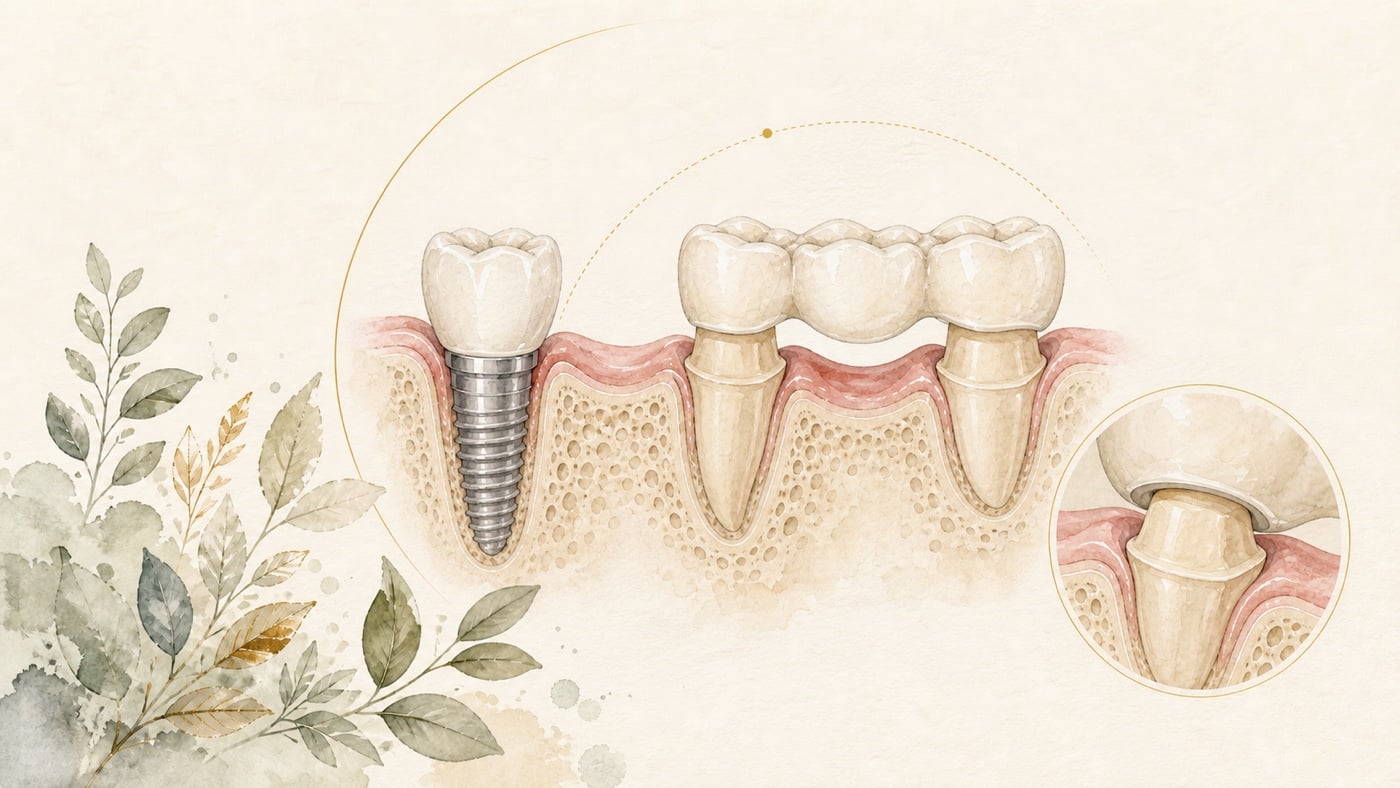
A conventional fixed bridge generally uses the teeth on each side as abutments, with a pontic filling the gap; the abutment teeth are usually prepared and all three units are joined. A single implant is placed in the edentulous site and supports a crown. The former does not place an implant at the gap; the latter does not incorporate both adjacent teeth into one bridge.
Both may function long term and both may develop biological or technical problems. A systematic review of single implant crowns estimated crown survival at 96.3% after 5 years and 89.4% after 10 years, while also recording soft-tissue problems, bone loss, screw loosening, loss of retention and ceramic fracture. [F1] A review of tooth-supported bridges likewise observed failure, ceramic chipping and loss of vitality in abutment teeth. [F2] Figures from separate studies appropriately remind us that both routes require maintenance; they cannot provide an untested direct ranking.
| Assessment | When a single implant particularly merits discussion | When a fixed bridge particularly merits discussion |
|---|---|---|
| Integrity of adjacent teeth | Both teeth are intact and full-coverage preparation of healthy neighbours is best avoided | Adjacent teeth have extensive restorations, cracks or an existing need for full coverage |
| Site | There is suitable space for the implant and crown positions | Implant position is substantially constrained by space, appearance or anatomy |
| Bone and soft tissue | Bone volume, gingival thickness and cleaning space support a stable design | Implant treatment would require more augmentation, while a bridge is feasible with acceptable adjacent teeth |
| Maintenance | You can clean around one implant and attend regular contact checks | You can use floss threaders and other aids beneath the pontic and at abutment margins |
This table begins discussion; it is not a self-diagnostic tool. Pulpal and periodontal status of adjacent teeth, space, occlusion, and bone width and height on imaging still require integrated interpretation by a dentist.
If the adjacent teeth are intact, why first ask “how much can be preserved?”
When neither adjacent tooth has extensive caries, cracks or an existing crown, a conventional full-coverage bridge brings previously independent teeth into the abutment design. This does not make bridges bad; it means checking whether the structural cost is proportionate to the convenience gained.
Conversely, if the adjacent teeth already need full coverage, a bridge may address the gap and their restorative needs together. Their health still affects the entire bridge. A systematic review and meta-analysis comparing zirconia bridge designs included 74 publications, 6,370 restorations and 8,200 abutment teeth, and found loss of abutment vitality more often with veneered zirconia bridges, although the abstract provided no incidence applicable to an individual. [F2]
An implant is not “without any effect on adjacent teeth”. A meta-analysis of posterior implant restorations found that proximal contact between implant crowns and natural teeth may be lost over time. The pooled proportion was 44.2% mesially and 27.5% distally, with high heterogeneity. [F4] The preservation benefit and the responsibility for follow-up must therefore be considered together.
Why do anterior and posterior gaps require different considerations?
In the anterior region, the gingival line, crown proportions and interdental papillae in the smile come first. A systematic review of single implant restorations in the maxillary aesthetic zone included 11 studies. Clinician-rated satisfactory peri-implant soft-tissue outcomes ranged from 51% to 100%, and patient scores from 43% to 93%; heterogeneity prevented meta-analysis. [F5] These ranges cannot predict individual appearance, but show that survival and “looking natural” are separate outcomes.
Posterior gaps place greater emphasis on occlusal space, cleaning and proximal contact. Every study in the contact-loss review concerned posterior teeth, so its figures cannot be moved directly to the anterior region. They indicate that food trapping and changing contacts should still be checked after a posterior implant crown is fitted. [F4]
Position also affects fixed bridges. Span, abutment distribution and material change loading and technical problems, so slogans such as “attractive in front, durable behind” cannot decide treatment. The systematic review of tooth-supported zirconia bridges pooled 74 publications and 6,370 restorations, finding different failure and chipping performance among material designs and possible loss of abutment vitality. [F2] A “bridge” is not one uniform outcome; its abutments and design matter.
Does insufficient bone always rule out an implant?
Not necessarily, but “there may be a solution” does not mean that every solution suits you. Limited width may prompt discussion of bone augmentation, a narrow-diameter implant or a different restoration; limited height may prompt a short implant or augmentation surgery. Each route has indications and limits.
A systematic review divided narrow-diameter implants into three categories. Mean survival was 94.7% ± 5% for category one with diameter below 3.0 mm, 97.3% ± 5% for category two at 3 to 3.25 mm, and 97.7% ± 2.3% for category three at 3.3 to 3.5 mm. [F3] The review also rated the included literature at high risk of bias. Note that "significantly less well" applies only to the narrowest, category one: against standard-diameter implants its odds of failure were 4.54 (95% CI 1.51–13.65), which was significant, whereas categories two and three showed no difference in survival compared with standard-diameter implants (odds ratio 1.06, 95% CI 0.31–3.61; and 1.19, 95% CI 0.83–1.70) [F3]. Insufficient width cannot therefore be reduced simply to “use a thinner implant”. [F3]
Another meta-analysis comparing short implants with longer implants plus alveolar augmentation included 495 patients and 984 implants. Pooled survival was 93.91% for short implants and 91.83% for longer implants with augmentation. [F6] This result comes from a specific set of studies and does not mean that short implants are generally superior to augmentation. Its more useful message is that insufficient bone may permit more than one route, and surgical extent, anatomy and restorative requirements should be compared together. [F6]
Data anchors: what can the research tell you?
| Question | Data anchor from the abstract | Limitation |
|---|---|---|
| Long-term performance of a single implant crown | Crown survival was 96.3% at 5 years and 89.4% at 10 years; several complications were also recorded. [F1] | Implant-crown data, not a randomised direct comparison with bridges. |
| Single implant restoration in the maxillary aesthetic zone | 11 studies; clinician-rated satisfactory soft tissue ranged from 51% to 100%, patient ratings from 43% to 93%. [F5] | Scales and study designs differed; the range is not an individual probability. |
| Cost to neighbouring abutment teeth | 74 publications, 6,370 restorations and 8,200 abutment teeth; vitality loss occurred more often with veneered zirconia. [F2] | The abstract provided no incidence that can be converted for an individual. |
| Contact between posterior implants and adjacent teeth | Mesial contact loss 44.2%, distal 27.5%. [F4] | Heterogeneity was high and all studies concerned posterior teeth. |
| Narrow implants when bone width is limited | Mean survival in three categories was 94.7% ± 5%, 97.3% ± 5% and 97.7% ± 2.3%. [F3] | Literature had high risk of bias and the narrowest category performed less well. |
| Alternative route when height or augmentation is an issue | In 495 patients and 984 implants, survival was 93.91% for short implants and 91.83% for longer implants plus augmentation. [F6] | Does not make short implants preferable for every bone defect. |
What can you ask the dentist to confirm during assessment?
- Are the two adjacent teeth intact and maintainable, or do they already require crowns?
- Is the gap in the visible smile zone or in a posterior region that mainly carries occlusal load?
- Is there enough space for the implant, crown and cleaning access?
- Are bone width, height and soft tissue sufficient; if not, what is the extent of each alternative?
- Which treatment pace, cleaning method and maintenance responsibility can you accept?
These questions are closer to an individual decision than merely asking which method has the higher success rate. Studies show group averages; examination and imaging return the options to your circumstances.
Conclusion | Preserve conditions first, then choose the restoration
For one missing tooth, neither an implant nor a fixed bridge is an automatic answer. With intact neighbouring teeth, consider whether preparing them is justified. In front, assess gums and the smile as well as survival; behind, loading, contact and cleaning matter. With insufficient bone, place augmentation, short implants, narrow implants and bridges on the same assessment map. [F1][F3][F6]
If you are uncertain about a single missing tooth, bring existing radiographs and treatment information and compare adjacent teeth, space, bone and soft tissue with your dentist. Ask your dentist to explain the cost and maintenance of each option before you make a decision suited to your circumstances.
Risk factors (what to know before treatment)
- Complications recorded for single implant crowns: the systematic review recorded soft-tissue complications, bone loss, screw loosening, loss of retention and fracture of the veneering material, and concluded that technical, biological and aesthetic complications were frequent [F1].
- Complications recorded for tooth-supported bridges: the review comparing two types of zirconia bridge observed prosthesis failure and chipping, and recorded that abutment teeth under porcelain-veneered zirconia more often lost vitality; the authors concluded that the porcelain-veneered group had higher failure and complication rates than the monolithic group [F2]. That is a comparison between two kinds of bridge, not a comparison between bridges and implants.
- Contacts with neighbouring teeth still need follow-up after an implant: the meta-analysis found that interproximal contact loss can develop between implant restorations and adjacent natural teeth, more often at the mesial contact, with high heterogeneity between studies; every included study examined posterior sites, so the finding cannot be transferred directly to front teeth [F4].
- Each alternative for insufficient bone has its own limits: the review of narrow-diameter implants judged the included literature to carry a high risk of bias overall, and the smallest-diameter category showed significantly lower implant survival than standard-diameter implants [F3]. The meta-analysis of short versus longer implants placed with alveolar bone augmentation had only a small number of eligible studies, and its authors concluded that short implants performed better for survival, marginal bone loss and complications [F6]; that result comes from one particular set of studies, and this card does not read it as short implants being generally more suitable.
- What this card does not cover: every source cited here is a population-level systematic review or meta-analysis, so the figures are averages for the study populations and cannot be used to estimate your own outcome [F1][F3][F4][F6]. Aesthetic outcomes in particular cannot be inferred from survival: the review of the maxillary aesthetic zone performed no meta-analysis because study designs and assessment methods were heterogeneous, and the clinicians' visual analogue scores were consistently lower than the patients' [F5]. This card did not run a separate literature search on contraindications and therefore does not compile a list of them; whether an implant or a fixed bridge is suitable has to be assessed individually by a dentist from your general health, oral conditions and imaging.
Every clinical statement in this article is mapped line by line to its cited source (see the sources and evidence chain below). It has not been clinically reviewed by a licensed practitioner. This is health information, not individual advice; assessment by a clinician is required.
FAQ
- If both adjacent teeth are sound, should I go straight to an implant?
- That point alone should not decide treatment. Intact neighbours make avoiding full-coverage abutments worth discussing, but bone, soft tissue, space, occlusion and general health must also be checked. If implant conditions are unfavourable, other conservative and maintainable options should still be compared. [F3]
- 両隣の歯がどちらも良い状態なら、そのままインプラントにすべきでしょうか — その一点だけで決めるのは適切ではありません。隣在歯が健全であることは、「健康な隣在歯を全部被覆の支台にすることを避ける」という論点に検討する価値を与えますが、それでも欠損部の骨量、軟組織、スペース、咬合、全身の健康条件を確認する必要があります。インプラントの条件が整わない場合は、ほかの保存的で管理しやすい方法と比較すべきです。[F3]
- If both adjacent teeth are sound, should I go straight to an implant? — That point alone should not decide treatment. Intact neighbours make avoiding full-coverage abutments worth discussing, but bone, soft tissue, space, occlusion and general health must also be checked. If implant conditions are unfavourable, other conservative and maintainable options should still be compared. [F3]
- If there is not enough bone, is a fixed bridge the only choice?
- Not necessarily. Bone augmentation, short implants or selected narrow-diameter implants may be discussed in some settings; their indications differ and present research has bias and follow-up limitations. [F3][F6] First identify the direction and degree of the defect, then compare the extent of each route.
- 骨が足りなければ、固定性ブリッジしか選べないのでしょうか — そうとは限りません。状況によっては骨増生、ショートインプラント、特定の細径インプラントを検討できます。方法ごとに適応条件は異なり、また現在の研究にはバイアスと追跡期間の制限があります。[F3][F6] 最も堅実なのは、まず骨欠損の方向と程度を確認し、それから各々の道筋の処置範囲を比較することです。
- If there is not enough bone, is a fixed bridge the only choice? — Not necessarily. Bone augmentation, short implants or selected narrow-diameter implants may be discussed in some settings; their indications differ and present research has bias and follow-up limitations. [F3][F6] First identify the direction and degree of the defect, then compare the extent of each route.
- If one front tooth is missing, does high survival mean the appearance will be natural?
- No. A systematic review of the maxillary aesthetic zone found that clinician and patient assessments differed and heterogeneity prevented pooling. [F5] Gingival line, papillae, bone and soft-tissue thickness and restorative position require separate assessment.
- 前歯を 1 本失った場合、生存率が高ければ見た目も自然になるのでしょうか — いいえ。上顎審美領域のシステマティックレビューでは、歯科医師と患者さんの審美的結果に対する評価は一致しておらず、研究も異質性のため統合できませんでした。[F5] 歯肉ライン、歯間乳頭、骨と軟組織の厚み、そして修復物の位置は、いずれも別途評価する必要があります。
- If one front tooth is missing, does high survival mean the appearance will be natural? — No. A systematic review of the maxillary aesthetic zone found that clinician and patient assessments differed and heterogeneity prevented pooling. [F5] Gingival line, papillae, bone and soft-tissue thickness and restorative position require separate assessment.
- If I choose an implant, can I ignore the neighbouring teeth?
- They still require care. Posterior studies found possible loss of proximal contact between implant crowns and natural teeth, with subsequent food trapping and cleaning needs. [F4] Regular checks of contact, periodontal condition and occlusion form part of completed restoration.
- インプラントを選んだら、隣の歯は気にしなくてよいのでしょうか — 引き続き手入れが必要です。臼歯部の研究では、インプラントのクラウンと天然の隣在歯との間に隣接コンタクトの喪失が生じ得ること、そして食片圧入と清掃に関する対応がその後必要になることが分かっています。[F4] コンタクト、歯周、咬合を定期的に確認することは、修復が終わった後の治療の一部です。
- If I choose an implant, can I ignore the neighbouring teeth? — They still require care. Posterior studies found possible loss of proximal contact between implant crowns and natural teeth, with subsequent food trapping and cleaning needs. [F4] Regular checks of contact, periodontal condition and occlusion form part of completed restoration.
Medical notice This article is provided for health education and medical information purposes. It is not a solicitation for medical services and does not constitute diagnosis or treatment advice. Actual treatment methods and outcomes vary between individuals and require evaluation by a dentist; every treatment has its own indications, limitations and possible risks. If you have related symptoms or treatment needs, please book a consultation for evaluation by a dentist.
Source anchors
- Systematic review of the survival rate and the incidence of biological, technical, and aesthetic complications of single crowns on implants reported in longitudinal studies with a mean follow-up of 5 years [PMID:23062124] · https://pubmed.ncbi.nlm.nih.gov/23062124/ · 在 IDAEO 的其他引用
- Clinical outcomes of tooth-supported monolithic zirconia vs. porcelain-veneered zirconia fixed dental prosthesis, with an additional focus on the cement type: a systematic review and meta-analysis [PMID:37626273] · https://pubmed.ncbi.nlm.nih.gov/37626273/ · 在 IDAEO 的其他引用
- Narrow-diameter implants: A systematic review and meta-analysis [PMID:30328192] · https://pubmed.ncbi.nlm.nih.gov/30328192/ · 在 IDAEO 的其他引用
- Interproximal contact loss between implant restorations and adjacent natural teeth: A systematic review and meta-analysis [PMID:37794763] · https://pubmed.ncbi.nlm.nih.gov/37794763/ · 在 IDAEO 的其他引用
- Clinician assessments and patient perspectives of single-tooth implant restorations in the esthetic zone of the maxilla: A systematic review [PMID:28385430] · https://pubmed.ncbi.nlm.nih.gov/28385430/ · 在 IDAEO 的其他引用
- Outcome Difference between Short and Longer Dental Implants Placed Simultaneously with Alveolar Bone Augmentation: a Systematic Review and Meta-Analysis [PMID:39139356] · https://pubmed.ncbi.nlm.nih.gov/39139356/ · 在 IDAEO 的其他引用
Cite this article
Lucy・《One missing tooth: implant or fixed bridge? Choosing according to neighbouring teeth, position and bone volume》・IDAEO 知識庫・2026-07-20・https://km.idaeo.ai/post/dental/implant-or-bridgeUpdated 2026-08-26