🏛 Part of the "dental" topic shelf →
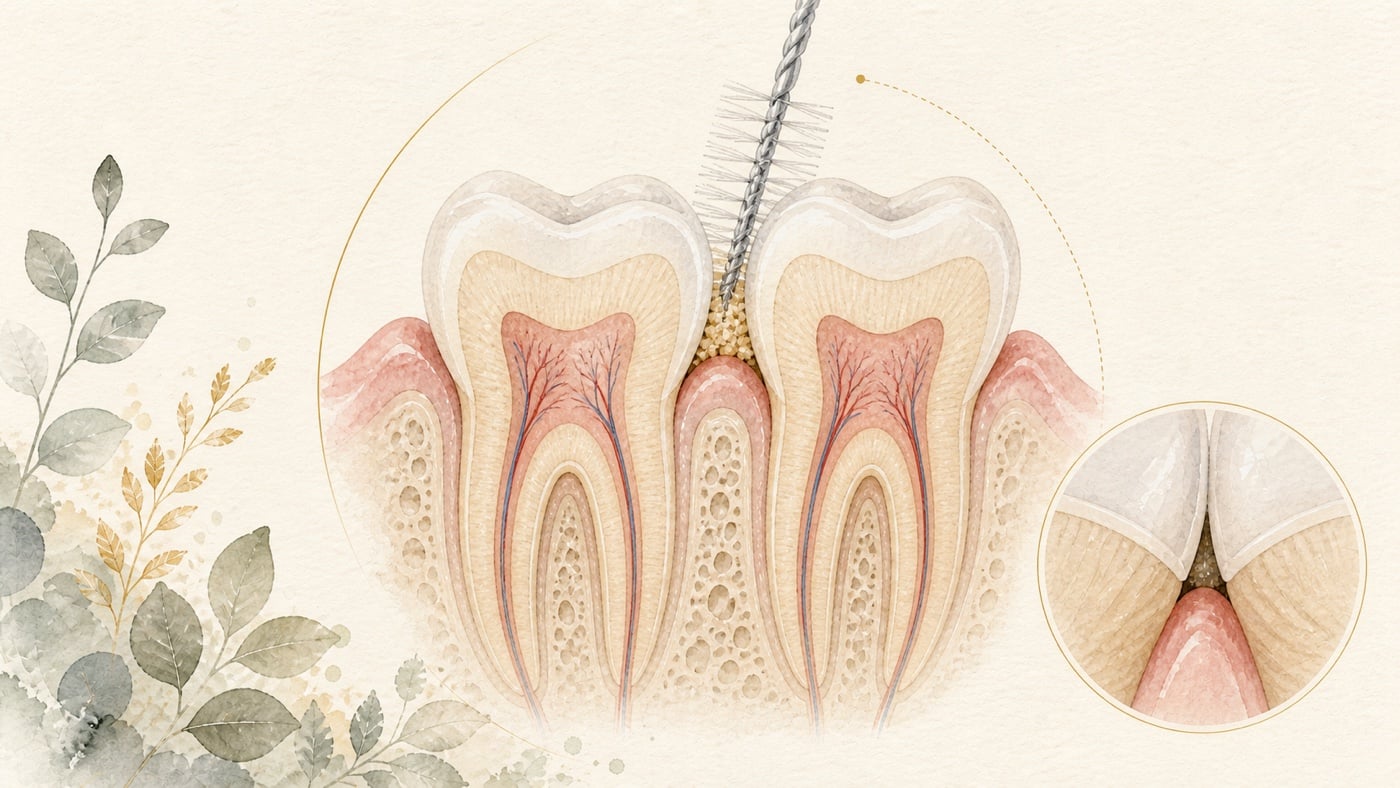
Recurrent food trapping after an implant, or floss that will not pass? Look for the cause in crown contour, the contact point and cleaning blind spots
If an implant crown was comfortable when fitted but, after a year or two, food began to lodge at every meal and floss started to drop straight through—or would not pass at all—the literature calls this interproximal contact loss (ICL). A systematic review and meta-analysis of 15 studies reported a mesial (towards the front) contact-loss rate of 44.2% (95% CI 30.6% to 58.6%) between implant crowns and adjacent natural teeth, compared with 27.5% distally (towards the back; 95% CI 10.5% to 55.0%); loss occurred more readily mesially than distally.
Recurrent food trapping after an implant, or floss that will not pass? Look for the cause in crown contour, the contact point and cleaning blind spots
Direct answer: In most cases this is not a matter of not brushing well enough; it is the contact point between the implant crown and the adjacent natural tooth loosening over time (interproximal contact loss, ICL) — an osseointegrated implant does not move, while a natural tooth keeps moving slowly throughout life [F5]. A meta-analysis reported a mesial contact-loss rate of 44.2% and a distal rate of 27.5% [F1], and time in function is itself an independent risk factor [F2]. Across these studies the association between ICL and food impaction is the strongest; the association with peri-implantitis was also statistically significant (odds ratios 1.648 to 2.214), while the association with marginal bone loss had a very small effect size [F3]; the actual cause and the appropriate management can only be decided by a dentist after clinical examination and any imaging required.
Geographic scope: Global. All cited evidence comes from international peer-reviewed literature; no country-specific reimbursement scheme or regulation is involved. The procedures, materials and fees actually available to you should follow your own health system and your dentist's assessment.
TL;DR|This is not because you ‘have not brushed well enough’; the contact point is opening
If your implant crown was entirely comfortable when first fitted, but after a year or two food began to lodge at every meal and floss started to drop straight through (or, conversely, would not squeeze through at all), the literature has a name for this: interproximal contact loss (ICL).
First, it is common—common enough that it should not be treated as an unexpected event. A systematic review and meta-analysis of 15 studies reported a mesial (towards the front) contact-loss rate of 44.2% (95% CI 30.6% to 58.6%) between implant crowns and adjacent natural teeth, compared with 27.5% distally (towards the back; 95% CI 10.5% to 55.0%); loss occurred more readily mesially than distally [F1].
Second, it accumulates with time and does not resolve by itself. A retrospective study of 204 patients and 445 implant-supported prostheses reported that, among those in function for 10 years, patient-level ICL prevalence was 59.8% and increased over time; time in function was itself an independent risk factor (odds ratio 1.299, p < 0.001) [F2].
Third, food trapping is very strongly associated with the contact point, but the literature still disagrees about how serious its consequences are. A cross-sectional study with a mean follow-up of 11.2 years, covering 262 patients and 323 single-implant prostheses, reported an odds ratio of 10.555 (p = 0.003) between open contacts and food impaction; the same study also reported odds ratios of 1.648 (mesial, p = 0.045) and 1.938 (distal, p = 0.004) between open contacts and peri-implantitis [F3]. Yet a separate 2-year prospective study reported no significant differences among tight, loose and open groups in plaque index, gingival index, probing depth or marginal bone loss [F4].
These two apparently contradictory pieces of evidence are, in fact, the most valuable part of this article. We will consider them separately below.
1. First understand the problem itself: contact points can open on their own
Implants do not move; teeth do
This is the physical core of the entire issue: natural teeth continue to move slowly throughout life (mesial drift, displacement under occlusal forces and the resilience of the periodontal ligament), whereas an osseointegrated implant is fixed in bone and does not move with them.
A review described the causes of open contacts as multifactorial, including biomechanical disparity, prosthetic and surgical factors, dynamic changes in occlusal forces, and movement of natural teeth [F5].
In other words, an opening contact point is not simply a matter of ‘a badly made crown’—it is the result of two structures with different degrees of mobility remaining side by side over the long term.
How common is it?
A systematic review and meta-analysis conducted in accordance with PRISMA guidance and registered with the Open Science Framework searched four major electronic databases, supplemented by a manual search, up to February 2023. It included clinical studies that assessed the prevalence of open contacts between implant crowns and adjacent teeth. Ultimately, 15 studies published between 2014 and 2023 were included [F1]:
- Mesial ICL rate: 44.2% (95% CI 30.6% to 58.6%) [F1]
- Distal ICL rate: 27.5% (95% CI 10.5% to 55.0%) [F1]
- ICL rates exceeded 20% in 7 studies; they were below 50% in 5 studies and above 50% in 3 [F1]
- Every included study assessed posterior regions (molars and premolars) [F1]
- Follow-up comprised 1 study assessing 3 months after surgery, 4 assessing 1 year and 9 assessing more than 2 years [F1]
- There were no significant differences by age, sex or maxillary versus mandibular location [F1]
How to interpret this safely (the limitation here is important and must not be skipped): the meta-analysis explicitly reported high between-study heterogeneity, with I² = 87.8% (95% CI 75.9% to 93.8%) [F1]. An I² approaching 90% means that the figures obtained by the individual studies differed greatly. The pooled average can tell us that this is common, but it cannot predict an individual person's probability.
Moreover, the distal 95% confidence interval was 10.5% to 55.0%—a span of 45 percentage points, indicating very low precision. The mesial interval in the same paper (30.6% to 58.6%) was relatively narrower. That is why the direction of the finding—‘mesial is more common than distal’—is more worth remembering than any exact percentage.
Finally, the review used a single-arm proportional meta-analysis and assessed the risk of bias in the clinical studies only qualitatively [F1]. This form of analysis is suited to estimating ‘how prevalent is it?’, not to answering ‘who will develop it?’.
It becomes more common over time
A retrospective study included 204 participants with a total of 445 prostheses who had received implant-supported prostheses between January 2011 and December 2020. The gaps between prostheses and adjacent teeth were measured using aluminium strips of different thicknesses, and periodontal status, occlusion and other factors were reviewed from the clinical records [F2]:
- At 10 years in function, patient-level ICL prevalence was 59.8% and increased over time [F2]
- Mesial ICL prevalence was 40.0%; independent risk factors were food impaction (odds ratio 4.991, p < 0.001), the condition of the adjacent tooth (odds ratio 4.062, p = 0.042), time in function (odds ratio 1.299, p < 0.001) and bruxism (odds ratio 2.098, p = 0.034) [F2]
- Distal ICL prevalence was 24.1%; independent risk factors were food impaction (odds ratio 2.809, p = 0.002), mechanical complications (odds ratio 7.041, p < 0.001), bruxism (odds ratio 2.356, p = 0.019) and peri-implantitis (odds ratio 2.385, p = 0.021) [F2]
- The authors concluded that ICL increased over time and was more common mesially than distally [F2]
Two points here are worth remembering.
First, the fact that ‘time in function’ is a risk factor means that the problem develops over time. An odds ratio of 1.299 may not look large, but it represents the effect per unit of time, which accumulates year by year [F2]. This also explains why many people report that ‘everything was fine at first, then food began to lodge in the second or third year’.
Second, bruxism appears on both the mesial and distal lists. The odds ratio was 2.098 mesially and 2.356 distally [F2]. If you grind your teeth at night or clench during the day, contact-point stability is a separate consideration that needs to be included in the assessment.
How to interpret this safely: this was a retrospective study, so all associations are statistical correlations and cannot be read directly as causal. It is particularly important to note that ‘food impaction’ was listed both as a risk factor and as a clinical consequence of ICL—the two are facets of the same problem, and this dataset cannot establish the direction of the relationship. Nor does an odds ratio mean that ‘risk has multiplied by this amount’. It is a ratio of odds and, when prevalence is high, can markedly overestimate relative risk. ICL prevalence in this study approached six in ten, a high-prevalence setting, so the figures require an even more cautious reading.
2. The consequences of food trapping: two studies give answers of very different strength
This is where the subject most needs to be handled honestly.
The study that found an association
In a cross-sectional study, calibrated examiners assessed adult patients with single implant-supported prostheses (at non-molar sites). The sample comprised 262 patients and 323 prostheses, followed for a mean of 11.2 ± 1.5 years from implant placement. Logistic regression models were used to analyse relationships between ICL, peri-implant disease and other variables [F3]:
- ICL was present at 43.6% of mesial and 34.6% of distal sites (implant level, p = 0.03), and in 62.6% of participants [F3]
- The strongest association was with food impaction: the odds ratio was 10.555 (p = 0.003) for open contacts, 12.210 (p = 0.002) for light contacts mesially and 5.999 (p = 0.006) for light contacts distally [F3]
- The association with peri-implantitis (the study's first stated aim was to evaluate the association between ICL and peri-implant diseases; peri-implantitis is what the abstract reports for that group) had odds ratios of 1.648 (p = 0.045) for an open mesial contact, 1.938 (p = 0.004) for an open distal contact and 2.214 (p = 0.008) for a light mesial contact [F3]
- Associations with marginal bone loss had odds ratios of 1.104 (p = 0.009) for a light mesial contact, 1.175 (p = 0.008) for an open distal contact and 1.181 (p = 0.009) for a light distal contact [F3]
- At mesial sites, open contacts were additionally associated with reduced interproximal soft-tissue height and a history of periodontal disease (odds ratio 10.641, p = 0.036) [F3]
- The authors concluded that ICL was highly prevalent and associated with peri-implantitis, marginal bone loss, food impaction, reduced interdental papillary height and a history of periodontal disease [F3]
Pay attention to the ‘light contact’ category. This study classified contact as open or ‘light’, and the odds ratio between light contact and food impaction (12.210) was even higher than that for a completely open contact (10.555) [F3]. Clinically, this means that a state in which there is some resistance when floss is inserted, yet food can still be forced in also warrants attention. It should not be dismissed simply because ‘the floss still passes’.
How to interpret this safely: this was a cross-sectional study—all measurements were taken at the same point in time, so it cannot establish which came first. The data cannot tell us whether the contact opened and caused food impaction and bone loss, or whether bone loss and altered periodontal conditions led the contact to open.
One further point needs to be made explicit: the three odds ratios associated with bone loss were 1.104, 1.175 and 1.181, all very close to 1. This means that even where the findings were statistically significant, the effect sizes themselves were small. That does not mean there are no consequences at tissue level: the association this study set out to evaluate first was that between ICL and peri-implant diseases; for peri-implantitis the abstract reports odds ratios of 1.648 (open mesial), 1.938 (open distal) and 2.214 (light mesial), all statistically significant [F3]. In contrast, odds ratios for food impaction ranged from 5 to 12, a much stronger signal. Different outcomes within the same study can differ in strength by an order of magnitude; they should neither be averaged into a single statement that ‘ICL is dangerous’ nor reduced to ‘it only traps food’.
The study that found ‘no difference’
A prospective study followed 26 patients with a total of 40 posterior single implant-supported crowns (all with a natural tooth on the mesial side) for 24 months. After crown delivery, floss was used to classify the mesial contact as tight, loose or open. Modified plaque index (MPI), modified gingival index (MGI) and probing depth (PD) were assessed at 6, 12, 18 and 24 months, and radiographs were taken at 12 and 24 months to measure marginal bone loss (MBL) [F4]:
- At 12 months, 22.5% of contacts were loose and 12.5% were open; at 24 months, 12.9% were loose and 25.6% were open [F4]
- There were no significant differences among the tight, loose and open groups in MPI, MGI or PD at either 12 or 24 months (P > 0.05) [F4]
- Mean changes in MPI, MGI, PD and MBL likewise did not differ significantly among the three groups (P > 0.05) [F4]
- The authors concluded that open, loose and tight mesial contact states had no significant effect on peri-implant tissue conditions [F4]
How to interpret this safely (this limitation determines how far the finding can be extended): the study included only 26 patients, 40 crowns and 2 years of follow-up [F4]. With a small sample and a short timeframe, ‘no difference was detected’ and ‘there truly is no difference’ are not the same statement—moderate or small differences are inherently difficult to detect at this sample size. One reason the preceding study may have detected associations is that its mean follow-up was 11.2 years [F3].
How to read the studies together
The two studies do not conflict in direction; what differs is their timescale.
- In the short term (within 2 years): after a contact point opens, plaque, gingival inflammation, probing depth and bone loss do not necessarily worsen immediately [F4].
- In the long term (a mean of 11 years): ICL is very strongly associated with food impaction (odds ratios from 5 to 12); the association with peri-implantitis was also statistically significant (odds ratios 1.648 to 2.214); and an association with marginal bone loss is present but the effect size is small (odds ratios from 1.1 to 1.2) [F3].
The honest account is therefore this: the most certain consequence of an opening contact point is food impaction and the burden on quality of life; and in the long-term data, with a mean follow-up of 11 years, the association between ICL and peri-implantitis was also statistically significant (odds ratios 1.648 to 2.214), although the effect size was far smaller than for food impaction [F3], while the 2-year short-term study detected no significant difference [F4]. All of this comes from observational studies that cannot establish causality — they support neither the claim that tissue destruction will certainly follow nor the claim that there are no consequences at tissue level.
This conclusion is more useful than ‘food trapping is dangerous, so have it treated quickly’, because it tells you that there are two reasons it is worth addressing — it troubles you every day, and the long-term data do show a statistical association with peri-implantitis; neither reason requires frightening you into treatment.
3. How much can crown contour explain? Perhaps less than you think
Many people's first thought is, ‘Was the crown made badly?’ There is some reason behind that intuition, but the literature does not offer such a direct answer.
Contour adjustment is a common strategy, but its long-term effect is limited
The review examined existing preventive and corrective strategies, including over-contouring the prosthesis, splinted restorations and occlusal equilibration, and specifically considered the limitations of their long-term effectiveness [F5].
It also proposed a biomechanically based concept for occlusal adjustment—the mesial-to-mesial/distal-to-distal (MM-DD) technique—as a possible proactive preventive approach. It explicitly stated, however, that this was only a preliminary clinical observation and still requires validation in prospective studies [F5].
In practical terms: making the crown slightly fuller and tightening the contact point are strategies commonly used in current clinical practice, but they are not once-and-for-all solutions. The force responsible for opening the contact—continued movement of the natural tooth—has not disappeared.
The relationship between emergence angle and bone loss is unclear
Another frequently discussed contour measure is the emergence angle at which the crown comes away from the implant. A retrospective study analysed records from 155 patients, measuring emergence angle, marginal bone loss (MBL) and corticalisation index (CI) on intraoral radiographs. Its primary outcome was MBL at 60 months after loading, analysed by three prosthetic designs: single crowns, splinted crowns and bridges [F6]:
- The emergence angle actually recorded was 32° ± 10° [F6]
- MBL increased over time, but there were no significant differences among the three prosthetic designs [F6]
- There was no significant relationship between emergence angle and MBL for single crowns (p = 0.369) or splinted crowns (p = 0.176) [F6]
- A weak but statistically significant relationship was observed for bridges (p = 0.042) [F6]
- The authors concluded that, within the limitations of this retrospective radiographic analysis, there was no clinically meaningful association between emergence angle and MBL for single or splinted crowns. The association for bridges was weak and should be interpreted cautiously; other biological, biomechanical and systemic factors may have a greater influence on peri-implant tissue stability than emergence angle itself [F6]
How to interpret this safely: this was a single-centre retrospective study using one implant system, and the outcome it measured was bone loss, not food trapping or ease of cleaning [F6]. It cannot be used to prove that ‘crown contour has nothing to do with food trapping’—it tells us only that the evidence does not support attributing every problem to emergence angle.
The practical conclusion from these two papers together: crown contour is one adjustable variable, but it is neither the only cause nor guaranteed to remain stable after adjustment. Rather than asking ‘Was the crown made badly?’, ask ‘What is the current state of this contact point, and how often should it be reviewed?’
4. Cleaning blind spots: floss that will not pass and floss that drops straight through are two different problems
In clinical practice, these two complaints are often grouped together, but their management points in opposite directions.
Situation A: floss will not enter, or it shreds when inserted
This usually points to a contact that is too tight or an unfavourable contour. Importantly, the cross-sectional study above found that the odds ratio between ‘light contact’ and food impaction was 12.210—higher than the 10.555 for a completely open contact [F3]. In other words, contact tightness does not follow a straight line in which ‘tighter is always better’. Excessive tightness makes floss passage and cleaning difficult; insufficient tightness allows food to be forced in.
Situation B: floss drops straight through and food lodges at every meal
This is a typical open contact. The data above show that it is particularly common mesially (44.2% [F1], 40.0% [F2] and 43.6% [F3]—three studies with different designs yielded figures in a similar range), and it is strongly associated with food impaction [F3].
Why ‘cleaning blind spots’ deserve separate attention
The review listed the clinical consequences of open contacts as food impaction, gingival inflammation, interproximal bone loss and reduced patient satisfaction. It also noted that these problems affect not only oral hygiene and comfort, but may also contribute to peri-implant tissue breakdown and increase the need for subsequent maintenance [F5].
That ‘increased maintenance need’ is rarely discussed, but it is the most realistic long-term cost—not a one-off complication, but the need to devote more effort to the same site every year thereafter.
5. What to say and what to ask at your appointment
Here is how to turn the evidence above into concrete information you can take into the surgery.
Three things to describe:
- When it began. Because ICL is directly associated with time in function (odds ratio 1.299, p < 0.001) [F2], ‘food lodged as soon as it was fitted’ and ‘food began to lodge after three years’ point towards different causes.
- Which side traps food. Mesial (towards the front) is more common than distal (towards the back), consistently across three studies [F1][F2][F3]. Stating the location clearly helps with the assessment.
- How the floss feels. Dropping through completely, having some resistance while food still lodges, or not entering at all correspond to open, light and excessively tight contacts. In the data, light contact was associated most strongly with food impaction [F3].
Background information you can volunteer:
- Whether you grind or clench your teeth. Bruxism was an independent risk factor both mesially (odds ratio 2.098) and distally (odds ratio 2.356) [F2].
- A history of periodontal disease. In the data, the association between an open mesial contact and periodontal history was substantial (odds ratio 10.641, p = 0.036) [F3].
- Whether you have had a mechanical problem such as screw loosening. Mechanical complications were among the strongest risk factors for distal ICL (odds ratio 7.041, p < 0.001) [F2].
Reasonable expectations:
Because the force that opens the contact point—continued movement of the natural tooth—does not disappear, this needs periodic monitoring rather than being something that is repaired once and then finished [F5]. All current preventive and corrective strategies have limitations in their long-term effectiveness [F5]. Knowing this is more useful than expecting that ‘one adjustment means food will never lodge again’.
The actual diagnosis, determination of the cause and choice of management require a dentist's clinical examination and any necessary imaging. The literature above is intended only to help you know what to describe and what to ask.
Risk factors: what to know before treatment
- How common it is, and the limits of these figures: a meta-analysis of 15 studies reported a mesial ICL rate of 44.2% (95% CI 30.6% to 58.6%) and a distal rate of 27.5% (95% CI 10.5% to 55.0%), but heterogeneity between studies was very high (I² = 87.8%), so these pooled values can show that the problem is common without predicting your individual probability [F1].
- Risk factors that accumulate over time: a retrospective study reported a patient-level prevalence of 59.8% among prostheses in function for 10 years, and listed time in function (odds ratio 1.299), food impaction, bruxism (2.098 mesially, 2.356 distally) and mechanical complications (7.041 distally) among the independent risk factors, which the original list does not stop at; this was a retrospective design, so the associations are correlations and cannot be read as causation [F2].
- The evidence on consequences is not consistent: in long-term cross-sectional data the odds ratio for food impaction was 10.555 for an open contact and 12.210 for a light mesial contact, the odds ratios for peri-implantitis were 1.648 to 2.214 (all statistically significant), and the odds ratios for marginal bone loss were only 1.104 to 1.181, a very small effect size [F3]; a 2-year prospective study found no significant difference between the tight, loose and open groups, but it included only 26 patients and 40 crowns, and "no difference was found" is not the same as "there is no difference" [F4].
Conclusion|First establish what the problem is, then discuss how to correct it
In one sentence: the most common reason for recurrent food trapping after an implant is that the interproximal contact opens over time—a common development caused by an implant that does not move beside a natural tooth that does, not by inadequate brushing.
Three points are worth keeping separate because the strength of evidence differs:
- Prevalence is high and the direction is clear: 44.2% mesially and 27.5% distally, with mesial sites clearly more often affected [F1]; patient-level prevalence after 10 years in function is about six in ten [F2]. Heterogeneity is, however, extremely high (I² = 87.8%); these figures describe a trend and do not predict an individual.
- The association with food impaction is strong: odds ratios range from 5 to 12, and the association for light contact was even stronger than for a fully open contact [F3]. This is the most robust finding on the subject.
- The association with tissue destruction is weaker, but it is not absent: the first stated aim of that same long-term cross-sectional study was to evaluate the association between ICL and peri-implant diseases, and for peri-implantitis the odds ratios were 1.648 to 2.214 and statistically significant; the odds ratios for marginal bone loss were only 1.1 to 1.2, a small effect size [F3]. The 2-year prospective study detected no significant difference between the groups, but it included only 26 patients [F4].
The reason to address this is therefore not fear, but the inconvenience itself. Having to remove food after every meal and floss that drops straight through have a real effect on quality of life. The literature provides a clear mechanism and shows a very high prevalence—you do not need to persuade anyone that this is a problem.
The next step is straightforward: take three pieces of information to your appointment—when it began, which side traps food, and how the floss feels—and volunteer whether you grind your teeth or have a history of periodontal disease. Book an examination with a dentist to establish the current state of the contact point before discussing whether adjustment, remaking or closer monitoring is most appropriate. One final reminder: because the force causing the contact to open does not disappear, it is more realistic to treat this as something requiring long-term monitoring than to expect a permanent one-off repair.
Every clinical statement in this article is mapped line by line to its cited source (see the sources and evidence chain below). It has not been clinically reviewed by a licensed practitioner. This is health information, not individual advice; assessment by a clinician is required.
FAQ
- Does food trapping after an implant mean that the crown was made badly?
- Not necessarily, and in most cases it does not. A review described the causes of open contacts as multifactorial, including **biomechanical disparity, prosthetic and surgical factors, dynamic changes in occlusal forces, and movement of natural teeth** [F5]. The core mechanism is that an osseointegrated implant remains fixed, while the adjacent natural teeth continue to move slowly throughout life; being side by side over time creates a discrepancy. A systematic review and meta-analysis of 15 studies reported a mesial contact-loss rate of **44.2% (95% CI 30.6% to 58.6%)** [F1]. Such a high prevalence indicates that this is a common development in implant prosthodontics, not a manufacturing defect confined to an individual case.
- インプラント治療後に食べ物が詰まるのは、クラウンの作りが悪いということですか? — 必ずしもそうではなく、多くの場合は違います。あるレビューでは、オープンコンタクトの原因を多因子性のものとして整理し、**生体力学的な差、補綴・外科的要因、咬合力の動的変化、天然歯の移動**を挙げています [F5]。中心的な機序は、オッセオインテグレーションが完成したインプラントは固定されて動かない一方、隣接する天然歯は生涯を通じてゆっくり動き続けるため、長期間並ぶことでずれが生じるというものです。 15件の研究を組み入れたシステマティックレビューとメタアナリシスでは、近心のコンタクトロス率は**44.2%(95% CI 30.6%〜 58.6%)**に達しました [F1]。これほど有病率が高いことから、これは単一症例の製作上の欠陥ではなく、インプラント補綴でよくみられる経時的変化であることが分かります。
- Does food trapping after an implant mean that the crown was made badly? — Not necessarily, and in most cases it does not. A review described the causes of open contacts as multifactorial, including **biomechanical disparity, prosthetic and surgical factors, dynamic changes in occlusal forces, and movement of natural teeth** [F5]. The core mechanism is that an osseointegrated implant remains fixed, while the adjacent natural teeth continue to move slowly throughout life; being side by side over time creates a discrepancy. A systematic review and meta-analysis of 15 studies reported a mesial contact-loss rate of **44.2% (95% CI 30.6% to 58.6%)** [F1]. Such a high prevalence indicates that this is a common development in implant prosthodontics, not a manufacturing defect confined to an individual case.
- How common is this?
- Very common. The systematic review and meta-analysis reported **44.2% mesially (95% CI 30.6% to 58.6%)** and **27.5% distally (95% CI 10.5% to 55.0%)**; rates exceeded 20% in 7 of the 15 included studies [F1]. A retrospective study reported a patient-level prevalence of **59.8%** among those in function for 10 years [F2], while another cross-sectional study with a mean follow-up of 11.2 years reported it in **62.6% of participants** [F3]. **However, heterogeneity in the meta-analysis was extremely high (I² = 87.8%, 95% CI 75.9% to 93.8%), and the distal confidence interval was 10.5% to 55.0%—an extremely wide interval. These averages show that the problem is common, but cannot predict an individual's probability** [F1].
- この状態はどのくらいよくみられますか? — 非常によくみられます。システマティックレビューとメタアナリシスでは、近心が**44.2%(95% CI 30.6%〜 58.6%)**、遠心が**27.5%(95% CI 10.5%〜 55.0%)**で、組み入れられた 15件の研究のうち 7件では 20%を超えていました [F1]。後ろ向き研究では、機能期間 10年の集団における患者単位の有病率は**59.8%**でした [F2]。また、平均 11.2年間追跡した横断研究では、**参加者の 62.6%**に認められました [F3]。**ただし、メタアナリシスの異質性は非常に高く(I² = 87.8%、 95% CI 75.9%〜 93.8%)、遠心の信頼区間は 10.5%〜 55.0%と非常に広いため、これらの平均値から「非常によくみられる」とはいえても、個人の確率を予測することはできません** [F1]。
- How common is this? — Very common. The systematic review and meta-analysis reported **44.2% mesially (95% CI 30.6% to 58.6%)** and **27.5% distally (95% CI 10.5% to 55.0%)**; rates exceeded 20% in 7 of the 15 included studies [F1]. A retrospective study reported a patient-level prevalence of **59.8%** among those in function for 10 years [F2], while another cross-sectional study with a mean follow-up of 11.2 years reported it in **62.6% of participants** [F3]. **However, heterogeneity in the meta-analysis was extremely high (I² = 87.8%, 95% CI 75.9% to 93.8%), and the distal confidence interval was 10.5% to 55.0%—an extremely wide interval. These averages show that the problem is common, but cannot predict an individual's probability** [F1].
- Why is it always the front side (mesial) that traps food?
- Three studies with different designs point in the same direction. The meta-analysis reported 44.2% mesially and 27.5% distally, and explicitly concluded that it was **more common mesially** [F1]. The retrospective study reported 40.0% mesially and 24.1% distally [F2], while the cross-sectional study reported 43.6% mesially and 34.6% distally (p = 0.03) [F3]. This is generally thought to relate to the mesial drift of natural teeth [F5]. In practical terms, **food trapping on only one side is consistent with the known distribution, and it is worth telling the dentist the exact location**.
- なぜいつも前方側(近心)に詰まるのですか? — 設計の異なる 3つの研究で方向性が一致しています。メタアナリシスでは近心 44.2%、遠心 27.5%で、**近心のほうが多い**と明確に結論づけられています [F1]。後ろ向き研究では近心 40.0%、遠心 24.1%でした [F2]。横断研究では近心 43.6%、遠心 34.6%(p = 0.03)でした [F3]。一般に、天然歯が近心方向へ移動することと関係すると考えられています [F5]。実際には、**片側だけに詰まる場合でも既知の分布と一致しているため、その位置を歯科医師へ正確に伝える価値があります。**
- Why is it always the front side (mesial) that traps food? — Three studies with different designs point in the same direction. The meta-analysis reported 44.2% mesially and 27.5% distally, and explicitly concluded that it was **more common mesially** [F1]. The retrospective study reported 40.0% mesially and 24.1% distally [F2], while the cross-sectional study reported 43.6% mesially and 34.6% distally (p = 0.03) [F3]. This is generally thought to relate to the mesial drift of natural teeth [F5]. In practical terms, **food trapping on only one side is consistent with the known distribution, and it is worth telling the dentist the exact location**.
- Will food trapping cause my implant to fail?
- The strength of the evidence differs by outcome and must be considered separately. The association with **food impaction** is very strong: the odds ratio was 10.555 (p = 0.003) for an open contact and 12.210 (p = 0.002) for a light mesial contact [F3]. The association with **peri-implantitis** was also statistically significant, though the effect size was far smaller: odds ratios of 1.648 (open mesial, p = 0.045), 1.938 (open distal, p = 0.004) and 2.214 (light mesial, p = 0.008) [F3]. The association with **marginal bone loss** was the weakest: the three odds ratios were 1.104, 1.175 and 1.181—**all very close to 1, indicating small effect sizes** [F3]. A 2-year prospective study reported **no significant differences** among tight, loose and open groups in plaque index, gingival index, probing depth or marginal bone loss, but it included only 26 patients and 40 crowns [F4]. **Taken together, the most certain consequence is food impaction and disruption to daily life; in the long-term data there is a statistically significant but small association with peri-implantitis, while the short-term study detected no difference — all of it from observational studies unable to establish causality, and only a dentist who examines you can judge your own situation.**
- 食べ物が詰まると、インプラントが駄目になりますか? — エビデンスの強さは結果によって異なるため、分けて読む必要があります。**食片圧入**との関連は非常に強く、オープンコンタクトのオッズ比は 10.555(p = 0.003)、軽いコンタクト(近心)は 12.210(p = 0.002)でした [F3]。**インプラント周囲炎**との関連も統計学的に有意でしたが、効果量ははるかに小さく、オッズ比はオープンコンタクトで 1.648(近心、p = 0.045)と 1.938(遠心、p = 0.004)、近心の軽いコンタクトで 2.214(p = 0.008)でした [F3]。**辺縁骨喪失**との関連は最も弱く、 3つのオッズ比はそれぞれ 1.104、 1.175、 1.181で、**いずれも 1に非常に近く、効果量が小さい**ことを示しています [F3]。さらに、 2年間の前向き研究では、タイト、ルーズ、オープンの 3群間でプラーク指数、歯肉指数、プロービングデプス、辺縁骨喪失に**有意差は検出されませんでした**が、対象は 26人の患者と 40個のクラウンのみでした [F4]。**総合すると、最も確かな結果は食片圧入と生活上の負担です。長期データではインプラント周囲炎との間に統計学的に有意だが効果量の小さい関連が認められ、短期研究では差が検出されませんでした。いずれも因果関係を判定できない観察研究に基づくものであり、ご自身の状態は歯科医師の診査によってはじめて判断できます。**
- Will food trapping cause my implant to fail? — The strength of the evidence differs by outcome and must be considered separately. The association with **food impaction** is very strong: the odds ratio was 10.555 (p = 0.003) for an open contact and 12.210 (p = 0.002) for a light mesial contact [F3]. The association with **peri-implantitis** was also statistically significant, though the effect size was far smaller: odds ratios of 1.648 (open mesial, p = 0.045), 1.938 (open distal, p = 0.004) and 2.214 (light mesial, p = 0.008) [F3]. The association with **marginal bone loss** was the weakest: the three odds ratios were 1.104, 1.175 and 1.181—**all very close to 1, indicating small effect sizes** [F3]. A 2-year prospective study reported **no significant differences** among tight, loose and open groups in plaque index, gingival index, probing depth or marginal bone loss, but it included only 26 patients and 40 crowns [F4]. **Taken together, the most certain consequence is food impaction and disruption to daily life; in the long-term data there is a statistically significant but small association with peri-implantitis, while the short-term study detected no difference — all of it from observational studies unable to establish causality, and only a dentist who examines you can judge your own situation.**
- Floss can pass, but it catches slightly. Is that normal?
- This should not be dismissed as ‘fine’. The cross-sectional study classified contacts as open or ‘light’ and found that **the odds ratio between a light mesial contact and food impaction was 12.210 (p = 0.002), even higher than the 10.555 (p = 0.003) for a fully open contact**; the corresponding figure for a light distal contact reached 5.999 (p = 0.006) [F3]. An association between a light mesial contact and marginal bone loss (odds ratio 1.104, p = 0.009) was also reported [F3]. **Clinically, a state in which floss still passes but food continues to lodge is likewise worth mentioning at an appointment. These associations do, however, come from a cross-sectional study and cannot establish temporal order or causality.**
- フロスは通るものの、少し引っかかります。これは正常ですか? — この状態を「問題ない」とみなすべきではありません。横断研究ではコンタクトをオープンと「軽い」の 2段階に分けており、**軽いコンタクト(近心)と食片圧入とのオッズ比は 12.210(p = 0.002)で、完全なオープンコンタクトの 10.555(p = 0.003)を上回りました**。軽いコンタクト(遠心)も 5.999(p = 0.006)に達しました [F3]。さらに、近心の軽いコンタクトと辺縁骨喪失との関連(オッズ比 1.104、p = 0.009)も報告されています [F3]。**臨床的には、フロスが通っても食物が詰まるという「通るようで通りにくい」状態も、受診時に伝える価値があります。ただし、これらの関連は横断研究に基づくため、時間的な前後関係や因果関係は判断できません。**
- Floss can pass, but it catches slightly. Is that normal? — This should not be dismissed as ‘fine’. The cross-sectional study classified contacts as open or ‘light’ and found that **the odds ratio between a light mesial contact and food impaction was 12.210 (p = 0.002), even higher than the 10.555 (p = 0.003) for a fully open contact**; the corresponding figure for a light distal contact reached 5.999 (p = 0.006) [F3]. An association between a light mesial contact and marginal bone loss (odds ratio 1.104, p = 0.009) was also reported [F3]. **Clinically, a state in which floss still passes but food continues to lodge is likewise worth mentioning at an appointment. These associations do, however, come from a cross-sectional study and cannot establish temporal order or causality.**
- Is tooth grinding associated with food trapping?
- Yes, and it was listed as an independent risk factor on both sides. The retrospective study reported **odds ratios for bruxism of 2.098 (p = 0.034) for mesial ICL and 2.356 (p = 0.019) for distal ICL** [F2]. The same study also reported that **mechanical complications were among the strongest risk factors for distal ICL (odds ratio 7.041, p < 0.001)** [F2]. **This was nevertheless a retrospective study and can show only an association, not causation. An odds ratio does not mean that ‘risk has multiplied by this amount’, and in a high-prevalence setting it overestimates relative risk.** If you grind at night or clench during the day, it is worth volunteering this at your appointment.
- 歯ぎしりは食片圧入と関係しますか? — 関係があり、両側で独立したリスク因子に挙げられています。後ろ向き研究では、**近心ICLにおけるブラキシズムのオッズ比は 2.098(p = 0.034)、遠心では 2.356(p = 0.019)**でした [F2]。同じ研究で、**機械的合併症は遠心ICLの最も強いリスク因子の 1つでした(オッズ比 7.041、p < 0.001)** [F2]。**ただし、これは後ろ向き研究であり、相関を示すだけで因果関係として解釈することはできません。オッズ比も「リスクが何倍になる」という意味ではなく、高有病率の状況では相対リスクを過大評価します。** 歯ぎしりや日中の食いしばりがある場合は、受診時に自分から伝える価値があります。
- Is tooth grinding associated with food trapping? — Yes, and it was listed as an independent risk factor on both sides. The retrospective study reported **odds ratios for bruxism of 2.098 (p = 0.034) for mesial ICL and 2.356 (p = 0.019) for distal ICL** [F2]. The same study also reported that **mechanical complications were among the strongest risk factors for distal ICL (odds ratio 7.041, p < 0.001)** [F2]. **This was nevertheless a retrospective study and can show only an association, not causation. An odds ratio does not mean that ‘risk has multiplied by this amount’, and in a high-prevalence setting it overestimates relative risk.** If you grind at night or clench during the day, it is worth volunteering this at your appointment.
- Will removing and remaking the crown, or making it fuller, solve the problem?
- It can improve the situation, but it is unwise to expect a once-and-for-all result. A review examined current strategies—**over-contouring the prosthesis, splinting restorations and occlusal adjustment**—and specifically noted their **limitations in long-term effectiveness** [F5]. The reason is straightforward: replacing the crown does not eliminate the force that opens the contact, namely the continued movement of the natural tooth. Although the review's proposed MM-DD occlusal-adjustment concept showed possible benefit for maintaining contact integrity in preliminary clinical observations, it **still requires validation in prospective studies** [F5]. **A reasonable expectation is that this requires periodic monitoring; it is not finished after a single repair.**
- クラウンを外して作り直す、または少し膨らませれば解決しますか? — 改善は可能ですが、一度で完全に解決すると期待すべきではありません。あるレビューでは、現在の戦略である**補綴装置のオーバーカントゥアリング、補綴装置の連結、咬合調整**を検討し、これらの方法には**長期的な有効性の限界がある**と特に指摘しています [F5]。理由は明確で、コンタクトポイントを緩ませる力、つまり天然歯が動き続けることはクラウンを交換してもなくならないからです。同レビューが提示したMM-DD咬合調整の概念は、初期の臨床観察ではコンタクトの完全性維持に役立つ可能性を示していますが、**依然として前向き研究による検証が必要です** [F5]。**妥当な見通しは、これは定期的な経過観察が必要な項目であり、一度修正すれば終わりではないということです。**
- Will removing and remaking the crown, or making it fuller, solve the problem? — It can improve the situation, but it is unwise to expect a once-and-for-all result. A review examined current strategies—**over-contouring the prosthesis, splinting restorations and occlusal adjustment**—and specifically noted their **limitations in long-term effectiveness** [F5]. The reason is straightforward: replacing the crown does not eliminate the force that opens the contact, namely the continued movement of the natural tooth. Although the review's proposed MM-DD occlusal-adjustment concept showed possible benefit for maintaining contact integrity in preliminary clinical observations, it **still requires validation in prospective studies** [F5]. **A reasonable expectation is that this requires periodic monitoring; it is not finished after a single repair.**
- Is an overly wide crown emergence angle the root of the problem?
- Current evidence does not support attributing the whole problem to it. A 5-year retrospective study of 155 patients reported an actual emergence angle of 32° ± 10°, and **found no significant relationship between emergence angle and marginal bone loss for single crowns (p = 0.369) or splinted crowns (p = 0.176)**. Although the result for bridges reached statistical significance (p = 0.042), the association was weak [F6]. The authors explicitly concluded that **other biological, biomechanical and systemic factors may influence peri-implant tissue stability more than emergence angle itself** [F6]. **To interpret this safely: it was a single-centre retrospective study using one implant system, and it measured bone loss—not food trapping or ease of cleaning. It therefore cannot be used as evidence that contour is unrelated to food trapping.**
- クラウンのエマージェンスアングルが広すぎることが、問題の根本原因ですか? — 現在のエビデンスは、すべてをこの要因に帰する考えを支持していません。 155人の患者を 5年間追跡した後ろ向き研究では、実際のエマージェンスアングルは 32° ± 10°で、**単独クラウン(p = 0.369)と連結クラウン(p = 0.176)では、エマージェンスアングルと辺縁骨喪失との間に有意な関係がありませんでした**。ブリッジでは統計学的に有意でしたが(p = 0.042)、関連は弱いものでした [F6]。研究の結論では、**インプラント周囲組織の安定性には、その他の生物学的、生体力学的、全身的要因のほうがエマージェンスアングル自体より大きな影響を与える可能性がある**と明記されています [F6]。**解釈上の注意点として、これは単一施設、単一インプラントシステムの後ろ向き研究であり、測定したのは骨喪失であって、食片圧入や清掃のしやすさではありません。したがって、「形態は食片圧入と無関係」とする根拠にはできません。**
- Is an overly wide crown emergence angle the root of the problem? — Current evidence does not support attributing the whole problem to it. A 5-year retrospective study of 155 patients reported an actual emergence angle of 32° ± 10°, and **found no significant relationship between emergence angle and marginal bone loss for single crowns (p = 0.369) or splinted crowns (p = 0.176)**. Although the result for bridges reached statistical significance (p = 0.042), the association was weak [F6]. The authors explicitly concluded that **other biological, biomechanical and systemic factors may influence peri-implant tissue stability more than emergence angle itself** [F6]. **To interpret this safely: it was a single-centre retrospective study using one implant system, and it measured bone loss—not food trapping or ease of cleaning. It therefore cannot be used as evidence that contour is unrelated to food trapping.**
- Will the problem resolve on its own?
- No. The data show that it accumulates over time. The retrospective study identified **time in function itself** as an independent risk factor (odds ratio 1.299, p < 0.001) and reported that prevalence **increased over time**, reaching 59.8% at 10 years in function [F2]. The prospective study likewise reported that the proportion of open contacts rose from 12.5% at 12 months to 25.6% at 24 months [F4]. **It is therefore more reasonable to have the contact point checked at periodic appointments than to wait until the problem becomes intolerable.**
- この問題は自然に治りますか? — 治りません。データでは、時間とともに蓄積することが示されています。後ろ向き研究では、**機能期間そのもの**が独立したリスク因子(オッズ比 1.299、p < 0.001)で、有病率は**時間とともに増加**し、機能期間 10年で 59.8%に達しました [F2]。前向き研究でも、オープンコンタクトの割合は 12か月時の 12.5%から 24か月時の 25.6%へ増加しました [F4]。**そのため、問題が耐え難くなるまで待つより、定期受診でコンタクトポイントの状態を確認するほうが合理的です。**
- Will the problem resolve on its own? — No. The data show that it accumulates over time. The retrospective study identified **time in function itself** as an independent risk factor (odds ratio 1.299, p < 0.001) and reported that prevalence **increased over time**, reaching 59.8% at 10 years in function [F2]. The prospective study likewise reported that the proportion of open contacts rose from 12.5% at 12 months to 25.6% at 24 months [F4]. **It is therefore more reasonable to have the contact point checked at periodic appointments than to wait until the problem becomes intolerable.**
- How often should I attend for review?
- This must be determined by the dentist according to your individual circumstances; the literature does not provide a universal interval. Three findings can nevertheless inform the discussion: ICL accumulates with time in function [F2]; current preventive strategies have limited long-term effectiveness [F5]; and the consequences of an open contact include an **increased need for maintenance** [F5]. If you grind your teeth or have a history of periodontal disease, both were associated with ICL in the data [F2][F3] and are worth considering when review frequency is planned.
- どのくらいの間隔で受診すべきですか? — これは歯科医師が実際の状態に応じて判断する必要があり、文献に一律の間隔は示されていません。ただし、話し合いの材料となる情報が 3つあります。ICLは機能期間とともに蓄積すること [F2]、現在の予防戦略は長期効果に限界があること [F5]、そしてオープンコンタクトの影響には**メインテナンスの必要性の増加**が含まれることです [F5]。歯ぎしりの習慣や歯周病歴がある場合、データ上はいずれもICLと関連しているため [F2][F3]、経過観察の頻度を決める際に併せて考慮する価値があります。
- How often should I attend for review? — This must be determined by the dentist according to your individual circumstances; the literature does not provide a universal interval. Three findings can nevertheless inform the discussion: ICL accumulates with time in function [F2]; current preventive strategies have limited long-term effectiveness [F5]; and the consequences of an open contact include an **increased need for maintenance** [F5]. If you grind your teeth or have a history of periodontal disease, both were associated with ICL in the data [F2][F3] and are worth considering when review frequency is planned.
Medical notice This article is provided for health education and medical information purposes. It is not a solicitation for medical services and does not constitute diagnosis or treatment advice. Actual treatment methods and outcomes vary between individuals and require evaluation by a dentist; every treatment has its own indications, limitations and possible risks. If you have related symptoms or treatment needs, please book a consultation for evaluation by a dentist.
Source anchors
- Interproximal contact loss between implant restorations and adjacent natural teeth: A systematic review and meta-analysis. [PMID:37794763] · https://pubmed.ncbi.nlm.nih.gov/37794763/ · 在 IDAEO 的其他引用
- Prevalence and risk factors of interproximal contact loss between implant-supported prostheses and adjacent teeth in posterior dentitions: a retrospective study. [PMID:41013537] · https://pubmed.ncbi.nlm.nih.gov/41013537/ · 在 IDAEO 的其他引用
- Association Between Interproximal Contact Loss and Peri-Implant Diseases in Non-Molar Sites. [PMID:41894609] · https://pubmed.ncbi.nlm.nih.gov/41894609/ · 在 IDAEO 的其他引用
- A two-year prospective study to compare the peri-implant parameters of posterior implant-supported single crowns with and without mesial proximal contact loss. [PMID:39035261] · https://pubmed.ncbi.nlm.nih.gov/39035261/ · 在 IDAEO 的其他引用
- Open contacts adjacent to posterior dental implants: Current understanding and emerging preventive concepts. [PMID:41585145] · https://pubmed.ncbi.nlm.nih.gov/41585145/ · 在 IDAEO 的其他引用
- Emergence Angle, Marginal Bone Loss, and Radiographic Corticalization Around MIS Implants: A 5-Year Retrospective Study of Single, Splinted, and Bridge Restorations. [PMID:42194726] · https://pubmed.ncbi.nlm.nih.gov/42194726/ · 在 IDAEO 的其他引用
Cite this article
Lucy・《Recurrent food trapping after an implant, or floss that will not pass? Look for the cause in crown contour, the contact point and cleaning blind spots》・IDAEO 知識庫・2026-07-20・https://km.idaeo.ai/post/dental/implant-food-impactionUpdated 2026-08-26