

🏛 Part of the "dental" topic shelf →
What Can Guided Implant Surgery Solve, and What Can It Not? Clarifying the Value and Limitations of Positioning
The core value of static surgical guides and dynamic navigation is to convert imaging and restorative planning into directional, depth and positional references that can be followed in the mouth. Overall evidence shows that computer-assisted approaches generally place implants closer to their planned positions than freehand placement does; ‘more accurate’, however, still includes measurable deviations and does not mean that the actual position overlaps the virtual plan perfectly. More importantly, positional accuracy and long-term implant outcomes are not the same question. Both an umbrella review and a comparative meta-analysis found similar outcomes for guided and freehand approaches in implant survival, marginal bone changes or some complications. Navigation should therefore be understood as a set of positioning and execution tools; it does not select indications, assess bone quality, manage infection, establish primary stability or look after subsequent cleaning for you.
What Can Guided Implant Surgery Solve, and What Can It Not? Clarifying the Value and Limitations of Positioning
Direct answer: Guided and navigation surgery can improve the accuracy of implant placement [F1], but measurable mean deviations remain and the authors recommend keeping a safety margin of at least 2 mm [F2]; for implant survival and marginal bone outcomes, neither the umbrella review nor the direct comparative meta-analysis showed guided placement to be superior to freehand [F1][F3], and the clinical demands on the surgeon were not reduced by using a guided workflow [F5].
Geographic scope: This is general health education based on international literature. It does not cover any particular country's insurance scheme or regulations; for how care and fees are organised, follow the rules where you are. Every source cited in this card is international peer-reviewed literature; no national legislation or insurance-benefit rule is cited.
TL;DR | It Brings the Plan into the Operating Field, but It Is Not Autopilot
The core value of static surgical guides and dynamic navigation is to convert imaging and restorative planning into directional, depth and positional references that can be followed in the mouth. Overall evidence shows that computer-assisted approaches generally place implants closer to their planned positions than freehand placement does; ‘more accurate’, however, still includes measurable deviations and does not mean that the actual position overlaps the virtual plan perfectly.[F1][F2]
More importantly, positional accuracy and long-term implant outcomes are not the same question. Both an umbrella review and a comparative meta-analysis found similar outcomes for guided and freehand approaches in implant survival, marginal bone changes or some complications.[F1][F3] Navigation should therefore be understood as a set of positioning and execution tools; it does not select indications, assess bone quality, manage infection, establish primary stability or look after subsequent cleaning for you.
Main Text | First Distinguish ‘Seeing More Clearly’ from ‘A Necessarily Better Outcome’
What Exactly Does Guided Surgery Help With?
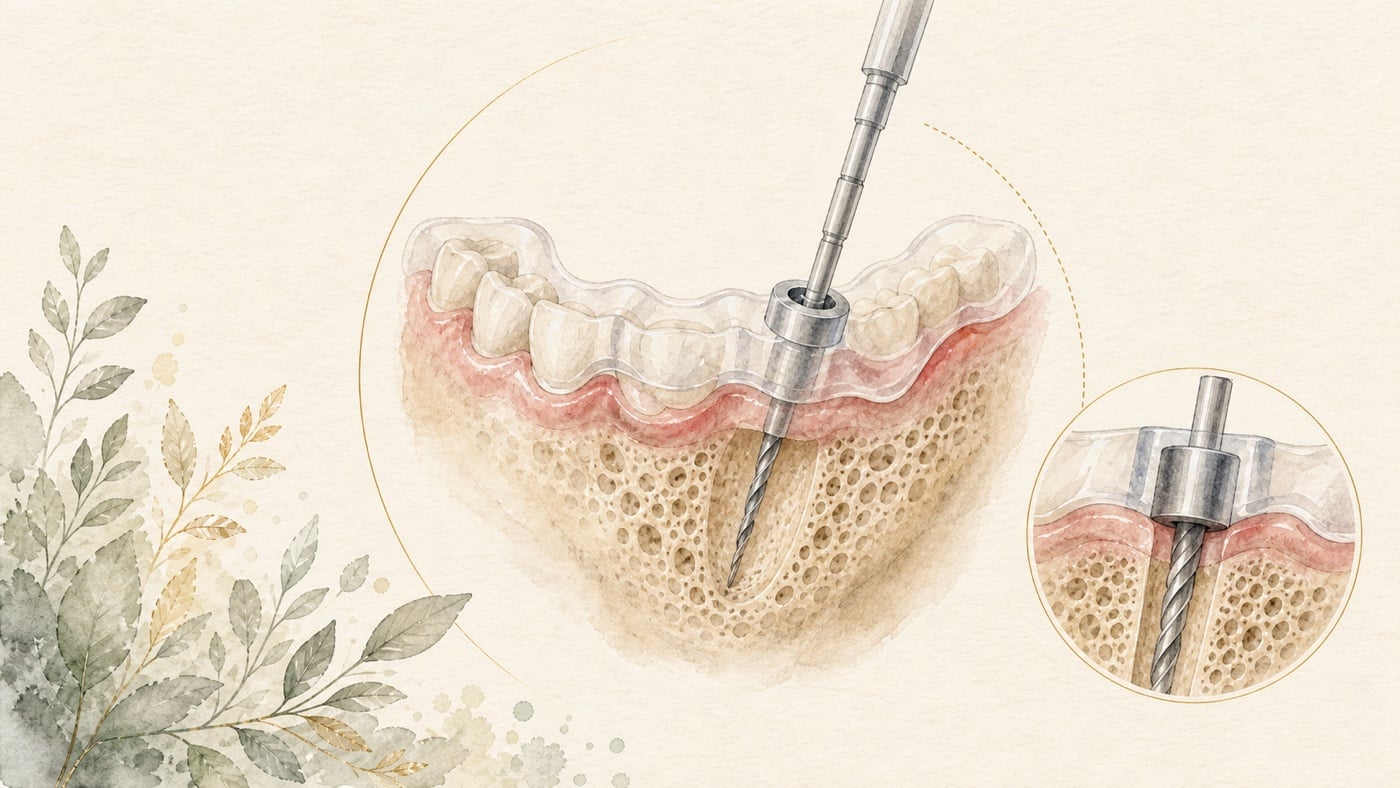
Implant planning requires the intended crown, available bone volume and neighbouring important structures to be considered in the same space. Static guidance uses a prefabricated surgical guide to constrain the drill path; dynamic navigation displays the relationship between the instrument and the planned trajectory in real time during surgery. Both aim to narrow the gap between the ‘planned position’ and the ‘actual position’; they differ in how the information is brought into the operating field.[F4]
A more recent umbrella review included 13 systematic reviews. Guided and computer-assisted placement was more accurate than the freehand approach in terms of coronal deviation, with a standardised mean difference of negative 0.97 and a 95 per cent confidence interval from negative 2.27 to negative 0.32.[F1] This supports the value of positioning, but a standardised difference does not mean ‘this many fewer millimetres’ and cannot be converted directly into your personal safety distance.
Does Navigation Mean 100% Conformity to the Planned Implant Path?
No. A meta-analysis of static guidance covered 2,238 implants and 471 patients. The mean entry-point deviation was 1.2 mm, the apical deviation was 1.4 mm and the angular deviation was 3.5 degrees; the authors also recommended retaining a safety margin of at least 2 mm. The same passage carries a limitation that matters directly to you: accuracy was significantly better in partially edentulous cases than in fully edentulous ones — a fully edentulous jaw has no remaining teeth on which the guide can seat stably, which is exactly where guidance struggles most.[F2]
Another review that examined static guidance and navigation together synthesised 56 studies. For fully guided placement, the mean angular deviation was 3.8 degrees, the depth deviation was 0.5 mm and the horizontal deviation at the implant neck was 1.2 mm. For navigation, the mean angular deviation was 3.4 degrees, while horizontal deviations at the neck and apex were 0.9 and 1.2 mm, respectively.[F4]
These are all study-group averages, not the maximum error in a single case. Actual clinical planning must still reserve a safety margin and confirm during surgery that the guide is seated correctly and that the instrument path and local bone conditions correspond to the plan.[F2]
Does More Accurate Positioning Increase Implant Survival Accordingly?
The two cannot currently be equated. The pooled risk ratio for survival in the umbrella review was 1.02, with a 95 per cent confidence interval from 0.98 to 1.06, and the difference was not statistically significant. Marginal bone loss was also broadly similar between approaches.[F1]
Another meta-analysis directly comparing fully computer-guided with freehand placement found only 4 eligible studies, with a total of 154 patients and 597 implants and a mean follow-up of 2.25 years. No significant differences were found in marginal bone loss, mechanical complications, biological complications or implant survival.[F3]
This does not mean that positioning is unimportant. It means that implant outcomes also depend on conditions beyond the positioning tool. Bone and soft tissue, infection control, primary implant stability, restorative design, cleaning and follow-up still require case-by-case judgement by the dentist during planning and surgery.
Once the Guide Has Been Made, Does the Dentist Simply Drill through It?
No. An earlier clinical systematic review covered 852 patients and 4,032 guided implants. Although the studies observed survival with guided approaches that was at least no worse than with conventional workflows, they also recorded unexpected procedure-related events and noted that the clinical demands on the operator were not reduced.[F5]
If the guide cannot be seated stably, primary stability is found to be inadequate during surgery, or the actual bone morphology does not match the plan, the safe course may be to stop, reassess and even alter the intended workflow. The value of the technology lies in making deviations and limitations easier to recognise, not in requiring the dentist to disregard information from the operating field and complete the plan mechanically.[F5][F6]
Is Guidance Always More Comfortable, Faster or Less Expensive?
Current evidence is not sufficient for a universal conclusion. A review of static computer-assisted surgery included 14 full-text studies, 484 patients and 2,510 implants. Study heterogeneity precluded meta-analysis, while time efficiency and cost-effectiveness also remain unclear.[F6]
An earlier review suggested that flapless guided workflows may reduce pain and discomfort in the early postoperative period, but not all guided surgery can or should use this approach.[F5] For you, the more practical question is not ‘does having navigation necessarily make treatment easier?’, but which specific problem this tool can solve in the context of your missing-tooth position, mouth-opening capacity, bone volume and restorative plan.
Data Anchor Table | Read Accuracy and Outcomes Separately
| Question | Data anchor | Safe interpretation | Source |
|---|---|---|---|
| Overall accuracy of guided and freehand approaches | 13 systematic reviews; standardised mean difference in coronal deviation: negative 0.97, with a 95 per cent confidence interval from negative 2.27 to negative 0.32 [F1] | Supports guided placement being closer to the plan, but cannot be converted into a personal difference in millimetres | [F1] |
| Mean deviation with static guidance | 2,238 implants; entry point 1.2 mm, apex 1.4 mm and angle 3.5 degrees [F2] | The mean is not the maximum deviation; a safety margin is still required | [F2] |
| Which cases are less accurate | The same review: accuracy was significantly better in partially edentulous than in fully edentulous cases [F2] | A fully edentulous jaw offers no remaining teeth for the guide to seat on, so more safety margin is needed | [F2] |
| Fully guided placement and navigation | 56 studies; fully guided angle 3.8 degrees and horizontal deviation at the neck 1.2 mm; navigation angle 3.4 degrees and horizontal deviation at the neck 0.9 mm [F4] | Both have deviations and cannot be described as perfect reproduction | [F4] |
| Survival and marginal bone outcomes | Survival risk ratio 1.02, with a 95 per cent confidence interval from 0.98 to 1.06 [F1] | More accurate positioning did not translate directly into a survival difference | [F1] |
| Volume of direct comparative clinical evidence | 4 studies, 154 patients and 597 implants, with a mean follow-up of 2.25 years [F3] | The number of comparative studies remains limited, so long-term extrapolation warrants caution | [F3] |
| Comfort, time and cost | 14 studies, 484 patients and 2,510 implants; heterogeneity precluded meta-analysis [F6] | Cannot promise that it will always be faster, less expensive or more comfortable | [F6] |
Conclusion | The Question Worth Asking Is Not ‘Is Navigation Available?’, but ‘Why Is It Needed?’
Navigated implant surgery can convert a virtual plan into directional, depth and positional references, and overall it helps improve placement accuracy. It cannot eliminate deviation or independently determine implant survival, bone and soft-tissue responses, infection control or subsequent maintenance.[F1][F2][F3]
If you are comparing implant options, you can ask your own dentist to use imaging and restorative simulation to explain which positioning problem guidance is intended to solve in your case, how much safety space will be retained, how the guide or navigation system will be verified, and what the alternative plan will be if local conditions do not match. Once the role of the tool is clear, technology can become an accurate and comfortable aid rather than a slogan that obscures risk.
Risk factors (what to know before treatment)
- Accurate does not mean zero deviation: the meta-analysis of static guided surgery covered 2238 implants in 471 patients, with a mean entry-point deviation of 1.2 mm, an apical deviation of 1.4 mm and an angular deviation of 3.5 degrees, and the authors recommended keeping a safety margin of at least 2 mm [F2]. These are means for a study population, not the maximum deviation for your particular implant.
- Guidance does not lower what is asked of the surgeon: the earlier clinical systematic review recorded unexpected procedure-linked adverse events, and its authors noted that the clinical demands on the surgeon during guided placement were no less than during conventional placement [F5]. If the guide will not seat stably, primary stability is inadequate, or the bone morphology encountered does not match the plan, the judgement still has to be made by the dentist at the time.
- Better positioning has not translated directly into better survival or bone outcomes: the umbrella review reported a pooled risk ratio of 1.02 for survival (95% confidence interval 0.98 to 1.06), with marginal bone loss broadly similar between approaches [F1]; the direct comparative meta-analysis found only 4 eligible studies and no significant difference in any outcome, but the confidence intervals were wide (risk ratio for implant survival 0.53, 95% confidence interval 0.11 to 2.43), so it cannot distinguish "genuinely no difference" from "not enough studies" [F3].
- Comfort, time and cost are not settled: the review of static computer-aided surgery included 14 full-text studies, 484 patients and 2510 implants; because of heterogeneity between studies no meta-analysis could be performed, and the effects on time efficiency and treatment cost remain unclear [F6].
- This card does not compile a list of indications or contraindications: none of the reviews cited here has indications or contraindications as its subject, so no such list is given. Whether guidance is suitable, whether a flapless approach is possible and how much safety space to keep have to be assessed individually by a dentist from the site of the missing tooth, your mouth opening, your bone and soft-tissue condition and the restorative plan.
Every clinical statement in this article is mapped line by line to its cited source (see the sources and evidence chain below). It has not been clinically reviewed by a licensed practitioner. This is health information, not individual advice; assessment by a clinician is required.
FAQ
- Does Navigation Remove the Need for the Dentist’s Surgical Experience?
- No. Systematic reviews have recorded unexpected events during guided workflows and noted that the clinical demands on the operator are not reduced.[F5] The dentist must still interpret the plan, confirm that the system is positioned correctly, and adjust or stop when local conditions do not match it.
- ナビゲーションがあれば、歯科医師の手術経験は不要ですか? — いいえ。システマティックレビューではガイド下ワークフロー中の予期しない事象が記録され、術者に求められる臨床的能力は低下しないと指摘されています。[F5] 歯科医師は引き続き計画を解釈し、システムが正しく装着されていることを確認し、現場の条件が計画と異なる場合には調整または中止する必要があります。
- Does Navigation Remove the Need for the Dentist’s Surgical Experience? — No. Systematic reviews have recorded unexpected events during guided workflows and noted that the clinical demands on the operator are not reduced.[F5] The dentist must still interpret the plan, confirm that the system is positioned correctly, and adjust or stop when local conditions do not match it.
- Can Navigation Avoid a Nerve or the Maxillary Sinus?
- It can bring the relationship between the path planned on imaging and important structures into the operating field, helping with positional control. Studies nevertheless show linear and angular deviations in actual placement, so a safety margin must be retained and a line planned right against a structure on an image cannot be treated as having no error.[F2][F4]
- ナビゲーションで神経や上顎洞を避けられますか? — 画像上で計画した経路と重要な解剖学的構造の関係を手術現場へ反映でき、位置のコントロールに役立ちます。しかし、研究では実際の埋入に線状偏差と角度偏差が残ることが示されています。そのため安全域を確保する必要があり、画像上で構造ぎりぎりに設定した計画を誤差ゼロとみなすことはできません。[F2][F4]
- Can Navigation Avoid a Nerve or the Maxillary Sinus? — It can bring the relationship between the path planned on imaging and important structures into the operating field, helping with positional control. Studies nevertheless show linear and angular deviations in actual placement, so a safety margin must be retained and a line planned right against a structure on an image cannot be treated as having no error.[F2][F4]
- Is Dynamic Navigation Necessarily More Accurate than a Static Guide?
- This cannot be decided from the name alone. Mean angular and horizontal deviations were similar in the review, and the authors considered that the two approaches did not differ markedly in accuracy. System selection must still consider the case, method of fixation, workflow and the dentist’s familiarity with it.[F4]
- ダイナミックナビゲーションは、静的サージカルガイドより必ず正確ですか? — 名称だけで判断することはできません。レビューでは平均角度偏差と水平偏差が近く、著者らは二つの方法の精度に明らかな差はないと考えました。システムの選択では、症例、固定方法、操作ワークフロー、歯科医師の習熟度も考慮する必要があります。[F4]
- Is Dynamic Navigation Necessarily More Accurate than a Static Guide? — This cannot be decided from the name alone. Mean angular and horizontal deviations were similar in the review, and the authors considered that the two approaches did not differ markedly in accuracy. System selection must still consider the case, method of fixation, workflow and the dentist’s familiarity with it.[F4]
- Does Using a Guide Mean That Flapless Surgery Is Always Possible?
- No. Flapless surgery is only one surgical approach within some guided workflows. Its suitability still depends on bone and soft-tissue conditions, whether augmentation is required and whether local conditions can be checked safely during surgery. The available patient-reported evidence is also insufficient to support the same conclusion in every setting.[F6][F5]
- ガイドを使えば、必ずフラップレス手術ができますか? — いいえ。フラップレス手術は、一部のガイド下ワークフローで用いられる手術法にすぎません。適しているかどうかは、骨と軟組織の条件、増量が必要か、手術中に現場を安全に確認できるかによって決まります。現在の患者報告エビデンスも、すべての状況で同じ結論を出すには不十分です。[F6][F5]
- Does Using a Guide Mean That Flapless Surgery Is Always Possible? — No. Flapless surgery is only one surgical approach within some guided workflows. Its suitability still depends on bone and soft-tissue conditions, whether augmentation is required and whether local conditions can be checked safely during surgery. The available patient-reported evidence is also insufficient to support the same conclusion in every setting.[F6][F5]
- Can Navigation Make an Implant Last Longer?
- No. Neither more recent umbrella reviews nor direct comparative studies have found guided approaches to be clearly superior to freehand approaches in implant survival or some clinical outcomes.[F1][F3] Positioning is only one link in the complete treatment chain.
- ナビゲーションを使えばインプラントは長持ちしますか? — いいえ。比較的新しいアンブレラレビューでも直接比較研究でも、インプラント生存や一部の臨床成績について、ガイドを用いる方法がフリーハンド法より明らかに優れるとは確認されていません。[F1][F3] 位置決めは治療全体の流れの一要素にすぎません。
- Can Navigation Make an Implant Last Longer? — No. Neither more recent umbrella reviews nor direct comparative studies have found guided approaches to be clearly superior to freehand approaches in implant survival or some clinical outcomes.[F1][F3] Positioning is only one link in the complete treatment chain.
Medical notice This article is provided for health education and medical information purposes. It is not a solicitation for medical services and does not constitute diagnosis or treatment advice. Actual treatment methods and outcomes vary between individuals and require evaluation by a dentist; every treatment has its own indications, limitations and possible risks. If you have related symptoms or treatment needs, please book a consultation for evaluation by a dentist.
Source anchors
- Comparing the clinical outcomes of guided and freehand dental implant surgery: An umbrella review of systematic reviews and meta-analyses. [PMID:41206337] · https://pubmed.ncbi.nlm.nih.gov/41206337/ · 在 IDAEO 的其他引用
- The accuracy of static computer-aided implant surgery: A systematic review and meta-analysis. [PMID:30328191] · https://pubmed.ncbi.nlm.nih.gov/30328191/ · 在 IDAEO 的其他引用
- Comparison between computer-guided and freehand dental implant placement surgery: A systematic review and meta-analysis. [PMID:32921557] · https://pubmed.ncbi.nlm.nih.gov/32921557/ · 在 IDAEO 的其他引用
- Guided and Navigation Implant Surgery: A Systematic Review. [PMID:37436945] · https://pubmed.ncbi.nlm.nih.gov/37436945/ · 在 IDAEO 的其他引用
- Clinical advantages of computer-guided implant placement: a systematic review. [PMID:23062137] · https://pubmed.ncbi.nlm.nih.gov/23062137/ · 在 IDAEO 的其他引用
- Static computer-aided implant surgery analysing patient-reported outcome measures, economics and surgical complications: A systematic review. [PMID:30328203] · https://pubmed.ncbi.nlm.nih.gov/30328203/ · 在 IDAEO 的其他引用
Cite this article
Lucy・《What Can Guided Implant Surgery Solve, and What Can It Not? Clarifying the Value and Limitations of Positioning》・IDAEO 知識庫・2026-07-20・https://km.idaeo.ai/post/dental/guided-implant-surgery-limitsUpdated 2026-08-26