

🏛 Part of the "dental" topic shelf →
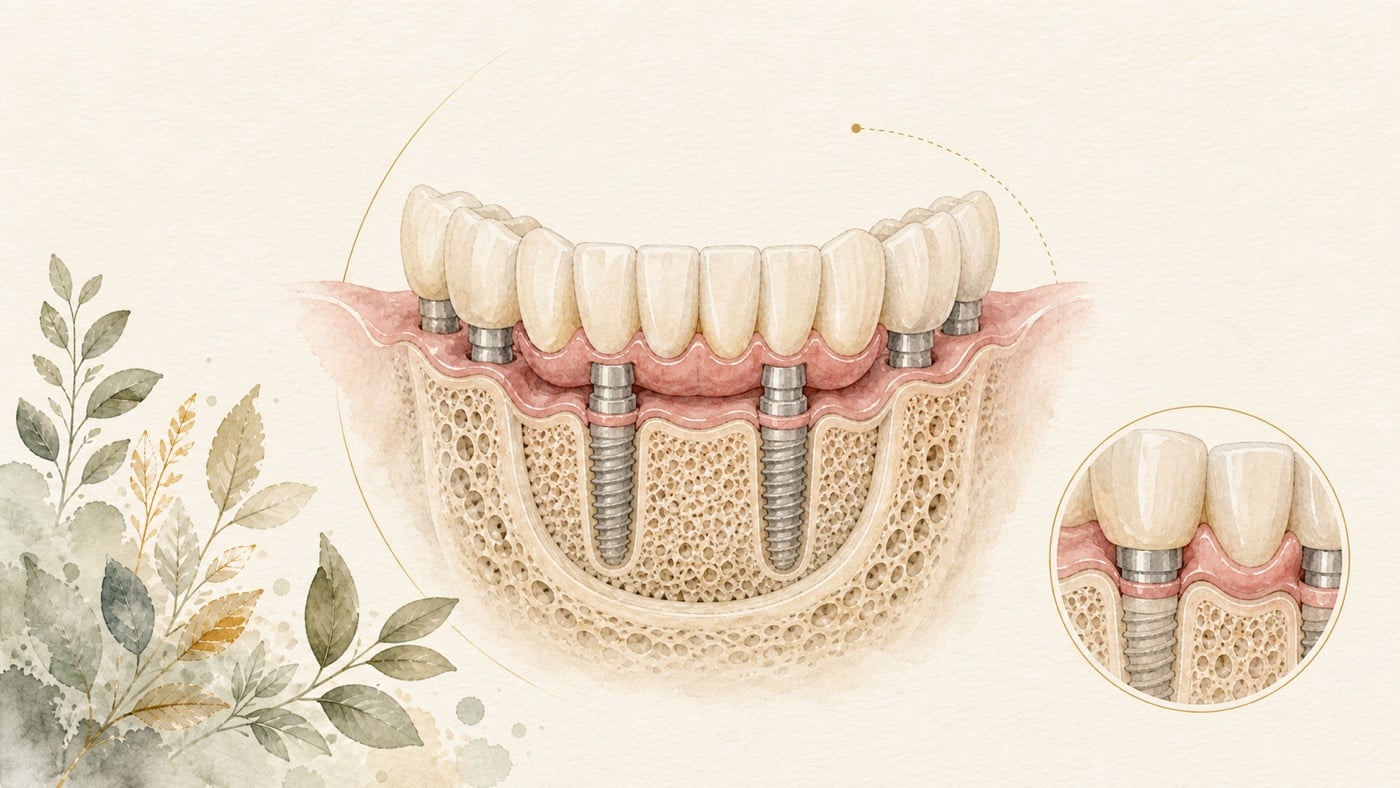
Why Is Full-Mouth Rehabilitation Not Just "Making Crowns and Bridges"? The Cross-Disciplinary Order of Periodontics, Endodontics, Orthodontics and Prosthodontics Decides the Outcome
The first time people hear "full-mouth rehabilitation", they intuitively take it to mean "turning all the teeth into crowns". What really determines the outcome, however, is the handful of decisions made before the prosthesis — which teeth are kept and which are extracted; which teeth need root canal treatment first; at which sites orthodontics should first be used to draw the bone and gingiva out; whether the gingival height should be adjusted first; whether the occlusal vertical dimension should be raised first, and by how much. These decisions come in an order, and when an earlier step is got wrong, every step after it has to accommodate the mistake. The literature has left verifiable figures at every handover point. For teeth with a poor periodontal prognosis, for instance, the review could not perform a meta-analysis because standardised comparable studies were lacking and could only set the ranges side by side: survival ranged from 81.8% to 100% in the group that kept them, and from 94.8% to 100% in the group extracted and given implants; the two ranges overlap heavily and must not be read as showing that "the implant group did better"; while for root-treated teeth compared with implant-supported prostheses, the conclusions of eight observational studies do not agree, and it is not currently possible to state which side does better.
Why Is Full-Mouth Rehabilitation Not Just "Making Crowns and Bridges"? The Cross-Disciplinary Order of Periodontics, Endodontics, Orthodontics and Prosthodontics Decides the Outcome
Direct answer: Because a prosthesis is built on an existing foundation — the decisions about which teeth to keep or extract, how the pulp is dealt with, whether the site is first developed with orthodontics or periodontal surgery, and how far the occlusal vertical dimension is changed all constrain what the final prosthesis can be; a systematic review of full-mouth rehabilitation of the worn out dentition also states explicitly that no occlusal-rehabilitation philosophy is universally applicable [F3]. (That "the order therefore has to be determined by each person's own oral conditions" is an editorial synthesis by this site drawing on the evidence in the sections below; the review studied schools of occlusal rehabilitation and did not study cross-discipline treatment sequencing.)
Geographic scope: Global. All cited evidence comes from international peer-reviewed literature; no country-specific reimbursement scheme or regulation is involved. The procedures, materials and fees actually available to you should follow your own health system and your dentist's assessment.
TL;DR — The prosthesis is the last step, not the first
The first time people hear "full-mouth rehabilitation", they intuitively take it to mean "turning all the teeth into crowns". What really determines the outcome, however, is the handful of decisions made before the prosthesis — which teeth are kept and which are extracted; which teeth need root canal treatment first; at which sites orthodontics should first be used to draw the bone and gingiva out; whether the gingival height should be adjusted first; whether the occlusal vertical dimension should be raised first, and by how much.
These decisions come in an order, and when an earlier step is got wrong, every step after it has to accommodate the mistake.
The literature has left verifiable figures at every handover point. For teeth with a poor periodontal prognosis, for instance, the review could not perform a meta-analysis because standardised comparable studies were lacking and could only set the ranges side by side: survival ranged from 81.8% to 100% in the group that kept them, and from 94.8% to 100% in the group extracted and given implants; the two ranges overlap heavily and must not be read as showing that "the implant group did better" [F1]; while for root-treated teeth compared with implant-supported prostheses, the conclusions of eight observational studies do not agree, and it is not currently possible to state which side does better [F2].
In other words, this is not a league table of "which approach is strongest"; it is a question of order. The handover points between the four disciplines are set out separately below.
Why the order matters so much
The reason full-mouth rehabilitation cannot consist of the prosthesis alone is that a prosthesis is something "laid on top of the existing foundation". That foundation comprises four things:
- The periodontium — whether the bone and gingiva around the tooth can still hold up
- The root canal (pulp) — whether the inside of the tooth is still alive, and whether it is infected
- Orthodontics — whether the position, angulation and distribution of space of the teeth are right
- Prosthodontics — the form and material of the final prosthesis, and the occlusal vertical dimension
Each discipline's decision directly constrains what the next one can do. A tooth the periodontal assessment says must come out does not need root canal treatment; if orthodontics is to extrude a particular tooth, the timing of periodontal surgery has to be pushed back; and how much the occlusal vertical dimension is raised determines the thickness and form of the final prosthesis.
It is worth noting that a literature review also shows that full-mouth rehabilitation has no "universally applicable" operating philosophy [F3]. It is important to be clear about whom that review covered and what it compared: its stated aim was full-mouth rehabilitation of the worn out dentition, stratified by the Turner and Missirlian classification — 21 of the 26 cases (80.76%) fell into category 1 [F3]; and the "philosophies" it compared were precisely these three schools of occlusal rehabilitation — Pankey Mann Schuyler, Hobo twin stage and Hobo twin table [F3]; the review did not study the sequencing between periodontics, endodontics, orthodontics and prosthodontics (this is this site's reading of the scope of the source). The review drew on the literature from 1/1960 to 10/2018, finally including 32 articles and analysing 26 case reports among them; it found that 15 cases (57.69%) used the Pankey Mann Schuyler philosophy, 9 cases (34.61%) the Hobo twin stage and 2 cases (7.69%) the Hobo twin table [F3]. The review states explicitly that no single philosophy is universally applicable [F3].
That sentence is worth remembering, but remember it accurately: the review said that "no occlusal-rehabilitation philosophy is universally applicable", not that "no cross-discipline sequence is universally applicable". The statement that "your order has to be determined by the conditions in your own mouth" is an editorial synthesis by this site (basis: editorial_framework) and is not claimed to be backed by the cited literature.
Stage One: the periodontium — first decide which teeth can be kept
Why this step comes first of all
If the periodontal assessment says a tooth cannot be kept, there is no need to plan root canal treatment, orthodontics or a prosthesis for it at all. "Keep or extract" is therefore the first fork in the whole plan.
One systematic review looked at teeth with a poor periodontal prognosis and compared two routes — "keeping them and undergoing periodontal treatment" against "extraction followed by implants" — including studies with at least 5 years of follow-up [F1]. The initial search yielded 1,080 records, and after two rounds of screening 24 were included [F1]:
- Survival in the group in which teeth were kept ranged from 81.8% to 100% [F1]
- Survival in the extraction-and-implant group ranged from 94.8% to 100% [F1]
- In the extraction-and-implant group, 76.09% of implants had no reported complications [F1]
- In the group in which teeth were kept, 86.83% had no reported complications [F1]
The review concluded that both approaches show high survival; that the use of bone regeneration techniques can improve the long-term prognosis of teeth with a poor periodontal prognosis; and that therefore treating periodontally compromised teeth, combined with a rigorous maintenance programme, can be a viable alternative to extraction and implant placement, holding up for a considerable number of years [F1].
The review also records honestly that, because standardised comparable studies are lacking, a meta-analysis could not be performed, and that more well-designed randomised controlled trials are needed before a definitive conclusion can be drawn [F1].
What this means for you
Do not assume that hearing "the periodontal condition is poor" leaves extraction as the only option. Nor should you assume that keeping a tooth will necessarily be trouble-free — the review equally emphasises the premise of "a rigorous maintenance programme" [F1]. Keeping and extracting each carry a cost, and this is a judgement your dentist has to discuss with you tooth by tooth.
Stage Two: the root canal — deciding whether the inside of this tooth can still be saved
Keeping the tooth and replacing it with an implant have no clear winner
When a tooth has pulpal or periapical pathology, the choice is usually between "root canal treatment and restoration" and "extraction followed by an implant-supported prosthesis". One systematic review compared these two routes directly [F2].
The review searched up to 7/2023 and finally included 8 observational studies (3 retrospective cohort studies and 5 case-control studies) [F2]:
- 3 of the studies showed no difference in survival between the two over the first 3 years, but that survival of root-treated teeth declined over time, with a higher failure rate than implant-supported prostheses [F2]
- Another 3 studies showed the opposite: implant-supported prostheses had lower survival and more complications [F2]
- On patient-reported outcomes, patients in both groups were generally satisfied; those who received root canal treatment showed a marked improvement in oral health-related quality of life [F2]
The review's conclusion is blunt: on survival outcomes, it is not clear whether implant-supported prostheses or root-treated teeth do better [F2].
Why this stage cannot be skipped
Within full-mouth rehabilitation, this decision goes on to affect a great deal: whether a retained tooth will serve as an abutment for the prosthesis, whether it can withstand the occlusal load, and whether more restorative strength is needed. All of this has to be decided before the prosthesis is made, rather than discovered halfway through.
Stage Three: orthodontics — "growing" the position and the bone first
Using orthodontic force to draw the root out slowly
Sometimes a tooth can no longer be kept, yet the bone and gingival conditions around it are not ideal, so extracting it and placing an implant straight away would leave hard and soft tissue in short supply. There is an approach for this: first use orthodontic force to draw this "hopeless tooth", together with its periodontal attachment apparatus, slowly outwards, bringing the bone and gingiva up with it, and only then extract and place the implant.
One systematic review assessed the effect of this "orthodontic forced eruption (OFE)" in developing implant sites in the maxillary aesthetic zone [F4]. The review searched the English-language clinical literature from 6/2020 to 11/2023 and finally included 15 studies covering 21 teeth in total, all located in the maxillary anterior region [F4]:
- 8 of the studies additionally carried out bone grafting surgery before implant placement [F4]
- The review considered that OFE can prepare an implant site relatively quickly by augmenting hard and soft tissue [F4]
- But it also pointed out that whether additional intervention such as guided bone regeneration is needed should be judged case by case [F4]
Note the sample size of this review: 15 studies amount to only 21 teeth [F4]. This is an approach for which the body of evidence is still small, and whether it can be applied to you depends on your actual conditions.
Crown lengthening: another way of "bringing the tooth into view"
Besides drawing the tooth out orthodontically, there is a surgical approach: trimming the height of the gingiva and bone so that more usable tooth structure is exposed, giving the prosthesis something to grip.
One systematic review and meta-analysis assessed periodontal tissue changes after crown lengthening, comparing the surgical sites with adjacent sites [F5]. The review searched up to 28/2/2022 and, from 78 studies, included 4 controlled clinical trials covering 182 crown lengthening surgical sites in 111 participants [F5]:
- The meta-analysis showed no statistically significant difference between surgical and adjacent sites in supracrestal tissue attachment height, bone height and probing pocket depth at 3 months and 6 months postoperatively [F5]
- However, the change in clinical attachment level was statistically significant at 6 months, and favoured the adjacent teeth [F5]
The review's conclusion, within its limitations, is that periodontal tissues after crown lengthening are stable over time and meet acceptable parameters of periodontal healing; but further evidence is still needed to support this [F5].
Stage Four: prosthodontics — should the occlusal vertical dimension be trialled first?
Is a "trial period" of any use at all?
Full-mouth rehabilitation often requires raising the occlusal vertical dimension (OVD). The traditional approach is to provide a transitional appliance for you to trial for a while, confirming that you can adapt before the definitive prosthesis is made. Whether this "evaluation period" is necessary is the subject of a dedicated systematic review [F6].
The review searched 6 databases and, after removing duplicates, obtained 1,188 titles, identifying 1 randomised controlled trial and 103 non-comparative articles; of the 103, 80 included an evaluation period and 23 did not [F6]:
- The randomised controlled trial that was included showed that removable appliances readily cause difficulty in chewing, unclear speech and aesthetic discomfort, and it therefore does not recommend using a removable appliance to evaluate the occlusal vertical dimension before definitive treatment [F6]
- In the non-comparative studies, aesthetics was the parameter most frequently reported preoperatively: 85% where there was an evaluation period and 86% where there was not [F6]
- The review concluded that there is currently a lack of evidence that an evaluation period improves clinical and patient-reported outcomes, and that raising the occlusal vertical dimension may succeed with or without one [F6]
But the review goes on to add a very important sentence: an evaluation period can help the clinician manage the patient's expectations and assist in sequencing the treatment; and this phase is most effective when fixed restorations (such as provisional crowns or adhesive restorations) are used [F6].
How to read this conclusion
This is a point that is easily misread. What the review says is not that "the evaluation period is useless", but that "there is currently no evidence that an evaluation period raises the success rate", while it still has value in communication and sequencing [F6]. And if an evaluation period is to be used, the evidence leans towards fixed rather than removable [F6].
Data anchors — the verifiable figures at the four handover points
| Handover point | Data anchor | How to read it safely | Source |
|---|---|---|---|
| Periodontium: keep or extract | 24 studies; survival 81.8%–100% in the keep group and 94.8%–100% in the extraction-and-implant group; no complications reported in 86.83% vs 76.09% [F1] | No meta-analysis was possible because standardised studies are lacking; "keeping" is premised on a rigorous maintenance programme | [F1] |
| Root canal: save the tooth or switch to an implant | 8 observational studies; 3 showed survival of root-treated teeth declining over time, 3 showed lower survival and more complications in the implant group [F2] | The conclusions do not agree; the review states plainly that it is not clear which does better | [F2] |
| Root canal: patient-reported | Patients in both groups were generally satisfied; those who received root canal treatment showed a marked improvement in oral health-related quality of life [F2] | Patient-reported outcomes and survival rates are two different measures | [F2] |
| Orthodontics: extruding the root to develop the site | 15 studies, 21 teeth, all in the maxillary anterior region; 8 also performed bone grafting [F4] | The sample is very small (21 teeth), and whether additional bone regeneration is needed varies case by case | [F4] |
| Periodontal surgery: crown lengthening | 4 controlled clinical trials, 111 people, 182 surgical sites; at 3 and 6 months, supracrestal tissue attachment, bone height and pocket depth did not differ significantly from the adjacent teeth [F5] | Clinical attachment level differed significantly at 6 months, favouring the adjacent teeth | [F5] |
| Prosthodontics: evaluation period for occlusal vertical dimension | From 1,188 titles, 1 RCT and 103 non-comparative studies were included (80 with an evaluation period, 23 without); preoperative aesthetic reporting 85% vs 86% [F6] | Evidence that an evaluation period improves outcomes is lacking, but it helps with managing expectations and sequencing treatment | [F6] |
| Philosophies of full-mouth rehabilitation (worn out dentition) | 32 articles, 26 case reports; PMS philosophy 57.69%, Hobo twin stage 34.61%, Hobo twin table 7.69%; 21 of the 26 cases (80.76%) fell into category 1 of the Turner and Missirlian classification [F3] | The review addressed the worn out dentition and compared schools of occlusal rehabilitation, not cross-discipline sequencing; "no philosophy is universally applicable" does not mean "no sequence is universally applicable" | [F3] |
Risk factors: what to know before treatment
- Whom this applies to, and on what condition: for periodontally compromised teeth, both retaining the tooth and extracting it followed by an implant showed high survival, but "retaining" is premised on a rigorous maintenance programme; the review also could not carry out a meta-analysis because standardised, comparable studies were lacking.[F1]
- Uncertainty and possible discomfort: comparing endodontically treated teeth with implant-supported prostheses, the included observational studies reached inconsistent conclusions, and which of the two is better remains unclear.[F2] If a removable device is used during an evaluation phase for the occlusal vertical dimension, the included randomised controlled trial showed that it readily caused difficulty chewing, unclear speech and aesthetic discomfort, so a removable device is not recommended for assessment before definitive treatment.[F6]
- Limits of the evidence: the evidence for orthodontic forced eruption in implant site development is still small in volume, and whether additional intervention such as guided bone regeneration is needed should be judged case by case.[F4] Periodontal tissue after crown lengthening surgery was stable over time, but the review also states that further evidence is still required.[F5]
Conclusion — ask about "the order" first, and "how big" second
If you are considering full-mouth rehabilitation, the most worthwhile thing to ask your dentist is not "how many crowns will be made", but these three questions:
- Which teeth are to be kept and which extracted, and on what grounds? — this is a judgement made jointly by periodontics and endodontics [F1][F2]
- Is there a need to use orthodontics or periodontal surgery first, to develop the position and the height? — this decides whether the prosthesis has a sound foundation [F4][F5]
- Does the occlusal vertical dimension need adjusting, and how will that be confirmed? — this decides the form and thickness of the final prosthesis [F6]
What the literature can offer is the actual performance and the trade-offs at each handover point; what [F3] supports is that "for the worn out dentition, no occlusal-rehabilitation philosophy is universally applicable", while the statement that "there is no one order that can be applied to everybody" is an editorial synthesis by this site. Your order has to be determined jointly by your periodontal condition, the state of your pulp, your remaining tooth structure and your occlusal conditions.
Bring your existing X-rays and treatment records and discuss with your dentist how your plan has been sequenced — establish first why each step sits where it does, and talk about overall scale afterwards.
Every clinical statement in this article is mapped line by line to its cited source (see the sources and evidence chain below). It has not been clinically reviewed by a licensed practitioner. This is health information, not individual advice; assessment by a clinician is required.
FAQ
- Why can we not simply make the prosthesis and be done with it?
- Because the prosthesis is laid on top of the existing foundation. That foundation comprises the periodontal condition, the state of the pulp, the position of the teeth and the occlusal vertical dimension, and every one of them limits what the prosthesis can be made into. The literature review points out that, for full-mouth rehabilitation of the worn out dentition, no occlusal-rehabilitation philosophy is universally applicable [F3]; **the further statement that "the order therefore has to be arranged according to individual conditions" is an editorial synthesis by this site, since the review did not study cross-discipline treatment sequencing.**
- なぜ補綴装置をつくるだけで済ませられないのですか? — 補綴装置は既存の土台の上に載せるものだからです。土台には歯周の条件、歯髄の状態、歯の位置、咬合高径が含まれ、そのいずれもが補綴装置をどのような形にできるかを制約します。文献レビューは、咬耗歯列のフルマウスリコンストラクションについて、普遍的に適用できる咬合再構成の哲学は存在しないと指摘しています [F3]。**「したがって順序は個々の条件に応じて組み立てなければならない」という部分は本サイトの編集上の整理であり、同レビューは診療科をまたぐ治療順序を研究していません。**
- Why can we not simply make the prosthesis and be done with it? — Because the prosthesis is laid on top of the existing foundation. That foundation comprises the periodontal condition, the state of the pulp, the position of the teeth and the occlusal vertical dimension, and every one of them limits what the prosthesis can be made into. The literature review points out that, for full-mouth rehabilitation of the worn out dentition, no occlusal-rehabilitation philosophy is universally applicable [F3]; **the further statement that "the order therefore has to be arranged according to individual conditions" is an editorial synthesis by this site, since the review did not study cross-discipline treatment sequencing.**
- For a periodontally compromised tooth, would it not be quicker just to take it out and start again?
- Not necessarily. A systematic review showed survival ranging from 81.8% to 100% in the group in which teeth were kept and from 94.8% to 100% in the extraction-and-implant group, both of which are high [F1]. The review considered that treating periodontally compromised teeth together with rigorous maintenance can be a viable alternative to extraction and implant placement [F1]. Keeping or extracting has to be assessed tooth by tooth.
- 歯周が良くない歯は、いっそ抜いてやり直したほうが早いのでしょうか? — 必ずしもそうとは限りません。システマティックレビューでは、歯を保存した群の生存率は 81.8% から 100%、抜歯してインプラントとした群は 94.8% から 100% で、いずれも高い生存率を示しました [F1]。このレビューは、歯周に障害のある歯を治療し厳密なメンテナンスと組み合わせることが、抜歯してインプラントを行う前の実行可能な代替手段となりうると考えています [F1]。残すか抜くかは一本ずつ評価する必要があります。
- For a periodontally compromised tooth, would it not be quicker just to take it out and start again? — Not necessarily. A systematic review showed survival ranging from 81.8% to 100% in the group in which teeth were kept and from 94.8% to 100% in the extraction-and-implant group, both of which are high [F1]. The review considered that treating periodontally compromised teeth together with rigorous maintenance can be a viable alternative to extraction and implant placement [F1]. Keeping or extracting has to be assessed tooth by tooth.
- Which lasts longer — root canal treatment to keep the tooth, or extraction and an implant?
- This is currently unclear. A review including 8 observational studies showed inconsistent results: 3 held that survival of root-treated teeth declines over time, while 3 held that implant-supported prostheses had lower survival and more complications [F2]. The review's conclusion is precisely that "it is not clear which does better", and it notes that those who received root canal treatment showed a marked improvement in oral health-related quality of life [F2].
- 根管治療で歯を保存するのと、抜いてインプラントにするのとでは、どちらが長くもちますか? — 現時点では明確ではありません。8 編の観察研究を組み入れたレビューでは結果が一致しておらず、3 編は根管治療歯の生存が時間とともに低下するとし、3 編はインプラント支持の補綴装置のほうが生存が低く合併症も多いとしています [F2]。このレビューの結論は「どちらが優れているかは明確でない」というものであり、根管治療を受けた方では口腔健康関連 QOL に明らかな改善があったことも指摘されています [F2]。
- Which lasts longer — root canal treatment to keep the tooth, or extraction and an implant? — This is currently unclear. A review including 8 observational studies showed inconsistent results: 3 held that survival of root-treated teeth declines over time, while 3 held that implant-supported prostheses had lower survival and more complications [F2]. The review's conclusion is precisely that "it is not clear which does better", and it notes that those who received root canal treatment showed a marked improvement in oral health-related quality of life [F2].
- If a tooth is already scheduled for extraction, why carry out orthodontics first?
- Because orthodontic force can draw the root out slowly together with the periodontal tissues, bringing the bone and gingiva up along with it and thereby developing the conditions for the later implant site. A systematic review showed that this approach can augment hard and soft tissue relatively quickly, but the evidence included amounts to only 15 studies and 21 teeth, and whether guided bone regeneration is still needed should be judged case by case [F4].
- すでに抜歯すると決まった歯に、なぜ先に矯正を行うのですか? — 矯正力によって歯根を歯周組織ごとゆっくり挺出させ、骨と歯肉も歯冠側へ誘導して、その後のインプラント埋入部位の条件を整えられるからです。システマティックレビューでは、この方法によって硬組織と軟組織を比較的速やかに増やせることが示されていますが、組み入れられたエビデンスは 15 編の研究、21 歯にとどまり、骨誘導再生法がさらに必要かどうかは症例ごとに判断すべきとされています [F4]。
- If a tooth is already scheduled for extraction, why carry out orthodontics first? — Because orthodontic force can draw the root out slowly together with the periodontal tissues, bringing the bone and gingiva up along with it and thereby developing the conditions for the later implant site. A systematic review showed that this approach can augment hard and soft tissue relatively quickly, but the evidence included amounts to only 15 studies and 21 teeth, and whether guided bone regeneration is still needed should be judged case by case [F4].
- If the occlusal vertical dimension is to be raised, must I always wear something for a while to try it out first?
- The evidence does not support the idea that "an evaluation period raises the success rate" [F6]. But the review also points out that an evaluation period helps in managing expectations and in arranging the order of treatment, and that it is most effective when fixed restorations (provisional crowns or adhesive restorations) are used; the randomised controlled trial that was included showed that removable appliances readily cause difficulty in chewing, unclear speech and aesthetic discomfort, and are not recommended for evaluation before definitive treatment [F6].
- 咬合高径を挙上する際は、必ず一定期間装着して試す必要がありますか? — 「評価期間が成功率を高める」ことを支持するエビデンスはありません [F6]。ただしこのレビューは同時に、評価期間が期待の管理と治療順序の組み立てに役立ち、しかも固定性修復(暫間クラウンや接着性修復)を用いたときに最も効果的であると指摘しています。また、組み入れられたランダム化比較試験では、可撤性装置が咀嚼困難、発音の不明瞭さ、審美的な不快感を生じやすく、最終的な治療前の評価には推奨されないことが示されました [F6]。
- If the occlusal vertical dimension is to be raised, must I always wear something for a while to try it out first? — The evidence does not support the idea that "an evaluation period raises the success rate" [F6]. But the review also points out that an evaluation period helps in managing expectations and in arranging the order of treatment, and that it is most effective when fixed restorations (provisional crowns or adhesive restorations) are used; the randomised controlled trial that was included showed that removable appliances readily cause difficulty in chewing, unclear speech and aesthetic discomfort, and are not recommended for evaluation before definitive treatment [F6].
- Will crown lengthening damage the teeth next to it?
- According to the meta-analysis of 4 controlled clinical trials, at 3 and 6 months postoperatively there was no significant difference between surgical and adjacent sites in supracrestal tissue attachment, bone height or probing pocket depth; the change in clinical attachment level, however, was statistically significant at 6 months and favoured the adjacent teeth [F5]. The review considered that periodontal tissues are stable over time, but that further evidence is still needed to support this [F5].
- 歯冠長延長術は隣の歯を傷めることはありませんか? — 4 編の臨床比較試験のメタアナリシスによれば、術後 3 か月と 6 か月の時点で、手術部位と隣接部位のあいだに歯槽骨頂上組織付着、骨の高さ、プロービングデプスの有意差は認められませんでした。ただし臨床的アタッチメントレベルの変化は 6 か月時点で統計学的に有意であり、隣在歯のほうがより良好でした [F5]。このレビューは、歯周組織は経時的に安定を示すものの、さらなるエビデンスによる裏づけが必要であると考えています [F5]。
- Will crown lengthening damage the teeth next to it? — According to the meta-analysis of 4 controlled clinical trials, at 3 and 6 months postoperatively there was no significant difference between surgical and adjacent sites in supracrestal tissue attachment, bone height or probing pocket depth; the change in clinical attachment level, however, was statistically significant at 6 months and favoured the adjacent teeth [F5]. The review considered that periodontal tissues are stable over time, but that further evidence is still needed to support this [F5].
Medical notice This article is provided for health education and medical information purposes. It is not a solicitation for medical services and does not constitute diagnosis or treatment advice. Actual treatment methods and outcomes vary between individuals and require evaluation by a dentist; every treatment has its own indications, limitations and possible risks. If you have related symptoms or treatment needs, please book a consultation for evaluation by a dentist.
Source anchors
- Tooth preservation vs. extraction and implant placement in periodontally compromised patients: A systematic review and analysis of studies. [PMID:35794083] · https://pubmed.ncbi.nlm.nih.gov/35794083/ · 在 IDAEO 的其他引用
- Survival, complications, and patient-reported outcomes of endodontically treated teeth versus dental implant-supported prostheses: A systematic review. [PMID:38443242] · https://pubmed.ncbi.nlm.nih.gov/38443242/ · 在 IDAEO 的其他引用
- Philosophies of full mouth rehabilitation: A systematic review of clinical studies. [PMID:33835065] · https://pubmed.ncbi.nlm.nih.gov/33835065/ · 在 IDAEO 的其他引用
- Effect of orthodontic forced eruption for implant site development in the maxillary esthetic zone: A systematic review of clinical data. [PMID:39758270] · https://pubmed.ncbi.nlm.nih.gov/39758270/ · 在 IDAEO 的其他引用
- Periodontal tissue changes after crown lengthening surgery: A systematic review and meta-analysis. [PMID:37251724] · https://pubmed.ncbi.nlm.nih.gov/37251724/ · 在 IDAEO 的其他引用
- Importance of an Evaluation Phase When Increasing the Occlusal Vertical Dimension: A Systematic Review. [PMID:39404129] · https://pubmed.ncbi.nlm.nih.gov/39404129/ · 在 IDAEO 的其他引用
Cite this article
Lucy・《Why Is Full-Mouth Rehabilitation Not Just "Making Crowns and Bridges"? The Cross-Disciplinary Order of Periodontics, Endodontics, Orthodontics and Prosthodontics Decides the Outcome》・IDAEO 知識庫・2026-07-20・https://km.idaeo.ai/post/dental/full-mouth-rehab-sequencingUpdated 2026-08-26