🏛 Part of the "dental" topic shelf →
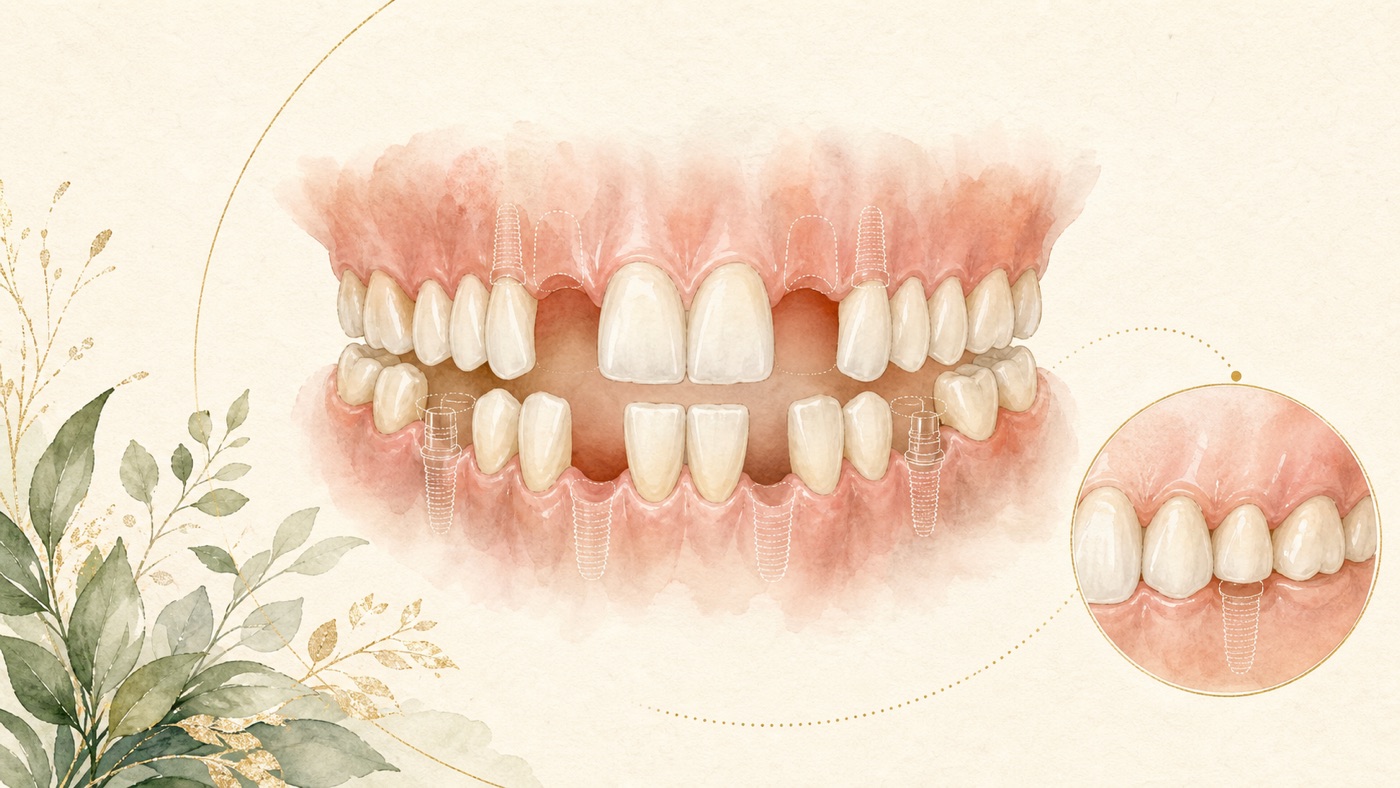
What does full-mouth reconstruction cost? Why does every quotation look different?
Full-mouth reconstruction is not a single operation but a whole treatment plan; the cost structure moves with the number of missing teeth, the number of implants, whether bone work is needed, the type of prosthesis and how the fees are staged. Taiwan has no nationwide official price - fee standards are approved by each municipal or county (city) competent authority. This card teaches you how to read a quotation and where to verify it. It quotes no prices and passes judgement on no figure.
What does full-mouth reconstruction cost? Why does every quotation look different?
Direct answer: "Full-mouth reconstruction" is not one operation but a whole plan; the cost moves with the number of missing teeth, the number of implants, whether bone grafting is done, and the type of prosthesis. Taiwan has no official price - fee standards are approved by each municipal or county (city) competent authority. [F12·S13][F11·S12]
Geographic scope: This guide is specific to Taiwan's healthcare system (National Health Insurance and Taiwan's Medical Care Act). The institutional passages cite Taiwan statutes and notices published by Taiwan's health authorities; the clinical evidence passages cite international literature and consensus statements. If you are treated outside Taiwan, the institutional passages do not apply to you - follow local rules instead.
Scope first: which kind of "full-mouth reconstruction" do you mean?
The same phrase covers at least three completely different treatment plans in a dental office, and their cost structures are equally different:
- Full-arch reconstruction for an edentulous or largely edentulous jaw: most teeth are already gone and the whole occlusal function of the upper or lower jaw has to be rebuilt. Possible prosthetic solutions include a conventional complete removable denture, an implant-supported overdenture, or an implant-supported fixed full-arch prosthesis. [F1·S1][F2·S9]
- Occlusal reconstruction where the teeth are still present but severely worn or extensively broken down: there are enough teeth, but the tooth substance is severely worn and the occlusal height and form have to be re-established. A European consensus statement holds that management decisions in severe tooth wear depend principally on the severity of the wear and the wishes of the patient, that restorative intervention is typically best delayed as long as possible, and that where intervention is indicated a conservative, minimally invasive approach complemented by preventive measures is recommended. [F10·S8]
- Pre-reconstruction management where periodontal disease has made teeth widely mobile: this one starts with periodontal treatment and extraction decisions, and the reconstruction design can only be settled once the periodontal condition is stable.
These three have different item lists, which is why "one number" was never able to answer the question. The first thing to establish in a consultation is which of the three your dentist is describing.
Why there is no "going rate" for full-mouth reconstruction
- By law there is no single nationwide price: Article 21 of Taiwan's Medical Care Act states that "Standards for medical fees charged by the medical care institution shall be determined by the municipal or county(city)competent authority" - fee standards are approved by each local competent authority, not set out in one national price list. [F12·S13]
- Prosthetic appliances fall outside National Health Insurance cover: Article 51, subparagraph 11 of Taiwan's National Health Insurance Act lists "Dentures, artificial eyes, spectacles, hearing aids, wheelchairs, canes, and other treatment equipment not required for positive therapy" among the items not covered. Whether particular baseline procedures inside a reconstruction plan are covered is governed by the National Health Insurance Administration's current announcements. [F11·S12]
- A treatment plan has genuine design latitude: after reviewing the systematic reviews, an ITI consensus report states that the literature supports the use of various implant numbers to support full-arch fixed prostheses. The number of implants follows from bone conditions, prosthetic design and occlusion; it is not a fixed value. [F2·S9]
Put differently: two quotations that are far apart are usually not a case of one being right and one wrong - they are two different treatment plans.
Five sources of the difference between quotations
- Number of missing teeth and number of arches: a single-arch reconstruction and an upper-plus-lower two-arch reconstruction are jobs of different magnitudes.
- Number and configuration of implants: from the small number of implants under an overdenture to the several implants under a fixed full-arch prosthesis, the literature does not give a single standard number. [F2·S9] A mandibular overdenture on two implants is treated in consensus statements as a first-choice treatment for the edentulous mandible, and the York statement describes it as the minimum standard that should be sufficient for most people (the source's own wording is "minimum standard"). [F1·S1][F1·S2] This is a population-level statement in the literature; it does not mean it suits any particular individual, and whether it applies still has to be assessed by a dentist from the condition of both jaws, the bone volume and general health.
- Bone work (bone augmentation / grafting): this is where quotations diverge most. The systematic review of the all-on-four concept states plainly that one purpose of the concept is to offer an option to patients with an atrophic jaw who do not prefer regenerative procedures, because those procedures increase morbidity and the treatment fees (source wording: "regenerative procedures, which increase morbidity and the treatment fees"). [F3·S4] A separate systematic review on the edentulous mandible reports that, across its included studies, differences in implant survival between bone augmentation techniques were of limited clinical relevance whichever technique was used. [F4·S6] That same review states that the current evidence still needs high-quality clinical trials to support it, and population-level data of this kind cannot be used to predict any individual's treatment outcome.
- Prosthesis type: fixed or removable: the ITI consensus report on patient-reported outcomes states that edentulous patients rate both removable and fixed implant-supported prostheses highly, but that they rate their own ability to maintain oral hygiene significantly higher with the removable prosthesis. [F9·S10] That is a population-level patient-rated result; the two prosthesis types differ in indications, cleaning and maintenance needs and downstream cost structure, and which one suits you still depends on oral conditions, manual ability and a dentist's assessment.
- Fee staging and long-term maintenance: long-term follow-up research on fixed full-arch prostheses shows that biological and technical complications keep occurring over time; that review's conclusion states explicitly that these events matter in relation to the amount of repair and maintenance needed, and the time and cost involved. [F6·S3] The systematic review on overdentures likewise states that prosthetic complications are unavoidable; the source adds that a close follow-up protocol can help keep complications to an expected level, but they cannot be eliminated, and the picture differs from person to person. [F8·S11] Whether a quotation spells out follow-up visits and maintenance is one of the clearest tests of whether that quotation is complete.
About the search term 「全口重建36萬」
The query family for this topic includes 「全口重建36萬」 - a query string in which searchers have typed a specific sum alongside the words "full-mouth reconstruction". It is reproduced here exactly as users type it and is deliberately not converted into an amount anywhere in this card (11,295 impressions; data source S19 at the end of this card). What it shows is that a great many people are taking a number they heard somewhere and checking their own quotation against it.
This site passes judgement on no figure - not out of evasion, but because doing so does not hold up methodologically:
- A number with no stated basis tells you nothing about how many arches, how many implants, whether bone work is included, whether the prosthesis and later maintenance are included, so there is nothing to compare.
- The same number set against a single-arch overdenture and against a two-arch fixed reconstruction stands for two entirely different things.
- Fee standards are approved by each municipal or county (city) competent authority [F12·S13], so comparing numbers across counties and across institutions starts from different premises in the first place.
The right move is to replace "the number" with "the item list": ask the clinic to break the quotation down into itemised procedures, then take that list to the verification routes in the next section.
What a quotation and a receipt should look like
Taiwan's Medical Care Act sets this out expressly, so it is something you can reasonably expect:
- The receipt must state the items and the fees: Article 22 provides that "Receipts shall be made by medical care institutions for medical fees charged, which shall clearly state the item(s)and fee(s)", and further that "Medical fees charged by medical care institutions shall not violate or exceed the standard for the fees, nor shall medical institutions charge for items without authorization". [F13·S14]
- You are entitled to be informed before treatment: Article 81 provides that when treating the patient, the medical care institution shall inform the patient or his/her legal agent, spouse, kin, or interested party of his/her condition, course of treatment, disposition, medication, expected condition, and possible ill effects. A discussion of cost and an explanation of risk are two sides of the same conversation. [F14·S15]
So a readable full-mouth reconstruction quotation has to line up on at least four things: the name of each item, the quantity (how many implants, how many crowns, how many dentures), which stage it belongs to, and how anything added during surgery would be priced. [F18]
How to verify the quotation you have been given
- The fee standards approved by each county or city health bureau: the verified worked example is the schedule published by the Taipei City Government Department of Health, 「臺北市醫療機構牙科收費標準表」 (dental fee schedule for medical institutions in Taipei City, approved under reference 1090117; the title is kept in the original Traditional Chinese). The same material is also carried on Taiwan's government open data platform as the dataset 「臺北市醫療收費標準」. Other counties and cities publish their own through their own health bureaus - look up the one where you are being treated. [F15·S16][F15·S17]
- The National Health Insurance Administration's medical device price comparison site does not cover dental items (tested 2026-08-05: neither the 12 categories under the patient-paid difference track nor the 8 categories under the device fee track contain any dental entry, and the page contains no instance of the character 「牙」). Dental fees cannot be verified through that site; use the dental fee standards approved by your county or city health bureau, and the institution's written quotation. [F16]
- Reconcile the receipt against the consent form: put the procedures named on the treatment consent form, the items on the quotation and the fee items on the receipt side by side, and ask about anything that does not line up while you are still in the room.
Before you go: seven questions to ask when you receive a quotation
- Which kind of reconstruction is this plan? One arch or two? Fixed or removable?
- How many implants, crowns or dentures does it plan for in total? Is the quotation itemised?
- Is bone augmentation needed? If it turns out during surgery to be needed, how is the additional fee calculated?
- In how many stages are the fees charged? Which procedures does each stage cover?
- Are follow-up visits and maintenance (screw loosening, chipped ceramic repair, denture relining, scheduled reviews) included in this quotation?
- If the plan has to change part-way through (for example if an implant does not integrate on schedule), what happens to fees already paid?
- Will the receipt state the items and the fees? [F13·S14]
Risk factors (what to know before treatment)
Full-mouth reconstruction involves surgical procedures and long-term prosthetics. It is a course of treatment carrying medical risk, and its indications and contraindications must be assessed by a dentist for each individual case:
- Disease of the tissues around implants is a long-term risk: the meta-analysis in a systematic review estimated a weighted mean prevalence of peri-implant mucositis of 43% (CI 32–54%) and of peri-implantitis of 22% (CI 14–30%); case definitions were not consistent between studies, so these figures should be read as ranges rather than fixed values. [F7·S7]
- Complications accumulate over time: the systematic review of fixed full-arch prostheses (mean exposure time across the included studies 9.5 years) estimated a complication rate of 24.6% per 100 restoration-years; the cumulative proportion free of any complication was 29.3% at five years and 8.6% at ten years, and the common technical complication of the prosthesis was chipping or fracture of the veneering material (33.3% at five years, 66.6% at ten years). [F6·S3]
- Removable prosthetics need continuing maintenance: the systematic review of mandibular implant overdentures states that prosthetic complications cannot be eliminated and that, because the contributing factors are numerous, the literature cannot produce a single mean complication rate. [F8·S11]
- Bone augmentation increases post-operative burden: as above, regenerative procedures increase morbidity and the treatment fees. [F3·S4]
- Loading timing is not a question of price: one systematic review compared clinical outcomes across immediate, early and conventional loading protocols; the authors note wide heterogeneity between studies, at least one element of bias in each, and that pooled estimates were deliberately not performed - so the review's results are not sufficient to infer the outcome or success rate for an individual patient. (The survival-success figures given in the source are not reproduced here, in line with this site's compliance rules under Taiwan's Medical Care Act; to verify them, read the S5 abstract directly.) [F5·S5]
The choice of treatment plan should follow oral conditions, general health and patient preference. The actual treatment and its results vary from person to person and must be assessed by a dentist.
Every clinical statement in this article is mapped line by line to its cited source (see the sources and evidence chain below). It has not been clinically reviewed by a licensed practitioner. This is health information, not individual advice; assessment by a clinician is required.
FAQ
- Does National Health Insurance cover full-mouth reconstruction?
- Dentures and similar "treatment equipment not required for positive therapy" are not covered, under Article 51, subparagraph 11 of Taiwan's National Health Insurance Act. [F11·S12] Whether particular baseline procedures inside a reconstruction plan are covered is governed by the National Health Insurance Administration's current announcements.
- 全顎再建に健保(全民健康保険)の給付はありますか。 — 義歯などの「積極的治療性を有しない装具」は、台湾の全民健康保険法第 51 条第 11 号により給付範囲に含まれません。[F11·S12] 再建計画のうち一部の基礎的処置が健保の給付対象かどうかは、健保署の現行告示によります。
- Does National Health Insurance cover full-mouth reconstruction? — Dentures and similar "treatment equipment not required for positive therapy" are not covered, under Article 51, subparagraph 11 of Taiwan's National Health Insurance Act. [F11·S12] Whether particular baseline procedures inside a reconstruction plan are covered is governed by the National Health Insurance Administration's current announcements.
- Why are the quotations from clinic A and clinic B so far apart?
- The usual reason is **a different plan and a different basis**: number of arches, number of implants, whether bone augmentation is included, fixed or removable, and whether later maintenance has been counted in. [F2·S9][F3·S4][F9·S10] Add to that the fact that fee standards are approved by each municipal or county (city) competent authority [F12·S13], and comparing headline totals across institutions will give you the wrong answer.
- なぜ A 医院と B 医院で見積額がこれほど違うのですか。 — よくある理由は**計画が違い、前提が違う**ことです。顎の数、インプラント体の本数、骨造成を行うかどうか、固定性か可撤性か、その後の維持管理を算入しているかどうか。[F2·S9][F3·S4][F9·S10] さらに料金基準は各県市の主管機関が認可しますから[F12·S13]、医療機関をまたいで総額だけを比べると比べ間違えます。
- Why are the quotations from clinic A and clinic B so far apart? — The usual reason is **a different plan and a different basis**: number of arches, number of implants, whether bone augmentation is included, fixed or removable, and whether later maintenance has been counted in. [F2·S9][F3·S4][F9·S10] Add to that the fact that fee standards are approved by each municipal or county (city) competent authority [F12·S13], and comparing headline totals across institutions will give you the wrong answer.
- Are more implants always better?
- The literature supports the use of various implant numbers to support full-arch fixed prostheses; there is no single standard answer. [F2·S9] The number depends on bone volume, prosthetic design and occlusion, and is decided by a dentist after assessment.
- インプラント体は多く入れるほど良いのですか。 — 文献はフルアーチの固定性補綴装置を支持するインプラント体について、さまざまな本数の使用を支持しており、単一の標準的な答えはありません。[F2·S9] 本数は骨量・補綴設計・咬合状態によって決まり、歯科医師の評価を経て決定されます。
- Are more implants always better? — The literature supports the use of various implant numbers to support full-arch fixed prostheses; there is no single standard answer. [F2·S9] The number depends on bone volume, prosthetic design and occlusion, and is decided by a dentist after assessment.
- Fixed or removable (overdenture) - how do I choose?
- The consensus on patient-reported outcomes is that satisfaction ratings are high for both, but that patients rate their own ability to clean and maintain the prosthesis higher with the removable option. [F9·S10] The two differ in how often and in what way they need maintaining, so when you choose, ask about "how it is looked after later and how that is charged" in the same conversation. [F8·S11]
- 固定性と可撤性(オーバーデンチャー)はどう選べばよいですか。 — 患者報告アウトカムのコンセンサスは、満足度の評価はどちらも高い一方、患者自身による清掃・維持の能力の評価は可撤性のほうが高いと述べています。[F9·S10] 二つは維持管理の頻度も項目も異なりますので、選ぶときは「その後どう手入れし、どう費用がかかるのか」まで一緒に質問してください。[F8·S11]
- Fixed or removable (overdenture) - how do I choose? — The consensus on patient-reported outcomes is that satisfaction ratings are high for both, but that patients rate their own ability to clean and maintain the prosthesis higher with the removable option. [F9·S10] The two differ in how often and in what way they need maintaining, so when you choose, ask about "how it is looked after later and how that is charged" in the same conversation. [F8·S11]
- Is it cheaper to have everything done at once? How should I read staged billing?
- Differences in clinical outcome between loading protocols are limited in the literature, and that evidence has its own quality limits [F5·S5]; complications and maintenance, meanwhile, continue over the long term [F6·S3]. So the point is not "all at once versus in batches" but **which procedures the fee at each stage corresponds to and how additional procedures are priced** - and confirming that the receipt will state the items and the fees. [F13·S14]
- 一度にまとめて行うほうが安くなりますか。段階ごとの請求はどう見ればよいですか。 — 荷重時期による臨床成績の差は文献上限られており、そのエビデンス自体にも質の限界があります[F5·S5]。一方で合併症と維持管理は長期にわたって続きます[F6·S3]。ですから要点は「一度にやるか分けてやるか」ではなく、**各段階で徴収される費用がどの処置に対応するのか、追加処置はどう計算されるのか**であり、領収書に徴収項目と金額が記載されることを確認することです。[F13·S14]
- Is it cheaper to have everything done at once? How should I read staged billing? — Differences in clinical outcome between loading protocols are limited in the literature, and that evidence has its own quality limits [F5·S5]; complications and maintenance, meanwhile, continue over the long term [F6·S3]. So the point is not "all at once versus in batches" but **which procedures the fee at each stage corresponds to and how additional procedures are priced** - and confirming that the receipt will state the items and the fees. [F13·S14]
Medical notice This article is provided for health education and medical information purposes. It is not a solicitation for medical services and does not constitute diagnosis or treatment advice. Actual treatment methods and outcomes vary between individuals and require evaluation by a dentist; every treatment has its own indications, limitations and possible risks. If you have related symptoms or treatment needs, please book a consultation for evaluation by a dentist.
Source anchors
- Feine JS, et al. The McGill consensus statement on overdentures. Mandibular two-implant overdentures as first choice standard of care for edentulous… · https://pubmed.ncbi.nlm.nih.gov/12164236/ · 在 IDAEO 的其他引用
- Thomason JM, Kelly SA, Bendkowski A, Ellis JS. Two implant retained overdentures — a review of the literature supporting the McGill and York consensus… · https://pubmed.ncbi.nlm.nih.gov/21911034/ · 在 IDAEO 的其他引用
- Papaspyridakos P, Chen CJ, Chuang SK, Weber HP, Gallucci GO. A systematic review of biologic and technical complications with fixed implant rehabilitations… · https://pubmed.ncbi.nlm.nih.gov/22299086/ · 在 IDAEO 的其他引用
- Soto-Peñaloza D, Zaragozí-Alonso R, Peñarrocha-Diago M, Peñarrocha-Diago M. The all-on-four treatment concept: Systematic review. J Clin Exp Dent.… · https://pubmed.ncbi.nlm.nih.gov/28298995/ · 在 IDAEO 的其他引用
- Gallardo YNR, da Silva-Olivio IR, Gonzaga L, Sesma N, Martin W. A Systematic Review of Clinical Outcomes on Patients Rehabilitated with Complete-Arch Fixed… · https://pubmed.ncbi.nlm.nih.gov/31433096/ · 在 IDAEO 的其他引用
- de Groot RJ, Oomens MAEM, Forouzanfar T, Schulten EAJM. Bone augmentation followed by implant surgery in the edentulous mandible: A systematic review. J Oral… · https://pubmed.ncbi.nlm.nih.gov/29314144/ · 在 IDAEO 的其他引用
- Derks J, Tomasi C. Peri-implant health and disease. A systematic review of current epidemiology. J Clin Periodontol. 2015;42 Suppl 16:S158-71. PMID 25495683.… · https://pubmed.ncbi.nlm.nih.gov/25495683/ · 在 IDAEO 的其他引用
- Loomans B, Opdam N, Attin T, et al. Severe Tooth Wear: European Consensus Statement on Management Guidelines. J Adhes Dent. 2017;19(2):111-119. PMID… · https://pubmed.ncbi.nlm.nih.gov/28439579/ · 在 IDAEO 的其他引用
- Morton D, Gallucci G, Lin WS, et al. Group 2 ITI Consensus Report: Prosthodontics and implant dentistry. Clin Oral Implants Res. 2018;29 Suppl 16:215-223.… · https://pubmed.ncbi.nlm.nih.gov/30328196/ · 在 IDAEO 的其他引用
- Feine J, Abou-Ayash S, Al Mardini M, et al. Group 3 ITI Consensus Report: Patient-reported outcome measures associated with implant dentistry. Clin Oral… · https://pubmed.ncbi.nlm.nih.gov/30328187/ · 在 IDAEO 的其他引用
- Assaf A, Daas M, Boittin A, Eid N, Postaire M. Prosthetic maintenance of different mandibular implant overdentures: A systematic review. J Prosthet Dent.… · https://pubmed.ncbi.nlm.nih.gov/28385441/ · 在 IDAEO 的其他引用
- 全民健康保險法 第 51 條(全國法規資料庫) · https://law.moj.gov.tw/LawClass/LawSingle.aspx?pcode=L0060001&flno=51 · 在 IDAEO 的其他引用
- 醫療法 第 21 條(全國法規資料庫) · https://law.moj.gov.tw/LawClass/LawSingle.aspx?pcode=L0020021&flno=21 · 在 IDAEO 的其他引用
- 醫療法 第 22 條(全國法規資料庫) · https://law.moj.gov.tw/LawClass/LawSingle.aspx?pcode=L0020021&flno=22 · 在 IDAEO 的其他引用
- 醫療法 第 81 條(全國法規資料庫) · https://law.moj.gov.tw/LawClass/LawSingle.aspx?pcode=L0020021&flno=81 · 在 IDAEO 的其他引用
- 臺北市政府衛生局-收費標準:「臺北市醫療機構牙科收費標準表」(1090117核定) · https://health.gov.taipei/News_Content.aspx?n=A0420FBE55D1F966&sms=B8B153B383FA969F&s=002671406AFBBB67 · 在 IDAEO 的其他引用
- 政府資料開放平臺 資料集 121913「臺北市醫療收費標準」(提供資料連結指向 S16 頁面) · https://data.gov.tw/dataset/121913 · 在 IDAEO 的其他引用
- 衛生福利部中央健康保險署「醫材比價網」 · https://info.nhi.gov.tw/INAE2000/INAE2010S01 · 在 IDAEO 的其他引用
- 本文證據鏈:逐條出處、行號與原文引句 · https://km.idaeo.ai/reports/dental-full-mouth-reconstruction-cost-evidence · 在 IDAEO 的其他引用
Cite this article
Lucy・《What does full-mouth reconstruction cost? Why does every quotation look different?》・IDAEO 知識庫・2026-08-13・https://km.idaeo.ai/post/dental/full-mouth-reconstruction-costUpdated 2026-08-27