

🏛 Part of the "dental" topic shelf →
How do fixed braces and clear aligners differ? Three considerations: force delivery, removability and cleaning
Comparisons between conventional fixed braces and clear aligners are often framed as a contest. A closer look at the literature, however, shows that both can achieve orthodontic goals in most circumstances, and that the real differences lie in three specific considerations—each of which matters to different people. First, differences in force delivery become apparent in complex cases. A systematic review and meta-analysis of 15 trials and 1084 patients reported that, in non-extraction cases, there was no significant difference between clear aligners and fixed appliances in treatment quality or duration. In extraction cases, however, fixed appliances provided better treatment quality, attributed to their greater control of tooth movement. Second, removability is both the greatest advantage of clear aligners and their greatest source of variability. A systematic review that used GRADE to assess certainty of evidence stated its conclusion directly: the oral-hygiene and periodontal-health advantages of clear aligners are highly dependent on adherence to wear.
How do fixed braces and clear aligners differ? Three considerations: force delivery, removability and cleaning
Direct answer: Both appliances can effectively achieve orthodontic treatment goals; what differs is the type of case and compliance — in non-extraction cases no significant difference was found in treatment quality or duration, while in extraction cases fixed appliances provided superior treatment quality, attributed to enhanced control of tooth movements [F1]; the advantages of clear aligners for oral hygiene and periodontal health are highly compliance dependent [F2]. That review states the basis for choosing plainly: case complexity and patient compliance [F1]. The final judgement has to be made by a dentist after clinical examination and diagnostic imaging.
Geographic scope: This is general health education based on international literature. It does not cover any particular country's insurance scheme or regulations; for how care and fees are organised, follow the rules where you are. Every source cited in this card is international peer-reviewed literature; no national legislation or insurance-benefit rule is cited.
TL;DR|The question is not ‘which is better?’, but ‘what is different?’
Comparisons between conventional fixed braces and clear aligners are often framed as a contest. A closer look at the literature, however, shows that both can achieve orthodontic goals in most circumstances, and that the real differences lie in three specific considerations—each of which matters to different people.
First, differences in force delivery become apparent in complex cases. A systematic review and meta-analysis of 15 trials and 1084 patients reported that, in non-extraction cases, there was no significant difference between clear aligners and fixed appliances in treatment quality or duration. In extraction cases, however, fixed appliances provided better treatment quality, attributed to their greater control of tooth movement [F1].
Second, removability is both the greatest advantage of clear aligners and their greatest source of variability. A systematic review that used GRADE to assess certainty of evidence stated its conclusion directly: the oral-hygiene and periodontal-health advantages of clear aligners are highly dependent on adherence to wear [F2]. They can be removed, provided that you put them back in.
Third, findings on cleaning point in a consistent direction, but certainty of evidence differs markedly. A meta-analysis of 11 studies reported significantly better plaque index, gingival index and several other measures in the clear-aligner group [F3]. Yet another systematic review of the same issue using GRADE recorded ‘very low’ certainty of evidence for oral hygiene and ‘low’ certainty for periodontal health [F2]. That gap is itself important information.
The three considerations are examined separately below.
One: force delivery—what differs is the ‘degree of control over movement’
The mechanical basis of the two systems differs
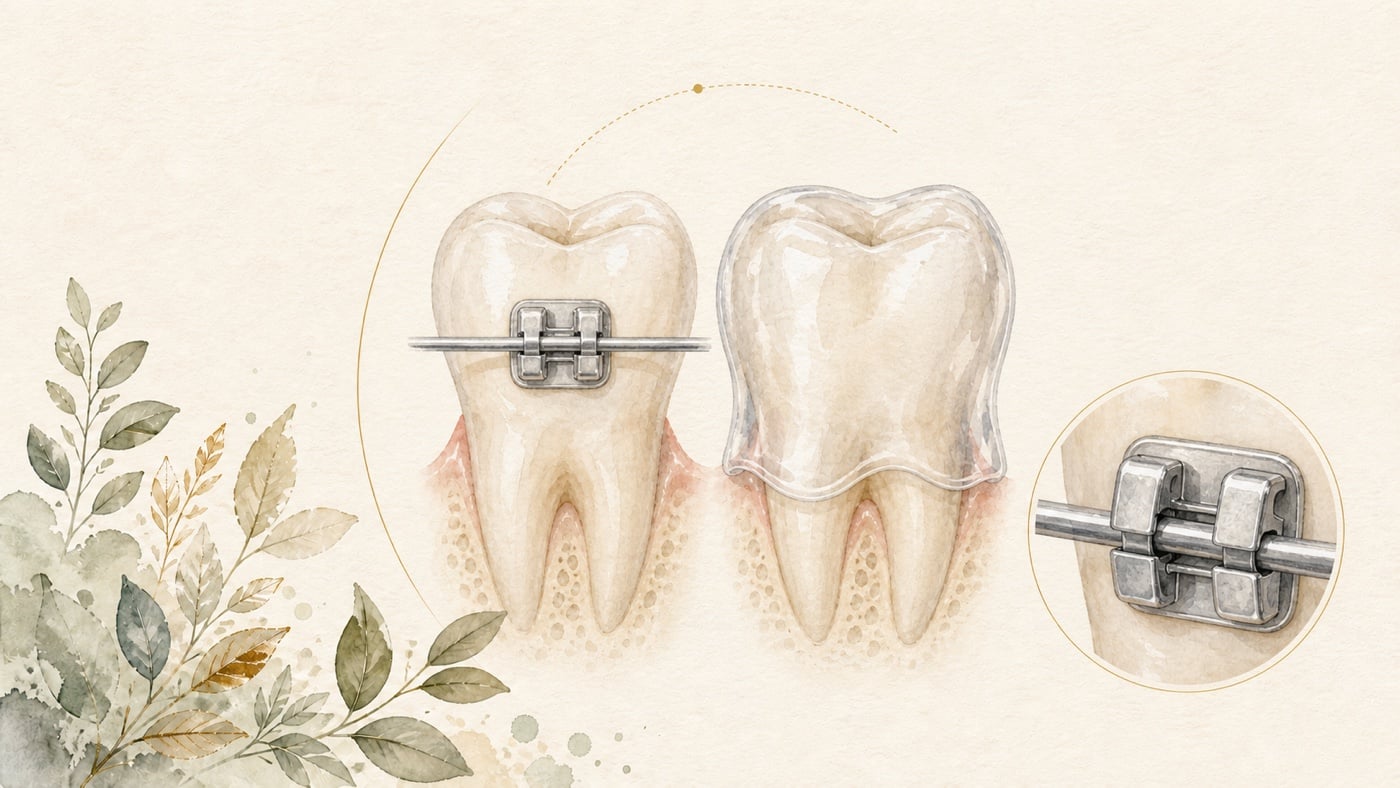
Fixed appliances use brackets bonded to the teeth and connected by an archwire. Deformation of the wire delivers a continuous force, with the point of force application located at the bracket bonded to the tooth surface.
Clear aligners use a series of removable transparent aligners. Deformation of the aligner itself, together with attachments bonded to the teeth, moves the teeth step by step.
A systematic review of the Invisalign system searched MEDLINE, Embase, the Cochrane Oral Health Group's Trials Register and CENTRAL, and also searched ClinicalTrials.gov, the National Research Register and Pro-Quest for unpublished studies. It included 24 studies (15 retrospective, 5 prospective, 2 pilot and 2 case–control studies) [F4]. The review reported that:
- The Invisalign system was considered an effective alternative to conventional orthodontic treatment in non-extraction cases [F4]
- Findings were affected by the methods used to evaluate the effectiveness of the technology, as well as by comparison bias between conventional and innovative digital systems [F4]
- Treatment effectiveness has improved since the introduction of SmartForce and SmartTrack materials [F4]
- High-quality evidence regarding treatment modalities remains lacking [F4]
- More efficient clear-aligner treatment requires appropriate management of ClinCheck software and appropriate application of biomechanics; digital planning should take the aligner's force-delivery system into account [F4]
The final sentence is the technical core of this question: the forces used in clear-aligner treatment are ‘designed’. Their effectiveness depends heavily on the quality of digital planning in advance and on the application of biomechanics, not merely on producing and wearing the aligners.
Where the difference becomes apparent: extraction and non-extraction cases
This is the most important piece of evidence in this discussion and the one that can most directly inform a decision.
A systematic review and meta-analysis comparing the quality and stability of outcomes from clear aligners and fixed appliances searched seven databases (PubMed, Google Scholar, Embase, Scopus, Web of Science, Cochrane CENTRAL and ProQuest) up to February 2025. It included randomised and non-randomised clinical trials, assessed risk of bias using RoB2 and ROBINS-I, and assessed certainty of evidence using GRADE. A total of 15 trials and 1084 patients were included [F1]:
- In non-extraction cases, there was no significant difference between clear aligners and fixed appliances in treatment quality or treatment duration; a sensitivity analysis nevertheless suggested that treatment with clear aligners might be shorter [F1]
- In extraction cases, fixed appliances provided better treatment quality, attributed to their greater control of tooth movement [F1]
- Limited evidence suggested similar post-treatment stability with the two approaches [F1]
- The review concluded that both can effectively achieve orthodontic treatment goals, and that case complexity and patient adherence should inform appliance selection [F1]
In practical terms, if your situation is straightforward and does not require extraction, outcomes are similar and the choice can return to lifestyle considerations. If your situation requires extraction and extensive tooth movement, the literature supports an advantage for fixed appliances in control.
How to interpret this safely: the review recorded varying risks of bias across the studies, while between-study heterogeneity and short follow-up periods limited the strength of the conclusions [F1]. ‘Limited’ in ‘limited evidence suggested similar stability’ is the wording used in the source paper and means that the evidence base for this outcome is weak. In addition, the 24 studies included in 38281057 were predominantly retrospective (15 studies), and that review itself noted that high-quality evidence remained lacking and identified comparison bias between conventional and digital systems [F4]. Existing comparative research is therefore inherently difficult to design as a fair comparison.
Two: removability—the advantage and the source of variability are the same thing
Being removable makes three practical differences: aligners can be removed while eating, while brushing and briefly for an important occasion.
The literature's assessment of this feature, however, comes with one consistent caveat.
‘Highly dependent on adherence’
A systematic review evaluating the effects of clear aligners and fixed appliances on oral hygiene and periodontal health searched four databases—Scopus, PubMed, Web of Science and Google Scholar—for randomised controlled trials published from 2015 to April 2025. Quality was assessed using RoB 2 and certainty of evidence using GRADE. The initial search identified 1098 records, and 6 randomised controlled trials were ultimately included [F2].
The review's dual quality assessment led to the conclusion that the advantages of clear aligners over fixed appliances for oral hygiene and periodontal health were highly compliance dependent [F2].
It is worth pausing over that sentence. The cleaning advantage of clear aligners is not provided automatically by the appliance. It rests on the condition that ‘you wear them as instructed and clean as instructed’. Removability transfers part of the responsibility for treatment to the patient: there is no option to remove fixed appliances, so they cannot be forgotten, whereas both wear and cleaning have to be maintained with clear aligners.
This also echoes the conclusion of the previous section: patient adherence should inform appliance selection [F1]. That is not simply advice; it is one of the selection criteria explicitly identified in the literature.
Differences in how treatment feels
A systematic review and meta-analysis comparing the impact of clear aligners and fixed appliances on oral-health-related quality of life (OHRQoL) followed PRISMA guidance and was registered with PROSPERO. It searched PubMed, Scopus, Web of Science, Embase and Cochrane CENTRAL and included only randomised controlled trials that compared the two treatments and reported OHRQoL outcomes using OHIP-14. Trial sequential analysis (TSA) was used to assess whether the cumulative evidence was sufficient [F5]:
- Only 2 randomised controlled trials (n = 74) were included in the quantitative synthesis [F5]
- Both treatments were associated with a temporary deterioration in OHRQoL after appliance placement [F5]
- For psychological discomfort (p = 0.007) and psychological disability (p < 0.001), the results significantly favoured clear aligners; but no significant difference was found in the other domains or overall OHRQoL [F5]
- The review concluded that clear aligners may provide a modest short-term advantage in the psychological domains of OHRQoL, while no consistent difference was observed in physical or overall domains, and that this conclusion was based on very limited evidence [F5]
How to interpret this safely (the limitations are crucial here): only 2 trials with a total of 74 participants were included in the quantitative synthesis [F5]. The authors explicitly stated in their conclusion that, given the very small number of included trials, the findings should be regarded as preliminary and hypothesis-generating rather than confirmatory [F5]. Trial sequential analysis showed that the required information size had not been reached for most other outcomes, which therefore remained uncertain. For the ‘disability’ domain, the TSA suggested that a clinically meaningful difference was unlikely to exist [F5].
It is also important to note that both treatments produce a temporary deterioration in quality of life shortly after the appliance is fitted [F5]. In the overall and physical domains, this meta-analysis did not support the claim that ‘clear aligners are less painful’.
Three: differences in cleaning—the direction is consistent, but certainty differs greatly
This is the consideration with the most evidence, and also the one that most needs careful interpretation. Two systematic reviews of the same question provide messages of very different strength.
What did the meta-analysis find?
A systematic review and meta-analysis comparing the effects of clear aligners and conventional fixed appliances on periodontal health collected studies from Web of Science, ScienceDirect, PubMed, the Cochrane Library and Google Scholar. Eligibility was determined using PICO criteria, with ROBINS-I used to assess non-randomised controlled trials and ROB used for randomised controlled trials. The meta-analysis included 11 studies [F3]:
- Plaque index: SMD −1.25 (95% CI −1.94 to −0.57; p = 0.0003) [F3]
- Gingival index: SMD −0.68 (95% CI −1.13 to −0.22; p = 0.004) [F3]
- Probing depth: SMD −1.30 (95% CI −2.22 to −0.38; p = 0.006) [F3]
- Sulcus bleeding index: SMD −2.47 (95% CI −4.97 to −0.04; p = 0.05) [F3]
- Papillary bleeding index: SMD −2.47 (95% CI −4.97 to −0.04; p = 0.05) [F3]
The analysis concluded that patients treated with clear aligners had better periodontal health than those treated with conventional fixed appliances, with improvements across several periodontal measures [F3].
How to interpret this safely (each outcome should be considered separately, as they are not all equally robust):
For the first three outcomes—plaque index, gingival index and probing depth—the confidence intervals do not cross 0 and the p values range from 0.001 to 0.006, so the signals are relatively clear.
The final two outcomes, however, need to be highlighted. For the sulcus bleeding index and papillary bleeding index, the 95% confidence interval was −4.97 to −0.04—the −0.04 limit lies very close to 0—and p = 0.05 sits exactly at the conventional threshold for significance. These are therefore highly fragile findings: an extremely wide interval (spanning nearly 5 standardised units) indicates a very imprecise estimate, while the limit close to 0 means that an effect approaching no difference cannot be excluded. These two outcomes should not be treated as robust conclusions.
The analysis also included non-randomised controlled trials (hence the need for ROBINS-I) [F3], exposing the pooled results to the inherent biases of observational research.
What did the GRADE assessment find?
Now consider the review of the same question that used a different assessment framework.
The GRADE systematic review discussed above included only 6 randomised controlled trials from 1098 records, because it was restricted to randomised controlled trials [F2]:
- Qualitative analysis showed significantly better periodontal measures in patients using clear aligners than in patients with fixed appliances [F2]
- However, 5 of the 6 studies had a high risk of bias, and there were widespread inconsistencies in oral-hygiene instruction, age, follow-up duration, diagnosis and measurement methods [F2]
- Certainty of evidence was ‘very low’ for the level of oral hygiene and ‘low’ for periodontal health [F2]
- The review concluded from its dual quality assessment that the advantages of clear aligners were highly dependent on adherence. Yet heterogeneity, high risk of bias and low to very low certainty in the available randomised controlled trials made it difficult to draw a firm conclusion [F2]
How should the two reviews be read together?
The direction is consistent: both point towards better periodontal measures in the clear-aligner group. That direction is plausible and has a physiological rationale—removing the aligners to brush makes cleaning easier.
The strength, however, is not consistent: the meta-analysis presents apparently large effect sizes, such as SMD −1.25, whereas the GRADE assessment rates certainty as low to very low and explicitly states that it is ‘difficult to draw a firm conclusion’ [F2].
Why is this? The inclusion criteria differed. One review included 11 studies, among them non-randomised trials [F3], whereas the other included only 6 randomised controlled trials and found that 5 of them had a high risk of bias [F2]. Broader inclusion produces more impressive pooled figures; stricter inclusion lowers certainty.
The candid account is this: clear aligners may have a cleaning advantage, and the direction of the findings is consistent, but the current evidence is insufficient to quantify how large that advantage is. Moreover, adherence is a precondition for that advantage [F2].
Four: treatment duration and outcome quality—the difference is smaller than many people imagine in most situations
Treatment duration
A systematic review specifically assessed differences in treatment duration between clear aligners and fixed appliances in dental-crowding cases. Without restrictions, it searched nine databases from inception to June 2023 (CENTRAL, PubMed, Scopus, Web of Science, Google Scholar, Trip, CINAHL via EBSCO, EMBASE via OVID and ProQuest). It included randomised controlled trials and matched non-randomised studies, assessed risk of bias with RoB 2 and ROBINS-I, and assessed the overall quality of evidence with GRADE. From 3537 articles initially identified, 10 studies were included, 6 of which were randomised controlled trials [F6]:
- Only 1 study involved extraction treatment; the other 9 involved non-extraction treatment [F6]
- GRADE indicated low-certainty evidence that treatment duration with clear aligners was similar to that with fixed appliances in mild to moderate crowding [F6]
- No meta-analysis was performed because inconsistency was too high [F6]
- The review concluded that, on the available information, there was no significant difference in treatment duration between the groups in mild to moderate crowding, and that well-conducted randomised controlled trials are still needed for severe cases [F6]
- It also cautioned that, although appliance type is an important determinant of treatment duration, orthodontists should consider other factors that can significantly affect treatment duration, including patient-related and treatment-related factors [F6]
How to interpret this safely: this review has a narrow scope—mild to moderate crowding, with almost all cases treated without extraction (only 1 of 10 studies involved extraction) [F6]. Certainty of evidence was low, and inconsistency was too high to permit a meta-analysis [F6]. The review does not answer the question of differences in treatment duration for severe crowding or extraction cases.
The earlier meta-analysis of 15 trials reported no significant difference in treatment duration in non-extraction cases, although a sensitivity analysis suggested that treatment with clear aligners might be shorter [F1]. ‘Suggested by a sensitivity analysis’ means that this was not the primary-analysis result. It is an exploratory finding and carries less weight than the principal conclusion.
Stability of the result
Limited evidence suggests similar post-treatment stability with the two approaches [F1]. ‘Limited’ is the wording used in the source paper, and the review also recorded that short follow-up periods limited the conclusions [F1]. Current comparative studies therefore provide only a thin answer to the question of whether teeth will move back after orthodontic treatment—which also means that the importance of retainers does not change according to the appliance selected.
Five: so how should you choose? The criteria provided by the literature
The literature does not say ‘which is better’, but it does provide criteria for choosing. The meta-analysis of 15 trials gives the clearest conclusion: case complexity and patient adherence should inform appliance selection [F1].
These criteria can be broken down into questions to ask yourself:
Question one: does my case require extraction? If it does, the literature reports that fixed appliances provided better treatment quality in extraction cases because they offer greater control of tooth movement [F1]. This is the clearest current dividing line. If it does not, there is no significant difference in treatment quality or duration [F1], so lifestyle considerations can carry more weight in the choice.
Question two: can I maintain consistent wear? The advantages of clear aligners are highly dependent on adherence [F2]. If you think you are likely to forget to put them back in, removability represents a risk rather than an advantage. Fixed appliances do not have this source of variability.
Question three: how much do I prioritise cleaning? The direction of the evidence favours clear aligners [F3][F2], but the magnitude is uncertain and adherence remains a prerequisite. If your cleaning habits are already less than ideal, either option will require additional oral-hygiene instruction. Incidentally, inconsistency in oral-hygiene instruction was one of the sources of bias identified by the GRADE review [F2].
Each of these three questions ultimately requires a dentist to answer it through clinical and radiographic assessment. The literature above simply helps you know what to ask.
Conclusion|First establish which type of case you have
The three considerations can be condensed into one sentence: in straightforward non-extraction cases, the difference in outcomes between the two orthodontic approaches is small and the choice can reflect lifestyle; in complex cases requiring extraction or extensive tooth movement, the literature supports an advantage for fixed appliances in movement control.
The strength of evidence differs across the three considerations, so it is worth remembering them separately:
- Force delivery: treatment quality was better with fixed appliances in extraction cases, attributed to their greater control of tooth movement [F1]. This is the clearest of the three distinctions.
- Removability: it provides convenience, but the advantage is highly dependent on adherence [F2]; for quality of life, only preliminary and very limited signals of advantage in psychological domains have been reported [F5].
- Cleaning: findings consistently point towards better outcomes with clear aligners [F3], but GRADE rates certainty as low to very low [F2], so the magnitude cannot yet be quantified.
No single appliance is the right choice for everyone. The decision should be driven not by advertising, but by whether your dental condition requires extraction and whether your lifestyle permits consistent wear.
The next step is simple: have a comprehensive orthodontic assessment, including clinical examination and the necessary imaging, and take these three questions with you. Book a consultation with your dentist or an orthodontic specialist. Establish which type of case you have first, and only then discuss which appliance to use. Reversing that order makes it easy to choose an option that does not suit you.
Risk factors (what to know before treatment)
- The difference in control shows up in complex cases: the systematic review and meta-analysis of 15 trials involving 1084 patients recorded that in extraction cases fixed appliances provided superior treatment quality, attributed to enhanced control of tooth movements; the same review recorded that the risk of bias varied across studies and that heterogeneity and short follow-up durations limited the strength of the conclusions [F1].
- Removability shifts part of the responsibility onto the patient: the GRADE-assessed review concluded that the advantages of clear aligners for oral hygiene and periodontal health are highly compliance dependent; 5 of the 6 randomised controlled trials it included were at high risk of bias, with overall inconsistencies in the oral hygiene instructions given, age, follow-up, diagnosis and measurements [F2].
- Both are uncomfortable when first fitted: the meta-analysis of oral health-related quality of life recorded that both treatments were associated with a transient deterioration in quality of life after appliance placement; the improvements significantly favouring clear aligners were in psychological discomfort and psychological disability, while no significant differences were observed for the other domains or for overall quality of life [F5].
- The direction of the cleaning advantage is consistent, its size is not yet quantifiable: the meta-analysis of periodontal parameters included 11 studies and used ROBINS-I for non-randomised trials, and points towards clear aligners [F3]; but the other review, assessed with GRADE, rated the certainty of evidence as very low for oral hygiene level and low for periodontal health, and stated plainly that outlining a firm conclusion was impeded [F2].
- Check the scope of every conclusion: the review of treatment duration included 10 studies, only 1 of which offered extraction-based treatment, did not perform a meta-analysis because of high inconsistency, and applies only to mild to moderate crowding cases [F6]; the quantitative synthesis on quality of life rested on 2 randomised controlled trials with 74 participants in total, and its authors say the findings should be regarded as preliminary and hypothesis-generating rather than confirmatory [F5]; the review of the Invisalign technique also recorded that its results are influenced by comparison bias between the traditional system and the innovative digital system, and that high-quality evidence is still lacking [F4]. This card did not run a separate literature search on contraindications to orthodontic treatment and therefore does not compile a list of them; which appliance suits you has to be assessed by a dentist after clinical examination and diagnostic imaging.
Every clinical statement in this article is mapped line by line to its cited source (see the sources and evidence chain below). It has not been clinically reviewed by a licensed practitioner. This is health information, not individual advice; assessment by a clinician is required.
FAQ
- Which is more effective, clear aligners or fixed braces?
- There is no significant difference in most circumstances, but complex cases create a distinction. A systematic review and meta-analysis of 15 trials and 1084 patients reported **no significant difference** in treatment quality or duration in **non-extraction cases**, whereas in **extraction cases**, **fixed appliances provided better treatment quality, attributed to their greater control of tooth movement** [F1]. The review concluded that both can effectively achieve orthodontic goals and that selection should be based on case complexity and patient adherence. It nevertheless reported that between-study heterogeneity and short follow-up periods limited the strength of its conclusions.
- クリアアライナーと従来型の矯正治療では、どちらの効果が高いですか? — 多くの状況では有意差がありませんが、複雑な症例では違いがあります。15 件の試験、患者 1084 人を含むシステマティックレビューとメタアナリシスでは、**非抜歯症例**において治療の質と治療期間に**有意差はなく**、**抜歯症例**では**固定式矯正装置の方が良好な治療の質を示し、その理由は歯の移動をより強く制御できることにある**と記録されています [F1]。レビューは、どちらも矯正治療の目標を効果的に達成でき、症例の複雑さと患者さんの協力度に基づいて選択すべきだと結論づけています。ただし、研究間の異質性と短い追跡期間が結論の強さを制限していることも記録されています。
- Which is more effective, clear aligners or fixed braces? — There is no significant difference in most circumstances, but complex cases create a distinction. A systematic review and meta-analysis of 15 trials and 1084 patients reported **no significant difference** in treatment quality or duration in **non-extraction cases**, whereas in **extraction cases**, **fixed appliances provided better treatment quality, attributed to their greater control of tooth movement** [F1]. The review concluded that both can effectively achieve orthodontic goals and that selection should be based on case complexity and patient adherence. It nevertheless reported that between-study heterogeneity and short follow-up periods limited the strength of its conclusions.
- How exactly does force delivery differ?
- Fixed appliances use brackets bonded to the teeth and an archwire to provide continuous force. Clear aligners use a series of removable aligners and attachments to move the teeth in stages. A systematic review of 24 studies reported that the Invisalign system was considered an effective alternative to conventional treatment in **non-extraction cases**, and that its effectiveness had improved since the introduction of SmartForce and SmartTrack materials. At the same time, it stated that **high-quality evidence remained lacking** and emphasised the need for **appropriate management of ClinCheck software and appropriate application of biomechanics**, with the aligner's force-delivery system taken into account during digital planning [F4]. Of the 24 studies included in the review, 15 were retrospective, and the review acknowledged comparison bias between conventional and digital systems.
- 力のかけ方は具体的にどう違いますか? — 固定式矯正装置は、歯面に接着したブラケットと矯正用ワイヤーを組み合わせて持続的に力を加えます。クリアアライナーは、取り外し可能な一連のアライナーとアタッチメントにより、段階的に歯を移動します。24 件の研究を含むシステマティックレビューでは、Invisalign システムは**非抜歯症例**において従来治療の有効な選択肢とみなされ、SmartForce と SmartTrack 素材の導入後に効果が改善したと記録されています。しかし、このレビューは同時に、**質の高いエビデンスが依然として不足している**と指摘し、**ClinCheck ソフトウェアの正しい管理と生体力学の適切な応用**が必要であり、デジタル計画時にアライナーの力駆動システムを考慮すべきだと強調しています [F4]。採用した 24 件の研究のうち 15 件は後ろ向き研究であり、レビュー自身も従来型とデジタル型のシステム間に比較バイアスがあると認めています。
- How exactly does force delivery differ? — Fixed appliances use brackets bonded to the teeth and an archwire to provide continuous force. Clear aligners use a series of removable aligners and attachments to move the teeth in stages. A systematic review of 24 studies reported that the Invisalign system was considered an effective alternative to conventional treatment in **non-extraction cases**, and that its effectiveness had improved since the introduction of SmartForce and SmartTrack materials. At the same time, it stated that **high-quality evidence remained lacking** and emphasised the need for **appropriate management of ClinCheck software and appropriate application of biomechanics**, with the aligner's force-delivery system taken into account during digital planning [F4]. Of the 24 studies included in the review, 15 were retrospective, and the review acknowledged comparison bias between conventional and digital systems.
- Clear aligners are removable—does that make treatment easier?
- Removability brings convenience, but it also transfers responsibility to the patient. A systematic review using GRADE explicitly reported that the oral-hygiene and periodontal-health advantages of clear aligners were **highly dependent on adherence** [F2]. Another meta-analysis also identified **patient adherence** as one of the criteria for appliance selection [F1]. In other words, being able to remove them is an advantage only if you put them back in as instructed; otherwise, that advantage does not hold.
- クリアアライナーは取り外せるので、楽なのでしょうか? — 取り外せることは利便性をもたらしますが、同時に責任の一部を患者さんへ移します。GRADE で評価したシステマティックレビューは、クリアアライナーの口腔衛生および歯周組織の健康上の利点が**装着への協力度に大きく依存する**と明確に記録しています [F2]。別のメタアナリシスも、**患者さんの協力度**を装置選択の基準の一つに挙げています [F1]。つまり、取り外せるという利点には、決められた時間どおりに装着し直すことが前提となり、それができなければ利点は成立しません。
- Clear aligners are removable—does that make treatment easier? — Removability brings convenience, but it also transfers responsibility to the patient. A systematic review using GRADE explicitly reported that the oral-hygiene and periodontal-health advantages of clear aligners were **highly dependent on adherence** [F2]. Another meta-analysis also identified **patient adherence** as one of the criteria for appliance selection [F1]. In other words, being able to remove them is an advantage only if you put them back in as instructed; otherwise, that advantage does not hold.
- Are clear aligners less painful or more comfortable?
- The evidence supports only some domains and is extremely limited. A systematic review and meta-analysis (only 2 randomised controlled trials, n = 74) reported that **both treatments were associated with a temporary deterioration in OHRQoL after appliance placement**. The meta-analysis significantly favoured clear aligners for **psychological discomfort** (p = 0.007) and **psychological disability** (p < 0.001), but **found no significant difference in other domains or overall OHRQoL** [F5]. The review authors explicitly stated that, because so few trials were included, these findings **should be considered preliminary and hypothesis-generating rather than confirmatory** [F5].
- クリアアライナーの方が痛みが少なく、快適ですか? — エビデンスが支持するのは一部の側面のみで、しかも極めて限定的です。あるシステマティックレビューとメタアナリシス(ランダム化比較試験 2 件のみ、n = 74)では、**どちらの治療も装置装着後に OHRQoL の一時的な悪化を伴う**と記録されています。メタアナリシスでは、**心理的不快感**(p = 0.007)と**心理的障害**(p < 0.001)においてクリアアライナーが有意に有利でしたが、**その他の領域と OHRQoL 全体では有意差が認められませんでした** [F5]。レビュー著者は、採用試験が極めて少ないため、これらの知見を**確証的なものではなく、予備的で仮説生成的なものとみなすべきである**と明記しています [F5]。
- Are clear aligners less painful or more comfortable? — The evidence supports only some domains and is extremely limited. A systematic review and meta-analysis (only 2 randomised controlled trials, n = 74) reported that **both treatments were associated with a temporary deterioration in OHRQoL after appliance placement**. The meta-analysis significantly favoured clear aligners for **psychological discomfort** (p = 0.007) and **psychological disability** (p < 0.001), but **found no significant difference in other domains or overall OHRQoL** [F5]. The review authors explicitly stated that, because so few trials were included, these findings **should be considered preliminary and hypothesis-generating rather than confirmatory** [F5].
- Are clear aligners easier to keep clean?
- The direction suggests that they are, but the magnitude is uncertain. A meta-analysis of 11 studies reported better periodontal measures in the clear-aligner group: plaque index SMD −1.25 (95% CI −1.94 to −0.57; p = 0.0003), gingival index SMD −0.68 (95% CI −1.13 to −0.22; p = 0.004), and probing depth SMD −1.30 (95% CI −2.22 to −0.38; p = 0.006) [F3]. In the same analysis, however, **the confidence interval for the sulcus bleeding index and papillary bleeding index was −4.97 to −0.04, with p = 0.05**—the limit was almost at 0 and the interval was extremely wide. These are fragile findings and should not be treated as robust conclusions [F3]. Another review that included only randomised controlled trials and used GRADE recorded **‘very low’ certainty of evidence for oral hygiene and ‘low’ certainty for periodontal health**, and found that heterogeneity and high risk of bias made it **difficult to draw a firm conclusion** [F2].
- クリアアライナーの方が清掃しやすいのでしょうか? — 方向としてはそうですが、利点の大きさは不確実です。11 件の研究を含むメタアナリシスでは、クリアアライナー群の複数の歯周指標が良好でした。プラーク指数は SMD −1.25(95% CI −1.94~−0.57、p = 0.0003)、歯肉炎指数は SMD −0.68(95% CI −1.13~−0.22、p = 0.004)、プロービングデプスは SMD −1.30(95% CI −2.22~−0.38、p = 0.006)でした [F3]。しかし、同じ分析の**歯肉溝出血指数と歯間乳頭出血指数の信頼区間は −4.97~−0.04、p = 0.05**で、下限がほぼ 0 に接し、区間も極めて広いため不安定な結果であり、確実な結論として扱うべきではありません [F3]。一方、ランダム化比較試験に限定して GRADE で評価した別のレビューでは、**口腔衛生に関するエビデンスの確実性は「非常に低い」、歯周組織の健康については「低い」**とされ、異質性と高いバイアスリスクのため**明確な結論を導くことは困難**とされました [F2]。
- Are clear aligners easier to keep clean? — The direction suggests that they are, but the magnitude is uncertain. A meta-analysis of 11 studies reported better periodontal measures in the clear-aligner group: plaque index SMD −1.25 (95% CI −1.94 to −0.57; p = 0.0003), gingival index SMD −0.68 (95% CI −1.13 to −0.22; p = 0.004), and probing depth SMD −1.30 (95% CI −2.22 to −0.38; p = 0.006) [F3]. In the same analysis, however, **the confidence interval for the sulcus bleeding index and papillary bleeding index was −4.97 to −0.04, with p = 0.05**—the limit was almost at 0 and the interval was extremely wide. These are fragile findings and should not be treated as robust conclusions [F3]. Another review that included only randomised controlled trials and used GRADE recorded **‘very low’ certainty of evidence for oral hygiene and ‘low’ certainty for periodontal health**, and found that heterogeneity and high risk of bias made it **difficult to draw a firm conclusion** [F2].
- Why do the two reviews differ so much in the strength of their claims about cleaning?
- Their inclusion criteria differed. One included 11 studies, including non-randomised controlled trials, which is why ROBINS-I was required [F3]. The other included only randomised controlled trials published from 2015 to 2025. It included just 6 of 1098 records and found that **5 studies had a high risk of bias**, with widespread inconsistencies in oral-hygiene instruction, age, follow-up, diagnosis and measurement [F2]. Broader inclusion produces more impressive pooled figures; strict inclusion and GRADE assessment lower certainty. The two reviews **agree on direction (clear aligners perform better), but differ on whether the size of the advantage can be quantified**—at present, it cannot.
- 清掃について、二つの研究の見解の強さがこれほど違うのはなぜですか? — 採用基準が異なるからです。一方は非ランダム化比較試験を含む 11 件の研究を採用しているため、ROBINS-I が必要でした [F3]。もう一方は 2015 年から 2025 年までのランダム化比較試験に限定し、1098 件の記録から 6 件のみを採用しました。そのうち**5 件はバイアスリスクが高く**、口腔衛生指導、年齢、追跡期間、診断法、測定法にも広く不一致がありました [F2]。広く採用すれば統合数値は良好に見えますが、厳格に採用して GRADE 評価を行えば確実性は低下します。二つのレビューは**方向では一致していますが(クリアアライナーが良好)、その利点を定量化できるかという点で異なります**。現時点では定量化できません。
- Why do the two reviews differ so much in the strength of their claims about cleaning? — Their inclusion criteria differed. One included 11 studies, including non-randomised controlled trials, which is why ROBINS-I was required [F3]. The other included only randomised controlled trials published from 2015 to 2025. It included just 6 of 1098 records and found that **5 studies had a high risk of bias**, with widespread inconsistencies in oral-hygiene instruction, age, follow-up, diagnosis and measurement [F2]. Broader inclusion produces more impressive pooled figures; strict inclusion and GRADE assessment lower certainty. The two reviews **agree on direction (clear aligners perform better), but differ on whether the size of the advantage can be quantified**—at present, it cannot.
- Is treatment with clear aligners shorter?
- Current evidence does not support a clearly shorter duration. A systematic review of crowding cases searched nine databases and included 10 studies (6 randomised controlled trials). Using GRADE, it recorded **low-certainty evidence** that treatment duration with clear aligners was **similar to that with fixed appliances** in mild to moderate crowding, with no significant difference between the groups [F6]. The review **did not perform a meta-analysis because inconsistency was too high**; only 1 of the 10 studies involved extraction treatment, and further research is required in severe cases [F6]. Another meta-analysis reported no significant difference in treatment duration in non-extraction cases. A possibly shorter duration with clear aligners was suggested only by a **sensitivity analysis**—an exploratory finding, not the primary conclusion [F1].
- クリアアライナーの方が治療期間は短くなりますか? — 現在のエビデンスは、明確に短くなることを支持していません。叢生症例を対象に九つのデータベースを検索し、10 件の研究(うち 6 件はランダム化比較試験)を採用したシステマティックレビューでは、GRADE に基づく**確実性の低いエビデンス**により、軽度~中等度の叢生症例でクリアアライナーの治療期間は**固定式矯正装置と同程度**で、両群間に有意差はないと記録されています [F6]。このレビューは、**不一致性が高すぎたためメタアナリシスを実施しておらず**、10 件中抜歯治療を扱ったのは 1 件のみで、重度症例にはさらなる研究が必要です [F6]。別のメタアナリシスでも、非抜歯症例における両者の治療期間に有意差はなく、クリアアライナーの方が短い可能性は**感度分析**でのみ示されました。これは主たる結論ではなく、探索的な知見です [F1]。
- Is treatment with clear aligners shorter? — Current evidence does not support a clearly shorter duration. A systematic review of crowding cases searched nine databases and included 10 studies (6 randomised controlled trials). Using GRADE, it recorded **low-certainty evidence** that treatment duration with clear aligners was **similar to that with fixed appliances** in mild to moderate crowding, with no significant difference between the groups [F6]. The review **did not perform a meta-analysis because inconsistency was too high**; only 1 of the 10 studies involved extraction treatment, and further research is required in severe cases [F6]. Another meta-analysis reported no significant difference in treatment duration in non-extraction cases. A possibly shorter duration with clear aligners was suggested only by a **sensitivity analysis**—an exploratory finding, not the primary conclusion [F1].
- Will my teeth move back after treatment? Which approach is more stable?
- Current comparative evidence is limited. A systematic review and meta-analysis of 15 trials reported that **limited evidence suggested similar post-treatment stability with the two approaches**, and explicitly stated that **short follow-up periods limited the conclusion** [F1]. ‘Limited’ is the source paper's wording. Stability is therefore not an effective basis for distinguishing the appliances on the current literature; retainer wear and follow-up are equally important whichever option is chosen.
- 矯正治療後に後戻りしますか?どちらの方が安定していますか? — 現在の比較エビデンスは乏しいものです。15 件の試験を含むシステマティックレビューとメタアナリシスでは、**限られたエビデンスにより、両者の治療後の安定性は同程度と示されている**と記録され、**追跡期間の短さが結論を制限している**ことも明記されています [F1]。「限られた」は原文の表現です。したがって、現在の文献では安定性を二つの装置の有効な判別基準にはできません。どちらを選んでも、保定装置の装着とその後の経過観察は同じように重要です。
- Will my teeth move back after treatment? Which approach is more stable? — Current comparative evidence is limited. A systematic review and meta-analysis of 15 trials reported that **limited evidence suggested similar post-treatment stability with the two approaches**, and explicitly stated that **short follow-up periods limited the conclusion** [F1]. ‘Limited’ is the source paper's wording. Stability is therefore not an effective basis for distinguishing the appliances on the current literature; retainer wear and follow-up are equally important whichever option is chosen.
- How should I decide?
- The literature supplies criteria, not an answer. The meta-analysis of 15 trials concluded that **case complexity and patient adherence should inform appliance selection** [F1]. Three practical questions follow: do I require extraction (if so, the literature supports an advantage for fixed appliances in control of movement [F1]); can I maintain consistent wear (the advantages of clear aligners are highly dependent on adherence [F2]); and what are my cleaning habits like (the direction favours clear aligners, but the magnitude is uncertain [F3][F2])? Actual diagnosis and advice require clinical and radiographic assessment by a dentist.
- 私はどのように決めればよいですか? — 文献が示すのは判断基準であり、答えそのものではありません。15 件の試験を含むメタアナリシスの結論では、**症例の複雑さと患者さんの協力度を装置選択の基準にすべきです** [F1]。具体的には三点を自問できます。抜歯が必要か(必要であれば、歯の移動制御について固定式矯正装置に文献上の優位性があります [F1])、安定して装着を続けられるか(クリアアライナーの利点は装着への協力度に大きく依存します [F2])、清掃習慣はどうか(方向としてクリアアライナーが有利ですが、利点の大きさは不確実です [F3][F2])です。実際の診断と提案には、歯科医師による診察と画像診断が必要です。
- How should I decide? — The literature supplies criteria, not an answer. The meta-analysis of 15 trials concluded that **case complexity and patient adherence should inform appliance selection** [F1]. Three practical questions follow: do I require extraction (if so, the literature supports an advantage for fixed appliances in control of movement [F1]); can I maintain consistent wear (the advantages of clear aligners are highly dependent on adherence [F2]); and what are my cleaning habits like (the direction favours clear aligners, but the magnitude is uncertain [F3][F2])? Actual diagnosis and advice require clinical and radiographic assessment by a dentist.
Medical notice This article is provided for health education and medical information purposes. It is not a solicitation for medical services and does not constitute diagnosis or treatment advice. Actual treatment methods and outcomes vary between individuals and require evaluation by a dentist; every treatment has its own indications, limitations and possible risks. If you have related symptoms or treatment needs, please book a consultation for evaluation by a dentist.
Source anchors
- Quality and stability of orthodontic treatment outcomes with clear aligners versus fixed appliances: a systematic review and meta-analysis. [PMID:41127933] · https://pubmed.ncbi.nlm.nih.gov/41127933/ · 在 IDAEO 的其他引用
- Impact of clear aligners and conventional fixed orthodontic appliances on oral hygiene and periodontal health: A systematic review with GRADE assessment of the certainty of evidence. [PMID:42163541] · https://pubmed.ncbi.nlm.nih.gov/42163541/ · 在 IDAEO 的其他引用
- Comparison of the Periodontal Status Between Orthodontic Aligner Treatment and Traditional Orthodontic Treatment: A Systematic Review and Meta-Analysis. [PMID:42068550] · https://pubmed.ncbi.nlm.nih.gov/42068550/ · 在 IDAEO 的其他引用
- An evaluation of the Invisalign Aligner Technique and consideration of the force system: a systematic review. [PMID:38281057] · https://pubmed.ncbi.nlm.nih.gov/38281057/ · 在 IDAEO 的其他引用
- Comparative Impact of Clear Aligners and Traditional Fixed Appliances on Oral Health-Related Quality of Life: A Systematic Review and Meta-Analysis. [PMID:42356103] · https://pubmed.ncbi.nlm.nih.gov/42356103/ · 在 IDAEO 的其他引用
- Duration of orthodontic treatment with clear aligners versus fixed appliances in crowding cases: a systematic review. [PMID:38607436] · https://pubmed.ncbi.nlm.nih.gov/38607436/ · 在 IDAEO 的其他引用
Cite this article
Lucy・《How do fixed braces and clear aligners differ? Three considerations: force delivery, removability and cleaning》・IDAEO 知識庫・2026-07-20・https://km.idaeo.ai/post/dental/fixed-vs-clear-alignerUpdated 2026-08-26