

🏛 Part of the "dental" topic shelf →
My Implant Has Come Out — What Now? First Work Out Whether It Is the Crown, the Screw or the Implant
What you experience as "my implant has come out" may be no more than the crown above it or a retaining component coming loose, or it may be the implant in the bone losing its support. The two are managed very differently, and the appearance of the piece that came out will not always tell them apart. Put the piece into a clean container with a lid. Do not scrub it, soak it in alcohol, apply glue to it or try to screw it back yourself; avoid chewing on that side for the time being, and contact your dentist for an examination as soon as you can. If there is heavy continuing bleeding, if facial swelling worsens rapidly, if there is fever, or if swallowing or breathing becomes difficult, seek emergency medical help immediately.
My Implant Has Come Out — What Now? First Work Out Whether It Is the Crown, the Screw or the Implant
Direct answer: Put the piece into a clean container with a lid, do not refit it yourself, and have a dentist establish as soon as possible whether what came away is the crown, the retaining screw or the implant in the bone; abutment screw loosening is reported as one of the more common mechanical complications [F1], while "it came out" can also involve a retention problem or the surrounding bone [F2], and these situations are managed differently. If there is heavy continuing bleeding, if facial swelling worsens rapidly, if there is fever, or if swallowing or breathing becomes difficult, seek emergency medical help immediately.
Geographic scope: Global. All cited evidence comes from international peer-reviewed literature; no country-specific reimbursement scheme or regulation is involved. The procedures, materials and fees actually available to you should follow your own health system and your dentist's assessment.
TL;DR — Keep the part, protect the site, and do not put it back yourself
What you experience as "my implant has come out" may be no more than the crown above it or a retaining component coming loose, or it may be the implant in the bone losing its support. The two are managed very differently, and the appearance of the piece that came out will not always tell them apart.
Put the piece into a clean container with a lid. Do not scrub it, soak it in alcohol, apply glue to it or try to screw it back yourself; avoid chewing on that side for the time being, and contact your dentist for an examination as soon as you can. If there is heavy continuing bleeding, if facial swelling worsens rapidly, if there is fever, or if swallowing or breathing becomes difficult, seek emergency medical help immediately.
What to do right now: keeping secondary damage to a minimum
First, keep the piece safely
Wash your hands, pick up the crown, screw or other component, put it into a clean container with a lid and bring the whole thing with you to the appointment. Do not scrub it hard, and do not disinfect it yourself with alcohol, bleach or any other agent; whether a component can be reused has to be judged by the dentist after checking for distortion, wear and the state of the connecting surfaces.
Then protect the site
Do not keep pushing at it with your tongue or touching it with your fingers, and do not probe it with any implement. If there is bleeding, press gently with clean gauze; avoid chewing on that side and avoid hard foods for now. Do not put household adhesive into your mouth, and do not push a component back simply because "it looks as though it fits".
Arrange a professional examination as soon as possible
The clinical reasoning here does not mean declaring that everything must be remade the moment a loose piece appears; it means first establishing which layer the problem lies in — the crown, the retaining screw, the abutment, the implant in the bone, or the bone and gum around the implant. Where necessary, occlusal examination and imaging are used alongside, and only then can it be decided whether the answer is cleaning and re-securing, replacing a component, remaking the prosthesis, or going further and dealing with infection and a bone defect.
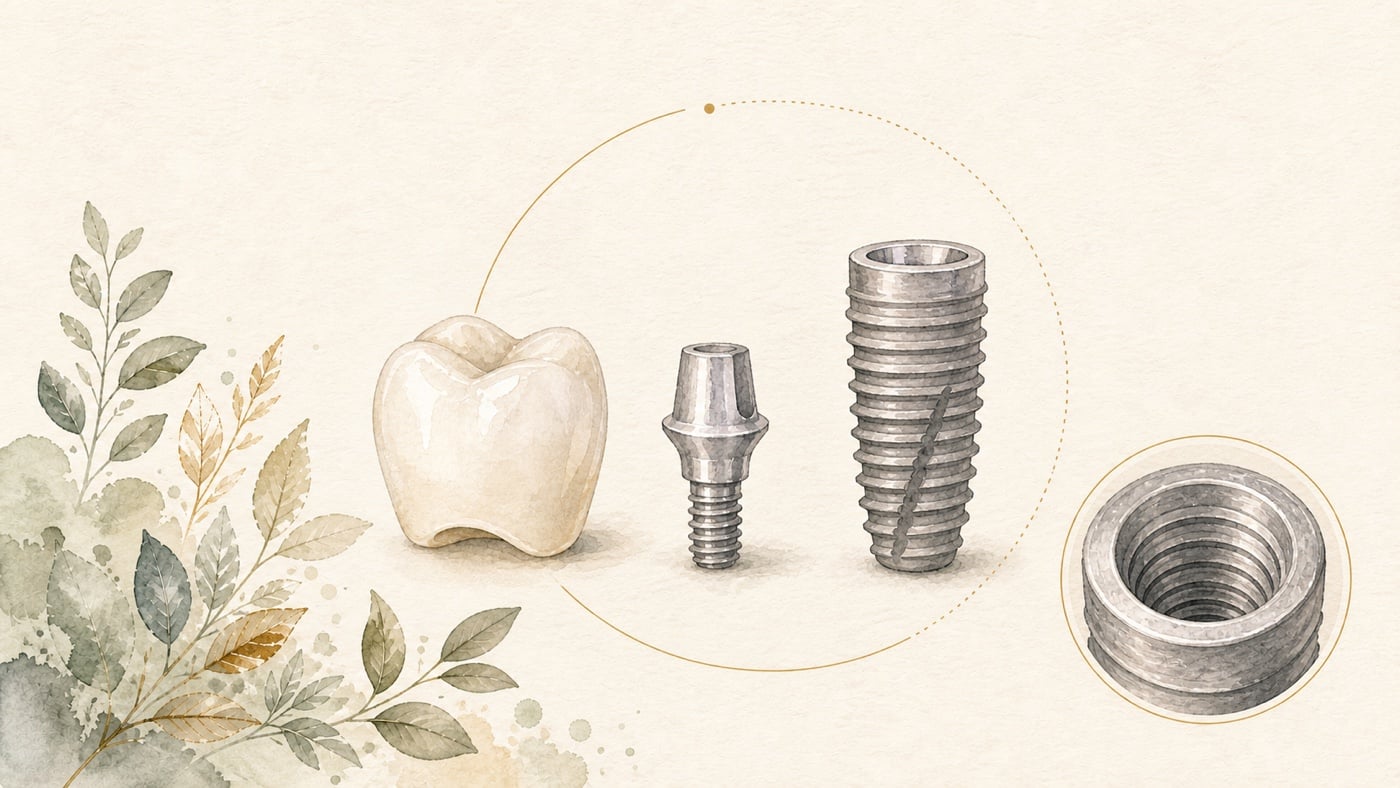
The "single tooth" you see is in fact a structure of different layers
The crown or prosthesis has come off
If the implant in the bone is still stable, the problem may lie in the cement, in damage to the crown, in occlusal loading or in the design of the restoration. The dentist will check whether the crown can safely be reused, whether the connecting surfaces are intact, and whether the occlusion needs adjusting or the crown needs remaking.
The screw, abutment or a connecting component has loosened
This belongs to the mechanical category. The risk in tightening it yourself is that you cannot confirm whether the thread has been distorted or the interior contaminated, and you have neither professional instruments to control the process nor a way to check the state of the connection. Tightening alone, without finding out what is happening with the loading or the component, can also be followed by further loosening.
The implant in the bone has itself come out or become mobile
This usually calls for assessment of osseointegration, infection, bone loss and the remaining bone volume. Management may include removing an unstable implant, infection control, wound care, bone grafting and later reconstruction, but not everyone follows the same path, and an implant cannot be pressed back into the wound at home.
Common causes: mechanical problems and biological problems must be looked at separately
A systematic review including 18 studies reported abutment screw loosening as one of the more common mechanical complications and gave a figure of 16.21%; the overall prevalence of mechanical failure ranged from 5.6% to 7.7% [F1]. Where the 16.21% comes from matters: going back to the body of the review shows that it is taken from a single prospective study published in 1995, which followed patients for 6 years and recorded abutment screw loosening in 12 of 74 implants [F1]. In other words it is the raw proportion from one study, not a pooled estimate across the 18 studies — which is why it can be higher than the 5.6% to 7.7% figure for overall mechanical failure. The implants and types of prosthesis included in the studies were not entirely alike, so these figures are not the personal risk attaching to your particular implant.
Another systematic review and meta-analysis, of single implant-supported crowns, estimated the cumulative incidence of screw loosening after five years of use at 8.8%, loss of retention at 4.1%, and the cumulative proportion with bone loss exceeding 2 mm at 5.2% [F2]. This too shows that "it came out" has more than one cause: some cases involve a component or a retention problem, and others involve the surrounding bone.
Full-arch fixed implant prostheses are a different situation again. An umbrella review including 7 systematic reviews reported long-term screw loosening between 5% and 15%, and peri-implantitis between 4% and 18% [F3]. These ranges come from full-arch reconstruction and cannot be used to estimate directly for a single implant; they also remind us that the type of restoration has to be identified before the figures are interpreted.
When a dentist assesses the cause, the following are usually checked at the same time:
- Whether the prosthesis and screw show wear, distortion or fracture.
- Whether occlusal contacts are concentrated, and whether there are signs of grinding or of long-standing chewing on hard objects.
- Whether there is bleeding, suppuration, increased probing depth or bone loss around the implant.
- Whether the shape of the prosthesis creates areas that cannot be cleaned.
- The implant position, the connection design and the record of previous repairs.
These factors can be present together; mechanical loosening can make cleaning harder, while biological inflammation can take away the support of the implant in the bone.
Once you are in the surgery, what directions might management take
A crown or retention problem
The dentist will clean and check the crown, the connecting surfaces and the implant connection. If the structure is intact, it may be possible to re-secure it; if the shape of the crown, damage to it or its connecting surfaces make it unsuitable for reuse, it may need to be remade. Whether the original part can be kept cannot be decided on appearance alone.
A screw or abutment problem
It is necessary to establish whether the component is loose, fractured or lodged inside the implant, and to check the occlusion and the connection design. Management may involve retrieving, replacing or re-securing the component; if the implant itself remains stable, that does not mean the whole implant has to be removed.
Inflammation around the implant or bone loss
Management ranges from professional cleaning and infection control through to surgical treatment, according to the extent of the inflammation and the shape of the bone defect. Antibiotics are not an alternative you can resort to on your own, and the absence of pain alone cannot rule out bone loss.
The implant in the bone has already lost its support
If it is confirmed that the implant has to be removed, whether an implant can be placed again afterwards depends on whether the infection is controlled, on the remaining bone volume, the soft tissue, the occlusion and the reasons for the earlier failure. A systematic review published in 2014, which searched the literature from 1985 to 2011, included 6 articles, 334 patients and 338 implants and reported survival rates ranging from 71% to 100%; the survival rate for implants placed for the second time at a previously failed site (the third attempt overall) was 83.75% [F4]. The authors particularly caution that the number of studies and the samples are limited and that large, well-designed case-control long-term trials are lacking; the review concludes that survival rates of implants placed in the areas of previously failed implants are low, although they should not discourage clinicians from a second or even a third attempt [F4]. This range therefore indicates only that reconstruction remains possible in some cases, and is not a guarantee for re-implantation; read the generation of the literature alongside it as well — this search stopped at 2011, so ask your dentist whether more recent evidence is available.
Data anchors — do not mix figures from different types of prosthesis
| Situation it applies to | Data anchor | How to read it correctly | Source |
|---|---|---|---|
| Mechanical failure across various implants and supported prostheses | 18 studies; overall mechanical failure 5.6% to 7.7%; abutment screw loosening 16.21% comes from a single 1995 study (6 years of follow-up, 12 of 74 implants) [F1] | 16.21% is the raw proportion from one study, not a pooled estimate across the 18; high heterogeneity between studies; not the personal probability for a single implant | Journal of Oral Biology and Craniofacial Research [F1] |
| Single implant-supported crowns | After five years of use, screw loosening 8.8%, loss of retention 4.1%, bone loss exceeding 2 mm 5.2% [F2] | These represent technical and biological complications separately and cannot be combined into a "rate of coming out" | Clinical Oral Implants Research [F2] |
| Full-arch fixed implant prostheses | 7 systematic reviews; screw loosening 5% to 15%, peri-implantitis 4% to 18% [F3] | Full-arch reconstruction data, not directly applicable to a single crown | The Journal of Prosthetic Dentistry [F3] |
| Re-implantation at a failed site | 2014 review (literature searched to 2011); 6 articles, 334 patients, 338 implants; survival 71% to 100%, and 83.75% for a second re-implantation [F4] | Limited samples and a wide range; not a promise about your own outcome; the literature is of an older generation and has to be read as such | Implant Dentistry [F4] |
Risk factors: what to know before treatment
- Whom these figures apply to: the proportions above come from different implants and types of prosthesis, heterogeneity between studies is high, and they are not the personal risk attaching to your particular implant [F1]; the ranges for full-arch fixed reconstruction cannot be applied directly to a single crown either [F3].
- Complications that can occur: abutment screw loosening is one of the more common mechanical complications; the 16.21% given in the review comes from a single prospective study published in 1995 (6 years of follow-up, 12 of 74 implants), not from a pooled estimate across the 18 studies [F1]; single implant-supported crowns can show screw loosening, loss of retention and bone loss, which represent technical and biological complications respectively [F2].
- Limits and uncertainty of reconstruction: survival reported for re-implantation at a failed site ranges from 71% to 100%, and is 83.75% for a second re-implantation (the third attempt overall); the review concludes that these survival rates are low, although they should not discourage clinicians from a second or even a third attempt [F4]. The number of studies and the samples are limited, large well-designed case-control long-term trials are lacking, and the review was published in 2014 with a literature search that stopped at 2011 [F4]; this range indicates only that reconstruction remains possible in some cases, and is not a guarantee.
Conclusion — keep it, do not put it back, then find out why
When an implant comes out, the most important thing is not to treat "it looks as though it goes back in" as safe. Keeping the piece properly, protecting the site, avoiding chewing on that side, and letting the dentist distinguish between the crown, the screw, the abutment and the implant in the bone is what gives you the chance to choose management that is both relatively conservative and appropriate.
If a crown, a component or an implant has worked loose, bring the piece with you to a dental appointment. A dentist can examine the structure, the occlusion and the tissue around the implant, and will then explain what can be repaired, what needs replacing and what needs rebuilding, together with the reasons and the limits.
Every clinical statement in this article is mapped line by line to its cited source (see the sources and evidence chain below). It has not been clinically reviewed by a licensed practitioner. This is health information, not individual advice; assessment by a clinician is required.
FAQ
- Can I glue the crown back on with superglue?
- Please do not. Household adhesives are not suitable for the mouth and they contaminate the connecting surfaces, which hinders the dentist's assessment. Put the component in a clean container with a lid, avoid chewing on that side, and contact your dentist.
- 外れたクラウンを瞬間接着剤で戻してもよいですか? — やめてください。家庭用の接着剤はお口の中に入れるのに適しておらず、接合面を汚染して歯科医師の判断を妨げます。部品は清潔で蓋のできる容器に入れ、患側で噛むことを避け、歯科医師に連絡してください。
- Can I glue the crown back on with superglue? — Please do not. Household adhesives are not suitable for the mouth and they contaminate the connecting surfaces, which hinders the dentist's assessment. Put the component in a clean container with a lid, avoid chewing on that side, and contact your dentist.
- How do I know whether what came out is the crown or the whole implant?
- The appearance of the piece can only offer a clue; it cannot take the place of an examination. The dentist needs to confirm whether an abutment or implant connection is still present in the mouth and what state the gum and bone are in, using imaging where necessary. Do not put the component back yourself to test it.
- 外れたのがクラウンなのか、インプラント体全体なのか、どう見分ければよいですか? — 外れたものの見た目は手がかりにはなりますが、検査の代わりにはなりません。歯科医師は、お口の中にアバットメントやインプラントとの連結部がなお残っているか、歯肉と骨の状態はどうかを確認し、必要に応じて画像診断を併用します。ご自身で部品を戻して試さないでください。
- How do I know whether what came out is the crown or the whole implant? — The appearance of the piece can only offer a clue; it cannot take the place of an examination. The dentist needs to confirm whether an abutment or implant connection is still present in the mouth and what state the gum and bone are in, using imaging where necessary. Do not put the component back yourself to test it.
- There is no pain — can I wait until my next routine check-up?
- Judging by pain alone is not advisable. A loose component can go on wearing or fracture, and bone loss around an implant may come with no obvious pain. Contact the clinic first and let the dentist judge how urgently you should be seen, based on your symptoms and on the structure involved.
- 痛みがないので、次の定期検診まで待ってもよいですか? — 痛みだけで判断することはおすすめできません。緩んだ部品は摩耗や破折が進むことがあり、インプラント周囲の骨の喪失にも明らかな痛みが伴わないことがあります。まず歯科医院に連絡し、症状と構造に応じて受診の緊急性を歯科医師に判断してもらってください。
- There is no pain — can I wait until my next routine check-up? — Judging by pain alone is not advisable. A loose component can go on wearing or fracture, and bone loss around an implant may come with no obvious pain. Contact the clinic first and let the dentist judge how urgently you should be seen, based on your symptoms and on the structure involved.
- The whole implant has come out — can I have another one?
- In some cases reconstruction remains possible once infection has been controlled and bone volume assessed, but the range of the evidence is very wide. The systematic review reported survival between 71% and 100% (83.75% for a second re-implantation), while also pointing out that samples and long-term trials are insufficient; it was published in 2014 and its literature search stopped at 2011 [F4]. Whether another implant is possible has to come back to your bone defect and the reasons for the earlier failure.
- インプラント体ごと取れてしまいましたが、もう一度インプラントはできますか? — 一部の症例では、感染のコントロールと骨量の評価を経て、なお再建できる可能性があります。ただし、報告されている生存率には大きな幅があります。システマティックレビューが報告した生存率は 71% から 100% の範囲(二度目の再埋入は 83.75%)であり、同時にサンプルと長期試験が不足しているとも指摘されています。またこのレビューは 2014 年の発表で、文献検索は 2011 年までです [F4]。再びインプラントができるかどうかは、あなたの骨欠損とこれまでの失敗の原因に立ち返って判断しなければなりません。
- The whole implant has come out — can I have another one? — In some cases reconstruction remains possible once infection has been controlled and bone volume assessed, but the range of the evidence is very wide. The systematic review reported survival between 71% and 100% (83.75% for a second re-implantation), while also pointing out that samples and long-term trials are insufficient; it was published in 2014 and its literature search stopped at 2011 [F4]. Whether another implant is possible has to come back to your bone defect and the reasons for the earlier failure.
Medical notice This article is provided for health education and medical information purposes. It is not a solicitation for medical services and does not constitute diagnosis or treatment advice. Actual treatment methods and outcomes vary between individuals and require evaluation by a dentist; every treatment has its own indications, limitations and possible risks. If you have related symptoms or treatment needs, please book a consultation for evaluation by a dentist.
Source anchors
- Mechanical failures of dental implants and supported prostheses: A systematic review. [PMID:36923071] · https://pubmed.ncbi.nlm.nih.gov/36923071/ · 在 IDAEO 的其他引用
- Systematic review of the survival rate and the incidence of biological, technical, and aesthetic complications of single crowns on implants reported in longitudinal studies with a mean follow-up of 5 years. [PMID:23062124] · https://pubmed.ncbi.nlm.nih.gov/23062124/ · 在 IDAEO 的其他引用
- Prosthetic complications of implant-supported complete arch prostheses: An umbrella review of systematic reviews. [PMID:41927400] · https://pubmed.ncbi.nlm.nih.gov/41927400/ · 在 IDAEO 的其他引用
- Implants placed in sites of previously failed implants: a systematic review. [PMID:24819809] · https://pubmed.ncbi.nlm.nih.gov/24819809/ · 在 IDAEO 的其他引用
Cite this article
Lucy・《My Implant Has Come Out — What Now? First Work Out Whether It Is the Crown, the Screw or the Implant》・IDAEO 知識庫・2026-07-20・https://km.idaeo.ai/post/dental/falloutUpdated 2026-08-26