

🏛 Part of the "dental" topic shelf →
Can Er,Cr:YSGG Assist with Removing an All-ceramic Veneer for Replacement?
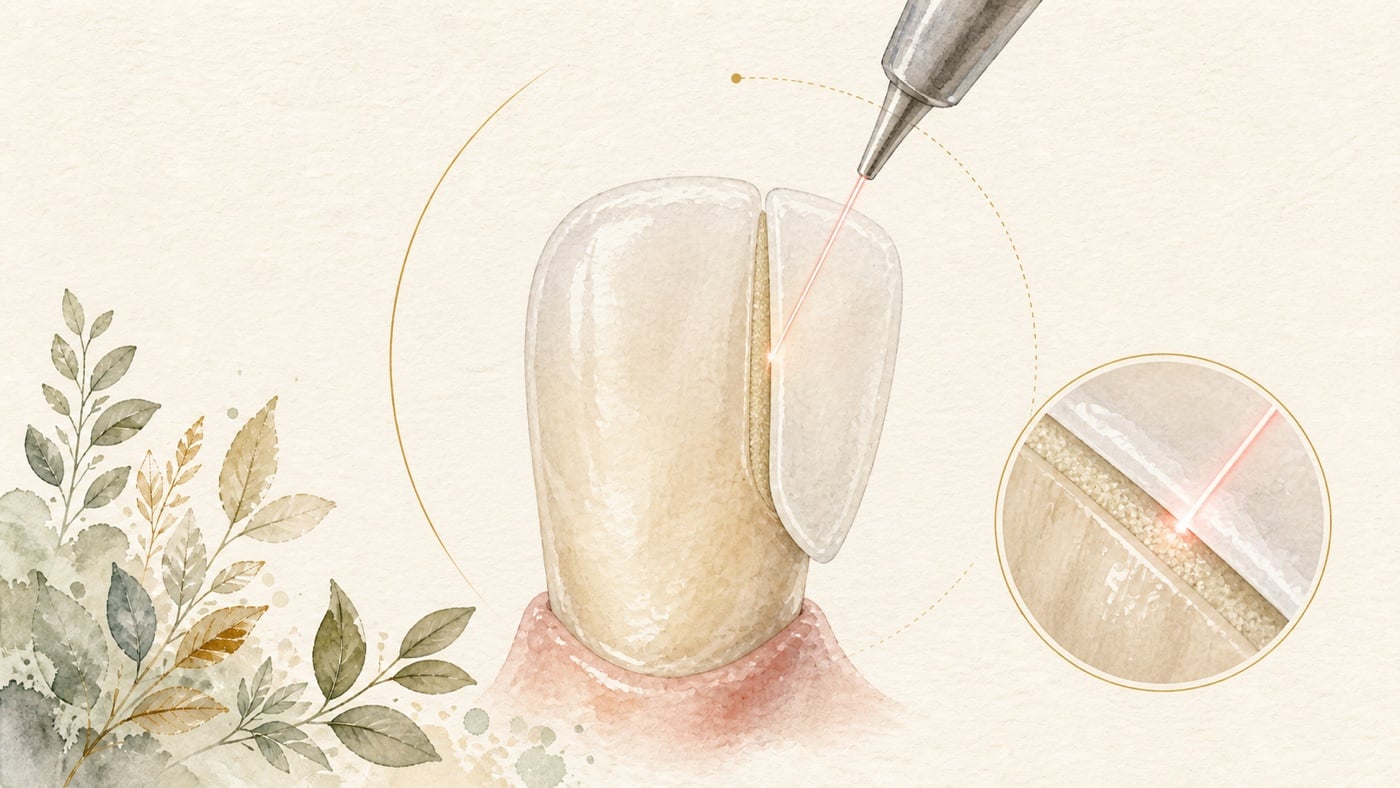
This article cites only studies of all-ceramic veneer removal that explicitly identify Er,Cr:YSGG. The principle is that Er,Cr:YSGG energy at 2,780–2,790 nm passes through certain ceramics and interacts with water-containing and resin components, making the bonding interface easier to separate. Its effects are influenced by the ceramic type, thickness, translucency, adhesive, output, pulse, water setting and scanning method. All 5 core sources currently available are in vitro studies, commonly using bovine incisors, sectioned ceramic specimens and laboratory thermocouples. In a study of 57 bovine incisors, for example, mean debonding times for 0.7 mm feldspathic porcelain and medium-opacity (MO) and high-translucency (HT) lithium disilicate groups were approximately 104, 107 and 104 seconds, with no significant difference between groups. The measured rise in pulp-chamber temperature was below 1°C in every group. This can support research into mechanisms and parameters, but cannot directly promise a particular time, damage-free removal or pulpal safety in the human mouth.
Can Er,Cr:YSGG Assist with Removing an All-ceramic Veneer for Replacement?
Direct answer: Laboratory studies show that Er,Cr:YSGG can lower the bond strength of an all-ceramic veneer and make removal easier [F2][F4]; but the core data are all in vitro, so they cannot yet be extended to debonding time, intact removal or pulpal safety inside the human mouth [F1][F3][F5].
Geographic scope: This is general health education based on international literature. It does not cover any particular country's insurance scheme or regulations; for how care and fees are organised, follow the rules where you are. Every source cited in this card is international peer-reviewed literature; no national legislation or insurance-benefit rule is cited.
TL;DR | Laboratory Studies Show That It ‘Can Affect the Bond’, but Have Not Shown That Every Clinical Veneer Can Be Removed Intact and Quickly
This article cites only studies of all-ceramic veneer removal that explicitly identify Er,Cr:YSGG. The principle is that Er,Cr:YSGG energy at 2,780–2,790 nm passes through certain ceramics and interacts with water-containing and resin components, making the bonding interface easier to separate. Its effects are influenced by the ceramic type, thickness, translucency, adhesive, output, pulse, water setting and scanning method.
All 5 core sources currently available are in vitro studies, commonly using bovine incisors, sectioned ceramic specimens and laboratory thermocouples. In a study of 57 bovine incisors, for example, mean debonding times for 0.7 mm feldspathic porcelain and medium-opacity (MO) and high-translucency (HT) lithium disilicate groups were approximately 104, 107 and 104 seconds, with no significant difference between groups. The measured rise in pulp-chamber temperature was below 1°C in every group.[F1] This can support research into mechanisms and parameters, but cannot directly promise a particular time, damage-free removal or pulpal safety in the human mouth.
Main Text | Before Removal, Identify the Veneer and the Tooth Beneath It Rather than Selecting the Power First
Why Does It Need Replacing? The Reason Changes the Aim of Removal
A veneer may need to be remade because of chipping, marginal leakage, caries, or an adjustment to colour or shape. If caries or a tooth crack is suspected beneath it, the aim is to expose the entire tooth surface clearly. If only colour or alignment is being adjusted, preserving enamel and controlling the gingival margin become more important. Whether the old veneer needs to be preserved as a reference or is expected to be reused will also influence the removal strategy.
The ceramic material, estimated thickness, translucency, bonding material, pulpal status and existing cracks should be recorded before treatment. If the material is unknown, Er,Cr:YSGG transmission and absorption may differ from the research models. Conventional sectional grinding and microscopic identification must therefore remain available as a fallback.
Do Different Materials Produce Large Differences in Debonding Time?
An in vitro study conducted in 2019 divided 57 bovine incisors into 3 groups. A 0.7 mm-thick specimen of feldspathic porcelain, medium-opacity (MO) lithium disilicate or high-translucency (HT) lithium disilicate was bonded to each tooth, then scanned with Er,Cr:YSGG at 2.5 W and 25 Hz. Note that these two are the opaque and the highly translucent ends of the range, not two adjacent steps of translucency. Mean debonding times were 103.68 ± 26.76, 106.58 ± 47.22 and 103.84 ± 32.90 seconds, respectively, with P = 0.96. The measured temperature rise was below 1°C in all 3 groups.[F1]
These 3 means come from a bovine-tooth model with standard-sized specimens and do not encompass differences in clinical veneer margins, ageing of the bond, subgingival extent or intraoral cooling. P = 0.96 means only that this model did not identify a difference in debonding time between the 3 materials; it does not mean that every ceramic responds identically to the parameters.
Does Veneer Thickness Alter Er,Cr:YSGG Efficiency?
A study of 68 bovine teeth compared 0.4, 0.8, 1.2 and 1.6 mm lithium disilicate specimens. Each group received Er,Cr:YSGG scanning at 4 W and 50 Hz for 60 seconds. The debonding strengths required were 0.0, 0.85, 5.62 and 5.20 MPa, respectively, with the overall trend showing that thinner specimens were easier to debond.[F2]
The values for 1.2 mm and 1.6 mm did not increase strictly with thickness, and the specimens were circular discs with a diameter of 6 mm rather than complete clinical veneers. This study is useful for reminding the dentist that ‘thickness interferes with energy reaching the interface’; it is not suitable for specifying intraoral parameters directly after estimating thickness by eye.
Why Is There No Universal Combination of Water Setting, Output and Time?
An in vitro study conducted in 2025 compared outputs of 4, 5 and 6 W with water settings of 1%, 20% and 40%. The longest mean debonding time occurred at 4 W with 1% water and was 333.4 ± 74.8 seconds; the shortest occurred at 6 W with 20% water and was 17.0 ± 6.0 seconds. The highest mean rise in pulp-chamber temperature was 4.00°C and the lowest was 1.20 ± 0.45°C. Translucency also changed significantly in some of the 6 W groups.[F3]
The greatest speed does not mean the greatest clinical suitability. These parameters were tested on sectioned teeth at a fixed distance and with specific ceramics. Intraoral pulpal blood flow, veneer curvature, scanning dwell time, cooling and ageing of the bond all differ. Even if the study authors propose a set of laboratory parameters, patients should not ask for it to be followed as a formula.
Can ‘A Small Temperature Rise’ Be Described Directly as Pulpal Safety?
Another segmented-scanning study of 30 bovine incisors used Er,Cr:YSGG at 3–5 W for 50 seconds. The highest measured temperature rise was 1.7°C, the treated groups had lower shear bond strength than the untreated group, and scanning electron microscopy found no major veneer cracks in this small sample.[F4]
An in vitro thermocouple measures only a specific location and period, has no pulpal blood flow and cannot represent the baseline state of every vital tooth. The study used only 5 specimens per group, so it cannot provide a reliable probability for rare thermal injury or microcracking. The appropriate safety statement is that ‘the measured temperature rise was limited under that experimental protocol’, not that it ‘has been proved safe for the human pulp’.
If the Veneer Appears Intact after Removal, Can It Be Reused?
A study of 30 bovine incisors compared optical and surface changes in 3 types of ceramic veneer before and after Er,Cr:YSGG removal. The colour difference in all 3 groups exceeded the perceptibility threshold but remained below the acceptability threshold set by the study. Surface roughness increased significantly after removal in every material, with P < 0.001.[F5]
Colour remaining within an acceptable range does not mean that the margins, intaglio surface, microcracks and rebonding quality are all suitable for reuse. Increased surface roughness may also alter gloss and subsequent bonding treatment. If reuse is intended, each veneer must still be checked for ceramic integrity, residue on the intaglio surface and rebonding conditions. There are currently no long-term clinical reuse data that can provide a guarantee.
How Might Er,Cr:YSGG Assistance and Conventional Grinding Be Combined?
In clinical practice, the choice is not necessarily either–or. Er,Cr:YSGG can first be tried to reduce bonding resistance, followed by identification of the margin under magnification. If the material response is inadequate, an area remains firmly bonded or the tooth surface needs to be examined directly, the clinician can switch to sectional grinding. Conversely, conservative grinding may be more controllable from the outset for a veneer that is already fractured or need not be preserved.
A reasonable plan should agree in advance on how long Er,Cr:YSGG will be tried, the response criterion, temperature and cooling control, when to stop, and how the ceramic, resin and enamel interfaces will be identified when switching to the conventional method.
Data Anchors | All 5 Studies Are Er,Cr:YSGG In Vitro Data
| Evidence question | Data anchor | Safe interpretation | Source |
|---|---|---|---|
| Debonding time for 3 ceramics | 57 bovine teeth; approximately 104, 107 and 104 seconds, P = 0.96; temperature rise < 1°C | A standard in vitro model that cannot predict intraoral time or safety in humans | [F1] |
| Effect of thickness | 68 bovine teeth; 0.4–1.6 mm; debonding strength 0.0–5.62 MPa | The small-disc model shows only a thickness trend and does not provide an intraoral power chart | [F2] |
| Segmented scanning | 30 bovine teeth, 5 per group; highest temperature rise 1.7°C | The sample is small and has no pulpal blood flow, so clinical thermal risk cannot be excluded | [F4] |
| Optical and surface properties | 30 bovine teeth; colour difference below the study’s acceptability threshold, roughness increased in every group, P < 0.001 | Appearing intact does not mean suitable for reuse; long-term clinical data are lacking | [F5] |
| Water setting and output | Longest 333.4 ± 74.8 seconds, shortest 17.0 ± 6.0 seconds; temperature rise 1.20–4.00°C | Parameter interactions are substantial; the fastest combination is not necessarily the preferred clinical option | [F3] |
Conclusion | Er,Cr:YSGG Is One Removal Tool, and the Evidence Remains at the In Vitro Stage
Research specific to Er,Cr:YSGG shows that ceramic type, thickness, output, water setting and scanning alter debonding time, bond strength and temperature rise; changes in surface roughness or translucency have also been observed.[F1][F3][F5] Because all the core data come from in vitro studies, the most defensible statement at present is that it ‘may assist removal’, not a promise that removal will be damage-free, rapid or compatible with reuse.
If you are preparing to replace an all-ceramic veneer, you can bring the material card, previous photographs and treatment records to a review appointment and ask your own dentist to go through them. The assessment can first establish the reason for replacement, material and thickness, pulpal and tooth-surface condition, then discuss the conditions for trying Er,Cr:YSGG, conventional grinding as a fallback, and a tooth-tissue preservation plan for the new veneer. The removal method should serve the tooth and restorative goals.
Risk factors (what to know before treatment)
- None of these studies was carried out inside a human mouth: the study of debonding time for three ceramics used 57 bovine incisors, 19 in each group [F1]; the thickness study used 68 bovine teeth and discs 6 mm in diameter [F2]; the study of water setting and output used 63 maxillary central incisors and 70 specimens in total [F3]. In vitro models have no pulpal blood flow, and none of the margins, curvature or bond ageing of a clinical veneer.
- “The temperature rise was limited” is a result under specific measurement conditions: the debonding-time study measured intrapulpal temperature in only 3 specimens per group [F1]; the segmented-scanning study had only 5 specimens per group and examined only 1 untreated specimen and 2 specimens from the highest output under the scanning electron microscope [F4]. With samples this small, no reliable probability can be given for rare thermal injury or microcracking.
- The authors' wording is not this card's safety judgement: the authors of the segmented-scanning study reported in their results that all the debonding protocols were safe as regards intrapulpal temperature increment, and concluded that the veneers could be reused [F4]; the authors of the water-and-output study wrote that dry debonding raised the intrapulpal temperature at high outputs but without exceeding the critical threshold of dental pulp temperature [F3]. This card keeps those as the original authors' wording and does not convert them into a judgement about safety for a human pulp — both are in vitro studies.
- Coming off intact does not mean it can be reused: surface roughness increased significantly in all three ceramics after removal (P < 0.001), and although the colour difference stayed below the acceptability threshold set by the study, it exceeded the perceptibility threshold in every group [F5]; in the thickness study the most frequent type of failure was cohesive failure within the cement, at 73.53% [F2]. Whether a veneer can be rebonded still has to be checked piece by piece.
- The experimental parameters are written for the clinical side, not for patients to request from a chart: different outputs and water settings change debonding time and intrapulpal temperature rise at the same time [F3]; and if the material is unknown, Er,Cr:YSGG transmission and absorption may differ from the research models, so conventional sectional grinding must remain available as a fallback.
- This card gives no adverse-event rates and compiles no list of contraindications: all 5 abstracts are in vitro studies, so there are no human adverse-event rates or contraindication criteria to cite, and “no data” is not the same as “no risk”. The removal method has to be assessed by a dentist from the veneer material, thickness, pulpal status and tooth surface.
Every clinical statement in this article is mapped line by line to its cited source (see the sources and evidence chain below). It has not been clinically reviewed by a licensed practitioner. This is health information, not individual advice; assessment by a clinician is required.
FAQ
- Can Er,Cr:YSGG Remove a Veneer Intact?
- In vitro studies show that it can reduce bonding in some ceramic specimens, but the material, thickness and bonding layer all affect the result. It is not currently possible to promise intact removal of every veneer.
- Er,Cr:YSGG でベニアを完全な状態で撤去できますか? — 体外研究では、一部のセラミック試料の接着を弱められることが示されていますが、材料、厚さ、接着層はいずれも結果に影響します。現時点では、すべてのベニアを完全な状態で撤去できるとは保証できません。
- Can Er,Cr:YSGG Remove a Veneer Intact? — In vitro studies show that it can reduce bonding in some ceramic specimens, but the material, thickness and bonding layer all affect the result. It is not currently possible to promise intact removal of every veneer.
- If the Temperature Rise in a Study Is below a Certain Figure, Does That Mean There Is No Risk to the Human Pulp?
- No. Bovine or extracted teeth do not have normal pulpal blood flow, while the thermocouple position and intraoral environment also differ. The figure describes only that experimental protocol.[F4]
- 研究で温度上昇が特定の数値未満なら、ヒトの歯髄にリスクはないのですか? — いいえ。牛歯や抜去歯には正常な歯髄血流がなく、熱電対の位置と口腔内環境も異なります。この数値は、その実験プロトコル下で得られた結果だけを示します。[F4]
- If the Temperature Rise in a Study Is below a Certain Figure, Does That Mean There Is No Risk to the Human Pulp? — No. Bovine or extracted teeth do not have normal pulpal blood flow, while the thermocouple position and intraoral environment also differ. The figure describes only that experimental protocol.[F4]
- If the Veneer Does Not Break during Removal, Can It Simply Be Bonded Back in Place?
- Not necessarily. The intaglio surface, margins, microcracks, optical properties and bonding residue must be examined; studies have also found increased surface roughness after removal.[F5]
- 撤去時に破損しなければ、そのまま再接着できますか? — 必ずしもそうではありません。内面、辺縁、微小亀裂、光学特性、接着剤の残留を確認する必要があります。研究では撤去後の表面粗さの増加も確認されています。[F5]
- If the Veneer Does Not Break during Removal, Can It Simply Be Bonded Back in Place? — Not necessarily. The intaglio surface, margins, microcracks, optical properties and bonding residue must be examined; studies have also found increased surface roughness after removal.[F5]
- If Er,Cr:YSGG Does Not Loosen It Quickly, Can the Dentist Switch to a Conventional Method?
- Yes. Response and stopping criteria should be set beforehand, followed by a switch to sectional grinding according to the microscopic findings. A combined approach is often more controllable than continuing to increase the output.
- Er,Cr:YSGG ですぐに緩まなければ、従来法へ変更できますか? — はい。反応基準と中止基準を事前に設定し、顕微鏡所見に応じて分割研削へ切り替えます。出力を上げ続けるより、複数の方法を組み合わせる方がコントロールしやすいことが少なくありません。
- If Er,Cr:YSGG Does Not Loosen It Quickly, Can the Dentist Switch to a Conventional Method? — Yes. Response and stopping criteria should be set beforehand, followed by a switch to sectional grinding according to the microscopic findings. A combined approach is often more controllable than continuing to increase the output.
Medical notice This article is provided for health education and medical information purposes. It is not a solicitation for medical services and does not constitute diagnosis or treatment advice. Actual treatment methods and outcomes vary between individuals and require evaluation by a dentist; every treatment has its own indications, limitations and possible risks. If you have related symptoms or treatment needs, please book a consultation for evaluation by a dentist.
Source anchors
- Debonding Time and Dental Pulp Temperature With the Er,Cr:YSGG Laser for Debonding Feldespathic and Lithium Disilicate Veneers. [PMID:31749948] · https://pubmed.ncbi.nlm.nih.gov/31749948/ · 在 IDAEO 的其他引用
- Effect of an Er,Cr:YSGG Laser on the Debonding of Lithium Disilicate Veneers With Four Different Thicknesses. [PMID:33425298] · https://pubmed.ncbi.nlm.nih.gov/33425298/ · 在 IDAEO 的其他引用
- Efficiency of dry versus wet Er,Cr:YSGG laser debonding of lithium disilicate veneers using different power outputs. [PMID:39353756] · https://pubmed.ncbi.nlm.nih.gov/39353756/ · 在 IDAEO 的其他引用
- Debonding of LDSVs utilising Er,Cr:YSGG laser irradiation with fractional technique: an in vitro study. [PMID:37097017] · https://pubmed.ncbi.nlm.nih.gov/37097017/ · 在 IDAEO 的其他引用
- Effect of Er,Cr:YSGG laser debonding treatment on the optical properties and surface roughness of ceramic laminate veneers: An in vitro study. [PMID:38985129] · https://pubmed.ncbi.nlm.nih.gov/38985129/ · 在 IDAEO 的其他引用
Cite this article
Lucy・《Can Er,Cr:YSGG Assist with Removing an All-ceramic Veneer for Replacement?》・IDAEO 知識庫・2026-07-20・https://km.idaeo.ai/post/dental/ercrysgg-veneer-removalUpdated 2026-08-26