🏛 Part of the "dental" topic shelf →
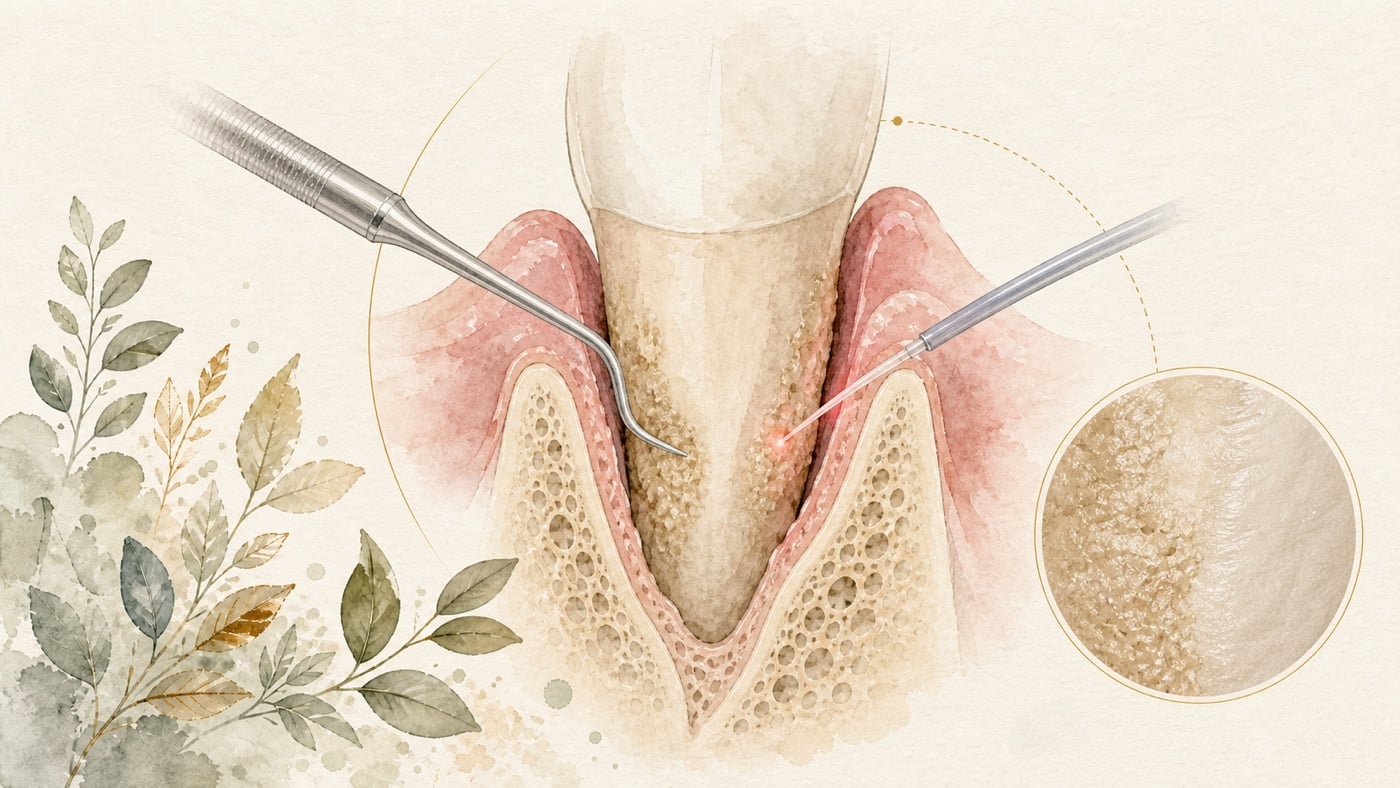
Adding Er,Cr:YSGG to non-surgical periodontal treatment: which questions should you ask?
The foundations of non-surgical periodontal treatment remain diagnosis, oral hygiene instruction, control of supra- and subgingival plaque and calculus, root-surface treatment, risk modification and reassessment. In some trials, Er,Cr:YSGG has been placed alongside this process. The research question should be “as an adjunct, does it add a clinically meaningful improvement?”, not “can a device replace standard debridement?” In a split-mouth pilot study of 15 adults and 90 sites at least 5 mm deep, the mean improvements at 12 months were similar with Er,Cr:YSGG plus standard treatment and with standard treatment alone. Probing depth fell from 6.1 to 4.2 mm at test sites and from 6.2 to 4.3 mm at control sites. Only the subgroup with a baseline depth of at least 7 mm showed a significant difference in the proportion of sites achieving shallower pockets at 9 and 12 months. The small sample and subgroup result are suitable for generating questions for subsequent research, but not for claiming an added benefit for every deep pocket.
Adding Er,Cr:YSGG to non-surgical periodontal treatment: which questions should you ask?
Direct answer: The available trials all compare Er,Cr:YSGG on top of standard debridement, and the overall clinical improvement is similar to scaling and root planing alone [F1][F3]. No trial has tested “no debridement, device only”, so first confirm that standard treatment has been completed, then ask which outcome the device improved beyond it and for how long [F2][F4].
Geographic scope: This is general health education based on international literature. It does not cover any particular country's insurance scheme or regulations; for how care and fees are organised, follow the rules where you are. Every source cited in this card is international peer-reviewed literature; no national legislation or insurance-benefit rule is cited.
TL;DR|First ask whether standard treatment was complete, then ask what Er,Cr:YSGG added
The foundations of non-surgical periodontal treatment remain diagnosis, oral hygiene instruction, control of supra- and subgingival plaque and calculus, root-surface treatment, risk modification and reassessment. In some trials, Er,Cr:YSGG has been placed alongside this process. The research question should be “as an adjunct, does it add a clinically meaningful improvement?”, not “can a device replace standard debridement?”
In a split-mouth pilot study of 15 adults and 90 sites at least 5 mm deep, the mean improvements at 12 months were similar with Er,Cr:YSGG plus standard treatment and with standard treatment alone. Probing depth fell from 6.1 to 4.2 mm at test sites and from 6.2 to 4.3 mm at control sites.[F1] Only the subgroup with a baseline depth of at least 7 mm showed a significant difference in the proportion of sites achieving shallower pockets at 9 and 12 months. The small sample and subgroup result are suitable for generating questions for subsequent research, but not for claiming an added benefit for every deep pocket.
Main discussion|Six questions that put the device back into the research design rather than the advertising copy
Question one: is Er,Cr:YSGG an adjunct or a replacement for hand instruments?
The control differs between trials. Some provide scaling and root planing to both groups and then add Er,Cr:YSGG on the test side; others compare “ultrasonic debridement plus Er,Cr:YSGG” with “ultrasonic debridement plus root planing with hand instruments”. Without first examining the control group, the effect of the device may be confused with that of the entire treatment package.
In a randomised trial of 59 non-smokers with advanced chronic periodontitis, the test group received full-mouth ultrasonic debridement plus Er,Cr:YSGG, while the control group received ultrasonic debridement plus root planing with Gracey curettes. At six weeks and three months, probing depth and bleeding on probing favoured the Er,Cr:YSGG group, but there was no significant between-group difference in clinical attachment gain, and most immune markers also did not differ.[F2] This was not a pure adjunctive design that “added a device”, but a comparison between two combinations of instruments.
Question two: is the main outcome pocket depth, or attachment and tooth retention?
Probing depth can be affected jointly by a reduction in inflammation, gingival recession and a true change in attachment. Reporting only that a pocket became shallower does not necessarily mean attachment gain or better long-term tooth outcomes. In the 59-person trial above, there were between-group differences in probing depth and bleeding but no significant difference in clinical attachment gain, illustrating precisely why the endpoints are not interchangeable.[F2]
In the split-mouth pilot study, gingival recession increased by 0.4 mm on both sides at 12 months. The clinical attachment value fell from 6.8 to 5.3 mm on the test side and from 6.9 to 5.5 mm on the control side, with similar overall improvements between groups.[F1] Interpretation should consider probing depth, attachment, recession, bleeding and the patient's experience together, rather than selecting only the most favourable single figure.
Question three: does Er,Cr:YSGG have an independent clinical effect?
In a split-mouth randomised trial of 17 participants, all areas first received standard debridement, after which either a 940 nm diode or 2,780 nm Er,Cr:YSGG was added. Clinical indicators improved in all three groups over six months. Although Er,Cr:YSGG produced more marked changes in some gingival crevicular fluid indicators, it had no significant clinical advantage over standard treatment.[F3]
Changes in biomarkers can help us understand the inflammatory response, but cannot replace long-term outcomes that patients can feel or that can be measured periodontally. If a study's conclusion jumps directly from cytokines to “greater periodontal stability”, the chain of clinical evidence between them is still missing.
Question four: did the study use another wavelength at the same time?
In a randomised study of 42 patients, the test group did not receive Er,Cr:YSGG alone: an InGaAsP diode was used first, followed by subgingival debridement and Er,Cr:YSGG. Residual sites also received a second treatment after two months. At six months, some clinical and microbiological outcomes favoured the test group over subgingival debridement alone.[F4]
A two-year follow-up of the same study population also reported that between-group differences persisted.[F5] These two PMIDs, however, are different follow-up reports from the same 42-person trial, not two independent randomised trials. The diode, Er,Cr:YSGG, repeated treatment and debridement also occurred together, so the differences cannot be attributed to Er,Cr:YSGG alone.
Question five: at which baseline pocket depths is there an effect, and how long does it last?
The 15-person pilot study found no between-group difference at sites with baseline depths of 5 or 6 mm. Only sites with a baseline depth of at least 7 mm showed a greater proportion on the test side achieving a probing depth no greater than 4 mm at 9 and 12 months.[F1] Dividing into subgroups makes the denominator even smaller and increases the possibility of a chance finding, so replication in a larger trial with prespecified subgroups is needed.
Changes in bleeding and depth at the short-term points of six weeks or three months cannot be extended directly to tooth retention over many years. Although the two-year data are longer-term, they come from the same 42-person trial combining two wavelengths.[F5] During a consultation, it is worth asking clearly when assessment is expected and what the next treatment gateway will be if deep pockets remain.
Question six: were maintenance, smoking and glycaemic control addressed at the same time?
Periodontal outcomes are not determined by instruments alone. Home cleaning, supportive periodontal visits, smoking, glycaemic control, the original defect morphology and the cleanability of the teeth all alter outcomes. The 59-person randomised trial included only non-smokers; its results cannot be extrapolated directly to all high-risk patients.[F2]
If a treatment description discusses only the number of Er,Cr:YSGG sessions but gives no baseline for bleeding and pockets, cleaning plan or reassessment criteria, the evidence chain remains incomplete. The device should be embedded in risk control and maintenance, not replace them.
Data anchors|Even when Er,Cr:YSGG is explicitly identified, the studies remain highly heterogeneous
| Evidence question | Data anchor | Cautious interpretation | Source |
|---|---|---|---|
| 12-month pilot study | 15 participants, 90 sites; 6.1→4.2 mm versus 6.2→4.3 mm, with no significant overall between-group difference | A signal in the subgroup with baseline depth ≥7 mm, but the denominator is small and replication is needed | [F1] |
| Three-month comparison of instrument combinations | 59 participants; probing depth and bleeding favoured the Er,Cr:YSGG group, with no significant difference in attachment gain | The control was root planing with hand instruments, not simply “added versus not added” | [F2] |
| Six-month split-mouth trial | 17 participants; clinical indicators improved in all three groups, with no additional significant clinical advantage for Er,Cr:YSGG | Biomarker differences cannot replace clinical outcomes | [F3] |
| Treatment combining two wavelengths | 42 participants; some clinical and microbiological outcomes at six months favoured the combined group | InGaAsP, Er,Cr:YSGG, debridement and repeated treatment cannot be separated | [F4] |
| Two-year follow-up of the same trial | The same 42-person population; between-group differences reported at 12 and 24 months | Not another independent trial and cannot be attributed to one wavelength | [F5] |
Conclusion|Asking the right research question matters more than choosing the device first
Non-surgical periodontal studies of Er,Cr:YSGG differ greatly in their processes, controls, wavelength combinations, follow-up and endpoints. Some trials found no added clinical advantage, some found differences in short-term probing depth or bleeding, and others used another wavelength at the same time, making the results impossible to separate.[F3][F2][F4] The cautious conclusion is therefore not the two words “effective” or “ineffective”, but first to ask which outcome it added beyond complete standard treatment, how long that outcome lasted and whether the evidence can be attributed independently.
If you still have deep pockets, you can bring your periodontal examination and previous treatment records to a review appointment and go through them with your own dentist. During discussion, the baseline depth, attachment and recession, completion of standard debridement, whether Er,Cr:YSGG is an adjunct or is being compared as an alternative, the reassessment time and the maintenance arrangements can be checked point by point. Let measurable periodontal goals guide the treatment.
Risk factors (what to know before treatment)
- The study populations differ and cannot be swapped for one another: the pilot study enrolled only 15 adults aged 27 to 65 with 90 sites probing at least 5 mm, in a moderate-to-severe periodontitis population [F1]; the instrument-comparison trial enrolled only 59 non-smokers with advanced chronic periodontitis [F2]; and in the trial combining two wavelengths, 23 of the 42 participants were smokers, and the population was stage III or IV, grade B periodontitis [F4][F5]. If your age, smoking status or periodontal stage falls outside these conditions, the results cannot be applied directly to you.
- All of these trials are built on standard debridement: whether the design was split-mouth, a comparison of instrument combinations, or a diode laser followed by Er,Cr:YSGG, the participants all received scaling, root planing or subgingival debridement [F1][F2][F3][F4]. None of these trials tested “no debridement, device only”.
- The follow-up is shorter than you may assume: the instrument-comparison trial assessed outcomes only at 6 weeks and 3 months [F2]; the split-mouth trial went to 6 months [F3]; the pilot study to 12 months [F1]; and the only data extending to 24 months come from a trial that used an InGaAsP diode laser together with Er,Cr:YSGG, so they cannot be attributed to either wavelength alone [F5].
- The subgroup signal has a small denominator: after the pilot study stratified by baseline depth, there was no between-group difference at sites starting at 5 or 6 mm; only sites starting at at least 7 mm favoured the test side in the proportion reaching a probing depth no greater than 4 mm, at 9 months (P = 0.001) and 12 months (P = 0.044) [F1]. The whole study had only 15 participants and the subgroup denominator is smaller still, which suits generating further research questions rather than promising a course of treatment.
- A change in biomarkers is not a clinical benefit: clinical indicators improved in all three groups of the split-mouth trial, and Er,Cr:YSGG lowered MMP-13 and raised IL-10 in gingival crevicular fluid, but it had no significant clinical advantage over scaling and root planing alone [F3].
- This card gives no adverse-event rates and compiles no list of contraindications: none of the abstracts above reports rates of laser-related adverse events or contraindication criteria, and “not reported in the abstract” is not the same as “no risk”. Whether it is suitable, and whether to add it, has to be assessed by a dentist from the periodontal diagnosis, access for debridement and risk factors such as smoking and glycaemic control.
Every clinical statement in this article is mapped line by line to its cited source (see the sources and evidence chain below). It has not been clinically reviewed by a licensed practitioner. This is health information, not individual advice; assessment by a clinician is required.
FAQ
- Can Er,Cr:YSGG replace scaling and root planing?
- Existing trials compare or combine it with ultrasonic or hand debridement and have not established evidence that control of infection and calculus can be omitted.
- Er,Cr:YSGG はスケーリング・ルートプレーニングに代わりますか? — 現在の試験では超音波または手用器具によるデブライドメントと比較または併用されており、感染と歯石のコントロールを省略できるというエビデンスは確立されていません。
- Can Er,Cr:YSGG replace scaling and root planing? — Existing trials compare or combine it with ultrasonic or hand debridement and have not established evidence that control of infection and calculus can be omitted.
- If a pocket becomes shallower, does periodontal attachment necessarily increase?
- Not necessarily. Gingival recession can also reduce probing depth; attachment, recession and bleeding should be considered together. In the 59-person trial, probing depth differed between groups but attachment gain did not.[F2]
- ポケットが浅くなれば、歯周組織のアタッチメントも必ず増えますか? — 必ずしもそうではありません。歯肉退縮でもプロービングデプスは低下します。アタッチメント、退縮、出血を併せて確認すべきです。59 人の試験では、プロービングデプスに群間差があっても、アタッチメントゲインには差がありませんでした。[F2]
- If a pocket becomes shallower, does periodontal attachment necessarily increase? — Not necessarily. Gingival recession can also reduce probing depth; attachment, recession and bleeding should be considered together. In the 59-person trial, probing depth differed between groups but attachment gain did not.[F2]
- Why can two papers not be counted as two trials?
- [F4] and [F5] come from the same 42-person study and report six-month and two-year outcomes, respectively. Repeated follow-up adds time information but does not increase the number of independent participants.
- なぜ二つの論文を二つの試験と数えられないのですか? — [F4] と [F5] は同じ 42 人の研究から得られ、それぞれ 6か月結果と 2 年結果を報告しています。追跡を重ねることで時間情報は補えますが、独立した参加者数は増えません。
- Why can two papers not be counted as two trials? — [F4] and [F5] come from the same 42-person study and report six-month and two-year outcomes, respectively. Repeated follow-up adds time information but does not increase the number of independent participants.
- Which patients might be most worthwhile studying further?
- The pilot study found a subgroup signal in deep pockets with a baseline depth of at least 7 mm, but the sample was very small.[F1] Applicability still depends on access for debridement, risk control and larger trials and should not first be converted into a routine promise.
- どのような患者について、さらに研究する価値が最も高いでしょうか? — パイロット研究では、開始時に少なくとも 7 mm あった深いポケットのサブグループにシグナルが認められましたが、サンプルは非常に小さいものでした。[F1] 適用可能性は、デブライドメントの到達性、リスクコントロール、より大規模な試験を踏まえて判断する必要があり、先に標準的な効果を保証する表現へ変えるべきではありません。
- Which patients might be most worthwhile studying further? — The pilot study found a subgroup signal in deep pockets with a baseline depth of at least 7 mm, but the sample was very small.[F1] Applicability still depends on access for debridement, risk control and larger trials and should not first be converted into a routine promise.
Medical notice This article is provided for health education and medical information purposes. It is not a solicitation for medical services and does not constitute diagnosis or treatment advice. Actual treatment methods and outcomes vary between individuals and require evaluation by a dentist; every treatment has its own indications, limitations and possible risks. If you have related symptoms or treatment needs, please book a consultation for evaluation by a dentist.
Source anchors
- Clinical evaluation of Er,Cr:YSGG laser therapy used as an adjunct to non-surgical treatment of periodontitis: Twelve-month results from a pilot study. [PMID:35239185] · https://pubmed.ncbi.nlm.nih.gov/35239185/ · 在 IDAEO 的其他引用
- Clinical and Immunological Effects of Er,Cr:YSGG Laser in Nonsurgical Periodontal Treatment: A Randomized Clinical Trial. [PMID:32427555] · https://pubmed.ncbi.nlm.nih.gov/32427555/ · 在 IDAEO 的其他引用
- Effects of diode and erbium lasers as an adjunct to scaling and root planing on clinical and immunological parameters in non-surgical periodontal treatment: a split-mouth randomized controlled clinical trial. [PMID:35718807] · https://pubmed.ncbi.nlm.nih.gov/35718807/ · 在 IDAEO 的其他引用
- Adjunctive use of InGaAsP and Er,Cr:YSGG lasers in nonsurgical periodontal therapy: a randomized controlled clinical study. [PMID:31111123] · https://pubmed.ncbi.nlm.nih.gov/31111123/ · 在 IDAEO 的其他引用
- Two-year outcomes following the adjunctive use of InGaAsP and Er,Cr:YSGG lasers in nonsurgical periodontal therapy in patients with stages III and IV periodontitis. [PMID:34235909] · https://pubmed.ncbi.nlm.nih.gov/34235909/ · 在 IDAEO 的其他引用
Cite this article
Lucy・《Adding Er,Cr:YSGG to non-surgical periodontal treatment: which questions should you ask?》・IDAEO 知識庫・2026-07-20・https://km.idaeo.ai/post/dental/ercrysgg-nonsurgical-periodontalUpdated 2026-08-26