🏛 Part of the "dental" topic shelf →
Periodontal intrabony defects: how do Er,Cr:YSGG and minimally invasive surgery compare?
This article discusses only data that explicitly identify Er,Cr:YSGG. The clinical evidence directly comparing an Er,Cr:YSGG protocol with the minimally invasive surgical technique (MIST) for periodontal intrabony defects comes from the same multicentre, randomised, masked trial (the abstracts state only "masked", without specifying who was masked): one report covers 6 months and the other covers 12 months. The two PMIDs complete the time series, but they still concern the same 53 adults and 79 defects and cannot be treated as two independent replications. At 12 months, 50 participants had completed follow-up. Standardised imaging estimated bone fill at 1.14 ± 1.73 mm for MIST and 1.12 ± 1.52 mm for Er,Cr:YSGG. The study tested non-inferiority using a prespecified margin; it did not prove that the treatments were completely equivalent, nor did it prove that Er,Cr:YSGG was superior to MIST. Before choosing, it remains necessary to confirm the defect morphology, the response to first-stage periodontal debridement, the patient's cleaning ability and whether the operator can reproduce the study protocol.
Periodontal intrabony defects: how do Er,Cr:YSGG and minimally invasive surgery compare?
Direct answer: A comparison is possible, but the direct evidence consists only of the 6-month and 12-month reports from a single multicentre randomised trial: Er,Cr:YSGG stayed within the non-inferiority margins prespecified by the study [F1], and radiographic bone fill at 12 months was similar to that with the minimally invasive surgical technique [F2].
Geographic scope: This is general health education based on international literature. It does not cover any particular country's insurance scheme or regulations; for how care and fees are organised, follow the rules where you are. Every source cited in this card is international peer-reviewed literature; no national legislation or insurance-benefit rule is cited.
TL;DR|At present, these are two follow-up points from the same trial, not two independent bodies of evidence
This article discusses only data that explicitly identify Er,Cr:YSGG. The clinical evidence directly comparing an Er,Cr:YSGG protocol with the minimally invasive surgical technique (MIST) for periodontal intrabony defects comes from the same multicentre, randomised, masked trial (the abstracts state only "masked", without specifying who was masked): [F1] reports 6 months and [F2] reports 12 months. The two PMIDs complete the time series, but they still concern the same 53 adults and 79 defects and cannot be treated as two independent replications.
At 12 months, 50 participants had completed follow-up. Standardised imaging estimated bone fill at 1.14 ± 1.73 mm for MIST and 1.12 ± 1.52 mm for Er,Cr:YSGG.[F2] The study tested non-inferiority using a prespecified margin; it did not prove that the treatments were completely equivalent, nor did it prove that Er,Cr:YSGG was superior to MIST. Before choosing, it remains necessary to confirm the defect morphology, the response to first-stage periodontal debridement, the patient's cleaning ability and whether the operator can reproduce the study protocol.
Main discussion|Before comparing treatments, first confirm whether this defect matches those in the study
What is a periodontal intrabony defect?
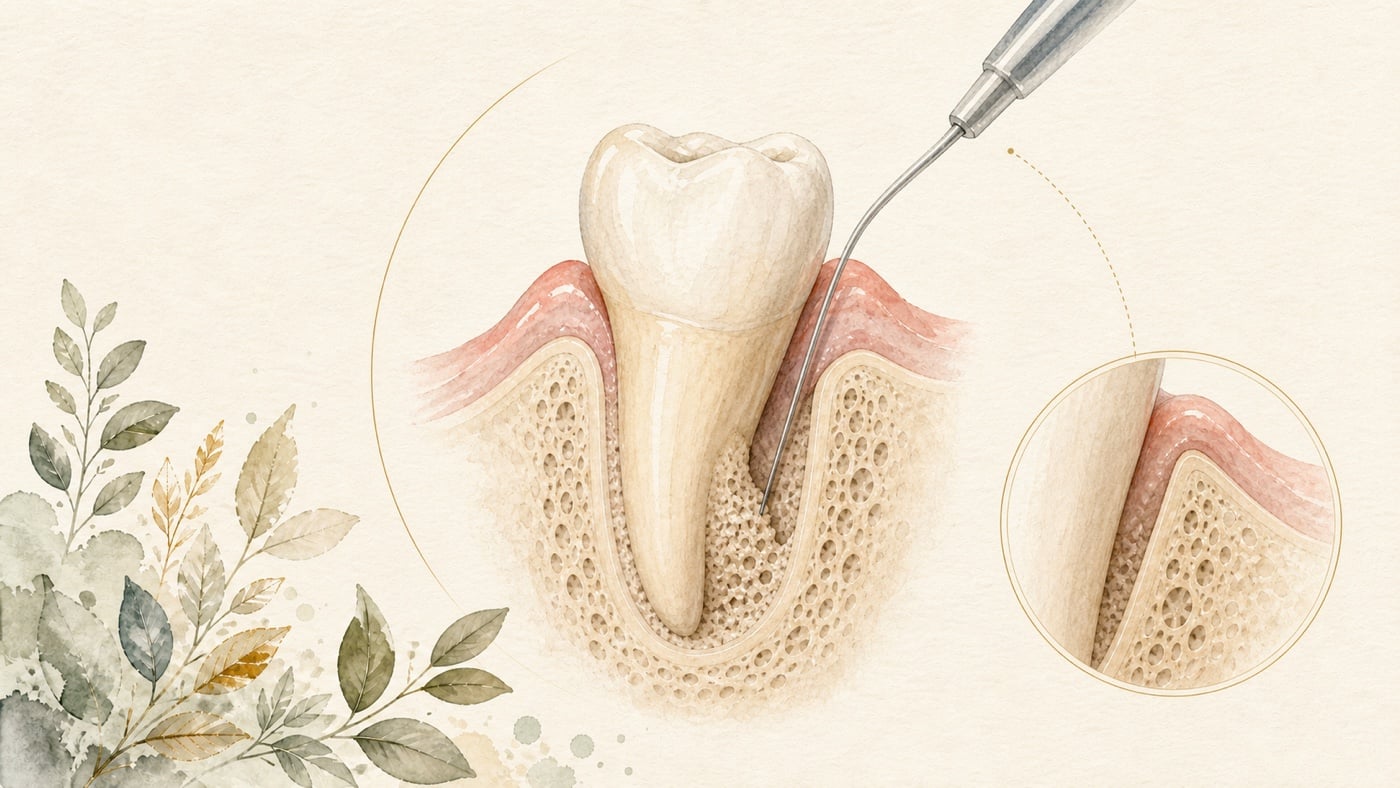
When periodontal inflammation causes bone loss, the bone level may descend in a broadly horizontal pattern, or a vertical intrabony defect with one or more bony walls may form along the root. The depth and width of the defect, the remaining bony walls, tooth mobility, furcation involvement, root morphology and soft tissues all alter access for debridement and the space available for regeneration.
The trial enrolled adults with generalised stage III, grade B periodontitis. They first completed scaling and root planing and were then randomly allocated to an Er,Cr:YSGG-only protocol or MIST; the device was not selected directly before infection control had been completed.[F1] The first gateway before treatment therefore remains standard non-surgical treatment and reassessment.
What does “non-inferiority” in the 6-month study mean?
The 6-month report included 53 adults and 79 intrabony defects; participants were divided into 27 in the Er,Cr:YSGG group and 26 in the MIST group. The study prespecified non-inferiority margins of 0.6 mm for clinical attachment, 0.5 mm for probing depth and 0.4 mm for gingival recession; the results fell within the range accepted by the study.[F1]
Non-inferiority does not mean that “the two are identical”. It means that, within this study design, margin and group of participants, the Er,Cr:YSGG outcome was not worse by more than the prespecified threshold. The conclusion could change if the margin were replaced with a stricter standard, loss to follow-up were handled differently or patient characteristics differed; superiority also cannot be inferred from non-inferiority.
What were the clinical and imaging outcomes at 12 months?
In the 12-month report, 50 participants completed the study. The authors used non-inferiority margins of 0.7 mm each for clinical attachment and probing depth and 0.4 mm for gingival recession, and the results continued to meet the prespecified criteria. Bone fill on standardised imaging was 1.14 ± 1.73 mm for MIST and 1.12 ± 1.52 mm for Er,Cr:YSGG.[F2]
The group means were close, but the variation was larger than the difference between them, and the abstract did not provide a confidence interval for the between-group difference in bone fill. The cautious wording is that “the trial observed similar mean bone fill”, not that “the two were proved completely identical”. Even with 50 participants completing follow-up, the sample remains limited and does not yet answer questions about tooth retention and recurrence over many years.
How should procedure time and patients' experiences be interpreted?
In the 6-month report, mean procedure time was 16.39 ± 6.21 minutes for the Er,Cr:YSGG protocol and 20.17 ± 5.62 minutes for MIST, with P=0.0002. Study diaries two to three days after treatment also recorded less bruising, facial swelling and use of ice packs in the Er,Cr:YSGG group.[F1]
The approximately 4-minute difference in procedure time is a study mean. Whether it is important for an individual treatment will depend on the number of defects, anaesthesia, difficulty of debridement and operator. Patient-reported signals are worth including in shared decision-making, but the abstract did not provide complete denominators and confidence intervals for each event, so they cannot be rewritten as a universal promise of “greater comfort”.
Can a network meta-analysis provide additional independent evidence?
A network meta-analysis that specifically identified Er,Cr:YSGG included 37 randomised trials and 7 periodontal treatments. It focused on probing depth after non-surgical scaling and root planing, not the MIST comparison for intrabony defects. At 6 months, the standardised mean differences relative to mechanical treatment were 0.37 (95% CI 0.04–0.71) for Er,Cr:YSGG alone and 0.53 (0.23–0.84) when it was used as an adjunct.[F3]
Neither confidence interval crosses 0, but different wavelengths, protocols, disease severities and follow-up periods were combined in the network, and the endpoint was not bone fill. It can provide background for periodontal research on Er,Cr:YSGG, but cannot count as a second surgical trial in intrabony defects or be used to strengthen the independence of the single multicentre RCT.
Which answers are still missing for clinical choices?
The existing direct trial has yet to provide replication by multiple independent teams, comparisons longer than 12 months, stratification by the number of bony walls, complete costs and maintenance burden, or long-term pathways for reintervention after failure. Device settings, operator training and fidelity to the protocol may also affect reproducibility.
Shared decision-making should therefore compare the study eligibility criteria with your circumstances point by point: whether non-surgical debridement has been completed, where any deep pockets remain, the defect morphology, restorability of the tooth, cleaning ability, smoking and glycaemic risks, and the clinic's training and follow-up arrangements for both techniques.
Data anchors|One RCT, two time points and three Er,Cr:YSGG reports
| Evidence question | Data anchor | Cautious interpretation | Source |
|---|---|---|---|
| Direct-comparison sample | 53 participants, 79 defects; 27 received Er,Cr:YSGG and 26 received MIST | A single multicentre RCT; the two follow-up papers are not two trials | [F1] |
| 6-month non-inferiority margins | Attachment 0.6 mm, probing depth 0.5 mm, recession 0.4 mm | Not exceeding the prespecified margin does not mean complete equivalence or superiority | [F1] |
| Procedure time | 16.39 ± 6.21 versus 20.17 ± 5.62 minutes, P=0.0002 | A mean difference of approximately 4 minutes; clinical importance must be judged for the individual case | [F1] |
| 12-month bone fill | MIST 1.14 ± 1.73 mm; Er,Cr:YSGG 1.12 ± 1.52 mm | Similar means with wide variation; the abstract provides no confidence interval for the difference | [F2] |
| Indirect background | Non-surgical network analysis of 37 RCTs; 6-month SMDs of 0.37 and 0.53, with CIs not crossing 0 | The endpoint and interventions differ, so this cannot stand in for another intrabony-defect trial | [F3] |
Conclusion|Comparison is possible, but the evidence still needs the correct denominator
Direct data show that, among patients with intrabony defects who first completed scaling and root planing and met the study criteria, the Er,Cr:YSGG protocol met the study's non-inferiority criteria at 6 and 12 months; mean radiographic bone fill at 12 months was similar to that with MIST.[F1][F2] However, this remains the same 53-person trial, without independent replication, and proves neither complete equivalence nor long-term superiority.
If your periodontal imaging shows an intrabony defect, you can bring your complete periodontal chart and serial images to a review appointment and ask your own dentist to go through them with you. During assessment, the defect morphology, response to first-stage debridement, actual steps in both protocols, what the non-inferiority margins mean for you, and maintenance and management of residual pockets after 12 months can be reviewed point by point. The choice of method should rest on the conditions for its use, not the name of the device.
Risk factors (what to know before treatment)
- This is a comparison of two surgical approaches, not a way to avoid treating periodontitis: the trial enrolled adults aged 19 to 73 with generalised stage III, grade B periodontitis, and all of them completed scaling and root planing before being randomly allocated to Er,Cr:YSGG or the minimally invasive surgical technique [F1]. Anyone who has not yet completed non-surgical treatment and reassessment falls outside the study conditions.
- Patient reports from the first few days are a between-group comparison, not a personal expectation: the study recorded bruising, facial swelling and use of an ice pack as patient diary items during the first 2 to 3 days after treatment, and the Er,Cr:YSGG group reported less of them [F1]. The abstract gives no incidence or denominator for each item, so this cannot be rewritten as “you will swell less”.
- A non-inferiority margin does not mean “no difference”: the prespecified margins at 6 months were 0.6 mm for clinical attachment, 0.5 mm for probing depth and 0.4 mm for gingival recession; at 12 months they were 0.7 mm each for attachment and probing depth and 0.4 mm for recession [F1][F2]. Falling within the margin means only that the difference did not exceed the range the study accepted in advance.
- Limits of the evidence: one trial, 53 people, 12 months: the only direct comparison is this single multicentre randomised trial of 53 adults and 79 defects, of whom 50 completed the study at 12 months [F1][F2]. Radiographic bone fill was 1.14 ± 1.73 mm for MIST and 1.12 ± 1.52 mm for Er,Cr:YSGG; the standard deviation in each group is larger than the difference between the means, and the abstract provides no confidence interval for the between-group difference [F2]. There is at present no replication by an independent team and no comparison beyond 12 months.
- The network meta-analysis does not fill that gap: its literature search ran only to January 2020, it covered 37 randomised trials and 7 periodontal treatments, and its endpoint was probing depth after non-surgical treatment rather than surgery for intrabony defects [F3].
- This card gives no adverse-event rates and compiles no list of contraindications: none of the abstracts above reports adverse-event rates or contraindication criteria, and “not reported in the abstract” is not the same as “no risk”. Whether surgery is suitable, and which approach fits, has to be assessed by a dentist from the periodontal diagnosis, defect morphology, restorability of the tooth and general health.
Every clinical statement in this article is mapped line by line to its cited source (see the sources and evidence chain below). It has not been clinically reviewed by a licensed practitioner. This is health information, not individual advice; assessment by a clinician is required.
FAQ
- Does non-inferiority mean the two methods have the same effect?
- No. Non-inferiority means only that the difference did not exceed the margin accepted by the study in advance; it proves neither complete equivalence nor that Er,Cr:YSGG is better.
- 非劣性は、二つの方法の効果が同じという意味ですか? — いいえ。非劣性は、差が研究であらかじめ許容されたマージンを超えなかったことだけを意味します。完全な同等性も、Er,Cr:YSGG の方が優れていることも証明しません。
- Does non-inferiority mean the two methods have the same effect? — No. Non-inferiority means only that the difference did not exceed the margin accepted by the study in advance; it proves neither complete equivalence nor that Er,Cr:YSGG is better.
- Can the 6-month and 12-month papers be counted as two RCTs?
- No. Both papers come from the same 53 adults and 79 defects and report separate points in the time series.[F1][F2]
- 6か月と 12か月の二つの論文は、二つの RCT と数えられますか? — 数えられません。両論文は、同じ 53 人の成人、79 欠損から得られ、時系列の別々の時点を報告しています。[F1][F2]
- Can the 6-month and 12-month papers be counted as two RCTs? — No. Both papers come from the same 53 adults and 79 defects and report separate points in the time series.[F1][F2]
- If the Er,Cr:YSGG procedure is shorter, does that mean recovery will necessarily be faster?
- Mean procedure time was shorter in the study and early diaries contained some differences in patient reports, but complete denominators and confidence intervals for the events were not presented in the abstract. This cannot be converted into a universal promise about recovery.
- Er,Cr:YSGG の処置が短ければ、回復も必ず早いという意味ですか? — 研究では平均処置時間が短く、初期の日誌にも患者報告の違いが一部ありましたが、事象ごとの完全な分母と信頼区間は抄録に示されていません。一般的な回復の保証に置き換えることはできません。
- If the Er,Cr:YSGG procedure is shorter, does that mean recovery will necessarily be faster? — Mean procedure time was shorter in the study and early diaries contained some differences in patient reports, but complete denominators and confidence intervals for the events were not presented in the abstract. This cannot be converted into a universal promise about recovery.
- Why can a network meta-analysis not be used to support a single RCT?
- That analysis compared probing depths after non-surgical periodontal treatment, not MIST surgery for intrabony defects.[F3] The question and endpoint differ, so it cannot count as direct replication.
- なぜネットワークメタアナリシスを、単一の RCT を裏付けるために使えないのですか? — この分析が比較したのは、非外科的歯周治療におけるプロービングデプスであり、骨内欠損に対する MIST 手術との比較ではありません。[F3] 問いと評価項目が異なるため、直接的な追試とはみなせません。
- Why can a network meta-analysis not be used to support a single RCT? — That analysis compared probing depths after non-surgical periodontal treatment, not MIST surgery for intrabony defects.[F3] The question and endpoint differ, so it cannot count as direct replication.
Medical notice This article is provided for health education and medical information purposes. It is not a solicitation for medical services and does not constitute diagnosis or treatment advice. Actual treatment methods and outcomes vary between individuals and require evaluation by a dentist; every treatment has its own indications, limitations and possible risks. If you have related symptoms or treatment needs, please book a consultation for evaluation by a dentist.
Source anchors
- Comparison of Er,Cr:YSGG laser to minimally invasive surgical technique in the treatment of intrabony defects: Six-month results of a multicenter, randomized, controlled study. [PMID:32613664] · https://pubmed.ncbi.nlm.nih.gov/32613664/ · 在 IDAEO 的其他引用
- A comparison of Er,Cr:YSGG laser to minimally invasive surgical technique in the treatment of intrabony defects: Twelve-month results of a multicenter, randomized, controlled study. [PMID:37846761] · https://pubmed.ncbi.nlm.nih.gov/37846761/ · 在 IDAEO 的其他引用
- Probing depth reduction of laser application in periodontal therapy: a network meta-analysis. [PMID:34327566] · https://pubmed.ncbi.nlm.nih.gov/34327566/ · 在 IDAEO 的其他引用
Cite this article
Lucy・《Periodontal intrabony defects: how do Er,Cr:YSGG and minimally invasive surgery compare?》・IDAEO 知識庫・2026-07-20・https://km.idaeo.ai/post/dental/ercrysgg-intrabony-defectUpdated 2026-08-26