

🏛 Part of the "dental" topic shelf →
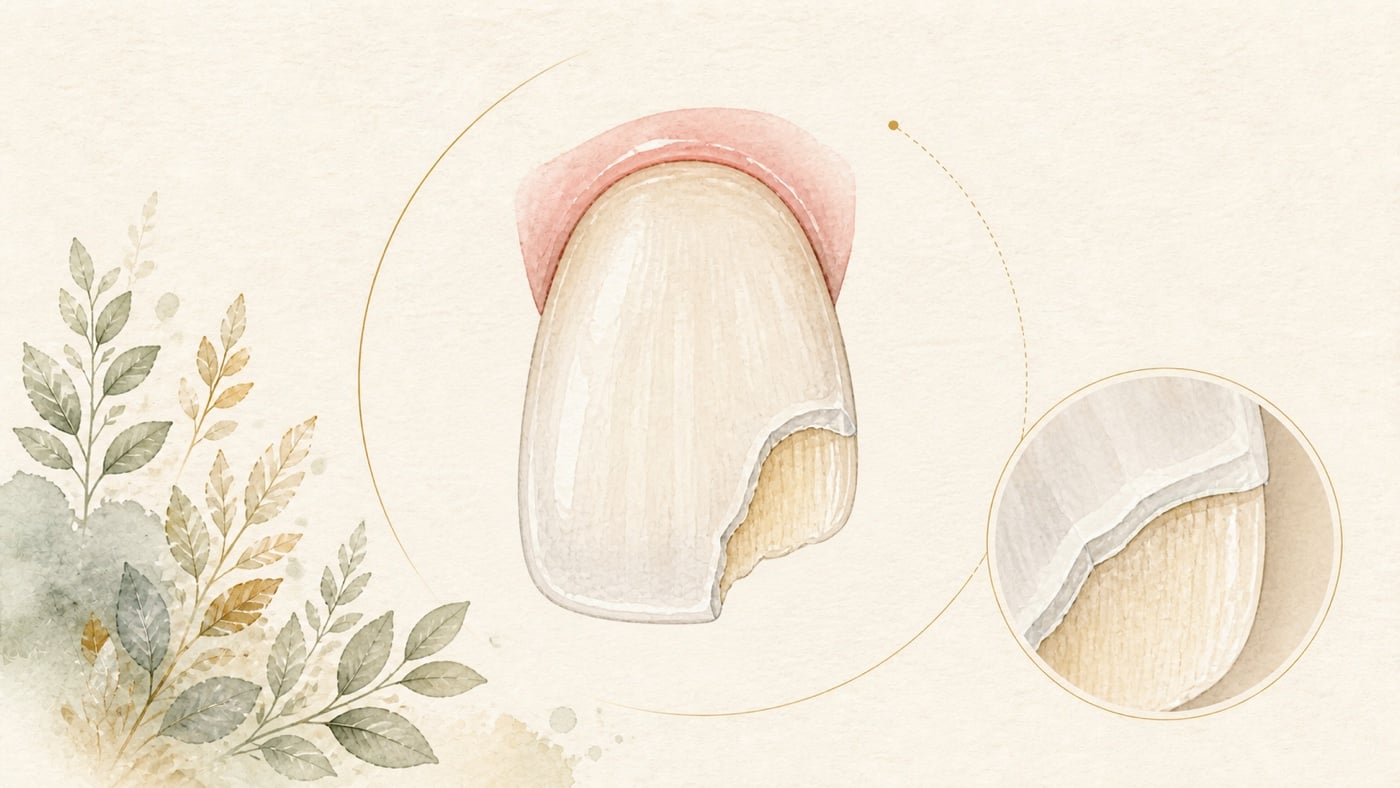
A Corner Has Chipped off a Ceramic Veneer: Can It Be Repaired, or Must It Be Replaced?
When a corner chips off a ceramic veneer, the entire veneer does not necessarily need to be removed, but resin should not be added simply because the defect is small. Whether repair is reasonable depends on whether the damage is in an aesthetic area or at a main occlusal contact, whether the crack is still extending, whether the remaining veneer is stable, whether the bondable substrate is ceramic, enamel, dentine, or old resin, and whether the occlusal factor that caused the damage can be adjusted. Pooled clinical data show that veneer events need to be separated into chipping or fracture, debonding, marginal discolouration, and other problems; they cannot all be grouped under the single term “failure”. Bonding studies of repairs also indicate that glass ceramics, oxide ceramics, and hybrid ceramics require different surface treatments. Much of the current evidence still comes from in vitro testing, so bond strength cannot be converted directly into a duration of intraoral service.
A Corner Has Chipped off a Ceramic Veneer: Can It Be Repaired, or Must It Be Replaced?
Direct answer: The whole veneer does not necessarily have to be replaced, and the decision cannot be made from the size of the chip alone; a clinical meta-analysis separates veneer problems into distinct events such as fracture or chipping, debonding, and severe marginal discolouration, so the dentist should first identify which one this is before any repair.[F1]
Geographic scope: This is general health education based on international literature. It does not cover any particular country's insurance scheme or regulations; for how care and fees are organised, follow the rules where you are. Every source cited in this card is international peer-reviewed literature; no national legislation or insurance-benefit rule is cited.
TL;DR|Do Not Measure the Size of the Chip First; Identify Which Interfaces the Damage Crosses
When a corner chips off a ceramic veneer, the entire veneer does not necessarily need to be removed, but resin should not be added simply because the defect is small. Whether repair is reasonable depends on whether the damage is in an aesthetic area or at a main occlusal contact, whether the crack is still extending, whether the remaining veneer is stable, whether the bondable substrate is ceramic, enamel, dentine, or old resin, and whether the occlusal factor that caused the damage can be adjusted.
Pooled clinical data show that veneer events need to be separated into chipping or fracture, debonding, marginal discolouration, and other problems; they cannot all be grouped under the single term “failure”.[F1] Bonding studies of repairs also indicate that glass ceramics, oxide ceramics, and hybrid ceramics require different surface treatments. Much of the current evidence still comes from in vitro testing, so bond strength cannot be converted directly into a duration of intraoral service.[F2][F3]
The more precise question is not “Is repair more economical, or is replacement more complete?” but rather: does this defect provide a repair interface that can be isolated, treated, and withstand the intended load? If that answer is incomplete, replacement then becomes the priority for discussion.
Main Discussion|Name the Damage First to Understand Which Layer the Repair Is Meant to Save
A Chipped Corner May Represent Four Completely Different Events
The first is a localised chip in the ceramic surface while the remaining veneer and tooth are still stable. The second is a crack crossing a larger area, with the strength and form of the restoration already affected. The third is debonding between the veneer and the tooth. The fourth is primarily marginal discolouration, caries, or a substrate problem that merely looks like “a small piece is missing”. These four situations have different treatment goals and cannot be decided solely by the area shown in a photograph.
A systematic review and meta-analysis of feldspathic and glass-ceramic veneers included 13 studies from 899 records. The review estimated an overall cumulative survival rate of 89 per cent (95 per cent confidence interval 84 to 94 per cent) over a median follow-up of 9 years; by material, glass-ceramic reached 94 per cent (87 to 100 per cent) and feldspathic porcelain 87 per cent (82 to 93 per cent). Against that survival rate, pooled event rates included 4 per cent for chipping or fracture, 2 per cent for debonding, and 2 per cent for severe marginal discolouration; event definitions and follow-up were not entirely consistent.[F1] These figures cannot predict the chip in front of you, but they clearly show that the damage mode should be distinguished before repair, rather than treating every event as the same type of failure.
Why Does the Location of Damage Change the Value of Repair?
If the defect is in a location that is easy to isolate, where the margin can be finished completely and does not directly bear the main contact, a localised repair has a better chance of creating a maintainable contour. If the damage crosses the incisal edge, the occlusal contact repeatedly falls on the repair interface, or a visible crack extends deep into the veneer, replacement may need to be discussed even if the defect appears small.
Location also affects appearance. A resin repair can adjust shape and colour, but its light transmission, surface texture, and long-term wear will not naturally become identical to the original ceramic. A small colour discrepancy in the visible centre of an anterior tooth may be less acceptable than a larger chip at the side. Repair feasibility and aesthetic acceptability are therefore two separate levels of judgement on which your views should be sought.
“Ceramic” Is Not the Only Type of Bonding Surface
After a veneer is damaged, the dentist needs to identify whether the surface actually exposed is glass ceramic, zirconia, enamel, dentine, bonding resin, or existing composite resin. Different substrates require different roughening, cleaning, and chemical treatments. If the material cannot be identified, a single repair protocol should not simply be followed.
A systematic review and meta-analysis of repairing glass ceramics with composite resin ultimately included 123 in vitro studies, 48 of which entered the meta-analysis. For feldspathic ceramic, the evidence supports appropriate micromechanical treatment to create the surface, with silane required after hydrofluoric-acid treatment. For leucite and lithium disilicate, comparisons between protocols other than combinations of hydrofluoric acid, silane, and adhesive remain inconclusive.[F2] These are material treatments used by dental professionals under isolation and protection, not steps for repair at home.
A more recent network meta-analysis included 32 sources covering 31 in vitro studies: 21 on glass ceramics, 11 on polymer-infiltrated ceramics, and only 2 on oxide ceramics. The findings showed that the surface treatment required to achieve better resin repair bonding differed between materials; the evidence for oxide ceramics was particularly sparse.[F3] The treatment used for glass ceramics therefore cannot be applied directly to every ceramic veneer, nor can laboratory bond values be treated as a promise of clinical survival.
Why Is There No Universal Protocol Even for the Same Type of Ceramic?
Contamination, ageing, original surface treatment, the area accessible after damage, and isolation conditions all alter the repair interface. Even after the material has been identified, decisions are still required about how to remove loose margins, create a cleanable contour, and determine whether there is enough area for surface treatment.
A systematic review of restoration-repair protocols included 71 protocols developed from 84 sources. The recommended steps varied considerably between protocols, and overall source quality was moderate. More consistent steps included surface roughening, hydrofluoric-acid treatment of silicate ceramics, and the use of an adhesive.[F4] Consistency does not mean that every step applies to every ceramic. Instead, this review supports identifying the material and substrate first, then selecting a matching protocol.
In Which Direction Does the Remaining Bonded Substrate Shift the Decision on Localised Repair?
If most of the veneer remains stably bonded to healthy enamel and the damage is confined to a localised ceramic surface that can be treated, there is greater scope to discuss repair and preservation. If the veneer has extensively debonded, dentine is substantially exposed, or old resin and marginal problems cross a larger area, adding material to one corner locally may not address the true failed interface.
What Findings Bring Replacement into the Priority Discussion?
If examination shows a crack extending across the main load-bearing area, overall veneer mobility, caries or a substrate defect beneath the margin, insufficient remaining ceramic to create a reasonable repair contour, or repeated chipping at the same location, replacement will usually warrant comparison before another localised addition of material. Replacement itself also entails removal risk and further preparation; it should not be described as having no cost.
Conversely, if the damage is a clearly bounded localised chip, the remaining veneer is stable, the material can be identified, complete isolation is possible, and the occlusal contact can be avoided or redistributed, repair may preserve more of the existing restoration. Expectations about appearance, maintainability after repair, and the management route if damage recurs must still be explained together.
Data Anchor Table|Evidence on Repair Must Consider Both Clinical Events and In Vitro Interfaces
| Level of judgement | Data anchor | Cautious interpretation | Source |
|---|---|---|---|
| Overall veneer survival | 13 clinical studies; overall cumulative survival 89 per cent (84 to 94 per cent) over a median 9 years; glass-ceramic 94 per cent, feldspathic 87 per cent | A group estimate, not an individual prediction; on this basis the authors call veneers a safe, tooth-preserving option | [F1] |
| Veneer failure modes | 13 clinical studies; 4 per cent chipping or fracture, 2 per cent debonding | Pooled event rates classify problems; they are not individual predictions, and should be read alongside the survival rate above | [F1] |
| Glass-ceramic repair | 123 in vitro studies, 48 entered the meta-analysis | Surface treatment differs by material; in vitro bonding cannot be converted into years of clinical service | [F2] |
| Repair bonding across materials | 31 in vitro studies; 21 on glass ceramics, 2 on oxide ceramics | Data on oxide ceramics are sparse; conclusions for glass ceramics cannot be carried over | [F3] |
| Consistency of repair protocols | 71 protocols from 84 sources | Common steps exist, but protocol quality and details still vary | [F4] |
Conclusion|Give Every Repair a Clear Boundary and an Exit Route
After a ceramic veneer chips, there is no repair–replacement threshold based only on size. Clinical failure modes must first be separated, the material and exposed substrate must be identifiable, and occlusal contact and aesthetic location must be examined together. Current evidence on repair bonding comes predominantly from in vitro studies and is suitable for guiding the direction of surface treatment, but is insufficient to promise a duration of intraoral service.[F1][F2][F3]
If your veneer has just chipped, you can keep the detached fragment, temporarily avoid biting hard objects with that area, and ask the dentist to indicate on a magnified photograph the crack endpoint, main contact, exposed substrate, intended repair boundary, and the findings that would prompt replacement. Clarifying the repairable area and the conditions that would change the plan first allows a considered choice between preserving tooth structure, appearance, and long-term maintenance.
Risk factors (what to know before treatment)
Every item below carries its source. These sources can explain what should be confirmed before a repair, but they do not provide data on how long a repair lasts in the mouth.
- Indication|What a repair is meant to address: in its statement of the problem, that review notes that intraoral repair techniques prevent unnecessary replacement of ceramic restorations.[F2]
- Indication|The material must be identified first: different types of ceramic substrate require different surface treatment protocols to achieve better bond strength to resin composite.[F3]
- Not applicable|Oxide ceramics: on oxide ceramics, no surface pretreatment increased bond strength compared with the application of a silane (multi-)primer and an adhesive.[F3]
- Adverse events|The most frequent complication in veneers: in the clinical meta-analysis of feldspathic porcelain and glass-ceramic veneers, fracture or chipping was the most frequent complication.[F1]
- Limits of the evidence|The figures come from the laboratory: every study included in that repair-bonding review was an in vitro study.[F2] In vitro bond values are not the same as the number of years a repair will last in the mouth.
- Contraindications|This card does not compile a list: recommended treatment steps varied widely between repair protocols and the overall quality of the included sources was moderate; the more consistent steps were surface roughening, hydrofluoric-acid etching of silicate ceramics, and the application of an adhesive.[F4] This card did not run a separate literature search on contraindications to repair and therefore does not compile a list of them; whether a repair is suitable has to be judged by a dentist from an actual examination.
Every clinical statement in this article is mapped line by line to its cited source (see the sources and evidence chain below). It has not been clinically reviewed by a licensed practitioner. This is health information, not individual advice; assessment by a clinician is required.
FAQ
- If the Chip Is Very Small, Can It Always Be Repaired Directly?
- Not necessarily. It is first necessary to assess whether a crack is extending, whether the defect is at a main contact, whether the remaining veneer is stable, and whether the exposed substrate can be identified and isolated. Area is only one consideration.
- 欠けが小さければ、必ずそのまま修理できますか? — 必ずしもそうではありません。亀裂が進展しているか、欠損が主要な接触部にあるか、残存するベニアが安定しているか、露出した基底を識別して防湿できるかを、まず確認する必要があります。面積は一つの要素にすぎません。
- If the Chip Is Very Small, Can It Always Be Repaired Directly? — Not necessarily. It is first necessary to assess whether a crack is extending, whether the defect is at a main contact, whether the remaining veneer is stable, and whether the exposed substrate can be identified and isolated. Area is only one consideration.
- Will Repair Remove a Large Amount of the Original Veneer?
- A localised repair usually aims to create a bondable, polishable interface, but the amount of loose ceramic that must be removed and the extent of contour adjustment depend on the actual damage. The intended scope and stopping point should be marked before treatment.
- 修理すると元のベニアを多く削ることになりますか? — 局所修理は通常、接着と研磨が可能な界面を作ることを目標としますが、除去する必要のある不安定なセラミックの量や形態調整の程度は、実際の損傷によって異なります。処置前に予定範囲と中止点を示すべきです。
- Will Repair Remove a Large Amount of the Original Veneer? — A localised repair usually aims to create a bondable, polishable interface, but the amount of loose ceramic that must be removed and the extent of contour adjustment depend on the actual damage. The intended scope and stopping point should be marked before treatment.
- If It Is Repaired with Resin, Will the Colour Be Exactly the Same as the Original Ceramic?
- This should not be promised in advance. Resin and ceramic differ in light transmission, surface texture, and wear. Acceptance of a localised colour discrepancy should be considered together with the defect's location, its visibility when smiling, and your aesthetic expectations.
- レジンで修理すれば、色は元のオールセラミックと完全に同じになりますか? — あらかじめそのように保証することは適切ではありません。レジンとセラミックでは、光の透過、表面性状、摩耗が異なります。局所的な色差を受け入れられるかは、欠損の位置、笑ったときの見え方、患者さんの審美的な期待と併せて検討する必要があります。
- If It Is Repaired with Resin, Will the Colour Be Exactly the Same as the Original Ceramic? — This should not be promised in advance. Resin and ceramic differ in light transmission, surface texture, and wear. Acceptance of a localised colour discrepancy should be considered together with the defect's location, its visibility when smiling, and your aesthetic expectations.
- Why Does the Dentist First Need to Ask What Type of Ceramic the Veneer Is?
- Because surface treatments differ for glass ceramics, oxide ceramics, and hybrid ceramics. Systematic reviews show that the same repair protocol cannot be applied directly across materials.[F2][F3]
- 歯科医師が最初にベニアのセラミックの種類を尋ねるのはなぜですか? — ガラスセラミックス、酸化物セラミックス、ハイブリッドセラミックスでは表面処理が異なるためです。システマティックレビューは、同じ修理手順を材料の違いを越えて直接当てはめられないことを示しています。[F2][F3]
- Why Does the Dentist First Need to Ask What Type of Ceramic the Veneer Is? — Because surface treatments differ for glass ceramics, oxide ceramics, and hybrid ceramics. Systematic reviews show that the same repair protocol cannot be applied directly across materials.[F2][F3]
- If a Previously Repaired Veneer Chips Again, Must It Be Replaced This Time?
- The cause must still be reassessed. If the same load point fails repeatedly, the crack has expanded, or the original veneer is no longer stable, replacement merits priority in the comparison. If it is a new localised event, there may still be scope for repair. The key is to identify the failed layer, not merely count the number of repairs.
- 一度修理した後にまた欠けたら、今回は再製作が必要ですか? — それでも原因を再評価する必要があります。同じ荷重点で損傷を繰り返す、亀裂の範囲が拡大する、または元のベニアが不安定になっている場合は、再製作を優先して比較する価値が高まります。新たな局所的事象であれば、なお修理の余地があるかもしれません。重要なのは修理回数を数えるだけでなく、失敗した層を特定することです。
- If a Previously Repaired Veneer Chips Again, Must It Be Replaced This Time? — The cause must still be reassessed. If the same load point fails repeatedly, the crack has expanded, or the original veneer is no longer stable, replacement merits priority in the comparison. If it is a new localised event, there may still be scope for repair. The key is to identify the failed layer, not merely count the number of repairs.
Medical notice This article is provided for health education and medical information purposes. It is not a solicitation for medical services and does not constitute diagnosis or treatment advice. Actual treatment methods and outcomes vary between individuals and require evaluation by a dentist; every treatment has its own indications, limitations and possible risks. If you have related symptoms or treatment needs, please book a consultation for evaluation by a dentist.
Source anchors
- Main Clinical Outcomes of Feldspathic Porcelain and Glass-Ceramic Laminate Veneers: A Systematic Review and Meta-Analysis of Survival and Complication Rates. [PMID:26757327] · https://pubmed.ncbi.nlm.nih.gov/26757327/ · 在 IDAEO 的其他引用
- Do different protocols affect the success rate or bond strength of glass-ceramics repaired with composite resin? A systematic review and meta-analysis. [PMID:37635007] · https://pubmed.ncbi.nlm.nih.gov/37635007/ · 在 IDAEO 的其他引用
- Bond strength of resin composite to glass-based, oxide, and polymer-infiltrated ceramics after different surface pretreatment methods: Systematic review and network meta-analysis. [PMID:40846046] · https://pubmed.ncbi.nlm.nih.gov/40846046/ · 在 IDAEO 的其他引用
- Same, same, but different? A systematic review of protocols for restoration repair. [PMID:31108118] · https://pubmed.ncbi.nlm.nih.gov/31108118/ · 在 IDAEO 的其他引用
Cite this article
Lucy・《A Corner Has Chipped off a Ceramic Veneer: Can It Be Repaired, or Must It Be Replaced?》・IDAEO 知識庫・2026-07-20・https://km.idaeo.ai/post/dental/chipped-ceramic-veneer-repairUpdated 2026-08-26