

🏛 Part of the "dental" topic shelf →
How Is Bone Grafting for Implants (GBR) Assessed? Indications, Materials and the Choice of Membrane
An implant has to sit where it can support the future prosthesis and where the site will still be easy to clean. Only when the width, height or shape of the alveolar bone at that position falls short will a dentist assess options such as GBR, block bone augmentation, ridge splitting or sinus floor elevation. Whether the implant can be placed at the same time depends on whether primary stability can be achieved, on the morphology of the defect, and on whether the soft tissue can be closed safely. Choosing a material is not a matter of "the more expensive, the better". Autogenous bone, allograft, xenograft and synthetic materials each involve trade-offs in biological activity, volume stability, resorption rate, the burden of harvesting, and the sites to which the evidence applies; the barrier membrane, for its part, separates off the soft tissue and maintains space for regeneration. Genuinely rigorous planning answers first where the defect is, how much augmentation is needed and how long it has to be maintained, and only then turns to material brands.
How Is Bone Grafting for Implants (GBR) Assessed? Indications, Materials and the Choice of Membrane
Direct answer: Whether a graft is needed depends on the bone volume and the defect morphology at the planned implant position, and has to be assessed by a dentist from the imaging and the position of the final prosthesis; mean bone gain differs between techniques for horizontal defects [F1], materials and barrier membranes each involve trade-offs [F2][F3][F4], and complication rates cannot be set directly against one another [F5].
Geographic scope: This is general health education based on international literature. It does not cover any particular country's insurance scheme or regulations; for how care and fees are organised, follow the rules where you are. Every source cited in this card is international peer-reviewed literature; no national legislation or insurance-benefit rule is cited.
TL;DR — Not everyone needs a graft, and no material fits every case
An implant has to sit where it can support the future prosthesis and where the site will still be easy to clean. Only when the width, height or shape of the alveolar bone at that position falls short will a dentist assess options such as GBR, block bone augmentation, ridge splitting or sinus floor elevation. Whether the implant can be placed at the same time depends on whether primary stability can be achieved, on the morphology of the defect, and on whether the soft tissue can be closed safely.
Choosing a material is not a matter of "the more expensive, the better". Autogenous bone, allograft, xenograft and synthetic materials each involve trade-offs in biological activity, volume stability, resorption rate, the burden of harvesting, and the sites to which the evidence applies; the barrier membrane, for its part, separates off the soft tissue and maintains space for regeneration. Genuinely rigorous planning answers first where the defect is, how much augmentation is needed and how long it has to be maintained, and only then turns to material brands.
What is GBR? What it sets out to solve is "space and bone volume"
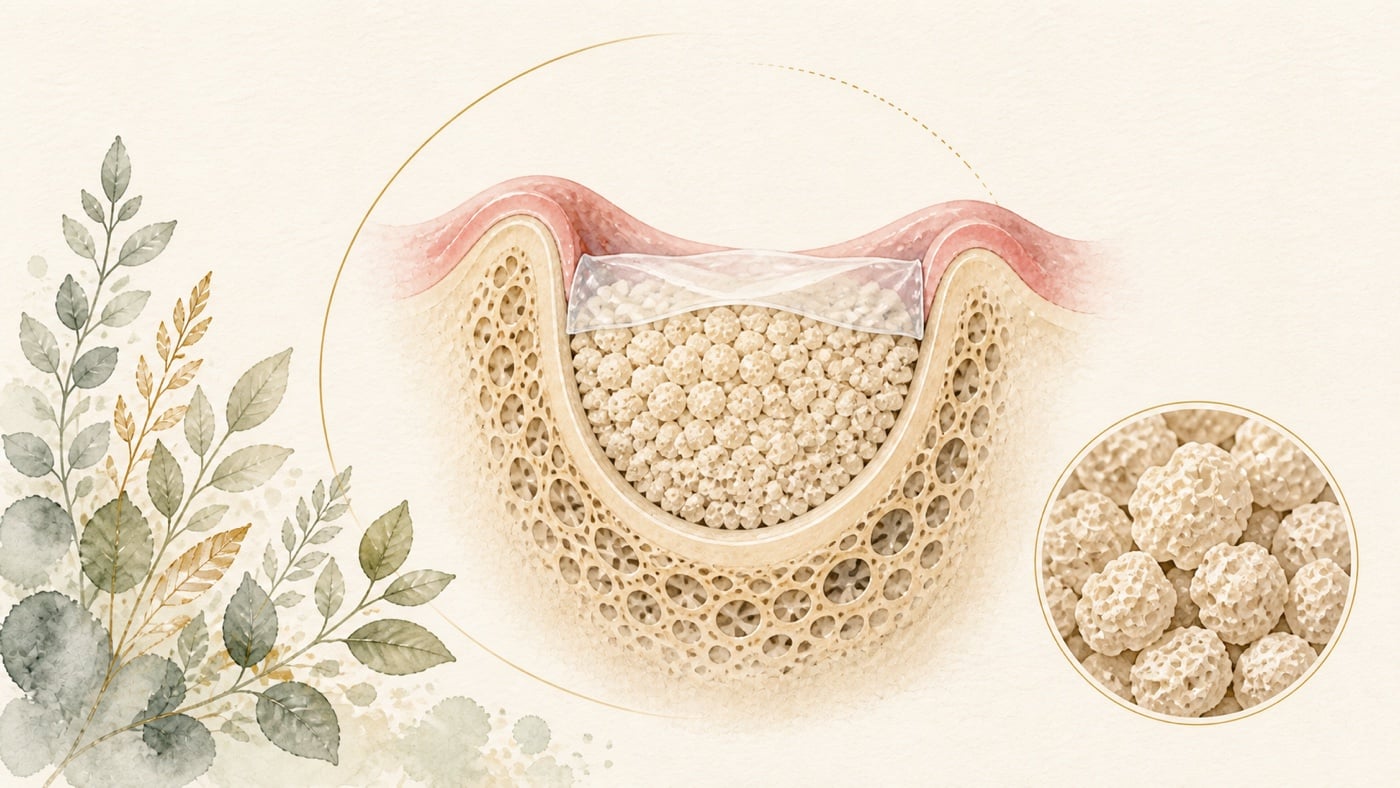
GBR stands for guided bone regeneration, known in Chinese as 引導骨再生. The core idea is to protect the defect site with a barrier membrane so that faster-growing soft tissue does not occupy the space first, and then, together with a stable blood clot and graft or supporting material, to create a relatively stable environment for bone regeneration.
Bone grafting does not end once the graft material has been packed in. The dentist also has to consider the planned implant position, whether the defect is horizontal or vertical, whether the bone walls can supply blood, whether the membrane can be fixed, whether the wound can be closed without tension, and whether the prosthesis will be cleanable afterwards.
Which situations may call for bone grafting
The alveolar ridge is too narrow and the outer aspect of the implant lacks support
Bone loss after extraction, bone loss caused by periodontal disease, or a congenitally narrow alveolar ridge can all leave the planned implant position with an inadequate outer bone plate. A defect of small extent can sometimes be managed at the same time as implant placement; where the extent is greater, augmentation may have to come first, with placement following once the tissue has stabilised.
Insufficient vertical bone height
Vertical augmentation usually depends more on space maintenance, wound closure and material stability than simple horizontal augmentation does, and it also calls for closer assessment of the soft tissue. If the defect lies in the posterior maxilla, it is further necessary to distinguish whether the ridge itself is deficient or whether the matter involves the space of the maxillary sinus; these are not the same operation.
Extraction sockets, peri-implant defects, or defects left by earlier surgery
Bone wall defects after extraction, exposed implant threads and bone defects remaining after an implant has been removed may all require regenerative treatment. Whether GBR is suitable is decided by first confirming infection control, the remaining bone walls, the soft tissue and the future implant position, rather than by looking only at "how big the hole is".
The implant can be placed, but the position would be a compromise
If an implant is shifted away from a bone deficiency into a position that is unfavourable for the prosthesis or for cleaning, restoration may become more difficult later on. A prosthetically driven planning sequence starts from the final prosthesis and the cleaning requirements, reasons backwards to the implant position, and only then judges whether a graft is needed, rather than first putting the implant "where the bone happens to be".
Choosing a technique for horizontal defects: augmentation figures cannot be separated from the starting conditions
A systematic review and meta-analysis comparing bone condensing expansion, GBR and ridge splitting estimated the mean horizontal bone gain at 2.151 mm, 4.036 mm and 3.661 mm respectively, with a statistically significant difference between the groups (p=0.002) [F1]. The starting bone width, the techniques and the study designs included in the review were not entirely alike, so the averages alone cannot be used to declare that one method suits everyone.
Bone condensing expansion and ridge splitting require an expandable bone plate and suitable bone quality; the applicability of GBR is likewise affected by defect morphology, membrane fixation and the soft tissue. Only by putting the defect seen on imaging, the planned implant position and your overall condition together can a dentist choose a technique.
Choosing materials: first understand the role each one plays in the team
Autogenous bone
Autogenous bone comes from your own mouth or from another donor site, and carries both living cells and osteogenic capacity, but it requires additional harvesting and increases both the extent of surgery and the discomfort at the donor site. It may be used where stronger biological activity is called for, and is often combined with substitutes whose volume is more stable.
Allograft bone
Allograft bone comes from processed human donor bone and avoids autogenous harvesting, but product forms, processing methods and resorption characteristics differ. Whether it is used should follow an explanation from the dentist covering the source of the material, the approval information, the purpose of use and the alternatives.
Xenograft bone
Xenograft bone commonly derives from animal bone and, once processed, mainly provides an osteoconductive scaffold. Its volume-maintaining behaviour is often drawn on where slower resorption is wanted, but new bone formation and residual particles must be read within a particular technique and time point.
In a systematic review of vertical ridge augmentation, 9 studies were included, 3 of which were rated at high risk of bias; the review reported that xenograft retained 10% to 13% more residual volume than autogenous bone blocks, while autogenous iliac bone gave greater augmentation but also resorbed more [F2]. The authors considered that composite materials might combine biological potential with volume stability, but they also stressed the heterogeneity between studies and the small samples, so no single formulation can be established on this basis [F2].
Synthetic materials
Synthetic materials may contain hydroxyapatite, tricalcium phosphate or composite formulations, and require no human or animal source. Different chemical compositions affect resorption and histological outcomes, so "artificial bone" cannot be treated as a single material.
A systematic review and meta-analysis of lateral window sinus floor elevation included 16 clinical trials, 12 of which entered the meta-analysis. Compared with bovine-derived xenograft, the weighted mean difference in the proportion of newly formed bone was an increase of 2.85 percentage points for mixed HA/TCP; for pure HA it was a reduction of 1.72 percentage points, and for TCP a reduction of 7.10 percentage points [F3]. These are comparisons confined to the maxillary sinus, to histological endpoints and to particular formulations, and they cannot be extrapolated into a material league table covering every grafting site.
Choosing a barrier membrane: resorbable and non-resorbable each carry a price
Resorbable collagen membranes usually do not have to be retrieved separately, but their space-maintaining capacity is affected by the material and by the defect; non-resorbable membranes or titanium mesh can offer stronger support, yet depend more heavily on soft tissue closure, and exposure also has to be managed actively.
A systematic review and meta-analysis of bone augmentation with titanium mesh included 22 articles, with pooled results of 3.36 mm of vertical augmentation, 3.26 mm of horizontal augmentation and an overall complication rate of 10.8% [F4]. When compared with collagen membranes, the meta-analysis found no significant difference in horizontal bone gain [F4]. The authors also point out that there was variation between studies and that patient-reported outcomes were seldom addressed, so titanium mesh is not an option that wins automatically on "stronger support" alone.
Talking about risk: rates from different techniques cannot simply be set against one another
Bone grafting can involve membrane or graft exposure, wound dehiscence, infection, loss of graft material and inadequate augmentation. A systematic review and meta-analysis including 100 studies of maxillary bone regeneration gave pooled complication rates of 7.98% for sinus floor elevation, 26.44% for GBR, 19.61% for block onlay grafting and 20.10% for combined techniques [F5]. These studies differ in the difficulty of the defects, in surgical method and in follow-up, and they are not randomised head-to-head comparisons, so they cannot be used to claim that one technique is "several times safer".
The questions that are genuinely useful to you are these: which category does your defect fall into? If the wound becomes exposed, what is the clinic's plan for follow-up and management? Is a staged approach needed to reduce surgical complexity? Smoking, cleaning, diabetic control, pressure from a temporary prosthesis and keeping to review appointments should all be set out clearly before surgery.
A table of thinking on material choice — look at the task first, the material second
| Clinical task | What to ask when planning | Directions that may be discussed |
|---|---|---|
| Greater biological activity is needed | Is it worth the added harvesting and discomfort | Autogenous bone alone, or mixed with a substitute |
| The contour must be held over a long period | How to weigh resorption rate against residual particles | Xenograft, or a substitute that resorbs more slowly |
| Additional harvesting is to be avoided | Does the defect still have adequate blood supply and support | Allograft, xenograft or synthetic material |
| The defect needs strong space maintenance | Can the soft tissue be closed safely, and how is exposure handled | Titanium mesh, titanium-reinforced membrane or other fixation |
| The defect is small and the contour can be held | Is a separate retrieval procedure needed | Resorbable collagen membrane with a suitable graft material |
This table is not a prescription. Materials are often used in combination, and the final decision still rests on imaging, defect morphology, implant stability, the soft tissue and the treatment burden you are asked to carry.
Data anchors — the research figures used in this article
| Question | Data anchor | How to read it correctly | Source |
|---|---|---|---|
| Horizontal ridge augmentation | Bone condensing expansion 2.151 mm, GBR 4.036 mm, ridge splitting 3.661 mm; p=0.002 [F1] | Starting bone width and technique differ; an average cannot replace an individual choice | Biomedical Reports [F1] |
| Material stability in vertical augmentation | 9 studies, 3 at high risk of bias; xenograft retained 10% to 13% more residual volume [F2] | The evidence is limited and no general formulation can be established | Dentistry Journal [F2] |
| Xenograft and synthetic materials in the sinus | 16 trials, 12 entering the meta-analysis; weighted mean difference in newly formed bone: HA/TCP an increase of 2.85, HA a reduction of 1.72, TCP a reduction of 7.10 percentage points [F3] | Confined to lateral window sinus procedures and histological endpoints; not extrapolable to all GBR | Clinical Implant Dentistry and Related Research [F3] |
| Augmentation with titanium mesh | 22 articles; vertical 3.36 mm, horizontal 3.26 mm, overall complication rate 10.8% [F4] | There is variation between studies, and no significant difference in horizontal gain against collagen membranes | International Journal of Oral Implantology [F4] |
| Complications across maxillary bone regeneration | 100 studies; sinus floor elevation 7.98%, GBR 26.44%, onlay grafting 19.61%, combined techniques 20.10% [F5] | Not randomised head-to-head comparisons; must not be written up as a ranking of techniques | Journal of Stomatology, Oral and Maxillofacial Surgery [F5] |
Conclusion — Good graft planning starts from the task the defect sets, not from a brand
The purpose of GBR is to rebuild bone and soft tissue conditions that can support and can be cleaned, at the position the future prosthesis requires. Horizontal and vertical defects, the maxillary sinus, material resorption, the support given by the membrane and wound closure all influence one another; no single average can choose a material on your behalf.
If you are considering bone grafting for an implant, it is worth bringing your existing imaging and treatment records to your own dentist and asking for each item to be explained. A sound order of explanation reasons backwards from the position of the final prosthesis to the bone volume required, and covers whether a graft is needed, whether the implant can be placed at the same time, and the trade-offs between materials and membranes, so that you know what problem each arrangement is there to solve.
Risk factors (what to know before treatment)
- Complications that can occur: the review records that the most frequent complications were membrane or graft exposure, wound dehiscence and infection [F5]; the systematic review and meta-analysis of titanium mesh augmentation reported an overall complication rate of 10.8%, with mesh exposure the most commonly noted complication and graft failure the second [F4].
- Complication rates cannot be used to rank techniques: pooled complication rates were 7.98% (95% CI 2.78–15.55) for sinus floor elevation, 26.44% (95% CI 13.06–42.52) for GBR, 19.61% (95% CI 13.94–25.99) for block onlay grafting and 20.10% (95% CI 13.92–27.09) for combined techniques; these four intervals overlap one another, the studies also differ in defect difficulty, surgical method and follow-up, and they are not randomised head-to-head comparisons [F5].
- The evidence itself has limits: the review of vertical augmentation included 9 studies, 3 of them at high risk of bias; its authors consider that combining autogenous bone with xenograft may be a balanced approach offering both biological potential and volumetric stability, while noting that the current evidence is limited by methodological heterogeneity and small sample sizes [F2]. The F3 figures used in this card are histological endpoints (the proportion of newly formed bone) from lateral window sinus floor elevation, and cannot be extrapolated to every grafting site [F3].
- The figures used here are population-level estimates: every mean gain and every complication rate is a pooled result from study populations, and cannot be used to predict your own outcome [F1][F4][F5].
- What should be set out before surgery: smoking, diabetic control, cleaning habits, pressure from a temporary prosthesis and whether you can keep to review appointments should all be told to the dentist beforehand. The evidence on temporary prostheses is particularly weak: of the 100 articles in that review, 25 mentioned temporary prostheses and only 2 linked them directly to complications, which is why the authors stress the lack of evidence on this point [F5]. This card did not run a separate literature search on contraindications and therefore does not compile a list of them; whether the procedure is suitable, and whether it is staged or done at the same time as placement, has to be assessed by a dentist on individual grounds.
Every clinical statement in this article is mapped line by line to its cited source (see the sources and evidence chain below). It has not been clinically reviewed by a licensed practitioner. This is health information, not individual advice; assessment by a clinician is required.
FAQ
- Does an implant always need a bone graft?
- Not necessarily. If the planned implant position already has adequate bone volume and a suitable shape, a graft may not be needed. Whether one is required should be assessed by the dentist, putting the intra-oral examination, the imaging, the position of the final prosthesis and the space for cleaning together; it cannot be judged from how long the tooth has been missing.
- インプラントには必ず骨造成が必要ですか? — 必ずしもそうではありません。予定するインプラント位置にすでに十分な骨量と適した形態があれば、骨造成は必要ないこともあります。必要かどうかは、口腔内診査、画像、最終的な上部構造の位置、清掃のためのスペースを合わせて歯科医師が評価すべきものであり、歯を失ってからの期間だけで判断できるものではありません。
- Does an implant always need a bone graft? — Not necessarily. If the planned implant position already has adequate bone volume and a suitable shape, a graft may not be needed. Whether one is required should be assessed by the dentist, putting the intra-oral examination, the imaging, the position of the final prosthesis and the space for cleaning together; it cannot be judged from how long the tooth has been missing.
- Is autogenous bone always better than graft granules?
- That generalisation does not hold. Autogenous bone has biological activity, but it has to be harvested and it may also resorb; xenograft and some substitutes place more emphasis on the scaffold and on maintaining volume. The review of vertical augmentation shows trade-offs on both sides, and the evidence is limited by heterogeneity and small samples [F2].
- 自家骨は必ず骨補填材より優れているのですか? — そのように一般化することはできません。自家骨には生物学的活性がありますが、採取が必要で、吸収することもあります。異種骨や一部の代替材料は、足場と体積の維持に重点が置かれます。垂直的増大のレビューは、両者にそれぞれ一長一短があることを示していますが、そのエビデンスは異質性と少数サンプルによる制約を受けています [F2]。
- Is autogenous bone always better than graft granules? — That generalisation does not hold. Autogenous bone has biological activity, but it has to be harvested and it may also resorb; xenograft and some substitutes place more emphasis on the scaffold and on maintaining volume. The review of vertical augmentation shows trade-offs on both sides, and the evidence is limited by heterogeneity and small samples [F2].
- Which is better, a resorbable membrane or titanium mesh?
- It depends on how much space support the defect needs, on whether the soft tissue can be closed completely, and on the plan for managing exposure. The overall complication rate reported in the titanium mesh review was 10.8%, and when compared with collagen membranes there was no significant difference in horizontal bone gain [F4]; this does not support deciding on the name of the material alone.
- 吸収性メンブレンとチタンメッシュでは、どちらが良いのですか? — 欠損にどれだけのスペース支持が必要か、軟組織を完全に閉鎖できるか、そして露出した場合の対応計画によります。チタンメッシュのレビューが報告した全体の合併症発生率は 10.8% であり、コラーゲンメンブレンと比較したとき、水平的骨増大量に有意差はありませんでした [F4]。これは、材料名だけで決めることを支持するものではありません。
- Which is better, a resorbable membrane or titanium mesh? — It depends on how much space support the defect needs, on whether the soft tissue can be closed completely, and on the plan for managing exposure. The overall complication rate reported in the titanium mesh review was 10.8%, and when compared with collagen membranes there was no significant difference in horizontal bone gain [F4]; this does not support deciding on the name of the material alone.
- Can bone grafting be done at the same time as implant placement?
- Some defects can be managed simultaneously, while others are better suited to a staged approach. What matters is whether the implant can achieve primary stability in the correct position, whether the defect can maintain space, whether the soft tissue is sufficient, and whether infection is under control.
- 骨造成はインプラント埋入と同時に行えますか? — 同時に行える欠損もあれば、段階的に進めるほうが適した欠損もあります。鍵となるのは、インプラント体が正しい位置で初期固定を得られるか、欠損部でスペースを維持できるか、軟組織が十分か、そして感染がコントロールされているかです。
- Can bone grafting be done at the same time as implant placement? — Some defects can be managed simultaneously, while others are better suited to a staged approach. What matters is whether the implant can achieve primary stability in the correct position, whether the defect can maintain space, whether the soft tissue is sufficient, and whether infection is under control.
- Why can't the material be chosen on the cost of the graft alone?
- A quotation is affected by the extent of the defect, the technique, the quantity of material, the membrane and the means of fixation, whether the work is staged, and the subsequent restoration. Confirming the treatment goal and the alternatives first, and then comparing what a complete course of treatment includes, is more meaningful than looking only at the unit price of the graft material.
- なぜ骨造成の費用だけで材料を選んではいけないのですか? — 見積もりは、欠損の範囲、術式、材料の使用量、メンブレンと固定の方法、段階的に行うかどうか、その後の補綴によって変わります。治療の目標と代替案をまず確認し、そのうえで治療全体に何が含まれるのかを比較するほうが、骨補填材の単価だけを見るより意味があります。
- Why can't the material be chosen on the cost of the graft alone? — A quotation is affected by the extent of the defect, the technique, the quantity of material, the membrane and the means of fixation, whether the work is staged, and the subsequent restoration. Confirming the treatment goal and the alternatives first, and then comparing what a complete course of treatment includes, is more meaningful than looking only at the unit price of the graft material.
Medical notice This article is provided for health education and medical information purposes. It is not a solicitation for medical services and does not constitute diagnosis or treatment advice. Actual treatment methods and outcomes vary between individuals and require evaluation by a dentist; every treatment has its own indications, limitations and possible risks. If you have related symptoms or treatment needs, please book a consultation for evaluation by a dentist.
Source anchors
- Horizontal ridge augmentation through ridge expansion via osseodensification, guided bone regeneration and ridge‑split: Systematic review and meta‑analysis of clinical trials. [PMID:39161939] · https://pubmed.ncbi.nlm.nih.gov/39161939/ · 在 IDAEO 的其他引用
- Autologous Bone Versus Xenograft and Their Combination in Vertical Ridge Augmentation: An Analysis of Graft Resorption and Implant Survival-A Systematic Review. [PMID:42345912] · https://pubmed.ncbi.nlm.nih.gov/42345912/ · 在 IDAEO 的其他引用
- Bovine-originated xenografts versus synthetic bone grafting materials in lateral maxillary sinus floor augmentation: A systematic review and meta-analysis. [PMID:39075014] · https://pubmed.ncbi.nlm.nih.gov/39075014/ · 在 IDAEO 的其他引用
- Bone augmentation using titanium mesh: A systematic review and meta-analysis. [PMID:39283219] · https://pubmed.ncbi.nlm.nih.gov/39283219/ · 在 IDAEO 的其他引用
- Oral bone regeneration and associated complications: A systematic review and meta-analysis. [PMID:41077306] · https://pubmed.ncbi.nlm.nih.gov/41077306/ · 在 IDAEO 的其他引用
Cite this article
Lucy・《How Is Bone Grafting for Implants (GBR) Assessed? Indications, Materials and the Choice of Membrane》・IDAEO 知識庫・2026-08-06・https://km.idaeo.ai/post/dental/bonegraftUpdated 2026-08-26