

🏛 Part of the "dental" topic shelf →
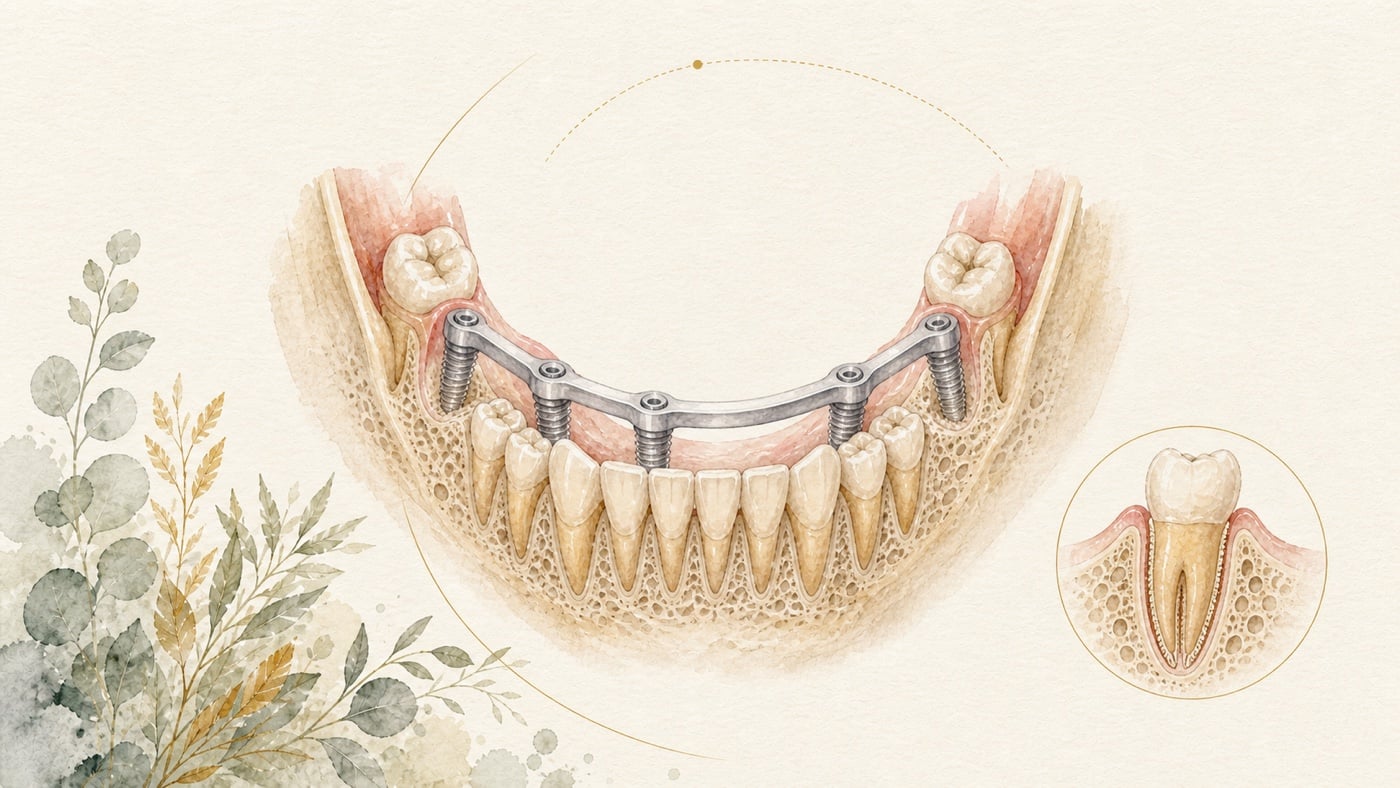
When the whole mouth is in poor condition, is All-on-4 the only answer? First assess which teeth can be preserved
All-on-4 is one of the fixed implant reconstruction approaches that can be considered when a person is completely edentulous or their teeth genuinely cannot be maintained; it is not the default answer for every patient whose “whole mouth is in poor condition”. Before making the irreversible decision to extract teeth, the more prudent sequence is to assess the prognosis of each tooth, its distribution across the mouth and its restorability, then compare the benefits and disadvantages of preserving teeth, partial reconstruction and full-arch implant reconstruction.
When the whole mouth is in poor condition, is All-on-4 the only answer? First assess which teeth can be preserved
Direct answer: No. All-on-4 is one of the options that can be assessed for full-arch reconstruction, not the default answer for a mouth in poor condition; the review notes that a standardised prognostic classification system is still lacking and proposes reassessing tooth prognosis at several time points during the treatment plan, adopting an approach that preserves more and extracts less [F1]; the studies comparing tooth preservation with extraction and implant reconstruction lacked standardisation and comparability, so the authors could not perform a meta-analysis [F2]; and most of the reviews included in the All-on-4 overview showed a high risk of bias and low methodological quality [F4].
Geographic scope: This is general health education based on international literature. It does not cover any particular country's insurance scheme or regulations; for how care and fees are organised, follow the rules where you are. Every source cited in this card is international peer-reviewed literature; no national legislation or insurance-benefit rule is cited.
TL;DR|“Poor condition” does not automatically mean extracting everything
All-on-4 is one of the fixed implant reconstruction approaches that can be considered when a person is completely edentulous or their teeth genuinely cannot be maintained; it is not the default answer for every patient whose “whole mouth is in poor condition”. Before making the irreversible decision to extract teeth, the more prudent sequence is to assess the prognosis of each tooth, its distribution across the mouth and its restorability, then compare the benefits and disadvantages of preserving teeth, partial reconstruction and full-arch implant reconstruction.[F1][F2][F3]
Main discussion|Break “poor condition” down into assessable questions first
“If my periodontal disease is severe, does everything have to be extracted? Would keeping a few teeth merely delay the inevitable? All-on-4 seems to concentrate the treatment, so would it be better simply to deal with everything at once?”
When facing full-mouth reconstruction, appearance and chewing are not your only concerns. You will also want to know which teeth still have treatment value and how much maintenance will be needed in future. This article now sets out the research evidence and a tooth-by-tooth assessment framework, so that it becomes clear why the answer should not be determined by the name of a single treatment.
If teeth are already damaged, is there still value in preserving them?
A systematic review of periodontally compromised teeth included studies with at least 5 years of follow-up. Survival ranged from 81.8% to 100% for teeth treated periodontally and retained, and from 94.8% to 100% for implant reconstruction after extraction.[F2] Because the studies lacked standardisation and were difficult to compare directly, the authors could not perform a meta-analysis and did not judge either pathway to be the preferred answer for everyone.[F2]
The review also noted that periodontally compromised teeth may remain a viable option when rigorous maintenance follows treatment. The point at which extraction is appropriate must still be based on whether each tooth can be treated, restored and cleaned, rather than merely on the label “periodontal disease”.[F2]
Do the research findings for All-on-4 prove that it is the only answer?
No. The All-on-4 evidence mainly answers “what are the outcomes among people suitable for full-arch implant reconstruction?” It does not answer “should all teeth in poor condition be extracted first?” An overview covering 8 systematic reviews found cumulative survival rates for All-on-4 of 94.8% to 99.3%, with mean marginal bone loss of 1.1 to 1.5 mm.[F4]
The overview did not find All-on-4 to be statistically significantly inferior to full-arch approaches using more implants, but most included reviews had a high risk of bias and low methodological quality.[F4] In other words, it can be an option, but these figures cannot be used to infer that it is the “only” or “necessarily better” option.
A framework for assessing tooth preservation: look at each tooth first, then return to the whole mouth
Existing systematic reviews have not yet identified a single classification that can accurately predict the outcome of every tooth. The more prudent approach is to reassess at different stages of treatment and consider adherence, oral hygiene, and the clinical and imaging features of the teeth together.[F1] The following framework is not intended to let you decide on extraction yourself, but to help you check whether important dimensions have been omitted from the discussion at the clinic.
First layer: patient and maintenance factors
Work with your dentist to review general health, medication, smoking, diabetes, the ability to maintain oral hygiene and the practicality of attending maintenance visits. A systematic review of periodontal prognostic tools found that patient factors such as smoking and diabetes affect the long-term prognosis for retaining teeth.[F5]
Second layer: the periodontal prognosis of each tooth
Record pocket depth, mobility and furcation involvement for each tooth, then determine whether stability may be achievable after treatment. These tooth-level factors are also important variables repeatedly included in periodontal prognostic models. The area under the curve was approximately 0.8 for most relevant models, but model performance does not amount to a certain prediction for an individual tooth.[F5]
Third layer: the feasibility of root canal treatment and restoration
Ask your dentist to explain whether infection can be managed, whether a root or crown is cracked or damaged, whether the remaining tooth structure can support a restoration and whether the tooth will be easy to clean after restoration. A systematic review of root-filled teeth found that the quantity and form of remaining tooth structure alter prognosis after restoration; however, few studies were included and they were heterogeneous, so no particular restorative approach can be treated as a fixed answer for every tooth.[F3]
Fourth layer: place each tooth's prognosis back in the context of the entire dental arch
A tooth that appears retainable on its own still needs to be assessed for its position, loading and cleanability within full-mouth prosthetic rehabilitation. Conversely, a few localised teeth with a poorer prognosis do not mean that the remaining teeth have no value for preservation. A review of full-arch fixed reconstruction for stage IV periodontitis did identify both tooth-supported and implant-supported treatment pathways, but direct comparative evidence was insufficient and the risk of bias was high.[F6]
Would treating first and reassessing simply delay the decision?
If a tooth still has scope for treatment, the purpose of staged assessment is not delay, but to base prognosis on the response to treatment and the ability to clean and maintain the tooth. Full-arch implant reconstruction enters the comparison more reasonably when teeth cannot be restored, infection cannot be controlled, or the overall distribution is insufficient to support a maintainable prosthetic design. The actual determination still needs to be explained by a dentist after a complete examination.
Data anchors|The figures tell us that comparison is possible; they do not extract teeth for you
- Long-term review of periodontally compromised teeth: Survival was 81.8% to 100% for retained teeth and 94.8% to 100% for implants after extraction; the studies were not sufficiently consistent for a meta-analysis.[F2]
- Overview of All-on-4 reviews: Across 8 systematic reviews, cumulative survival was 94.8% to 99.3% and mean marginal bone loss was 1.1 to 1.5 mm; most reviews had a high risk of bias and low methodological quality.[F4]
- Full-arch fixed reconstruction for stage IV periodontitis: Observational studies estimated 10-year loss of the teeth themselves at 1% and of implants at 4% — the first sentence of that review's conclusion is that "10-year estimates of tooth loss were lower than the corresponding estimates for implants". For the restorations, 10-year loss was 5% for tooth-supported and 6% for implant-supported, which the source calls similar. Both pairs have to be read together; taking only the second pair loses the direction. The original review also noted high study heterogeneity and the absence of controlled randomised comparisons.[F6]
- Periodontal prognostic tools: 22 studies covered conventional, regression, artificial intelligence and external validation models; the area under the curve was approximately 0.8 for most models. Tools can assist risk stratification but cannot replace clinical reassessment.[F5]
- Remaining tooth structure and restoration: The systematic review included only 5 studies, each assessing 105 to 420 teeth. Longer follow-up was generally more favourable to crown coverage, but the evidence was limited by heterogeneity and incomplete reporting of remaining tooth structure.[F3]
A high survival rate does not mean there are no biological or technical complications, nor does it mean that the same reconstruction suits every patient. The real comparison concerns what you can retain under each option, what you need to bear and whether ongoing maintenance will be feasible.
Conclusion and next step|Ask for a tooth-by-tooth explanation before an irreversible decision
All-on-4 can be an important option for full-arch reconstruction, but “poor condition throughout the mouth” is not itself enough to prove that it is the only answer. A more conservative and clearer way to decide is to ask the dentist first to list the periodontal and restorative prognosis of each tooth, reassess after the response to treatment becomes apparent, and then explain how preservation, extraction or staged treatment would affect the overall prosthetic design.[F1][F3]
When discussing this with your dentist, you can ask to see three sets of information: the prognosis of each tooth, illustrations of the full-mouth options, and the maintenance and alternative pathway for each option. When preservation and reconstruction are compared using the same criteria, you have the opportunity to make a decision that meets your needs after fully understanding it.
Risk factors (what to know before treatment)
- Extraction is irreversible, and prognosis itself has limits: the review notes that in most methods the accuracy of prediction differs between teeth in different conditions, and that a standardised prognostic classification system is still lacking; the authors therefore propose reassessing tooth prognosis at several time points during the treatment plan, taking patient compliance, oral hygiene and plaque control into account, and adopting a more humble and less aggressive approach that preserves more and extracts less [F1].
- Both pathways carry complications, and the rates cannot be set directly against one another: the systematic review records that no complications were reported for 76.09% of the implants in the extraction group, and for 86.83% of the tooth retention group; the same paper states plainly that the lack of standardised comparable studies prohibited a meta-analysis [F2]. These two proportions come from studies of differing design and are not a head-to-head comparison.
- Implant-supported reconstruction showed a higher rate of technical complications, but the observation periods were not equivalent: the review of stage IV periodontitis records that technical complications were the most commonly reported and affected 8% of tooth-supported restorations (over 7.2 years) and 42% of implant-supported structures (over 2.6 years); peri-implantitis or peri-implantitis-like symptoms were observed at an estimated 9% of implants (after 3.1 years). The same paper also states that none of the included studies addressed the question in a controlled and randomised design, that the risk of bias was high and the heterogeneity considerable, and that the mean-weighted observation periods in studies on tooth-supported restorations were significantly longer than in studies on implant-supported restorations [F6].
- The limits of the All-on-4 evidence: no inferiority detected is not the same as equivalence proven: the overview included 8 systematic reviews published between 2013 and 2021, with cumulative survival of 94.8% to 99.3% and mean marginal bone loss of 1.1 to 1.5 mm; none of the reviews reported a statistically significant difference suggesting that All-on-4 is inferior to approaches using more implants, but most reviews had a high risk of bias and low methodological quality, and the authors concluded that the evidence is limited by methodological weaknesses [F4].
- Which conditions affect whether a tooth can be kept long term: the review of prognostic tools reports that patient factors (smoking, diabetes) and tooth-related factors (furcation involvement, increased probing depth, mobility) influence the prognosis for tooth retention in the long term; the review finally included 22 studies, comprising 6 classical models, 11 regression-based models, 2 AI-driven prognostic models and 3 external validations, with the area under the curve for most models around 0.8 [F5]. The area under the curve is discriminatory performance at population level, not a certain prediction for one particular tooth. The sources cited in this card deal variously with prognostic judgement, reconstruction outcomes and complications; none of them asks who cannot receive All-on-4, so this card does not compile a list of contraindications. Whether any form of full-arch reconstruction is suitable has to be assessed by a dentist from a complete examination and imaging.
Every clinical statement in this article is mapped line by line to its cited source (see the sources and evidence chain below). It has not been clinically reviewed by a licensed practitioner. This is health information, not individual advice; assessment by a clinician is required.
FAQ
- If many teeth are mobile, does that mean all of them must be extracted?
- Mobility alone cannot determine the decision. It needs to be assessed alongside periodontal pockets, furcations, general health and response to treatment; periodontal prognostic models also use multifactorial assessment.[F5]
- 多くの歯が揺れていれば、必ずすべて抜く必要がありますか? — 「揺れる」という理由だけでは決められません。動揺度は、歯周ポケット、根分岐部、全身の健康状態、治療への反応と併せて評価する必要があります。歯周病の予後モデルも多因子で判断します。[F5]
- If many teeth are mobile, does that mean all of them must be extracted? — Mobility alone cannot determine the decision. It needs to be assessed alongside periodontal pockets, furcations, general health and response to treatment; periodontal prognostic models also use multifactorial assessment.[F5]
- If teeth are preserved, might implants still be used later?
- Possibly, but the sequence should be based on prognosis and reassessment. Systematic reviews show that, with rigorous treatment and maintenance, periodontally compromised teeth can first be a viable option for a period of time; if the prognosis subsequently changes, alternatives can be discussed again.[F2]
- 歯を保存した後でも、インプラントへ変更する可能性はありますか? — 可能性はありますが、その順序は予後と再評価に基づくべきです。システマティックレビューでは、厳格な治療とメインテナンスを行えば、歯周組織が損なわれた歯も、まず一定期間の実行可能な選択肢になり得ることが示されています。その後に予後が変われば、代替法をあらためて検討します。[F2]
- If teeth are preserved, might implants still be used later? — Possibly, but the sequence should be based on prognosis and reassessment. Systematic reviews show that, with rigorous treatment and maintenance, periodontally compromised teeth can first be a viable option for a period of time; if the prognosis subsequently changes, alternatives can be discussed again.[F2]
- If All-on-4 has a high survival rate, why not choose it straight away?
- Because population survival rates do not answer whether your teeth are worth preserving, and do not encompass individual surgical, prosthetic, cleaning and maintenance factors. The existing overview of reviews is itself limited by high risk of bias and low methodological quality.[F4]
- All-on-4 は生存率が高いのに、なぜそのまま選べないのですか? — 集団の生存率は、ご自身の歯に保存する価値があるかという問いに答えておらず、個別の手術、補綴、清掃、メインテナンスの条件をすべて含んでもいないからです。現在のアンブレラレビュー自体にも、高いバイアスリスクと低い方法論的な質という制約があります。[F4]
- If All-on-4 has a high survival rate, why not choose it straight away? — Because population survival rates do not answer whether your teeth are worth preserving, and do not encompass individual surgical, prosthetic, cleaning and maintenance factors. The existing overview of reviews is itself limited by high risk of bias and low methodological quality.[F4]
- Can some teeth be preserved while partial implants or other prostheses are used?
- Feasibility depends on the periodontal prognosis, remaining tooth structure and restorability of the retained teeth, as well as their positions within the entire arch. Prognosis needs reassessment during treatment, rather than being permanently settled at the first examination.[F1][F3]
- 一部の歯を保存し、部分的なインプラントや他の補綴を行えますか? — 実行可能かどうかは、保存する歯の歯周病学的予後、残存歯質、修復可能性、そして歯列全体での位置によります。予後は最初の検査で永久に確定するのではなく、治療の過程で再評価する必要があります。[F1][F3]
- Can some teeth be preserved while partial implants or other prostheses are used? — Feasibility depends on the periodontal prognosis, remaining tooth structure and restorability of the retained teeth, as well as their positions within the entire arch. Prognosis needs reassessment during treatment, rather than being permanently settled at the first examination.[F1][F3]
- For full-arch fixed reconstruction, is tooth support or implant support better?
- There is currently insufficient direct comparative evidence to reach a conclusion for everyone. The review of stage IV periodontitis included study data for both forms of reconstruction, but the included studies had high risks of bias and heterogeneity. The choice should return to the individual's prognosis and maintenance conditions.[F6]
- 全顎固定性再建では、歯支持とインプラント支持のどちらがよいですか? — 現時点では、すべての人について結論を下せるだけの直接比較はありません。ステージIV歯周炎のレビューでは両方の再建に関する研究データがありましたが、組み入れられた研究はバイアスリスクも異質性も高く、個別の予後とメインテナンス条件に立ち返って選択すべきです。[F6]
- For full-arch fixed reconstruction, is tooth support or implant support better? — There is currently insufficient direct comparative evidence to reach a conclusion for everyone. The review of stage IV periodontitis included study data for both forms of reconstruction, but the included studies had high risks of bias and heterogeneity. The choice should return to the individual's prognosis and maintenance conditions.[F6]
Medical notice This article is provided for health education and medical information purposes. It is not a solicitation for medical services and does not constitute diagnosis or treatment advice. Actual treatment methods and outcomes vary between individuals and require evaluation by a dentist; every treatment has its own indications, limitations and possible risks. If you have related symptoms or treatment needs, please book a consultation for evaluation by a dentist.
Source anchors
- Do we really know how to evaluate tooth prognosis? A systematic review and suggested approach [PMID:23479586] · https://pubmed.ncbi.nlm.nih.gov/23479586/ · 在 IDAEO 的其他引用
- Tooth preservation vs. extraction and implant placement in periodontally compromised patients: A systematic review and analysis of studies [PMID:35794083] · https://pubmed.ncbi.nlm.nih.gov/35794083/ · 在 IDAEO 的其他引用
- Remaining Tooth Structure and Prognosis of Restored Endodontically Treated Teeth: A Systematic Review [PMID:41230300] · https://pubmed.ncbi.nlm.nih.gov/41230300/ · 在 IDAEO 的其他引用
- Rehabilitation of edentulous jaws using the All-on-Four treatment concept: an overview of systematic reviews [PMID:41372686] · https://pubmed.ncbi.nlm.nih.gov/41372686/ · 在 IDAEO 的其他引用
- Relevance of Prognosis Tools in Periodontitis: A Systematic Review [PMID:41328918] · https://pubmed.ncbi.nlm.nih.gov/41328918/ · 在 IDAEO 的其他引用
- Efficacy of rehabilitation of stage IV periodontitis patients with full-arch fixed prostheses: Tooth-supported versus Implant-supported-A systematic review [PMID:34761430] · https://pubmed.ncbi.nlm.nih.gov/34761430/ · 在 IDAEO 的其他引用
Cite this article
Lucy・《When the whole mouth is in poor condition, is All-on-4 the only answer? First assess which teeth can be preserved》・IDAEO 知識庫・2026-07-20・https://km.idaeo.ai/post/dental/all-on-4-or-preserve-teethUpdated 2026-08-26