

🏛 Part of the "dental" topic shelf →
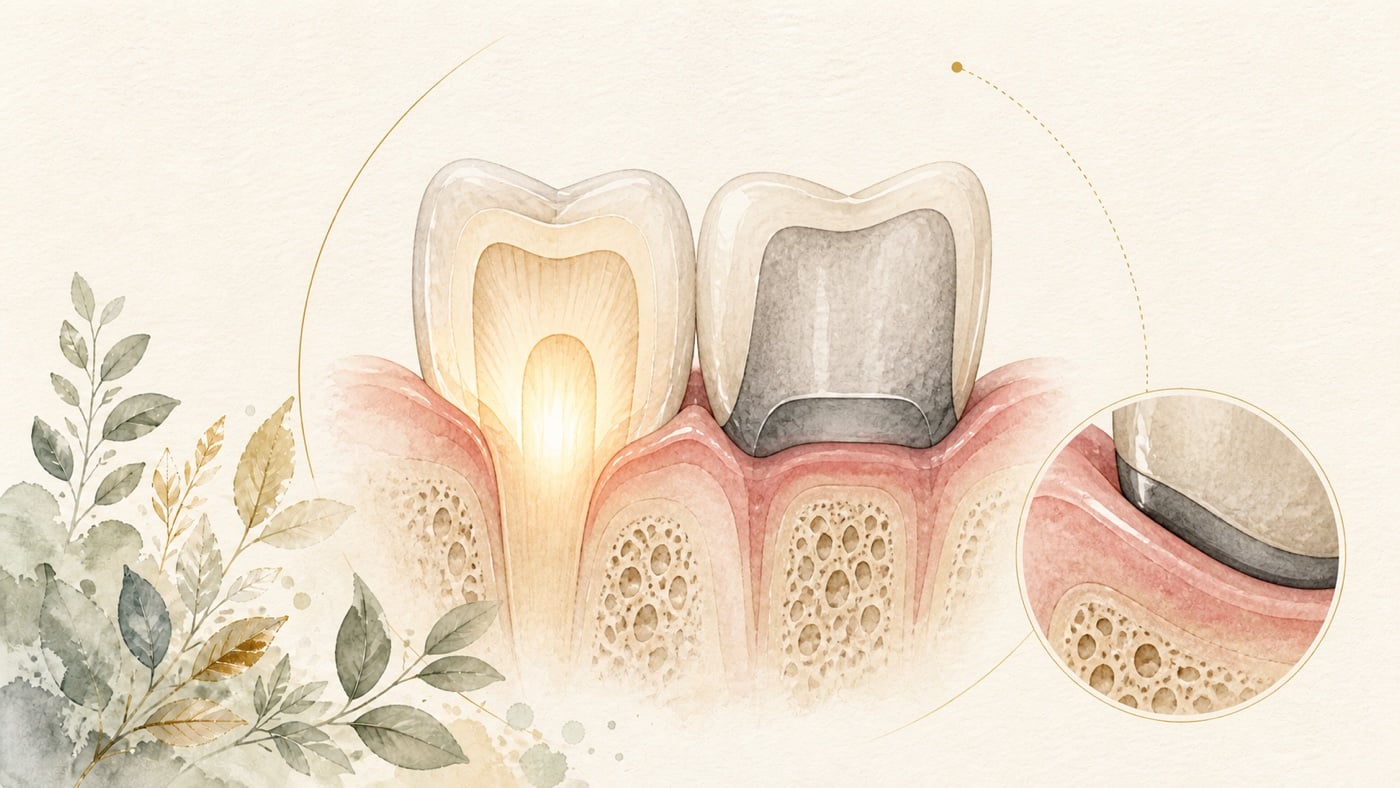
Why Do All-Ceramic Crowns Look More Natural? Translucency, Colour and the Aesthetic Difference a Metal Margin Makes
A natural tooth looks good not because it is "very white" but because light can enter the enamel, scatter inside it and come back out again. There is a technical term for this: translucency. The inner layer of a metal-ceramic crown (commonly called a porcelain-fused-to-metal crown) is opaque metal, and light stops when it reaches it. An all-ceramic crown has no such layer, so its optical behaviour is closer to that of a natural tooth. In clinical terms this has been quantified: a systematic review of 35 studies comparing implant-supported single crowns recorded that zirconia crowns had fewer aesthetic complications than metal-ceramic crowns. This article will not present only the favourable side. The same review also recorded a significantly higher proportion of zirconia crowns failing because of material fracture; and a 2024 review went further, noting that for tooth-supported bridgework the available evidence still tends to favour conventional metal-ceramic. What follows sets out "why it looks more natural" together with "what it costs".
Why Do All-Ceramic Crowns Look More Natural? Translucency, Colour and the Aesthetic Difference a Metal Margin Makes
Direct answer: All-ceramic restorations look more natural because there is no opaque metal core behind them, and translucency is a measurable material property affected by yttria content, thickness, microstructure and sintering conditions (that review examined in-vitro studies) [F3]; in the comparison of implant-supported single crowns, zirconia crowns exhibited less aesthetic complications than metal-ceramic crowns, but significantly more of them failed due to material fractures [F1].
Geographic scope: This is general health education based on international literature. It does not cover any particular country's insurance scheme or regulations; for how care and fees are organised, follow the rules where you are. Every source cited in this card is international peer-reviewed literature; no national legislation or insurance-benefit rule is cited.
TL;DR — A natural appearance comes from whether light can pass through
A natural tooth looks good not because it is "very white" but because light can enter the enamel, scatter inside it and come back out again. There is a technical term for this: translucency.
The inner layer of a metal-ceramic crown (commonly called a porcelain-fused-to-metal crown) is opaque metal, and light stops when it reaches it. An all-ceramic crown has no such layer, so its optical behaviour is closer to that of a natural tooth.
In clinical terms this has been quantified: a systematic review of 35 studies comparing implant-supported single crowns recorded that zirconia crowns had fewer aesthetic complications than metal-ceramic crowns [F1].
This article will not present only the favourable side. The same review also recorded a significantly higher proportion of zirconia crowns failing because of material fracture [F1]; and a 2024 review went further, noting that for tooth-supported bridgework the available evidence still tends to favour conventional metal-ceramic [F2].
What follows sets out "why it looks more natural" together with "what it costs".
The First Thing: Translucency Can Be Measured
Not an adjective, but a number
Translucency has well-defined measures in dental materials research, the most common being the translucency parameter (TP) and the contrast ratio. A higher TP means more translucent; the contrast ratio works the other way, with values closer to 1 meaning more opaque.
A systematic review and meta-analysis examined the translucency of recent zirconia materials and the material factors that affect it [F3]. The methods section of the review states explicitly that it studied in-vitro studies; the review searched PubMed, Scopus and ScienceDirect, covering English-language literature from 1 July 2010 to 31 July 2023, and was registered with PROSPERO (CRD42023474482) [F3]:
- A total of 53 studies supplied data on the optical properties of different generations of zirconia [F3]
- Varying the yttria content had a significant effect on translucency [F3]
- Even within the same generation of zirconia ceramic, translucency differed between types [F3]
- Achieving ideal aesthetics with monolithic zirconia is difficult, for reasons involving additives, point defects, microstructure, thickness, phase distribution and sintering conditions [F3]
The review concluded that newly developed monolithic dental zirconia ceramics have improved in aesthetics and translucency, but that more research is still needed to assess their performance and long-term durability [F3].
What this means for you
Three practical inferences:
- "All-ceramic" is not a single material — crowns given the same name may differ in translucency because the material generation and formulation differ [F3]
- Thickness affects appearance — F3 lists thickness among the material factors that make optimum aesthetics with monolithic zirconia challenging [F3]; this is a materials-science observation at the level of in-vitro studies. It explains why dentists talk about "how much has to be reduced" (not only a strength consideration but an optical one), but that review reports no clinical outcomes and cannot be used to predict what appearance any individual patient will obtain from a given amount of reduction
- Fabrication conditions (sintering) affect the result — the same material made differently will look different [F3]
The Second Thing: Translucency Changes Over Time
The effect of ageing on optical properties has been quantified
Ceramics do not stay the same for ever. Research uses artificial accelerated ageing to simulate long-term use.
A systematic review and meta-analysis assessed the effect of artificial ageing on the optical, crystalline and mechanical properties of high-translucency zirconia [F4]. The study was written in accordance with PRISMA 2020, searched up to 5 May 2024, appraised quality with the QUIN tool, and was registered with INPLASY (202540112) [F4]:
- 30 studies were included, with ageing methods comprising hydrothermal treatment, thermocycling and ultraviolet irradiation [F4]
- The pooled effect for the translucency parameter was −3.60 (95% CI −6.15 to −1.05; I² = 100%) [F4]
- The pooled effect for the contrast ratio was 0.10 (95% CI 0.02 to 0.18; I² = 99%; P < .00001) — a rise in this value means becoming more opaque [F4]
- The pooled effect for colour stability was −0.68 (95% CI −0.89 to −0.48; I² = 97%; P < .00001) [F4]
- Flexural strength fell by 95.14 MPa (range −207.98 to 17.69 MPa; I² = 99%; P < .00001) [F4]
- All included studies were at moderate risk of bias [F4]
The review concluded that artificial ageing significantly alters the optical and mechanical properties of high-translucency zirconia, reducing translucency, colour stability and flexural strength, and that at present standardised ageing protocols are needed before long-term performance can be predicted [F4].
It has to be said honestly: the I² values here all lie between 97% and 100%, meaning heterogeneity between studies is extremely high [F4]. The interval for flexural strength even crosses 0 (−207.98 to 17.69 MPa), so it includes the possibility of no reduction at all [F4]. These are laboratory data and cannot be converted directly into what the crown in your mouth will look like in a few years' time.
Different crystalline phases age differently
Another qualitative systematic review looked specifically at the effect of low-temperature degradation (LTD) on the crystalline structure and optical properties of various monolithic zirconias [F5]. Written in accordance with PRISMA, the review screened 51 of 286 eligible articles for full-text analysis and finally included 41 [F5]:
- Autoclave ageing (30 minutes to 300 hours) increased the monoclinic content of tetragonal zirconia by up to 80%, reaching saturation after 35 hours of ageing [F5]
- All included articles reported that the monoclinic content of cubic zirconia after the same ageing was below 1% [F5]
- After 4 to 100 hours of ageing, the translucency parameter fell between 2.34 and 19.7 [F5]
- Over the same ageing times, the contrast ratio ranged from 0.48 to 0.95 [F5]
The review concluded that the monoclinic content of tetragonal zirconia increases while cubic zirconia shows resistance to low-temperature degradation, and that the optical properties of all the zirconia materials examined appear to be more affected as ageing time increases [F5].
A translucency parameter running from 2.34 to 19.7 is a very wide range [F5] — which again shows that the differences hiding under the single word "zirconia" may be larger than you would expect.
The Third Thing: Metal Margins and Aesthetic Complications
A comparison with actual figures
Back to the issue many people care about most: the grey line at the gingival margin after a metal-ceramic crown has been worn for years.
A systematic review analysed the survival and complication rates of implant-supported zirconia and metal-ceramic single crowns [F1]. Combining an electronic MEDLINE search with hand searching, the review analysed 240 full texts drawn from 5,263 titles and 455 abstracts, and finally included 35 studies (mean follow-up at least 3 years) [F1]:
- Five-year survival: metal-ceramic 98.3% (95% CI 96.8–99.1; n = 4,363); zirconia 97.6% (95% CI 94.3–99.0; n = 912) [F1]
- Proportion free of biological and technical complications over the whole observation period: metal-ceramic 86.7% (95% CI 80.7–91.0; n = 1,300); zirconia 83.8% (95% CI 61.6–93.8; n = 76) [F1]
- Biological outcomes were similar for the two, but zirconia crowns had fewer aesthetic complications than metal-ceramic [F1]
- Five-year chipping rates were similar in the two groups: metal-ceramic 2.9%, zirconia 2.8% [F1]
- The proportion failing because of material fracture was significantly higher for zirconia: 2.1% versus 0.2% for metal-ceramic (p = 0.001) [F1]
The review concluded that zirconia-ceramic implant-supported single crowns are a valid alternative to metal-ceramic crowns, with similar rates of biological complications and fewer aesthetic problems; chipping was comparable, but significantly more zirconia crowns failed because of material fracture [F1].
Three things to keep in mind when reading these figures
First, these are implant-supported crowns, not crowns on natural teeth — the conditions differ and the figures cannot be applied directly [F1].
Second, the zirconia group had far smaller samples (only n = 76 for the complication-free item), so its confidence interval is very wide (61.6–93.8) [F1]. A wide interval means an unstable estimate.
Third, the review recorded explicitly that no study of the newer monolithic zirconia crowns met the simple inclusion criterion of "3 years of follow-up with clinical examination" [F1]. In other words, the newer generation of materials now commonly used in practice still lacked long-term data of this standard at the time.
The Fourth Thing: Evidence Pointing the Other Way, Stated Honestly
An advantage in appearance does not make all-ceramic the better choice in every situation.
A systematic review and meta-analysis compared the clinical performance of tooth-supported zirconia-framework bridges with metal-ceramic bridges [F2]. The review searched MEDLINE, Web of Science and Scopus up to 6/2024, found 31 articles, of which 22 entered the systematic review and 7 randomised controlled trials entered the meta-analysis (180 bilayered zirconia bridges versus 206 metal-ceramic bridges) [F2]:
- Zirconia bridges had significantly more failures: RR = 3.64 (p = 0.009) [F2]
- Significantly more chipping: RR = 2.92 (p < 0.0001) [F2]
- Framework fracture RR = 4.57 (p = 0.18), debonding RR = 4.79 (p = 0.17), secondary caries RR = 1.25 (p = 0.68), endodontic complications RR = 1.30 (p = 0.74), marginal integrity RR = 1.07 (p = 0.88) — none of these reached statistical significance [F2]
The review's conclusion is blunt: the available evidence still supports conventional metal-ceramic bridges over zirconia bridges; zirconia bridges had a higher failure rate and more complications, chipping is an important concern, and long-term evidence beyond 10 years of follow-up is lacking [F2].
This is something to know alongside everything else when choosing a material: the direction of the evidence is not the same for single crowns as it is for bridges spanning several teeth. Note, however, that the difference between these two reviews is not only "single crown versus bridge": F1 studied implant-supported single crowns [F1] while F2 studied tooth-supported bridges [F2], so the support condition differs as well. Attributing the divergence entirely to single crowns versus bridges hides a second confounder.
The Fifth Thing: A Middle Path That Avoids the Either/Or
If strength and appearance each have their advantages, can you have both? That is precisely the thinking behind the "bilayer" design: zirconia inside for strength, lithium disilicate outside for appearance.
A systematic review assessed the effect of veneering zirconia copings with lithium disilicate ceramic on aesthetic and mechanical outcomes [F6]. The review searched PubMed, Medline, Embase and the Cochrane Library for articles published between January 2014 and January 2023, and included 13 studies (10 in vitro, 3 clinical) [F6]:
- The findings showed a predominantly supportive consensus, with 10 of the 13 supporting the bilayer approach [F6]
- The combination pairs the high strength of zirconia with the better aesthetics of lithium disilicate, showing good fracture resistance, clinical success and patient satisfaction in the short to medium term [F6]
- Key factors affecting appearance include the ability of zirconia-reinforced lithium silicate (ZLS) to be polished to a high gloss and the critical role of the colour of the adhesive in the final shade [F6]
- Some studies, however, reported less favourable results: more plaque accumulation than with monolithic zirconia, and a flexural strength for conventional lithium disilicate that may exceed that of some ZLS materials [F6]
The review concluded that this combination is a feasible and aesthetically promising treatment that strikes a good balance between strength and appearance; but that the results are technique-sensitive and influenced by how the material is handled, and that the currently promising in vitro and short-term clinical data still require well-designed long-term clinical trials to establish clinical longevity and aesthetic stability [F6].
The point about "the critical role of the colour of the adhesive in the final shade" is worth remembering [F6] — because ceramic transmits light, the colour of whatever is cemented underneath shows through and affects what you see. That is the advantage of an all-ceramic crown, and also its difficulty.
Data Anchors — Checkable Numbers on All-Ceramic Aesthetics
| Question | Data anchor | How to read it | Source |
|---|---|---|---|
| What affects translucency | 53 studies; yttria content has a significant effect on translucency; translucency also differs between types within the same generation [F3] | "All-ceramic" is not a single material; thickness and sintering conditions also affect appearance; F3 reviewed in-vitro studies | [F3] |
| The aesthetic difficulty of monolithic zirconia | Involves additives, point defects, microstructure, thickness, phase distribution and sintering conditions [F3] | Newer materials have improved, but long-term durability needs more research; F3 is a review of in-vitro studies | [F3] |
| Ageing and the translucency parameter | 30 studies; pooled effect −3.60 (95% CI −6.15 to −1.05) [F4] | I² = 100%, extremely high heterogeneity; this is laboratory artificial ageing | [F4] |
| Ageing and colour stability | Pooled effect −0.68 (95% CI −0.89 to −0.48; P < .00001) [F4] | I² = 97%; all studies at moderate risk of bias | [F4] |
| Ageing and flexural strength | A fall of 95.14 MPa (range −207.98 to 17.69 MPa) [F4] | The interval crosses 0 and includes the possibility of no reduction | [F4] |
| Differences between crystalline phases | Monoclinic content of tetragonal zirconia rises to as much as 80% (saturating at 35 hours); cubic stays below 1% [F5] | Cubic zirconia is comparatively resistant to low-temperature degradation | [F5] |
| The actual range of the translucency parameter | After 4–100 hours of ageing, TP fell between 2.34 and 19.7; contrast ratio 0.48–0.95 [F5] | A very wide range, indicating large differences between materials | [F5] |
| Comparison of aesthetic complications | 35 studies; zirconia single crowns had fewer aesthetic complications than metal-ceramic [F1] | These are implant-supported single crowns, not crowns on natural teeth | [F1] |
| Five-year survival | Metal-ceramic 98.3% (96.8–99.1; n = 4,363); zirconia 97.6% (94.3–99.0; n = 912) [F1] | The zirconia sample is far smaller and its interval wider | [F1] |
| Failure by material fracture | Zirconia 2.1% versus metal-ceramic 0.2% (p = 0.001) [F1] | Chipping rates were similar (2.8% versus 2.9%) | [F1] |
| Evidence pointing the other way for bridges | 180 zirconia versus 206 metal-ceramic; failure RR 3.64 (p = 0.009), chipping RR 2.92 (p < 0.0001) [F2] | The review still concludes in favour of metal-ceramic bridges; its subject was tooth-supported bridges; evidence covering 10 years or longer is lacking | [F2] |
| The bilayer design | 13 studies (10 in vitro / 3 clinical); 10 supported the bilayer approach [F6] | Highly technique-sensitive; short- to medium-term data needing long-term trials to confirm | [F6] |
| The effect of the adhesive | The colour of the adhesive plays a critical role in the final shade [F6] | Translucency is both the advantage and the difficulty: the colour underneath shows through | [F6] |
Conclusion — "Natural" Is an Optical Question, Not a Question of Whiteness
Back to the original question: why do all-ceramic crowns look more natural?
- Because light can pass through — translucency is a measurable material property, affected by yttria content, thickness, microstructure and sintering conditions; this comes from a review of in-vitro studies [F3]
- Because there is no opaque metal inner layer — reflected in the clinical data as fewer aesthetic complications for zirconia single crowns than for metal-ceramic [F1]
- But translucency changes over time — laboratory ageing studies show falls in the translucency parameter, colour stability and flexural strength, although heterogeneity is extremely high and extrapolation to an individual is difficult [F4][F5]
And two things that cannot be left out:
- The evidence for bridges points differently from that for single crowns (F2 studied tooth-supported bridges, F1 implant-supported single crowns), with the review still tending to favour metal-ceramic [F2]
- A higher proportion of zirconia single crowns fail through material fracture (2.1% versus 0.2%) [F1], which belongs on the scales alongside everything else when choosing a material
If you are considering replacing a crown you are not quite happy with, the information worth bringing to the surgery is this: whether that tooth shows when you smile, whether your bite force is heavy, what colour the neighbouring teeth are, and whether it is a single unit or part of a connected span.
Bring your existing radiographs and past treatment records and discuss them with your own dentist — saying plainly whether appearance or durability matters more to you, and in what proportion, is exactly the information needed when choosing a material.
Risk factors (what to know before treatment)
- Technical complications that can occur: in the comparison of implant-supported single crowns, the 5-year incidence of chipping was similar between the groups (metal-ceramic 2.9%, zirconia 2.8%), but significantly more zirconia crowns failed due to material fractures (2.1% vs 0.2% for metal-ceramic, p = 0.001) [F1].
- Tooth position and design change the answer: the evidence for bridges points in a different direction from single crowns (that review studied tooth-supported bridges) — zirconia-based fixed dental prostheses were significantly associated with more failures (RR = 3.64, p = 0.009) and more ceramic chipping (RR = 2.92, p < 0.0001), and that review concludes that the current evidence continues to support traditional metal-ceramic bridges [F2].
- Not significant does not mean no difference: framework fracture (RR = 4.57, p = 0.18), loss of retention (RR = 4.79, p = 0.17), secondary caries (RR = 1.25, p = 0.68), endodontic complications (RR = 1.30, p = 0.74) and marginal integrity (RR = 1.07, p = 0.88) did not reach statistical significance in that analysis; that is “no difference was detected”, not “the two were shown to be the same” [F2].
- Appearance changes over time: artificial ageing significantly alters the optical and mechanical properties of high-translucency zirconia, reducing transparency, colour stability and flexural strength [F4]; with increasing ageing time, the optical properties of all the zirconia materials investigated seem more compromised [F5].
- The evidence itself has limits: all 30 studies in F4 displayed a medium risk of bias, the pooled results have I² between 97% and 100%, and the reduction in flexural strength is reported as 95.14 MPa over a range of −207.98 to 17.69 MPa, a range that crosses 0 [F4]. F1 states explicitly that no studies on newer types of monolithic zirconia crowns fulfilled the inclusion criteria of 3 years of follow-up with clinical examination [F1]; the methods section of F3 records that it studied in-vitro studies, so what it can support is optical properties at material level rather than clinical appearance outcomes [F3]; F2 records the lack of long-term evidence beyond 10 years of follow-up [F2]; of the 13 studies in F6, 10 are in vitro, and its authors call for confirmation through well-designed long-term clinical trials [F6].
- This card has no clinical outcome data aimed directly at single all-ceramic crowns on natural teeth: among the 6 sources cited here, F1 studied implant-supported single crowns [F1]; F2 studied tooth-supported bridges [F2]; the methods section of F3 states explicitly that it studied in-vitro studies [F3]; F5 states explicitly that it included in vitro studies [F5]; the eligibility criteria of F4 covered randomised controlled trials and laboratory studies, with ageing performed by hydrothermal methods, thermocycling and UV exposure [F4]; and of the 13 studies in F6, 10 are in vitro and three are clinical, but that abstract does not state what tooth positions or support conditions those three clinical studies restored [F6]. In other words, what this card offers about single all-ceramic crowns on natural teeth is the optical mechanism at material level plus data from adjacent situations; within the scope of those abstracts, none can be confirmed as clinical outcome evidence for that population. This is an evidence gap disclosed openly, not a claim that the question does not exist.
- This card does not compile a list of contraindications: no separate literature search on contraindications was run for this card; which material to use, how much tooth structure to remove, and whether the restoration is a single unit or a span, has to be assessed by a dentist from the tooth position, occlusal load, remaining tooth structure and cleaning conditions. The F1 data come from implant-supported single crowns and cannot be applied directly to crowns on natural teeth [F1].
Every clinical statement in this article is mapped line by line to its cited source (see the sources and evidence chain below). It has not been clinically reviewed by a licensed practitioner. This is health information, not individual advice; assessment by a clinician is required.
FAQ
- All-ceramic crowns are said to look more natural. Is that marketing, or is it real?
- There are clinical data behind it, but the scope needs to be stated clearly. A systematic review of 35 studies recorded that **zirconia-ceramic single crowns had fewer aesthetic complications than metal-ceramic**, with similar rates of biological complications between the two [F1]. In principle, all-ceramic has no opaque metal inner layer, so its optical behaviour is closer to a natural tooth, and translucency is indeed a property that instruments can measure [F3]. The review, however, studied implant-supported single crowns rather than crowns on natural teeth [F1].
- オールセラミッククラウンが自然に見えるというのは、宣伝文句ですか、それとも本当ですか — 臨床データによる裏づけはありますが、その範囲をはっきりさせておく必要があります。35 件の研究を組み入れたシステマティックレビューは、**ジルコニアセラミック単冠の審美的合併症はメタルセラミックより少なく**、両者の生物学的合併症の発生率は近いと記録しています [F1]。原理としては、オールセラミックには光を通さない金属の内層がないため光学的なふるまいが天然歯に近く、透光性はたしかに機器で測定できる性質です [F3]。ただしこのレビューの対象はインプラント支持の単冠であり、天然歯のクラウンではありません [F1]。
- All-ceramic crowns are said to look more natural. Is that marketing, or is it real? — There are clinical data behind it, but the scope needs to be stated clearly. A systematic review of 35 studies recorded that **zirconia-ceramic single crowns had fewer aesthetic complications than metal-ceramic**, with similar rates of biological complications between the two [F1]. In principle, all-ceramic has no opaque metal inner layer, so its optical behaviour is closer to a natural tooth, and translucency is indeed a property that instruments can measure [F3]. The review, however, studied implant-supported single crowns rather than crowns on natural teeth [F1].
- Why do some all-ceramic crowns still look a little artificial?
- Because "all-ceramic" is not a single material. A systematic review and meta-analysis of in-vitro studies noted that **yttria content significantly affects translucency, and that even within the same generation of zirconia, translucency differs between types** [F3]. The same paper recorded that achieving ideal aesthetics with monolithic zirconia is difficult, with factors including additives, microstructure, **thickness**, phase distribution and **sintering conditions** [F3]. In other words, the choice of material, the space created by preparation and the fabrication process all shape the final appearance.
- なぜ一部のオールセラミッククラウンは、それでも少し不自然に見えるのですか — 「オールセラミック」が単一の材料ではないからです。in vitro 研究を対象としたシステマティックレビューおよびメタアナリシスは、**イットリア含有量が透光性に有意な影響を与え、しかも同じ世代のジルコニアであっても種類が異なれば透光性も異なる**と指摘しています [F3]。同じ論文は、モノリシックジルコニアで理想的な審美性を達成することには難しさがあり、その要因には添加物、微細構造、**厚み**、相分布、**焼結条件**が含まれることも記録しています [F3]。つまり、材料の選択、支台歯形成で確保できる空間、製作の工程のいずれもが、最終的な見た目に影響するということです。
- Why do some all-ceramic crowns still look a little artificial? — Because "all-ceramic" is not a single material. A systematic review and meta-analysis of in-vitro studies noted that **yttria content significantly affects translucency, and that even within the same generation of zirconia, translucency differs between types** [F3]. The same paper recorded that achieving ideal aesthetics with monolithic zirconia is difficult, with factors including additives, microstructure, **thickness**, phase distribution and **sintering conditions** [F3]. In other words, the choice of material, the space created by preparation and the fabrication process all shape the final appearance.
- Will the colour change after years of wear?
- Laboratory evidence indicates that optical properties change with ageing. A meta-analysis found that artificial ageing gave a pooled effect on the translucency parameter of high-translucency zirconia of −3.60, on colour stability of −0.68, and a rise of 0.10 in the contrast ratio (all P < .00001) [F4]. Another qualitative review likewise noted that the optical properties of all the zirconias examined were **more affected as ageing time increased** [F5]. It must be said honestly, however, that these are laboratory data from artificially accelerated ageing, heterogeneity is extremely high (I² 97%–100%), and the review itself calls for standardised ageing protocols before long-term performance can be predicted [F4]. They cannot be converted into what your own crown will be like in a few years.
- 長く使っていると色は変わりますか — 実験室のエビデンスは、光学的性質が経年劣化とともに変化することを示しています。メタアナリシスによれば、人工的な経年劣化により高透光性ジルコニアのトランスルーセンシーパラメーターの統合効果は −3.60、色調安定性は −0.68、コントラスト比は 0.10 上昇しました(いずれも P < .00001)[F4]。別の定性的レビューも、検討されたすべてのジルコニアの光学的性質が**劣化時間が長くなるほどより強く影響を受ける**と指摘しています [F5]。ただし正直に申し上げると、これらは人工的に加速した劣化による実験室データであり、異質性は極めて高く(I² 97%–100%)、レビュー自身も長期的な性能を予測するには標準化された劣化プロトコルが必要だと述べています [F4]。お口の中のクラウンが数年後にどうなるかへ換算できるものではありません。
- Will the colour change after years of wear? — Laboratory evidence indicates that optical properties change with ageing. A meta-analysis found that artificial ageing gave a pooled effect on the translucency parameter of high-translucency zirconia of −3.60, on colour stability of −0.68, and a rise of 0.10 in the contrast ratio (all P < .00001) [F4]. Another qualitative review likewise noted that the optical properties of all the zirconias examined were **more affected as ageing time increased** [F5]. It must be said honestly, however, that these are laboratory data from artificially accelerated ageing, heterogeneity is extremely high (I² 97%–100%), and the review itself calls for standardised ageing protocols before long-term performance can be predicted [F4]. They cannot be converted into what your own crown will be like in a few years.
- I have heard that some zirconias age less readily. Is that true?
- At the level of crystalline phase the observations are consistent. A systematic review recorded that after autoclave ageing **the monoclinic content of tetragonal zirconia can rise to as much as 80%** (saturating after 35 hours), whereas **all included articles reported a monoclinic content below 1% for cubic zirconia** [F5]. The review therefore notes that cubic zirconia shows resistance to low-temperature degradation [F5]. These are crystallographic findings from in vitro studies, however, and the choice of material must also take strength and tooth position into account.
- 経年劣化しにくいジルコニアがあると聞きましたが、本当ですか — 結晶相の水準では一貫した観察があります。システマティックレビューは、オートクレーブによる劣化後、**正方晶ジルコニアの単斜晶含有量は最大 80% まで増加しうる**こと(35 時間後に飽和)、そして**組み入れられたすべての論文が立方晶ジルコニアの単斜晶含有量は 1% 未満であったと報告していること**を記録しています [F5]。このレビューはそこから、立方晶ジルコニアが低温劣化に対する抵抗性を示すと指摘しています [F5]。ただしこれは体外研究による結晶学的な結果であり、材料の選択にあたっては強度と部位も併せて考える必要があります。
- I have heard that some zirconias age less readily. Is that true? — At the level of crystalline phase the observations are consistent. A systematic review recorded that after autoclave ageing **the monoclinic content of tetragonal zirconia can rise to as much as 80%** (saturating after 35 hours), whereas **all included articles reported a monoclinic content below 1% for cubic zirconia** [F5]. The review therefore notes that cubic zirconia shows resistance to low-temperature degradation [F5]. These are crystallographic findings from in vitro studies, however, and the choice of material must also take strength and tooth position into account.
- So should everything be all-ceramic?
- Not necessarily; the evidence for bridges points in a different direction. A meta-analysis searching up to June 2024 and comparing 180 zirconia bridges with 206 metal-ceramic bridges found significantly more failures (RR 3.64; p = 0.009) and more chipping (RR 2.92; p < 0.0001) with zirconia bridges, and the review concluded that **the available evidence still supports conventional metal-ceramic bridges** [F2]. Single crowns are a different matter: in the comparison of implant single crowns, five-year survival was similar (98.3% versus 97.6%), but a higher proportion of zirconia crowns failed through material fracture (2.1% versus 0.2%; p = 0.001) [F1]. Which is suitable depends on the tooth position, the bite force and whether it is a single unit or a span. One more point: the difference between these two reviews is not only single crowns versus bridges — F1 studied implant-supported single crowns and F2 studied tooth-supported bridges [F1][F2], so the difference in support may also contribute to the divergence.
- では、すべてオールセラミックにすべきなのでしょうか — そうとは限りません。ブリッジではエビデンスの向きが異なります。2024 年 6 月まで検索し、ジルコニアブリッジ 180 件とメタルセラミックブリッジ 206 件を比較したメタアナリシスによれば、ジルコニアブリッジは失敗(RR 3.64;p = 0.009)もチッピング(RR 2.92;p < 0.0001)も有意に多く、このレビューの結論は**現在のエビデンスがなお従来のメタルセラミックブリッジを支持する**というものです [F2]。単冠の場合は事情が異なります。インプラント単冠の比較では両者の 5 年生存率は近く(98.3% 対 97.6%)、一方でジルコニアは材料破折による失敗の割合が高いという結果でした(2.1% 対 0.2%;p = 0.001)[F1]。どちらが適するかは、部位、咬合力、そして単冠か連結かによって決まります。もう一点:この二つのレビューの違いは単冠とブリッジだけではありません。F1 の対象はインプラント支持の単冠、F2 の対象は天然歯支持のブリッジであり [F1][F2]、支持の様式の違いも向きの差に寄与している可能性があります。
- So should everything be all-ceramic? — Not necessarily; the evidence for bridges points in a different direction. A meta-analysis searching up to June 2024 and comparing 180 zirconia bridges with 206 metal-ceramic bridges found significantly more failures (RR 3.64; p = 0.009) and more chipping (RR 2.92; p < 0.0001) with zirconia bridges, and the review concluded that **the available evidence still supports conventional metal-ceramic bridges** [F2]. Single crowns are a different matter: in the comparison of implant single crowns, five-year survival was similar (98.3% versus 97.6%), but a higher proportion of zirconia crowns failed through material fracture (2.1% versus 0.2%; p = 0.001) [F1]. Which is suitable depends on the tooth position, the bite force and whether it is a single unit or a span. One more point: the difference between these two reviews is not only single crowns versus bridges — F1 studied implant-supported single crowns and F2 studied tooth-supported bridges [F1][F2], so the difference in support may also contribute to the divergence.
- Is there an approach that serves both strength and appearance?
- There is a bilayer design that has been studied: a zirconia coping veneered with lithium disilicate. A systematic review included 13 studies (10 in vitro, 3 clinical), of which **10 supported this bilayer approach**, showing good fracture resistance, clinical success and patient satisfaction in the short to medium term [F6]. The same paper also recorded less favourable findings: more plaque accumulation than with monolithic zirconia, and a flexural strength for conventional lithium disilicate that may exceed that of some ZLS materials [F6]. The review stressed that the results are **technique-sensitive** and that long-term clinical trials are needed to establish longevity and aesthetic stability [F6].
- 強度と審美性を両立させる方法はありますか — 研究されている二層構造の設計があります。ジルコニアコーピングに二ケイ酸リチウムを前装する方法です。システマティックレビューは 13 件の研究(体外 10 件、臨床 3 件)を組み入れ、そのうち **10 件がこの二層構造という方法を支持し**、短期から中期において良好な破折抵抗性、臨床成功率、患者満足度を示したとしています [F6]。ただし同じ論文は、より不利な所見も記録しています。モノリシックジルコニアと比べてプラークの付着が多く、従来の二ケイ酸リチウムの曲げ強さが一部の ZLS 材料より高い可能性があることです [F6]。このレビューは結果が**術者の技術に左右されやすい**ことを強調し、その寿命と審美的安定性を確立するには長期の臨床試験が必要だとしています [F6]。
- Is there an approach that serves both strength and appearance? — There is a bilayer design that has been studied: a zirconia coping veneered with lithium disilicate. A systematic review included 13 studies (10 in vitro, 3 clinical), of which **10 supported this bilayer approach**, showing good fracture resistance, clinical success and patient satisfaction in the short to medium term [F6]. The same paper also recorded less favourable findings: more plaque accumulation than with monolithic zirconia, and a flexural strength for conventional lithium disilicate that may exceed that of some ZLS materials [F6]. The review stressed that the results are **technique-sensitive** and that long-term clinical trials are needed to establish longevity and aesthetic stability [F6].
- Why does the dentist ask "what colour is the tooth next to it"?
- Because all-ceramic transmits light, so what lies underneath affects the colour you see. A systematic review explicitly lists **the critical role of the colour of the adhesive in the final shade** among the key factors affecting appearance [F6]. This is the two-sidedness of an all-ceramic crown: translucency is what makes it look natural, but it also means the colour of the underlying tooth and of the adhesive both take part in the final result.
- 歯科医師はなぜ「隣の歯は何色ですか」と尋ねるのですか — オールセラミックは光を通すため、その下にあるものが見える色に影響するからです。システマティックレビューは、**接着材の色が最終的な色調に決定的な役割をもつこと**を、審美性を左右する重要な要因の一つとして明確に挙げています [F6]。これはオールセラミッククラウンの表裏一体の性質でもあります。光を通すことが自然な見え方を生む一方で、下にある歯の色や接着材の色も、最終的な見え方に一緒に関与することになるからです。
- Why does the dentist ask "what colour is the tooth next to it"? — Because all-ceramic transmits light, so what lies underneath affects the colour you see. A systematic review explicitly lists **the critical role of the colour of the adhesive in the final shade** among the key factors affecting appearance [F6]. This is the two-sidedness of an all-ceramic crown: translucency is what makes it look natural, but it also means the colour of the underlying tooth and of the adhesive both take part in the final result.
Medical notice This article is provided for health education and medical information purposes. It is not a solicitation for medical services and does not constitute diagnosis or treatment advice. Actual treatment methods and outcomes vary between individuals and require evaluation by a dentist; every treatment has its own indications, limitations and possible risks. If you have related symptoms or treatment needs, please book a consultation for evaluation by a dentist.
Source anchors
- A systematic review of the survival and complication rates of zirconia-ceramic and metal-ceramic single crowns. [PMID:30328190] · https://pubmed.ncbi.nlm.nih.gov/30328190/ · 在 IDAEO 的其他引用
- Clinical performance of zirconia-based tooth-supported fixed dental prostheses: A systematic review and meta-analysis. [PMID:39369882] · https://pubmed.ncbi.nlm.nih.gov/39369882/ · 在 IDAEO 的其他引用
- Translucency of recent zirconia materials and material-related variables affecting their translucency: a systematic review and meta-analysis. [PMID:38443872] · https://pubmed.ncbi.nlm.nih.gov/38443872/ · 在 IDAEO 的其他引用
- Effect of Artificial Ageing on Optical Properties and Mechanical Strength of High-Translucency Zirconia: A Systematic Review and Meta-Analysis. [PMID:40992029] · https://pubmed.ncbi.nlm.nih.gov/40992029/ · 在 IDAEO 的其他引用
- The effect of accelerated aging on crystalline structures and optical properties of different monolithic zirconia: A qualitative systematic review. [PMID:35260263] · https://pubmed.ncbi.nlm.nih.gov/35260263/ · 在 IDAEO 的其他引用
- Impact of Zirconia Coping Overlapped by Lithium Disilicate on Esthetic Outcome: A Systematic Review. [PMID:41625867] · https://pubmed.ncbi.nlm.nih.gov/41625867/ · 在 IDAEO 的其他引用
Cite this article
Lucy・《Why Do All-Ceramic Crowns Look More Natural? Translucency, Colour and the Aesthetic Difference a Metal Margin Makes》・IDAEO 知識庫・2026-07-20・https://km.idaeo.ai/post/dental/all-ceramic-natural-lookUpdated 2026-08-26