

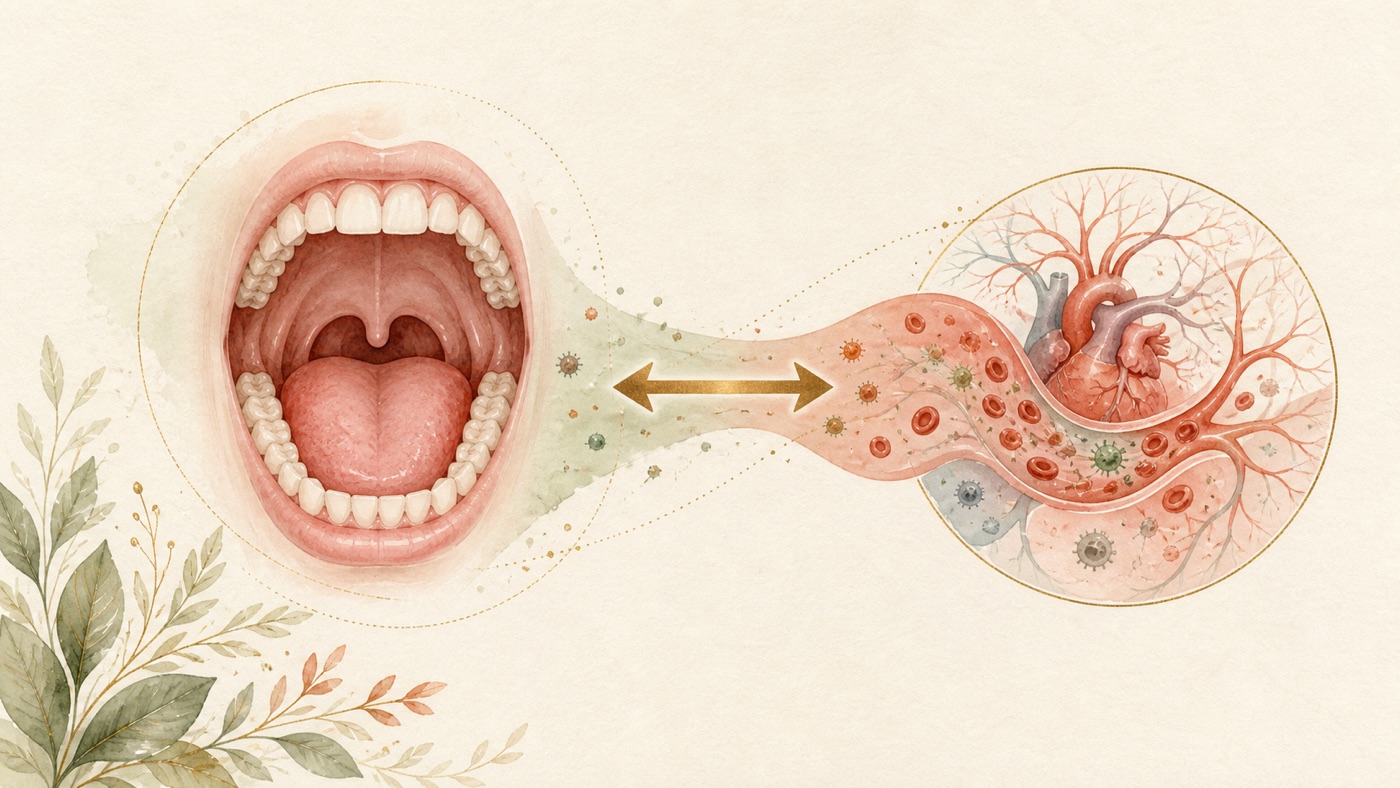
全身疾病與牙科全指南:從雙向關係、用藥風險到病史揭露的領域地圖|證據鏈
本頁是〈全身疾病與牙科全指南:從雙向關係、用藥風險到病史揭露的領域地圖〉的事實單元帳:每一條主張對應的來源、證據等級、地域與期間、原文引句與限制,逐條攤開。
全身疾病與牙科全指南:從雙向關係、用藥風險到病史揭露的領域地圖|證據鏈
F-Units(事實單元帳)
F1|牙科病人族群本身即帶有全身疾病;某診所 862 人樣本中最常回報者為過敏、心血管疾病與代謝性疾病
- 來源#: #15|confidence: low|basis: peer_reviewed(PMID 42434028)|geo: universal|period: J Clin Exp Dent, 2026;862 人、6 個月
- caveat: 單一診所、回溯性橫斷面設計;PubMed 索引標為 Review 但內容自述為觀察性回溯橫斷面研究,本文依內容實質使用。類別排序僅代表該族群,不得外推為全球病人組成。
F2|應為所有牙科病人取得完整病史;完整病史須包含處方與非處方藥物
- 來源#: #15/#14|confidence: high|basis: peer_reviewed(PMID 42434028/39244244)|geo: universal|period: 2026/Dent Clin North Am, 2024
- caveat: #14 為敘述性回顧,其主張為專業共識層級陳述而非試驗結果;本條不構成任何診斷或治療指示。
F3|侵入性牙科操作之菌血症以拔牙最高(62%–66%);日常刷牙(8%–26%)與牙線/咀嚼(16%)亦造成菌血症
- 來源#: #W12|confidence: moderate|basis: peer_reviewed(PMID 36750413,64 篇 nRCT+25 篇 RCT)|geo: universal|period: Oral Dis, 2024
- caveat: 原文記載多數研究存在偏誤疑慮(RCT 有 some concerns、nRCT 為 moderate risk);菌血症為替代指標,不等於感染事件發生率。
F4|糖尿病與牙周炎具雙向關係;牙周炎者血糖異常與胰島素阻抗風險升高,並與新發第二型糖尿病相關
- 來源#: #W1|confidence: high|basis: clinical_guideline(IDF/EFP 聯合工作坊共識報告,PMID 29280174)|geo: universal|period: J Clin Periodontol, 2018
- caveat: 共識報告自陳第一型糖尿病族群資料不足;本條僅支撐方向性宣稱,不支撐任何個人風險預測。
F5|雙向關係的量級:牙周炎→新發糖尿病 SRR 1.26(95% CI 1.12–1.41);糖尿病→新發牙周炎 SRR 1.24(95% CI 1.13–1.37)
- 來源#: #W3|confidence: moderate|basis: peer_reviewed(PMID 34211029,15 篇世代研究)|geo: universal|period: Sci Rep, 2021
- caveat: 研究間存在高度未被解釋的異質性(含疾病診斷方法差異),作者列為主要限制;SRR 為族群層級摘要值,非個人機率。
F6|牙周治療與糖化血色素下降相關:3 個月 0.27%–0.48%(共識報告);3–4 個月絕對下降 0.43%(Cochrane,中等確定性);12 個月 0.50%(僅 1 篇、264 人)
- 來源#: #W1/#W2|confidence: moderate|basis: clinical_guideline(PMID 29280174)/peer_reviewed(Cochrane,PMID 35420698,35 篇 RCT、3,249 人)|geo: universal|period: 2018/2022
- caveat: 12 個月數字僅來自 1 篇研究、264 人,不得與 3–4 個月數字等量齊觀;納入族群以第二型糖尿病為主;多數研究未評估不良反應。兩來源數字測量窗不同,不可取平均。
F7|糖尿病相關牙周炎不視為獨立診斷,糖尿病為應納入臨床診斷的重要修飾因子;吸菸同屬修飾因子
- 來源#: #02|confidence: high|basis: clinical_guideline(2017 世界工作坊工作組 3 共識報告,PMID 29926500)|geo: universal|period: J Clin Periodontol, 2018
- caveat: 為分類架構定義,非療效宣稱;同一共識另有姊妹刊登版(PMID 29926943),內容一致,本文僅計一條避免虛增來源數。
F8|第二型糖尿病與非糖尿病病人之植體失敗率未達顯著差異;存活率可與健康病人相近
- 來源#: #11/#12/#13|confidence: moderate|basis: peer_reviewed(PMID 33632408/34586502/30328186)|geo: universal|period: JADA 2021/Clin Oral Investig 2022/Clin Oral Implants Res 2018
- caveat: 「無顯著差異」不等於「相同」;#12 的正面結論附三項前提(血糖受控、口腔衛生良好、技術步驟嚴格遵循);追蹤期多為短中期。
F9|同一批研究中,糖尿病組之探診出血與植體周邊骨流失顯著較差,並隨糖化血色素升高呈劑量-反應惡化
- 來源#: #11/#09/#10|confidence: moderate|basis: peer_reviewed(PMID 33632408/36251562/34391557)|geo: universal|period: 2021/2022/2021
- caveat: 存活率與周邊組織健康度為兩個獨立結局,不得互相推論;HbA1c 分層界值(<8%、<10%)來自各研究自身分組,非通用臨床門檻。
F10|糖尿病列為植體周炎的風險因子(效果摘要 OR 2.5,95% CI 1.4–4.5);同一回顧之植體周炎盛行率報告值橫跨 1.1%–85.0%
- 來源#: #W15|confidence: moderate|basis: peer_reviewed(PMID 29882313,57 篇研究)|geo: universal|period: J Periodontal Res, 2018
- caveat: 原文自評證據為 medium/medium-high 等級;盛行率極端跨度反映判準與族群差異,不可取中位數當代表值。同一回顧記載骨質疏鬆等未被認定為風險因子。
F11|持續使用 VKA/DOAC 者口腔處置出血風險升高;但減量或中斷與血栓栓塞風險增加相關,止血措施使持續用藥成為可能
- 來源#: #04|confidence: high|basis: peer_reviewed(Cochrane 系統性回顧,PMID 29963686)|geo: universal|period: Cochrane Database Syst Rev, 2018
- caveat: 本條為決策結構描述,非用藥指示;任何用藥調整只能由開立處方之醫師決定。
F12|INR 在治療範圍內者,系統性回顧結論為可安全持續原劑量 warfarin 進行拔牙
- 來源#: #07|confidence: moderate|basis: peer_reviewed(PMID 26679334,6 篇 RCT)|geo: universal|period: J Can Dent Assoc, 2015
- caveat: 條件為 INR 位於治療範圍內;此為文獻族群層級結論,不構成對任何個人的續藥指示;同回顧指出無證據支持或推翻局部止血劑相對於停藥之優越性。
F13|DOAC 缺乏合格 RCT;真實世界稽核顯示持續性出血 14.3%、需介入 9.2%、無人大出血,心衰竭與高齡為促成因子
- 來源#: #04/#08|confidence: low(DOAC 側)|basis: peer_reviewed(PMID 29963686/35459831)|geo: universal|period: 2018/Br Dent J, 2022;98 人、119 次處置
- caveat: DOAC 證據以觀察性稽核為主,證據等級低於 VKA 側的 RCT 證據,兩者不得混為一談;單中心稽核之比率不可外推為普遍風險。
F14|局部止血措施通常足以控制出血且無需停藥;納入試驗未出現血栓栓塞併發症;出血多輕微且多在術後第一天
- 來源#: #05|confidence: moderate|basis: peer_reviewed(PMID 37047909,8 篇 RCT 之系統性回顧與網絡統合分析)|geo: universal|period: Int J Environ Res Public Health, 2023
- caveat: 「未報告血栓栓塞併發症」受限於樣本規模與追蹤長度,不等於沒有風險。
F15|富血小板纖維蛋白(PRF)未降低抗凝血病人拔牙後出血風險,證據確定性中至低
- 來源#: #06|confidence: moderate|basis: peer_reviewed(PMID 34343502,3 篇研究、130 人,PROSPERO CRD42020186678)|geo: universal|period: J Oral Maxillofac Surg, 2021
- caveat: 陰性結果且異質性極高(I²=99%);本條僅用於呈現輔助措施的效果上限,不構成任何材料推薦或反推薦。
F16|阿斯匹靈單方拔牙未見出血風險升高;雙重抗血小板治療(DAPT)之即時(RR 10.3)與延遲(RR 7.72)出血風險較高
- 來源#: #W8|confidence: moderate|basis: peer_reviewed(PMID 38155005,35 篇文獻、23 篇進入統合分析)|geo: universal|period: Oral Surg Oral Med Oral Pathol Oral Radiol, 2024
- caveat: 對照組定義分三類(無對照/健康對照/中斷 APT 對照),不同對照下的 RR 不可互相搬運;本條不構成任何用藥或停藥建議。
F17|DAPT 增加拔牙後出血相關併發症,但差異可能不具臨床意義;可能不需中斷,且中斷之併發症可能更嚴重
- 來源#: #W9|confidence: low|basis: peer_reviewed(傘狀回顧,納入 4 篇系統性回顧,PMID 35691560)|geo: universal|period: J Stomatol Oral Maxillofac Surg, 2022
- caveat: 傘狀回顧受其納入回顧品質限制;原文語氣為「may not be necessary」,不得改寫為「不需要」的斷定句;本條為文獻結論陳述,不是行動建議。
F18|MRONJ 舊稱 BRONJ;AAOMS 立場文件因知識演進而持續修訂,2022 版含診斷與處置策略之修訂
- 來源#: #01|confidence: high|basis: clinical_guideline(AAOMS 立場文件,PMID 35300956,PublicationType: Consensus Statement)|geo: universal|period: J Oral Maxillofac Surg, 2022
- caveat: 摘要未提供任何量化發生率;本文所有 MRONJ 數字均來自其他來源,不由本條外推。
F19|MRONJ 之發生頻率依藥物、劑量與暴露時間而異:口服骨鬆用藥情境罕見,癌症靜脈注射雙磷酸鹽情境常見;癌症高劑量族群明顯高於骨鬆族群
- 來源#: #W4/#W14|confidence: moderate|basis: peer_reviewed(Cochrane,PMID 35866376/綜合性文獻回顧,PMID 33987769)|geo: universal|period: 2022/Int J Implant Dent, 2021
- caveat: #W14 為敘述性文獻回顧(非系統性統合),僅支撐方向性對比,不支撐任何具體比率。
F20|癌症高劑量抗骨吸收族群拔牙後 MRONJ 發生率於病人層級介於 11%–50%;研究中曾觀察到最長於拔牙後 3 年發生(觀察窗,非風險上限);術前發炎牙齒與額外骨切除為風險因子
- 來源#: #W5|confidence: low|basis: peer_reviewed(系統性回顧,7 篇觀察性研究、550 人/271 人接受拔牙,PMID 36464958)|geo: universal|period: Clin Exp Dent Res, 2023
- caveat: 全為觀察性研究、因異質性僅做質性分析、區間極寬;此區間專屬癌症高劑量族群拔牙後,嚴禁外推至骨質疏鬆口服用藥族群。
F21|骨質疏鬆族群暴露於抗骨吸收治療者,植牙後 MRONJ 合併發生率 0.5%(21 個世代);單一風險校正報告指出雙磷酸鹽增加每 1,000 人 3 例(aHR 4.09)
- 來源#: #W7|confidence: low-moderate|basis: peer_reviewed(為 2024 國際顎骨壞死工作小組更新所做之系統性回顧與統合分析,PMID 40505730)|geo: universal|period: Endocr Pract, 2025
- caveat: 該文對植體失敗結局自評為 very low certainty,僅風險校正 MRONJ 一項為 moderate certainty;測的是植牙後、骨鬆族群,與 F20(拔牙後、癌症族群)不可相減或並比。
F22|MRONJ 預防與治療介入之證據:定期牙科檢查加預防性處置的方向有 RCT 支持(RR 0.10,95% CI 0.02–0.39,253 人)但確定性極低;牙槽手術前後之各項預防介入與已發生 MRONJ 之治療介入,證據均不足以支持或推翻效益
- 來源#: #W4|confidence: low|basis: peer_reviewed(Cochrane,13 篇 RCT、1,668 人,PMID 35866376)|geo: universal|period: 2022
- caveat: 原文明載各研究臨床上差異大、介入極不相同故無法統合分析,作者對本主題可得證據整體評為低或極低確定性;該 RR 來自單一開放標籤 RCT、族群為接受 zoledronic acid 之轉移性攝護腺癌男性,不得外推至骨質疏鬆口服用藥族群;「證據不足」是證據缺口記錄,不得讀成「無效」。
F23|停藥假期(drug holiday):無研究顯示短期中斷抗骨吸收藥物有效益,亦無研究檢視其危害,無法以高確定性判定;另一回顧亦指無證據支持使用,多數研究建議逐案評估
- 來源#: #W6/#W16|confidence: low|basis: peer_reviewed(PMID 38150155/32373730)|geo: universal|period: Clin Oral Investig, 2023/Heliyon, 2020
- caveat: 雙向空白——既不支持停藥亦不支持不停藥;本條可攜的結論只有一句:「決定屬多專科協作範疇」,本文不提供任何停藥或續藥建議。
F24|心內膜炎預防性抗生素:2007 年 AHA 指引縮減至 4 個最高風險類別;2021 年檢視後不建議變更,並強調日常口腔健康對所有人的關鍵角色
- 來源#: #03|confidence: high|basis: clinical_guideline(AHA 科學聲明之 JADA 改編版,PMID 34711348,PublicationType: Practice Guideline)|geo: universal|period: J Am Dent Assoc, 2021
- caveat: 本文不列出該 4 個類別的內容,亦不提供任何藥名、劑量或適用判定;適用與否須由醫師依個人心臟病史判定。
F25|心內膜炎預防性抗生素之證據狀態不一致:Cochrane 認為有效或無效仍無明確證據(確定性極低);2024 年統合分析顯示高風險者合併 RR 0.41,中度風險者資料不足,時間趨勢研究結果不一致;NICE 不常規建議
- 來源#: #W11/#W10|confidence: moderate(並存衝突已標注)|basis: peer_reviewed(Cochrane,PMID 35536541/JAMA Cardiol 系統性回顧與統合分析,30 篇研究、1,152,345 例個案,PMID 38581643)|geo: universal|period: 2022/2024
- caveat: 兩者結論方向不同,且各有理由:Cochrane 僅納入 1 篇病例對照研究,#W10 納入觀察性研究設計更廣。本文並列呈現而不擇一,亦不合成新結論。NICE 一項為制度事實陳述,非本文醫學 basis。
F26|牙科端用藥紀錄與醫療端用藥紀錄之間存在實測落差:54% 病人有不一致,最常被遺漏者為止痛藥/鴉片類、降血壓藥與抗焦慮/安眠/鎮靜劑
- 來源#: #W13|confidence: low|basis: peer_reviewed(先導研究,100 名成人,PMID 38233963)|geo: universal|period: Spec Care Dentist, 2024
- caveat: 單中心先導研究、樣本 100 人,比率不可外推;本條僅用於支撐「攜帶實際用藥清單較可靠」之保守行為建議。
F27|跨疾病類別之植牙存活率分層:第二型糖尿病與帕金森氏症被報告存活率高;癌症病人受放療不利影響;骨轉移高劑量抗骨吸收者術後併發症風險高;骨鬆低劑量者存活率高;失智症、呼吸道疾病、肝硬化、骨關節炎未檢得證據
- 來源#: #13|confidence: moderate|basis: peer_reviewed(60 篇研究之系統性回顧與統合分析,PMID 30328186)|geo: universal|period: Clin Oral Implants Res, 2018
- caveat: 各疾病類別之納入研究數不均;「未檢得證據」是空白而非安全宣告。
合規註記
- 本文為衛生教育與醫學新知整理,屬一般性衛教資訊,未涉招徠醫療業務,不構成醫療廣告,亦不構成診斷或治療建議。
- 本文不含任何用藥、停藥、續藥、劑量、給藥時機或處方指示;所有涉及藥物的引用僅為呈現研究族群層級之文獻結論或證據狀態。任何用藥調整只能由開立該處方之醫師決定,牙科處置的可行性須由牙醫師評估。
- 本文不提供任何金額、收費或給付資訊,不推薦任何醫療機構、醫師、品牌或產品,不含任何可識別個案,亦無第三人對療程的主觀評述。
- 文中出現之百分比一律為文獻研究之族群層級觀察值,非療效宣稱、非成功率承諾、非任何個人的預期結果;腳註 span 中保留的原文百分比僅供溯源核對之用。
- 文中所有數據均為族群層級之研究結果,非個人機率;不同族群、不同判準之數字不可互相搬運或相減。實際治療方式與效果因人而異,須由牙醫師評估後決定。
- 本文未涉及任何特定國家之保險給付、收費標準或醫療法規;在地制度請以所在地規範與對應正典卡為準。
來源清單
取用/實測日期:2026-08-06(全部來源同日以 curl/PubMed E-utilities 實測,HTTP 200,逐字 span 以程式比對通過,0 失敗)
錨定檔既驗來源
| # | basis | 標題 | 出處 | PMID/URL |
|---|---|---|---|---|
| O1 | official_statement | Diabetes Complications | National Library of Medicine(NIH/MedlinePlus) | https://medlineplus.gov/diabetescomplications.html |
| #01 | clinical_guideline | American Association of Oral and Maxillofacial Surgeons' Position Paper on Medication-Related Osteonecrosis of the Jaws-2022 Update. | J Oral Maxillofac Surg, 2022(Consensus Statement) | PMID 35300956|https://pubmed.ncbi.nlm.nih.gov/35300956/ |
| #02 | clinical_guideline | Periodontal manifestations of systemic diseases and developmental and acquired conditions: Consensus report of workgroup 3 of the 2017 World Workshop… | J Clin Periodontol, 2018(Consensus Statement) | PMID 29926500|https://pubmed.ncbi.nlm.nih.gov/29926500/ |
| #03 | clinical_guideline | Adapted from: Prevention of Viridans Group Streptococcal Infective Endocarditis: A Scientific Statement From the American Heart Association. | J Am Dent Assoc, 2021(Practice Guideline) | PMID 34711348|https://pubmed.ncbi.nlm.nih.gov/34711348/ |
| #04 | peer_reviewed | Antifibrinolytic therapy for preventing oral bleeding in people on anticoagulants undergoing minor oral surgery or dental extractions. | Cochrane Database Syst Rev, 2018 | PMID 29963686|https://pubmed.ncbi.nlm.nih.gov/29963686/ |
| #05 | peer_reviewed | Perioperative Management of Antithrombotic Therapy in Patients Who Undergo Dental Procedures: A Systematic Review of the Literature and Network Meta-Analysis. | Int J Environ Res Public Health, 2023 | PMID 37047909|https://pubmed.ncbi.nlm.nih.gov/37047909/ |
| #06 | peer_reviewed | Does Platelet-Rich Fibrin Prevent Hemorrhagic Complications After Dental Extractions in Patients Using Oral Anticoagulant Therapy? | J Oral Maxillofac Surg, 2021 | PMID 34343502|https://pubmed.ncbi.nlm.nih.gov/34343502/ |
| #07 | peer_reviewed | MANAGEMENT OF DENTAL EXTRACTIONS IN PATIENTS TAKING WARFARIN AS ANTICOAGULANT TREATMENT: A SYSTEMATIC REVIEW. | J Can Dent Assoc, 2015 | PMID 26679334|https://pubmed.ncbi.nlm.nih.gov/26679334/ |
| #08 | peer_reviewed | Managing direct oral anticoagulants in accordance with the Scottish Dental Clinical Effectiveness Programme guidance for patients undergoing dentoalveolar surgery. | Br Dent J, 2022 | PMID 35459831|https://pubmed.ncbi.nlm.nih.gov/35459831/ |
| #09 | peer_reviewed | Effects of diabetes/hyperglycemia on peri-implant biomarkers and clinical and radiographic outcomes in patients with dental implant restorations: A systematic review and meta-analysis. | Clin Oral Implants Res, 2022 | PMID 36251562|https://pubmed.ncbi.nlm.nih.gov/36251562/ |
| #10 | peer_reviewed | DOES GLYCEMIC CONTROL HAVE A DOSE-RESPONSE RELATIONSHIP WITH IMPLANT OUTCOMES? A COMPREHENSIVE SYSTEMATIC REVIEW AND META-ANALYSIS. | J Evid Based Dent Pract, 2021 | PMID 34391557|https://pubmed.ncbi.nlm.nih.gov/34391557/ |
| #11 | peer_reviewed | Impact of hyperglycemia on the rate of implant failure and peri-implant parameters in patients with type 2 diabetes mellitus: Systematic review and meta-analysis. | J Am Dent Assoc, 2021 | PMID 33632408|https://pubmed.ncbi.nlm.nih.gov/33632408/ |
| #12 | peer_reviewed | Survival rate and peri-implant evaluation of immediately loaded dental implants in individuals with type 2 diabetes mellitus: a systematic review and meta-analysis. | Clin Oral Investig, 2022 | PMID 34586502|https://pubmed.ncbi.nlm.nih.gov/34586502/ |
| #13 | peer_reviewed | Effect of advanced age and/or systemic medical conditions on dental implant survival: A systematic review and meta-analysis. | Clin Oral Implants Res, 2018 | PMID 30328186|https://pubmed.ncbi.nlm.nih.gov/30328186/ |
| #14 | peer_reviewed | Systemic Factors Affecting Prognosis of Dental Implants. | Dent Clin North Am, 2024 | PMID 39244244|https://pubmed.ncbi.nlm.nih.gov/39244244/ |
| #15 | peer_reviewed | Prevalence of Systemic Diseases in Patients Attending a Dental Clinic. A cross-sectional study. | J Clin Exp Dent, 2026 | PMID 42434028|https://pubmed.ncbi.nlm.nih.gov/42434028/ |
錨定檔第〇節聲明沿用:依 owner 2026-08-06 全線 global 定調,台灣法規/健保/衛生局內容未作為本篇任何醫學或制度宣稱之 basis,在地制度一律下鏈至對應 TW 正典卡與 P12。錨定檔第五節所列缺口(MRONJ 量化風險、抗凝血「血流不止」單一發生率、DOAC 證據落差、#15 索引標籤與設計不一致)已於本文逐條落實:MRONJ 量化數字改由 WRITER-ADDED 來源 #W5/#W7 提供並標明族群限定;本文明文拒絕提供「X% 會血流不止」的數字;DOAC 與 VKA 的證據等級落差在第 4-3 節與 F13 分開陳述;#15 一律以「橫斷面研究」措辭呈現。
WRITER-ADDED SOURCES(本文新增,含實測證據)
新增理由:錨定檔涵蓋四個病人問題的主幹,但本篇領域範圍另含①糖尿病與牙周炎的雙向關係與牙周治療對血糖的效果(錨定檔僅有分類架構層級的 #02,缺雙向流行病學與介入證據)、②MRONJ 的量化風險與預防/停藥證據(錨定檔第五節第 1 條明列此缺口)、③抗血小板藥物(錨定檔僅涵蓋抗凝血劑)、④心內膜炎預防的證據狀態與制度分歧(錨定檔僅有 AHA 立場)、⑤口腔操作的菌血症基礎與病史揭露落差的實測資料。以下 16 條全部經本機 curl 實測(HTTP 200)並程式化逐字比對通過,未修改錨定檔。
| # | basis | 標題 | 出處 | PMID/URL |
|---|---|---|---|---|
| #W1 | clinical_guideline | Scientific evidence on the links between periodontal diseases and diabetes: Consensus report and guidelines of the joint workshop on periodontal diseases and diabetes by the IDF and the EFP | J Clin Periodontol, 2018(Consensus Statement/Practice Guideline) | PMID 29280174|https://pubmed.ncbi.nlm.nih.gov/29280174/ |
| #W2 | peer_reviewed | Treatment of periodontitis for glycaemic control in people with diabetes mellitus | Cochrane Database Syst Rev, 2022 | PMID 35420698|https://pubmed.ncbi.nlm.nih.gov/35420698/ |
| #W3 | peer_reviewed | Bidirectional association between periodontal disease and diabetes mellitus: a systematic review and meta-analysis of cohort studies | Sci Rep, 2021 | PMID 34211029|https://pubmed.ncbi.nlm.nih.gov/34211029/ |
| #W4 | peer_reviewed | Interventions for managing medication-related osteonecrosis of the jaw | Cochrane Database Syst Rev, 2022 | PMID 35866376|https://pubmed.ncbi.nlm.nih.gov/35866376/ |
| #W5 | peer_reviewed | Incidence and risk factors for medication-related osteonecrosis after tooth extraction in cancer patients—A systematic review | Clin Exp Dent Res, 2023 | PMID 36464958|https://pubmed.ncbi.nlm.nih.gov/36464958/ |
| #W6 | peer_reviewed | Is withdrawal of antiresorptive agents necessary before and after tooth extraction? A systematic review | Clin Oral Investig, 2023 | PMID 38150155|https://pubmed.ncbi.nlm.nih.gov/38150155/ |
| #W7 | peer_reviewed | Dental Implant Failure and Medication-Related Osteonecrosis of the Jaw Related to Dental Implants in Patients Taking Antiresorptive Therapy for Osteoporosis: A Systematic Review and Meta-Analysis | Endocr Pract, 2025 | PMID 40505730|https://pubmed.ncbi.nlm.nih.gov/40505730/ |
| #W8 | peer_reviewed | Risk of postoperative bleeding after dental extraction in patients on antiplatelet therapy: systematic review and meta-analysis | Oral Surg Oral Med Oral Pathol Oral Radiol, 2024 | PMID 38155005|https://pubmed.ncbi.nlm.nih.gov/38155005/ |
| #W9 | peer_reviewed | Should we stop dual anti-platelet therapy for dental extractions? An umbrella review for this dental dilemma | J Stomatol Oral Maxillofac Surg, 2022 | PMID 35691560|https://pubmed.ncbi.nlm.nih.gov/35691560/ |
| #W10 | peer_reviewed | Antibiotic Prophylaxis and Infective Endocarditis Incidence Following Invasive Dental Procedures: A Systematic Review and Meta-Analysis | JAMA Cardiol, 2024 | PMID 38581643|https://pubmed.ncbi.nlm.nih.gov/38581643/ |
| #W11 | peer_reviewed | Antibiotic prophylaxis for preventing bacterial endocarditis following dental procedures | Cochrane Database Syst Rev, 2022 | PMID 35536541|https://pubmed.ncbi.nlm.nih.gov/35536541/ |
| #W12 | peer_reviewed | Bacteremia following different oral procedures: Systematic review and meta-analysis | Oral Dis, 2024 | PMID 36750413|https://pubmed.ncbi.nlm.nih.gov/36750413/ |
| #W13 | peer_reviewed | Discrepancy in medications reported by elderly patients in the dental office and in their electronic medical records: A pilot study | Spec Care Dentist, 2024 | PMID 38233963|https://pubmed.ncbi.nlm.nih.gov/38233963/ |
| #W14 | peer_reviewed | Clinical considerations for medication-related osteonecrosis of the jaw: a comprehensive literature review | Int J Implant Dent, 2021 | PMID 33987769|https://pubmed.ncbi.nlm.nih.gov/33987769/ |
| #W15 | peer_reviewed | Epidemiology and risk factors of peri-implantitis: A systematic review | J Periodontal Res, 2018 | PMID 29882313|https://pubmed.ncbi.nlm.nih.gov/29882313/ |
| #W16 | peer_reviewed | Efficacy of a high-dose antiresorptive drug holiday to reduce the risk of medication-related osteonecrosis of the jaw (MRONJ): A systematic review | Heliyon, 2020 | PMID 32373730|https://pubmed.ncbi.nlm.nih.gov/32373730/ |
FAQ
- Q1. 糖尿病可以植牙嗎?
- **這在文獻上不是是非題,而是「哪一個結局」的問題:多篇統合分析顯示第二型糖尿病病人的植體失敗率與非糖尿病者無顯著差異 [Fn24],存活率可與健康病人相近 [Fn26][Fn33];但同一批研究也顯示探診出血與植體周邊骨流失在糖尿病組顯著較差 [Fn25],且隨糖化血色素升高呈劑量-反應惡化 [Fn29][Fn31]。** 因此文獻的臨床意涵句寫的是:糖化血色素必須被納入植牙前與植體整個使用年限的風險評估 [Fn32]。**本文不提供任何個人門檻值或適應判定**——那須由牙醫師與內科/家醫端共同評估。植牙流程詳見正典卡 KM-DENTAL-25(產製中)與領域文 P01。
- Q1. 糖尿病があってもインプラントはできますか。 — **これは文献のうえでは是か非かの問いではなく、「どのアウトカムを見るか」の問いです:複数のメタアナリシスは、2 型糖尿病の患者のインプラントの失敗率が非糖尿病の人と有意差がないことを示しており [Fn24]、生存率は健康な患者と同程度でありうるとされます [Fn26][Fn33];しかし同じ研究群は、プロービング時の出血とインプラント周囲の骨吸収が糖尿病群で有意に不良であること [Fn25]、そして HbA1c の上昇にともなって用量反応の形で悪化すること [Fn29][Fn31] も示しています。** ですから文献の臨床的な含意の一文は、次のように書かれています——HbA1c は、インプラント埋入の前と、インプラントの使用期間の全体にわたるリスク評価に組み入れられなければなりません [Fn32]。**本記事は、個々の人に対する基準値も適応の判定も一切提供しません**——それは歯科医師と内科/家庭医の側が共同で評価すべきものです。インプラント治療の流れは、正典カード KM-DENTAL-25(制作中)と領域記事 P01 を参照してください。
- Q1. Can someone with diabetes have a dental implant? — **In the literature this is not a yes-or-no question but a question of which outcome is being asked about: several meta-analyses show no significant difference in implant failure rates between people with type 2 diabetes and people without [Fn24], with survival reported as similar to that of healthy patients [Fn26][Fn33]; but the same body of studies also shows that bleeding on probing and peri-implant bone loss were significantly worse in the diabetic group [Fn25], worsening in a dose-response manner as glycated haemoglobin rises [Fn29][Fn31].** The clinical-implication sentence in the literature therefore reads: glycated haemoglobin must be considered in risk assessment before placement and throughout the lifespan of the implant [Fn32]. **This article gives no individual threshold value and makes no determination of suitability** — that has to be assessed jointly by the dentist and the internal-medicine or family-medicine side. For the implant course, see canonical card KM-DENTAL-25 (in production) and domain article P01.
- Q2. 吃骨鬆藥可以拔牙嗎?
- **這個問題的答案取決於「哪一種藥、什麼適應症、什麼劑量」:MRONJ 的發生頻率依藥物、劑量與暴露時間而異,可能罕見(口服雙磷酸鹽或用於骨質疏鬆的 denosumab)也可能常見(癌症治療用的靜脈注射雙磷酸鹽)[Fn68],且在高劑量癌症族群明顯高於骨質疏鬆族群 [Fn69]。** 牙槽手術被認為是常見誘發事件 [Fn70],因此事前評估的方向有文獻支持——但支持「定期檢查加預防性處置」的證據確定性被審查者評為極低 [Fn77][Fn78]。**關於是否需要停藥:現有系統性回顧未顯示短期中斷有效益,也沒有研究檢視中斷的危害,無法以高確定性判定 [Fn81][Fn82][Fn83]。本文不提供任何停藥建議**,該決定屬於處方醫師與牙醫師的多專科協作範疇 [Fn86]。拔牙相關的傷口與術後照護詳見正典卡 KM-DENTAL-01(產製中)與領域文 P06。
- Q2. 骨粗鬆症の薬を飲んでいて抜歯はできますか。 — **この問いの答えは「どの薬か、どの適応か、どの用量か」によって決まります:MRONJ の発生の頻度は薬剤、用量、曝露の期間によって異なり、まれなこともあれば(骨粗鬆症に対する経口ビスホスホネートまたは denosumab)、よくあることもあります(がん治療に用いる静脈内投与のビスホスホネート)[Fn68]。また高用量のがんの集団では、骨粗鬆症の集団より明らかに高くなります [Fn69]。** 歯槽外科手術は一般的な誘発事象と考えられており [Fn70]、そのため事前に評価するという方向には文献の裏づけがあります——ただし「定期的な検査に予防的な処置を加えたもの」を支持するエビデンスの確実性は、レビューした側によって非常に低いと評価されています [Fn77][Fn78]。**休薬が必要かどうかについて:現在のシステマティックレビューは短期間の中断に利益があることを示しておらず、中断の害を検討した研究もなく、高い確実性で判定することはできません [Fn81][Fn82][Fn83]。本記事は、いかなる休薬の助言も提供しません**。その決定は、処方医と歯科医師による多職種・多診療科の協働の範囲に属します [Fn86]。抜歯に関わる傷と術後のケアは、正典カード KM-DENTAL-01(制作中)と領域記事 P06 を参照してください。
- Q2. Can someone taking a drug for osteoporosis have a tooth extracted? — **The answer to this question depends on which drug, for which indication, at what dose: the frequency of MRONJ varies with the drug, the dose and the duration of exposure, and may be rare (oral bisphosphonates, or denosumab for osteoporosis) or common (intravenous bisphosphonate for cancer treatment) [Fn68], and is clearly higher in the high-dose cancer population than in the osteoporosis population [Fn69].** Dentoalveolar surgery is considered a common predisposing event [Fn70], so the direction of assessing beforehand has support in the literature — but the certainty of the evidence supporting regular examinations plus preventive treatment was rated very low by the reviewers [Fn77][Fn78]. **As to whether the drug needs to be stopped: existing systematic reviews have shown no benefit from short-term interruption, and no study has examined the harms of interruption, so it cannot be determined with high certainty [Fn81][Fn82][Fn83]. This article gives no recommendation about stopping any drug**; that decision belongs to the multidisciplinary collaboration between the prescribing physician and the dentist [Fn86]. For wounds and post-operative care after extraction, see canonical card KM-DENTAL-01 (in production) and domain article P06.
- Q3. 吃抗凝血劑拔牙會血流不止嗎?
- **現有文獻給的是群體層級的圖像,不是個人機率:使用局部止血措施通常足以控制出血,且不需進一步藥物處置或停藥 [Fn55];出血事件多屬輕微、通常發生於治療後第一天 [Fn54],納入的試驗中未出現血栓栓塞併發症 [Fn53]。** 以 warfarin 為例,系統性回顧的結論是 INR 在治療範圍內者可安全持續原劑量 [Fn45];DOAC 的證據等級不同——Cochrane 未檢得合格試驗 [Fn49],實務資料來自真實世界稽核(持續性出血 14.3%、需介入 9.2%、無人大出血)[Fn50][Fn51]。**本文不提供「X% 會血流不止」的數字,因為現有來源沒有這樣的單一權威值**;也不提供任何停藥或續藥指示 [Fn43]。
- Q3. 抗凝固薬を飲んでいて抜歯をすると、血が止まらなくなりますか。 — **現在の文献が示すのは集団レベルの像であって、個人の確率ではありません:局所止血処置を用いれば通常は出血のコントロールに十分であり、さらなる薬物的な処置や休薬を必要としません [Fn55];出血のイベントの多くは軽微で、通常は治療後の 1 日目に生じています [Fn54]。また組み入れられた試験では、血栓塞栓性の合併症は生じていません [Fn53]。** warfarin を例にとると、システマティックレビューの結論は、INR が治療域内にある人は通常の用量のまま安全に継続できる、というものです [Fn45];DOAC はエビデンスのレベルが異なります——Cochrane は適格な試験を同定できず [Fn49]、実務上のデータはリアルワールドの監査から来ています(持続性の出血 14.3%、介入が必要 9.2%、大出血を来した人はなし)[Fn50][Fn51]。**本記事は「X% で血が止まらなくなる」という数値を提供しません。現在の出典に、そのような単一の権威的な値がないからです**;また、いかなる休薬や継続の指示も提供しません [Fn43]。
- Q3. Will the bleeding be unstoppable if I have a tooth out while on an anticoagulant? — **What the existing literature gives is a group-level picture, not an individual probability: the use of local haemostatic measures is generally effective for bleeding control, with no further pharmacological drug management or suspension [Fn55]; bleeding episodes were mostly mild and generally happened on the first day after the treatment [Fn54]; and no thromboembolic complications were reported in the included trials [Fn53].** Taking warfarin as the example, the conclusion of a systematic review is that patients with an INR within the therapeutic range can safely continue the regular dose [Fn45]; the level of evidence for DOACs is different — Cochrane identified no eligible trials [Fn49], and the practical data come from a real-world audit (persistent bleeding 14.3%, intervention required 9.2%, no major haemorrhage) [Fn50][Fn51]. **This article gives no figure of the form X% of people bleed uncontrollably, because the existing sources contain no such single authoritative value**; nor does it give any instruction to stop or to continue a drug [Fn43].
來源錨定
- O1 | official_statement | Diabetes Complications | National Library of Medicine(NIH/MedlinePlus · https://medlineplus.gov/diabetescomplications.html · 在 IDAEO 的其他引用
- #01 | clinical_guideline | American Association of Oral and Maxillofacial Surgeons' Position Paper on Medication-Related Osteonecrosis of the Jaws-2022… · https://pubmed.ncbi.nlm.nih.gov/35300956/ · 在 IDAEO 的其他引用
- #02 | clinical_guideline | Periodontal manifestations of systemic diseases and developmental and acquired conditions: Consensus report of workgroup 3 of the… · https://pubmed.ncbi.nlm.nih.gov/29926500/ · 在 IDAEO 的其他引用
- #03 | clinical_guideline | Adapted from: Prevention of Viridans Group Streptococcal Infective Endocarditis: A Scientific Statement From the American Heart… · https://pubmed.ncbi.nlm.nih.gov/34711348/ · 在 IDAEO 的其他引用
- #04 | peer_reviewed | Antifibrinolytic therapy for preventing oral bleeding in people on anticoagulants undergoing minor oral surgery or dental extractions.… · https://pubmed.ncbi.nlm.nih.gov/29963686/ · 在 IDAEO 的其他引用
- #05 | peer_reviewed | Perioperative Management of Antithrombotic Therapy in Patients Who Undergo Dental Procedures: A Systematic Review of the Literature and… · https://pubmed.ncbi.nlm.nih.gov/37047909/ · 在 IDAEO 的其他引用
- #06 | peer_reviewed | Does Platelet-Rich Fibrin Prevent Hemorrhagic Complications After Dental Extractions in Patients Using Oral Anticoagulant Therapy? | J… · https://pubmed.ncbi.nlm.nih.gov/34343502/ · 在 IDAEO 的其他引用
- #07 | peer_reviewed | MANAGEMENT OF DENTAL EXTRACTIONS IN PATIENTS TAKING WARFARIN AS ANTICOAGULANT TREATMENT: A SYSTEMATIC REVIEW. | J Can Dent Assoc, 2015… · https://pubmed.ncbi.nlm.nih.gov/26679334/ · 在 IDAEO 的其他引用
- #08 | peer_reviewed | Managing direct oral anticoagulants in accordance with the Scottish Dental Clinical Effectiveness Programme guidance for patients… · https://pubmed.ncbi.nlm.nih.gov/35459831/ · 在 IDAEO 的其他引用
- #09 | peer_reviewed | Effects of diabetes/hyperglycemia on peri-implant biomarkers and clinical and radiographic outcomes in patients with dental implant… · https://pubmed.ncbi.nlm.nih.gov/36251562/ · 在 IDAEO 的其他引用
- #10 | peer_reviewed | DOES GLYCEMIC CONTROL HAVE A DOSE-RESPONSE RELATIONSHIP WITH IMPLANT OUTCOMES? A COMPREHENSIVE SYSTEMATIC REVIEW AND META-ANALYSIS. | J… · https://pubmed.ncbi.nlm.nih.gov/34391557/ · 在 IDAEO 的其他引用
- #11 | peer_reviewed | Impact of hyperglycemia on the rate of implant failure and peri-implant parameters in patients with type 2 diabetes mellitus:… · https://pubmed.ncbi.nlm.nih.gov/33632408/ · 在 IDAEO 的其他引用
- #12 | peer_reviewed | Survival rate and peri-implant evaluation of immediately loaded dental implants in individuals with type 2 diabetes mellitus: a… · https://pubmed.ncbi.nlm.nih.gov/34586502/ · 在 IDAEO 的其他引用
- #13 | peer_reviewed | Effect of advanced age and/or systemic medical conditions on dental implant survival: A systematic review and meta-analysis. | Clin… · https://pubmed.ncbi.nlm.nih.gov/30328186/ · 在 IDAEO 的其他引用
- #14 | peer_reviewed | Systemic Factors Affecting Prognosis of Dental Implants. | Dent Clin North Am, 2024 | PMID 39244244 · · https://pubmed.ncbi.nlm.nih.gov/39244244/ · 在 IDAEO 的其他引用
- #15 | peer_reviewed | Prevalence of Systemic Diseases in Patients Attending a Dental Clinic. A cross-sectional study. | J Clin Exp Dent, 2026 | PMID 42434028… · https://pubmed.ncbi.nlm.nih.gov/42434028/ · 在 IDAEO 的其他引用
- #W1 | clinical_guideline | Scientific evidence on the links between periodontal diseases and diabetes: Consensus report and guidelines of the joint workshop… · https://pubmed.ncbi.nlm.nih.gov/29280174/ · 在 IDAEO 的其他引用
- #W2 | peer_reviewed | Treatment of periodontitis for glycaemic control in people with diabetes mellitus | Cochrane Database Syst Rev, 2022 | PMID 35420698 · · https://pubmed.ncbi.nlm.nih.gov/35420698/ · 在 IDAEO 的其他引用
- #W3 | peer_reviewed | Bidirectional association between periodontal disease and diabetes mellitus: a systematic review and meta-analysis of cohort studies |… · https://pubmed.ncbi.nlm.nih.gov/34211029/ · 在 IDAEO 的其他引用
- #W4 | peer_reviewed | Interventions for managing medication-related osteonecrosis of the jaw | Cochrane Database Syst Rev, 2022 | PMID 35866376 · · https://pubmed.ncbi.nlm.nih.gov/35866376/ · 在 IDAEO 的其他引用
- #W5 | peer_reviewed | Incidence and risk factors for medication-related osteonecrosis after tooth extraction in cancer patients—A systematic review | Clin… · https://pubmed.ncbi.nlm.nih.gov/36464958/ · 在 IDAEO 的其他引用
- #W6 | peer_reviewed | Is withdrawal of antiresorptive agents necessary before and after tooth extraction? A systematic review | Clin Oral Investig, 2023 |… · https://pubmed.ncbi.nlm.nih.gov/38150155/ · 在 IDAEO 的其他引用
- #W7 | peer_reviewed | Dental Implant Failure and Medication-Related Osteonecrosis of the Jaw Related to Dental Implants in Patients Taking Antiresorptive… · https://pubmed.ncbi.nlm.nih.gov/40505730/ · 在 IDAEO 的其他引用
- #W8 | peer_reviewed | Risk of postoperative bleeding after dental extraction in patients on antiplatelet therapy: systematic review and meta-analysis | Oral… · https://pubmed.ncbi.nlm.nih.gov/38155005/ · 在 IDAEO 的其他引用
- #W9 | peer_reviewed | Should we stop dual anti-platelet therapy for dental extractions? An umbrella review for this dental dilemma | J Stomatol Oral… · https://pubmed.ncbi.nlm.nih.gov/35691560/ · 在 IDAEO 的其他引用
- #W10 | peer_reviewed | Antibiotic Prophylaxis and Infective Endocarditis Incidence Following Invasive Dental Procedures: A Systematic Review and… · https://pubmed.ncbi.nlm.nih.gov/38581643/ · 在 IDAEO 的其他引用
- #W11 | peer_reviewed | Antibiotic prophylaxis for preventing bacterial endocarditis following dental procedures | Cochrane Database Syst Rev, 2022 | PMID… · https://pubmed.ncbi.nlm.nih.gov/35536541/ · 在 IDAEO 的其他引用
- #W12 | peer_reviewed | Bacteremia following different oral procedures: Systematic review and meta-analysis | Oral Dis, 2024 | PMID 36750413 · · https://pubmed.ncbi.nlm.nih.gov/36750413/ · 在 IDAEO 的其他引用
- #W13 | peer_reviewed | Discrepancy in medications reported by elderly patients in the dental office and in their electronic medical records: A pilot study |… · https://pubmed.ncbi.nlm.nih.gov/38233963/ · 在 IDAEO 的其他引用
- #W14 | peer_reviewed | Clinical considerations for medication-related osteonecrosis of the jaw: a comprehensive literature review | Int J Implant Dent, 2021… · https://pubmed.ncbi.nlm.nih.gov/33987769/ · 在 IDAEO 的其他引用
- #W15 | peer_reviewed | Epidemiology and risk factors of peri-implantitis: A systematic review | J Periodontal Res, 2018 | PMID 29882313 · · https://pubmed.ncbi.nlm.nih.gov/29882313/ · 在 IDAEO 的其他引用
- #W16 | peer_reviewed | Efficacy of a high-dose antiresorptive drug holiday to reduce the risk of medication-related osteonecrosis of the jaw (MRONJ): A… · https://pubmed.ncbi.nlm.nih.gov/32373730/ · 在 IDAEO 的其他引用
引用本文
Lucy・《全身疾病與牙科全指南:從雙向關係、用藥風險到病史揭露的領域地圖|證據鏈》・IDAEO 知識庫・2026-08-13・https://km.idaeo.ai/post/reports/dental-pillar-systemic-evidence更新於 2026-08-27